Vice Chairman Jeon Young-hyun, CEO of Samsung Electronics and Head of the DS Division, delivers his opening remarks at the 57th Regular Shareholders' Meeting of Samsung Electronics held at the Suwon Convention Center in Yeongtong-gu, Suwon-si, Gyeonggi Province on March 18. 2026.3.18 [Photo=Yonhap News]
The 57th Regular Shareholders' Meeting of Samsung Electronics, held on March 18, appeared largely similar to those of previous years on the surface. The procedures, such as the approval of financial statements, director appointments, and the reporting of business performance, are all standard for listed companies.
However, investors and the semiconductor industry viewed this shareholders' meeting with a different perspective.
The market's attention was focused not on a mere business report, but on Samsung Electronics' position amidst the AI semiconductor competition.
And that question ultimately boils down to one word:
HBM.
The global semiconductor industry is currently undergoing a massive structural shift driven by artificial intelligence (AI). The emergence of generative AI and large language models has led to a surge in data center investments, rapidly changing the focus of semiconductor demand.
In the past, smartphones and PCs were the primary consumers in the semiconductor market. However, the situation has changed in the AI era.
Data centers, which operate large-scale AI models, have emerged as the new center of semiconductor demand, and these data centers require significantly more memory than conventional servers.
The key semiconductor at the heart of this transformation is HBM (High Bandwidth Memory).
HBM is an ultra-high-speed memory used in conjunction with GPUs, significantly increasing the data processing speed required for AI computations. NVIDIA's AI accelerators also operate with HBM integrated into their structure.
This is why the AI semiconductor competition is also referred to as the HBM competition.
The problem is that the company currently leading this market is not Samsung Electronics.
The most crucial customer in the AI semiconductor supply chain is NVIDIA. And the company that established its presence first in this supply chain was SK hynix.
By securing NVIDIA's HBM supply chain ahead of others, SK hynix rapidly expanded its influence in the AI memory market. It is even being evaluated as having secured market leadership by virtually monopolizing the supply of core memory for AI servers.
In contrast, while Samsung Electronics remains the world's largest memory company, it is considered a follower in the HBM supply chain by many analysts.
This is why Samsung Electronics' shareholders' meeting this year held more significance than a mere corporate event.
The market viewed this shareholders' meeting as an opportunity to "confirm Samsung's strategy amidst the HBM war."
The management's emphasis on increasing memory demand due to the spread of AI at the shareholders' meeting is interpreted as a statement reflecting this market sentiment.
However, what the market is curious about is not just demand forecasts.
The advent of the AI era is almost certain.
The question is, who will dominate the supply chain in that market?
Currently, the global semiconductor industry structure is divided into three main segments.
In AI computation chips, NVIDIA has secured an almost monopolistic position. In the foundry sector, TSMC dominates the market. And in memory semiconductors, Samsung Electronics and SK hynix are in competition.
Within this structure, HBM is not just a memory product. It is a core component that connects the entire AI semiconductor supply chain.
Therefore, falling behind in the HBM competition is not simply an issue of product rivalry, but signifies a potential shift in one's position within the overall AI industry.
This is why this competition is even more critical for Samsung Electronics.
Samsung Electronics has long been a dominant force in the global memory semiconductor market. Its dominance in the DRAM and NAND flash markets has remained unshaken for decades.
However, the memory competition in the AI era is moving at a different pace than the traditional market. It is a structure where technological development, customer acquisition, and supply chain construction occur simultaneously.
For this reason, the industry views the current HBM competition not just as a product competition, but as an "AI supply chain war."
Ultimately, the question posed by this Samsung Electronics shareholders' meeting is simple.
Can Samsung Electronics maintain its position as a semiconductor empire in the AI semiconductor era?
While the shareholders' meeting concluded in a single day, the answer to this question has yet to be revealed.
However, one thing is clear.
As the AI era fully unfolds, the outcome of the HBM competition has the potential to reshape not just a single company's performance but also the landscape of the entire Korean semiconductor industry.

 [Statement by the Seo-beo-kka Korea Military Academy Save-the-Nation Comrades Association] ㉛ Recount the Votes Publicly, as the Previous Recount Concealed Election Fraud
Tongyeong Mayoral Election Recount [Photo=Yonhap News]South Korea's liberal democracy is dying. The National Election Commission (NEC) and the judiciary, which have plummeted into criminal syndicates
[Statement by the Seo-beo-kka Korea Military Academy Save-the-Nation Comrades Association] ㉛ Recount the Votes Publicly, as the Previous Recount Concealed Election Fraud
Tongyeong Mayoral Election Recount [Photo=Yonhap News]South Korea's liberal democracy is dying. The National Election Commission (NEC) and the judiciary, which have plummeted into criminal syndicates
 What is the significance of the "Trump 2028" red hats that keep making a comeback?
It is noteworthy that President Donald Trump is "intentionally" fueling controversy over whether he can actually run in the 2028 presidential election, even though it is "highly likely he is seriously
What is the significance of the "Trump 2028" red hats that keep making a comeback?
It is noteworthy that President Donald Trump is "intentionally" fueling controversy over whether he can actually run in the 2028 presidential election, even though it is "highly likely he is seriously
 Jin Cummings: "North Korea says it will increase the number of spies, so what is the government doing?"
U.S. political columnist Gene Cummings has publicly questioned the South Korean government, asking, "North Korea is announcing plans to increase its number of spies, yet what is the South Korean
Jin Cummings: "North Korea says it will increase the number of spies, so what is the government doing?"
U.S. political columnist Gene Cummings has publicly questioned the South Korean government, asking, "North Korea is announcing plans to increase its number of spies, yet what is the South Korean
 Attorney Do Tae-woo: “Discrepancies in Voter Count and Improper Sealing Confirmed in Tongyeong Mayoral Recount… Official Request for Additional Verification Submitted to Gyeongnam Election Commission”
A bundle of mail-in early voting ballots captured by lawyer Do Tae-woo at the Tongyeong mayoral election recount site. A clear solid line, raising suspicions of election fraud, is visible on the side
Attorney Do Tae-woo: “Discrepancies in Voter Count and Improper Sealing Confirmed in Tongyeong Mayoral Recount… Official Request for Additional Verification Submitted to Gyeongnam Election Commission”
A bundle of mail-in early voting ballots captured by lawyer Do Tae-woo at the Tongyeong mayoral election recount site. A clear solid line, raising suspicions of election fraud, is visible on the side
 Stock Market Crash 'Black Tuesday'… KOSPI down 10.8%, KOSDAQ down 7.7%
The KOSPI fell by more than 5% in early trading on the 28th, triggering a sell-side sidecar.On the 28th, the KOSPI plunged by more than 10%.Due to the sharp decline, a sell-side sidecar—a temporary
Stock Market Crash 'Black Tuesday'… KOSPI down 10.8%, KOSDAQ down 7.7%
The KOSPI fell by more than 5% in early trading on the 28th, triggering a sell-side sidecar.On the 28th, the KOSPI plunged by more than 10%.Due to the sharp decline, a sell-side sidecar—a temporary
 [World Heritage Committee] 25 New World Heritage Sites Inscribed in Busan… South Korea Successfully Expands 'Getbol' Listing
The Chairperson of the World Heritage Committee speaks at the plenary session of the 48th session of the World Heritage Committee, held at BEXCO in Busan on the 20th. [Photo: Yonhap News]A total of 25
[World Heritage Committee] 25 New World Heritage Sites Inscribed in Busan… South Korea Successfully Expands 'Getbol' Listing
The Chairperson of the World Heritage Committee speaks at the plenary session of the 48th session of the World Heritage Committee, held at BEXCO in Busan on the 20th. [Photo: Yonhap News]A total of 25
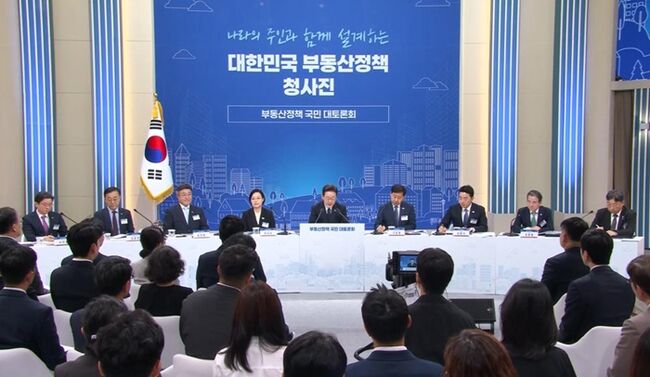 [Liberal Democratic Party Statement] Calling it a Grand Real Estate Debate… It Was Nothing More Than a Private Party Among Themselves
The 'National Grand Debate on Real Estate Policy' held on July 23rd and 27th. [Photo=Yonhap News]The 'National Grand Debate on Real Estate Policy,' hosted by the Lee Jae-myung administration under the
[Liberal Democratic Party Statement] Calling it a Grand Real Estate Debate… It Was Nothing More Than a Private Party Among Themselves
The 'National Grand Debate on Real Estate Policy' held on July 23rd and 27th. [Photo=Yonhap News]The 'National Grand Debate on Real Estate Policy,' hosted by the Lee Jae-myung administration under the
 [Photo] Evidence of Election Fraud Flooding U.S. Media… Trump Had 2.7 Million Votes Stolen
 [Video] U.S. Semiquincentennial Air Show... 'Art in the Sky' streaks across New York
 [Editorial Cartoon] A Draconian Law That Undermines Freedom of Expression

 List
List