In April 1973, high school students march in downtown Seoul as part of their cadet training. This was a time when even high school students received basic military training.
The Republic of Korea is a nation that has experienced compressed modernization in a short period. Amidst the continuous upheaval of liberation in 1945, the establishment of the government in 1948, and the Korean War in 1950, there was a single, most powerful criterion for national survival.
It was opposition to communism, that is, anti-communism. This criterion was understood not merely as a policy but as a matter of national survival, and as a result, the identity of the Republic of Korea was long shaped around anti-communism.
It is difficult to deny this point. Considering the circumstances at the time, it was rather a natural progression. North Korea, a communist regime supported by the Soviet Union and China, had actually instigated war to forcibly unify the South.
Anti-Communist Education Was Survival Education
In such a situation, anti-communism was not just an ideology but the minimum condition for national survival. Anti-communist education was survival education. The repetitive anti-communist education in schools, in the military, and across society functioned as a basic mechanism for defending the nation.
The problem lies in what came next. While anti-communism was excellent at teaching "what not to do," it failed to adequately explain "what to do." Opposing communism is merely one criterion. It does not, by itself, complete the nation's direction or the standards for an individual's life.
For a long time, the Republic of Korea strongly ingrained the message "Communism is bad," but it offered relatively meager explanations for "What, then, do we aspire to?"
The term "liberal democracy" was repeated, but education on what that "freedom" specifically entailed, and what responsibilities and attitudes it demanded of individuals, was severely lacking.
Freedom is not simply the state of doing whatever one wants. It is the state of designing and taking responsibility for one's own life within the scope of not infringing on the rights of others.
This concept cannot be conveyed through mere slogans. It is formed only through an understanding of history, philosophy, law, and economics. However, Korean education has been negligent in systematically teaching the substance of this freedom.
Let's take an example. Freedom of expression is the core of democracy. However, education on the extent to which freedom of expression is permitted, why it is important, and what responsibilities it entails has been virtually non-existent.
As a result, people apply freedom of expression differently depending on the situation. They are lenient towards opinions they support and easily justify suppression of opposing opinions. This is a typical manifestation of a lack of understanding of freedom.
The same applies to the economic sphere. Education on what a market economy is, why competition is necessary, and what the meaning of private property is has not been sufficiently provided.
Instead, only the outcomes of growth and distribution were emphasized. Consequently, many people tend to judge based on short-term gains and emotional reactions rather than understanding the operating principles of a free market economy.
The rule of law has also not been sufficiently internalized. Education on why laws exist, why procedures are important, and why systems should take precedence over individual notions of justice has been weak.
The Phenomenon of 'Emotional Justice' Preceding Law is Rampant
Thus, at times, the phenomenon of 'emotional justice' precedes the law. When a specific incident occurs, public opinion trials often precede legal judgments, and the legitimacy of the law can be shaken depending on the outcome.
Ultimately, identity education in the Republic of Korea has been strong on the "criterion of negation" but weak on the "criterion of affirmation." The reasons for opposing communism were repeatedly learned, but a deep understanding of why liberal democracy should be protected was lacking. This imbalance has become an increasingly significant problem over time.
This issue has become particularly evident since the end of the Cold War. In the past, with clear external threats, society could be somewhat integrated with the sole criterion of anti-communism.
However, as the world became more complex after the end of the Cold War, society could no longer be explained by simple ideological confrontation. Despite this, the Republic of Korea has still tended to rely heavily on anti-communist thinking.
One of the resulting phenomena is a "gap in identity." People know what they oppose but lack clarity on what they aspire to.
This gap is filled in various ways. Some fill it with nationalism, others with emotional appeals to justice, and still others with simple contrarianism. However, these methods fail to provide a consistent standard.
Another problem is extreme confrontation. As common standards weaken, people absolutize their differing standards. Consequently, political conflict escalates beyond mere differences of opinion to a level of outright negation of existence. This is because new unifying standards have not been formed in the void left by the weakening of the common anti-communist criterion.
A Time for Sophisticated Education on Freedom is Needed
What is needed in this situation is not simply to return to the past. Strengthening anti-communist education will not solve the problem. Rather, what is needed now is sophisticated education on freedom. A systematic understanding of what freedom is, why it is important, and what responsibilities it demands of individuals and society is necessary.
Freedom is not abandonment. Freedom operates within rules. It is maintained only when elements such as the rule of law, responsibility, contracts, and trust work together. Without understanding this, freedom easily devolves into chaos. Therefore, education on freedom should not be mere ideological instruction but education on a way of life.
Furthermore, history education must also play a crucial role. We need a concrete understanding of the process through which the Republic of Korea has reached its current state, and what institutions and values were formed during that process. Education is needed that helps understand the chain of choices and consequences, not just a simple listing of events.
Civic education also needs to be redesigned. Democracy is not maintained by voting alone. It requires an attitude of respecting others' opinions, seeking common ground for agreement, and accepting defeat. These attitudes do not arise naturally. They are formed through repeated education and training.
Ultimately, the crisis in the Republic of Korea is not merely a political or economic problem. At a deeper level, it is a problem of identity. It is a state where the common understanding of what standards to live by has weakened. A new standard has not sufficiently taken root in the void left by the disappearance of the anti-communist criterion.
Solving this problem requires more than simple slogans or emotional appeals. A concrete understanding of freedom, respect for laws and institutions, an attitude of responsible citizenship, and accurate historical awareness must be formed together. This should be the core of new identity education.
The Republic of Korea has already reached a considerable level economically and technologically. However, whether a commensurate spiritual foundation has been sufficiently established needs to be re-examined. Material growth has occurred rapidly, but the values and standards that underpin it have been formed relatively slowly.
This imbalance is what is creating the current confusion. What is needed now is not a method of positing external enemies but the task of precisely establishing internal standards. Cultivating citizens who understand freedom, accept responsibility, and respect the law. That is the indispensable condition for the Republic of Korea to endure in the future.
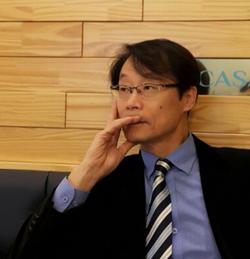
◆ Songsan
A poet and researcher of history and philosophy. Former director of the Syngman Rhee Institute. Currently serves as an advisor for the Korea Modern and Contemporary History Research Association and as the representative of the philosophy forum Lyceum. He has published four collections of poetry, co-translated "Heroes of Kōkōji," and authored the historical psychology commentary "Joseon That Became a Myth" (2026). He is actively engaged in the research and practice of the liberal cultural movement. Songsan is a pen name.

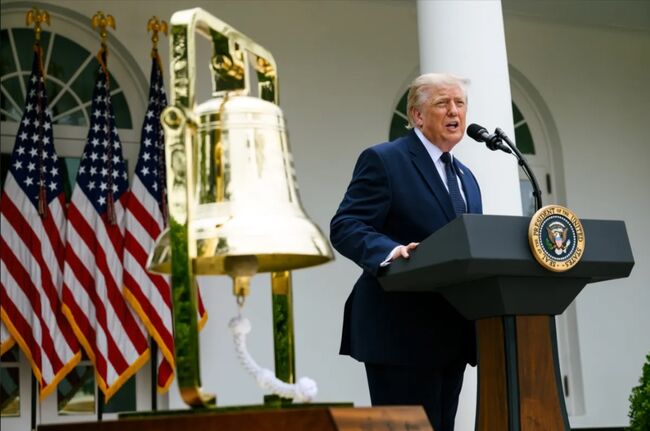 Trump pressures for rate cut again ahead of FOMC... "Should be the lowest in the world"
U.S. President Donald Trump. [Photo = The White House] U.S. President Donald Trump once again pressured the Federal Reserve, the U.S. central bank, to lower interest rates on the 27th (local time
Trump pressures for rate cut again ahead of FOMC... "Should be the lowest in the world"
U.S. President Donald Trump. [Photo = The White House] U.S. President Donald Trump once again pressured the Federal Reserve, the U.S. central bank, to lower interest rates on the 27th (local time
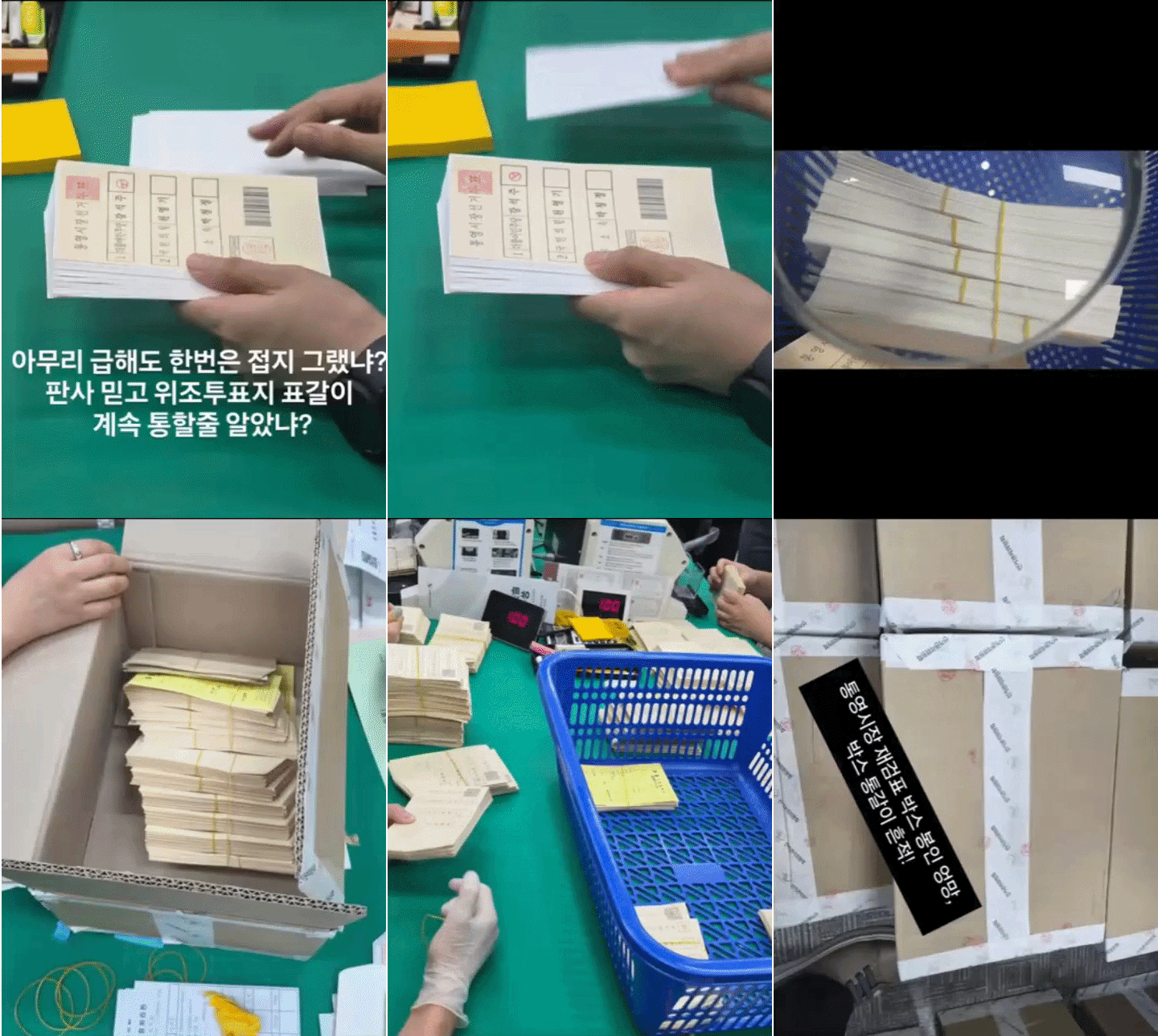 “Ignoring crisp ballots and damaged seals”… Tongyeong mayoral recount concludes with ‘no change in outcome,’ leaving suspicions and public outrage behind
Suspected counterfeit ballots discovered in Tongyeong [GIF from social media of Representative Hwang Kyo-ahn / Attorney Park Joo-hyun]During a recount of the Tongyeong mayoral election in South Gyeong
“Ignoring crisp ballots and damaged seals”… Tongyeong mayoral recount concludes with ‘no change in outcome,’ leaving suspicions and public outrage behind
Suspected counterfeit ballots discovered in Tongyeong [GIF from social media of Representative Hwang Kyo-ahn / Attorney Park Joo-hyun]During a recount of the Tongyeong mayoral election in South Gyeong
 President Yoon, regarding the first-instance ruling on the Public Official Election Act: “An excessive political verdict that distorts the facts… We will appeal immediately.”
The first-instance sentencing hearing for President Yoon Suk Yeol regarding violations of the Public Official Election Act is being broadcast live at Seoul Station on the 27th. [Photo=Yonhap News]Pres
President Yoon, regarding the first-instance ruling on the Public Official Election Act: “An excessive political verdict that distorts the facts… We will appeal immediately.”
The first-instance sentencing hearing for President Yoon Suk Yeol regarding violations of the Public Official Election Act is being broadcast live at Seoul Station on the 27th. [Photo=Yonhap News]Pres
 WSJ: "SK Hynix ADR Premium Is a Sign of AI Trading Overheat"
Advertisement for SK Hynix ADR listing in New York's Times Square [Reuters=Yonhap News file photo]The Wall Street Journal (WSJ) has pointed out that the price of SK Hynix’s American Depositary Recei
WSJ: "SK Hynix ADR Premium Is a Sign of AI Trading Overheat"
Advertisement for SK Hynix ADR listing in New York's Times Square [Reuters=Yonhap News file photo]The Wall Street Journal (WSJ) has pointed out that the price of SK Hynix’s American Depositary Recei
 'Godfather of Japanese Mystery Novels' Keigo Higashino Passes Away After Battle with Cancer at 68
Famous Japanese mystery novelist Keigo Higashino [AFP=Yonhap News]It has been belatedly reported that Keigo Higashino, the "godfather of Japanese mystery novels" and author of bestsellers such as "The
'Godfather of Japanese Mystery Novels' Keigo Higashino Passes Away After Battle with Cancer at 68
Famous Japanese mystery novelist Keigo Higashino [AFP=Yonhap News]It has been belatedly reported that Keigo Higashino, the "godfather of Japanese mystery novels" and author of bestsellers such as "The
 [Park Pil-kyu Security Column] To the Ignorant Trying to Clothe a Beast in Sheep's Clothing
Rep. Kim Byung-joo of the Democratic Party of Korea [Photo=Yonhap News]“The Air Force Academy doesn't teach you how to fly a plane!” “The Army, Navy, and Air Force academies are exactly the
[Park Pil-kyu Security Column] To the Ignorant Trying to Clothe a Beast in Sheep's Clothing
Rep. Kim Byung-joo of the Democratic Party of Korea [Photo=Yonhap News]“The Air Force Academy doesn't teach you how to fly a plane!” “The Army, Navy, and Air Force academies are exactly the
 [Issue Diagnosis] Two Effects of the Election Petition Review
 [Photo] Evidence of Election Fraud Flooding U.S. Media… Trump Had 2.7 Million Votes Stolen
 [Video] U.S. Semiquincentennial Air Show... 'Art in the Sky' streaks across New York
 [Editorial Cartoon] A Draconian Law That Undermines Freedom of Expression

 List
List