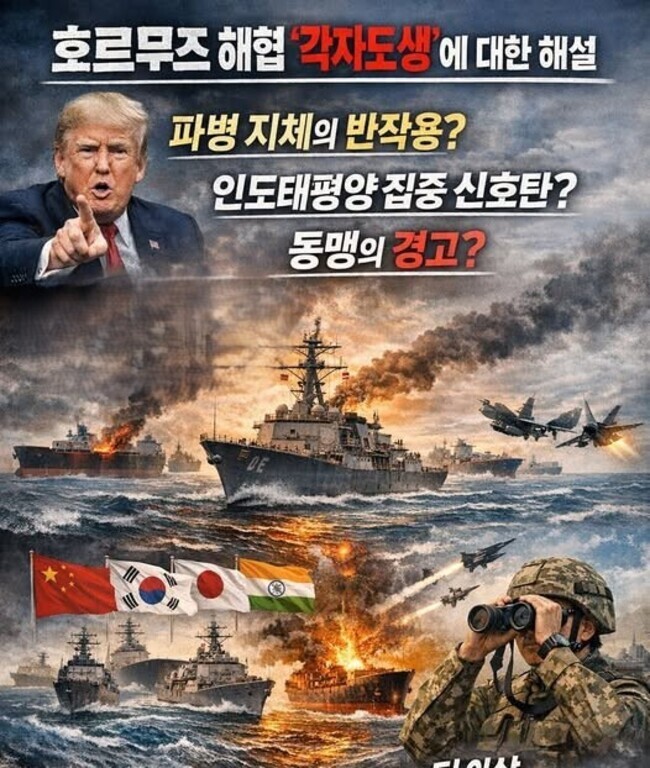
President Trump's statement, "The United States has no obligation to protect oil shipments for all countries," was a signal revealing that the existing international security structure can no longer be sustained. It signifies the end of an era where the United States bore the burden as a maritime security provider, and the world benefited.
Are the Self-Reliance Measures a Reaction to Delayed Troop Deployment?
The United States has long demanded "shared responsibility for shared interests" from its allies. However, many countries have maintained an ambiguous stance, delaying decisions due to political burdens and domestic public opinion. This is interpreted as the U.S. feeling fatigued by this structure.
While the United States, which hardly uses the Strait of Hormuz, has invested immense military power for its security, the countries that benefit the most are Asian nations such as China, India, South Korea, and Japan. This is the background behind the U.S. sending a "do it yourselves" message.
This measure goes beyond a simple redistribution of responsibility; it should be read as a warning against shirking responsibility. Alliances must be based on reciprocity, and a structure where one side bears all the costs cannot be sustained. The view that South Korea, with its economy ranked among the top 10 globally, must also take responsibility for its energy security is gaining traction. It is also emphasized that U.S. protection was a choice, not a right.
Are the Self-Reliance Measures a Signal Focusing on the Indo-Pacific?
The U.S. reduction of its surveillance in the Strait of Hormuz is not merely a tactical adjustment but part of a strategic shift to disengage from the Middle East and concentrate on the Indo-Pacific front. The U.S. has already been taking measures to reduce its burden on multiple fronts, such as reducing residual forces in Iraq and Syria and decreasing troop presence in the Middle East. Conversely, it is strengthening troop redeployments and alliance cooperation in the Indo-Pacific region to counter China.
President Trump's statement, "The United States has no obligation to protect oil shipments for all countries," symbolizes this trend. The U.S. is increasingly shifting the security burden in the Middle East to regional countries and allies, moving its strategic pivot to the Korean Peninsula and the Western Pacific. The return of two THAAD batteries supports this.
Of course, this perspective is controversial, and international affairs cannot be explained by simple black-and-white logic. Those who view these measures positively believe that the era of the U.S. bearing all the world's problems has ended, and an era has begun where each country must act for its own interests. The Strait of Hormuz is the symbolic starting point. While this change is a burden, it will also provide each country with an opportunity to choose the role it will play in the international community.
Are the Self-Reliance Measures a Warning to Allies?
The U.S. self-reliance measures in the Strait of Hormuz should be interpreted as a warning to restore mature alliances. A structure where the U.S. bears all the risks is closer to a relationship between a protector and the protected rather than an alliance, and these measures will serve as an opportunity to rectify that abnormality. South Korea, despite its economy being among the top 10 globally, has relied on the U.S. for the protection of its energy transport routes, and it is true that the discussion of troop deployment has been repeated as a political stalemate, giving the impression of shirking responsibility.
Ultimately, this situation is not simply a controversy over troop deployment but a "change in the rules themselves" of international security. Under Trump's "each for themselves" principle, a passage fee for the strait has begun to be established as a new global norm, and Japan has already moved in accordance with these rules. South Korea can no longer be an exception; if it tries to play tricks, it could trigger earthquakes in all existing systems related to tariffs, exchange rates, finance, and trade.
With Alexander's sword in Trump's hand, and the Northeast Asian landscape shaking, the most dangerous attitude is silence. While ambiguity in diplomacy can be a strategy, an empty message at a decisive moment becomes a vacuum, and a vacuum leads to weakened trust. What is needed now is not observation but the restoration of the ROK-U.S. alliance; if not restored, South Korea could be pushed to the periphery.
Ultimately, these self-reliance measures should be read as a re-prioritization of U.S. strategic objectives and a warning that allies can no longer remain mere spectators. The adjustment of multiple fronts and the focus on the Indo-Pacific require structural changes for South Korea as well. In a reality surrounded by nuclear-armed powers, the debate over operational control and independent defense has become a matter of harsh capabilities, not emotions.
For South Korea to maintain continuity, it must break free from the inertia of using security as a political tool. We hope that the repercussions of politically calculating even security will not be repeated.
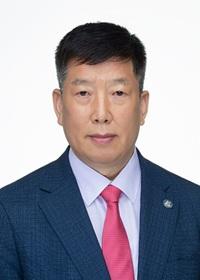
◆ Park Pil-gyu, Committee Member
Editor, Hankook Ilbo
40th graduating class, Korea Military Academy

 Iranian Foreign Ministry: "Continuing Message Exchanges with the U.S. and Activities of Mediating Countries"
Esmaeil Baghaei, Spokesperson for the Iranian Ministry of Foreign Affairs [Xinhua, Yonhap News file photo]Esmaeil Baghaei, spokesperson for the Iranian Ministry of Foreign Affairs, stated on the 26th
Iranian Foreign Ministry: "Continuing Message Exchanges with the U.S. and Activities of Mediating Countries"
Esmaeil Baghaei, Spokesperson for the Iranian Ministry of Foreign Affairs [Xinhua, Yonhap News file photo]Esmaeil Baghaei, spokesperson for the Iranian Ministry of Foreign Affairs, stated on the 26th
 President Yoon: "Do You Think You Are Safe from the Special Counsel?"... Final Statement Video Released
President Yoon Suk Yeol rebuking the special prosecutor on the 24th. [Court video / @birds_justice X account subtitle GIF] A video of President Yoon Suk Yeol's closing statement at his trial rega
President Yoon: "Do You Think You Are Safe from the Special Counsel?"... Final Statement Video Released
President Yoon Suk Yeol rebuking the special prosecutor on the 24th. [Court video / @birds_justice X account subtitle GIF] A video of President Yoon Suk Yeol's closing statement at his trial rega
 President Yoon, regarding the first-instance ruling on the Public Official Election Act: “An excessive political verdict that distorts the facts… We will appeal immediately.”
The first-instance sentencing hearing for President Yoon Suk Yeol regarding violations of the Public Official Election Act is being broadcast live at Seoul Station on the 27th. [Photo=Yonhap News]Pres
President Yoon, regarding the first-instance ruling on the Public Official Election Act: “An excessive political verdict that distorts the facts… We will appeal immediately.”
The first-instance sentencing hearing for President Yoon Suk Yeol regarding violations of the Public Official Election Act is being broadcast live at Seoul Station on the 27th. [Photo=Yonhap News]Pres
 WSJ: "SK Hynix ADR Premium Is a Sign of AI Trading Overheat"
Advertisement for SK Hynix ADR listing in New York's Times Square [Reuters=Yonhap News file photo]The Wall Street Journal (WSJ) has pointed out that the price of SK Hynix’s American Depositary Recei
WSJ: "SK Hynix ADR Premium Is a Sign of AI Trading Overheat"
Advertisement for SK Hynix ADR listing in New York's Times Square [Reuters=Yonhap News file photo]The Wall Street Journal (WSJ) has pointed out that the price of SK Hynix’s American Depositary Recei
 'Godfather of Japanese Mystery Novels' Keigo Higashino Passes Away After Battle with Cancer at 68
Famous Japanese mystery novelist Keigo Higashino [AFP=Yonhap News]It has been belatedly reported that Keigo Higashino, the "godfather of Japanese mystery novels" and author of bestsellers such as "The
'Godfather of Japanese Mystery Novels' Keigo Higashino Passes Away After Battle with Cancer at 68
Famous Japanese mystery novelist Keigo Higashino [AFP=Yonhap News]It has been belatedly reported that Keigo Higashino, the "godfather of Japanese mystery novels" and author of bestsellers such as "The
 [Park Pil-kyu Security Column] To the Ignorant Trying to Clothe a Beast in Sheep's Clothing
Rep. Kim Byung-joo of the Democratic Party of Korea [Photo=Yonhap News]“The Air Force Academy doesn't teach you how to fly a plane!” “The Army, Navy, and Air Force academies are exactly the
[Park Pil-kyu Security Column] To the Ignorant Trying to Clothe a Beast in Sheep's Clothing
Rep. Kim Byung-joo of the Democratic Party of Korea [Photo=Yonhap News]“The Air Force Academy doesn't teach you how to fly a plane!” “The Army, Navy, and Air Force academies are exactly the
 [Issue Diagnosis] Two Effects of the Election Petition Review
 [Photo] Evidence of Election Fraud Flooding U.S. Media… Trump Had 2.7 Million Votes Stolen
 [Video] U.S. Semiquincentennial Air Show... 'Art in the Sky' streaks across New York
 [Editorial Cartoon] A Draconian Law That Undermines Freedom of Expression

 List
List










