[Yonhap News Photo]
South Korea's total debt, including government, household, and corporate debt, has surpassed 6,500 trillion won for the first time on record.
As leverage across the economy expands, the growth rate of government debt has been particularly high. The ratio of government debt to Gross Domestic Product (GDP) also saw an unprecedented increase of 5.0 percentage points (p) in one year, reaching an all-time high.
◇ Total Debt Reaches 2.5 Times GDP
According to data from the Bank for International Settlements (BIS) on the 23rd, non-financial sector credit in Korean won stood at 6,500.5 trillion won as of the end of the third quarter of last year.
This represents an increase of approximately 280 trillion won (4.5%) from 6,220.5 trillion won at the end of the third quarter of 2024, surpassing 6,500 trillion won for the first time.
Of this, government debt was 1,250.7 trillion won, household debt was 2,342.6 trillion won, and corporate debt was 2,907.1 trillion won.
Compared to a year ago, government debt increased by 9.8%, showing a relatively high growth rate, while household debt and corporate debt increased by 3.0% and 3.6%, respectively.
Non-financial sector credit is the sum of debt from major economic entities—government, households, and corporations—based on flow of funds statistics for inter-country comparison.
It is commonly referred to as 'total national debt' and is used as an indicator to gauge how much a country's economic growth and asset price appreciation rely on borrowing.
Total debt has continuously increased, surpassing 5,000 trillion won in the first quarter of 2021, 5,500 trillion won in the fourth quarter of the same year, and 6,000 trillion won in the fourth quarter of 2023.
The ratio of total debt to GDP was 248.0% as of the end of the third quarter of last year. This means debt reached 2.5 times the GDP.
While this is a decrease of 0.3%p from the end of the second quarter of last year (248.3%), it is an increase of 1.5%p from the end of the third quarter of 2024 (246.5%).
Trend of Debt by Economic Entity in Korea (Unit: 10 Billion Won)
※ Latest data compiled from BIS. |
| Category | End of Q3 2025 | End of Q2 2025 | End of Q3 2024 |
| Government Debt | 12,507,746 | 12,391,435 | 11,394,017 |
| Household Debt | 23,426,728 | 23,258,980 | 22,752,097 |
| Corporate Debt | 29,071,369 | 28,718,715 | 28,059,656 |
| Total Debt | 65,005,843 | 64,369,130 | 62,205,770 |
◇ Household Debt Ratio Remains Among World's Highest
According to data from the Institute of International Finance (IIF), South Korea's government debt to GDP ratio was 48.6% at the end of the fourth quarter of last year, an increase of 5.0%p from 43.6% a year earlier, reaching an all-time high.
BIS data is as of the end of the third quarter of last year, and IIF data is as of the end of the fourth quarter. The IIF publishes statistics more than a quarter ahead of BIS using its own criteria, and the trends in the statistics from both institutions generally align.
South Korea's government debt ratio is considered relatively low compared to major economies such as the United States (122.8%), Japan (199.3%), the United Kingdom (81.1%), Germany (62.5%), and France (110.4%).
However, it is noteworthy that this ratio, which had gradually decreased from 45.4% at the end of the first quarter of 2024 to 43.6% by the end of the year, rebounded to 43.6% at the end of the first quarter last year, 48.2% at the end of the second quarter, 48.4% at the end of the third quarter, and 48.6% at the end of the fourth quarter.
It is the first time that the IIF's government debt to GDP ratio has approached 50% as of last year.
Expansionary fiscal policy and increased government spending can act as a factor stimulating inflation, according to general economic theory.
The Bank of Korea pointed out in its Monetary and Credit Policy Report released on the 12th, "The expansionary fiscal stance of major countries supports growth while also having the potential to increase inflationary pressure through the expected inflation path."
It further projected, "If concerns about fiscal sustainability intensify due to increased spending, it could stimulate expected inflation."
The household debt to GDP ratio was 89.4% at the end of the fourth quarter of last year.
While this is lower than 90.2% at the end of the third quarter of last year or 89.6% at the end of the fourth quarter of 2024, it remains the second highest among the 62 countries included in the IIF statistics, following Canada (100.4%).
The corporate debt ratio was 110.8%, which is lower than the previous quarter (112.6%) but higher than the same period last year (110.6%).
Trend of Government, Household, and Corporate Debt Ratio to GDP (Unit: %)
※ Latest data compiled from IIF. |
| Category | Government Debt | Household Debt | Corporate Debt |
| End of Q1 2024 | 45.4 | 92.1 | 112.3 |
| End of Q2 | 45.3 | 90.4 | 111.7 |
| End of Q3 | 45.1 | 90.2 | 111.2 |
| End of Q4 | 43.6 | 89.6 | 110.6 |
| End of Q1 2025 | 43.6 | 90.3 | 111.0 |
| End of Q2 | 48.2 | 90.2 | 111.3 |
| End of Q3 | 48.4 | 90.2 | 112.6 |
| End of Q4 | 48.6 | 89.4 | 110.8 |

 [Statement by the Seo-beo-kka Korea Military Academy Save-the-Nation Comrades Association] ㉛ Recount the Votes Publicly, as the Previous Recount Concealed Election Fraud
Tongyeong Mayoral Election Recount [Photo=Yonhap News]South Korea's liberal democracy is dying. The National Election Commission (NEC) and the judiciary, which have plummeted into criminal syndicates
[Statement by the Seo-beo-kka Korea Military Academy Save-the-Nation Comrades Association] ㉛ Recount the Votes Publicly, as the Previous Recount Concealed Election Fraud
Tongyeong Mayoral Election Recount [Photo=Yonhap News]South Korea's liberal democracy is dying. The National Election Commission (NEC) and the judiciary, which have plummeted into criminal syndicates
 What is the significance of the "Trump 2028" red hats that keep making a comeback?
It is noteworthy that President Donald Trump is "intentionally" fueling controversy over whether he can actually run in the 2028 presidential election, even though it is "highly likely he is seriously
What is the significance of the "Trump 2028" red hats that keep making a comeback?
It is noteworthy that President Donald Trump is "intentionally" fueling controversy over whether he can actually run in the 2028 presidential election, even though it is "highly likely he is seriously
 Jin Cummings: "North Korea says it will increase the number of spies, so what is the government doing?"
U.S. political columnist Gene Cummings has publicly questioned the South Korean government, asking, "North Korea is announcing plans to increase its number of spies, yet what is the South Korean
Jin Cummings: "North Korea says it will increase the number of spies, so what is the government doing?"
U.S. political columnist Gene Cummings has publicly questioned the South Korean government, asking, "North Korea is announcing plans to increase its number of spies, yet what is the South Korean
 Attorney Do Tae-woo: “Discrepancies in Voter Count and Improper Sealing Confirmed in Tongyeong Mayoral Recount… Official Request for Additional Verification Submitted to Gyeongnam Election Commission”
A bundle of mail-in early voting ballots captured by lawyer Do Tae-woo at the Tongyeong mayoral election recount site. A clear solid line, raising suspicions of election fraud, is visible on the side
Attorney Do Tae-woo: “Discrepancies in Voter Count and Improper Sealing Confirmed in Tongyeong Mayoral Recount… Official Request for Additional Verification Submitted to Gyeongnam Election Commission”
A bundle of mail-in early voting ballots captured by lawyer Do Tae-woo at the Tongyeong mayoral election recount site. A clear solid line, raising suspicions of election fraud, is visible on the side
 Stock Market Crash 'Black Tuesday'… KOSPI down 10.8%, KOSDAQ down 7.7%
The KOSPI fell by more than 5% in early trading on the 28th, triggering a sell-side sidecar.On the 28th, the KOSPI plunged by more than 10%.Due to the sharp decline, a sell-side sidecar—a temporary
Stock Market Crash 'Black Tuesday'… KOSPI down 10.8%, KOSDAQ down 7.7%
The KOSPI fell by more than 5% in early trading on the 28th, triggering a sell-side sidecar.On the 28th, the KOSPI plunged by more than 10%.Due to the sharp decline, a sell-side sidecar—a temporary
 [World Heritage Committee] 25 New World Heritage Sites Inscribed in Busan… South Korea Successfully Expands 'Getbol' Listing
The Chairperson of the World Heritage Committee speaks at the plenary session of the 48th session of the World Heritage Committee, held at BEXCO in Busan on the 20th. [Photo: Yonhap News]A total of 25
[World Heritage Committee] 25 New World Heritage Sites Inscribed in Busan… South Korea Successfully Expands 'Getbol' Listing
The Chairperson of the World Heritage Committee speaks at the plenary session of the 48th session of the World Heritage Committee, held at BEXCO in Busan on the 20th. [Photo: Yonhap News]A total of 25
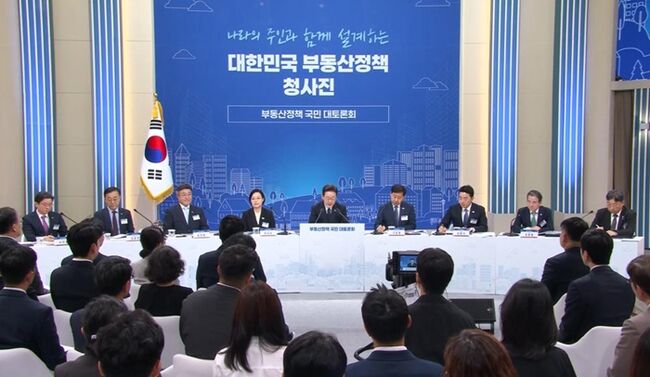 [Liberal Democratic Party Statement] Calling it a Grand Real Estate Debate… It Was Nothing More Than a Private Party Among Themselves
The 'National Grand Debate on Real Estate Policy' held on July 23rd and 27th. [Photo=Yonhap News]The 'National Grand Debate on Real Estate Policy,' hosted by the Lee Jae-myung administration under the
[Liberal Democratic Party Statement] Calling it a Grand Real Estate Debate… It Was Nothing More Than a Private Party Among Themselves
The 'National Grand Debate on Real Estate Policy' held on July 23rd and 27th. [Photo=Yonhap News]The 'National Grand Debate on Real Estate Policy,' hosted by the Lee Jae-myung administration under the
 [Photo] Evidence of Election Fraud Flooding U.S. Media… Trump Had 2.7 Million Votes Stolen
 [Video] U.S. Semiquincentennial Air Show... 'Art in the Sky' streaks across New York
 [Editorial Cartoon] A Draconian Law That Undermines Freedom of Expression

 List
List