This was a week that saw shifts in capital flows triggered by the simultaneous impact of rising oil prices and changes in inflation indicators.
Financial Markets in the 4th Week of March (March 16-20)
The global financial markets in the fourth week of March 2026 were not simply about rising or falling. The core question was, “Where did the money leave from, and where did it move to?”
The apparent variables were war, rising oil prices, and inflation. However, what truly moved the markets were the changes in interest rate expectations created by these variables, and the subsequent reallocation of capital.
In this regard, it is more accurate to interpret this week's market as a phase of structural adjustment rather than a trend-following market.
To summarize this week's flow in one sentence: War → Rising Oil Prices → Inflationary Pressure → Retreating Interest Rate Cut Expectations → Capital Reallocation. This structure is not just a theory; it is confirmed by actual data.
Following the rise in international oil prices, the US Producer Price Index (PPI) rose by 0.7% month-on-month, exceeding market expectations. This has significance beyond mere numbers.
The PPI is a leading indicator that moves ahead of the Consumer Price Index (CPI). This means that price increases at the production stage will eventually be passed on to consumer prices with a time lag. The moment the market recognizes this, expectations of interest rate cuts are bound to retreat.
Ultimately, it was not a single data point, but the "sustainability of inflation" that triggered the capital movement.
Capital Flows — Where it Left and Where it Went
The key theme of capital flow this week was "outflow + limited movement."
① Capital Outflow from Technology Stocks
Large technology stocks, which had been leading the market, had risen based on expectations of interest rate cuts. However, the moment the interest rate path becomes shaky, this structure weakens immediately. Interest rates are not just a cost; they are a key variable determining the present value (DCF) of future earnings.
Weakening expectations of interest rate cuts imply a reduction in the valuation premium for growth stocks. Therefore, the outflow of capital from technology stocks can be interpreted not as simple profit-taking, but as a preemptive response to changes in the interest rate structure.
② Three Pillars Where Capital Moved
The outflowing capital moved in the following three directions:
The rise in oil prices is directly linked to the revenue structure of energy companies. Especially since crude oil prices are directly connected to sales and profits rather than costs, the market reacts most quickly to this sector.
This week's capital inflow into energy was not an act of "risk aversion," but an investment in a structure that could convert price increases into profits.
Areas like power grids, transmission and distribution lines, and energy transfer networks maintain a certain level of demand regardless of economic fluctuations. Especially in the context of structurally increasing power demand in the AI era, this sector is being revalued not just as defensive stocks, but as "assets with a structural demand base."
In other words, capital did not just move to safe havens; it moved to assets with confirmed demand.
War increases uncertainty but also increases government spending. Defense industries, in particular, have demand at the national level, making it likely that sales will be maintained regardless of the economy.
However, here too, capital flowed in a limited manner, not for "indiscriminate gains," but only to companies that translated into actual orders and contracts.
The HALO Frenzy — But Capital is 'Selective'
One of the most frequently mentioned concepts in the market this week was HALO. HALO means "physical assets that are difficult to replace with AI." This category includes infrastructure, energy, and heavy industries.
On the surface, this week's capital movement appears to support the HALO concept. However, the actual data tells a different story.
Capital did not flow into HALO as a whole. Instead, it concentrated only on certain assets that met the following conditions:
Is cash flow stable? Does it have pricing power? Is demand structurally guaranteed? In essence, HALO is not an investment target but is acting as a "filter."
Key Variable: China's Supply Capacity
The most important variable in interpreting this week's market was not war, but China.
The market mentioned the possibility of a rise in cyclical industries such as steel, chemicals, and batteries, citing war and supply chain restructuring as reasons. However, actual capital flows did not support this expectation. The reason is clear.
China's supply capacity still controls global prices. Industrial prices are often determined by supply rather than demand. Especially when a country with such massive production capacity as China exists, price increases are limited unless supply is reduced.
A similar phenomenon occurred during the European energy crisis. The reason why the industrial structure did not change drastically despite the crisis was that the supply-side structure remained intact.
Ultimately, the same structure is repeating this time. While there is a "security premium," it does not translate into an "earnings premium."
This is Rotation, Not a Cycle
In this respect, interpreting the current market as the beginning of a cyclical upturn is an overstatement.
A more accurate diagnosis is as follows:
This is a factor rotation phase, not a cycle transition. This means that capital is moving within the existing upward structure, rather than the entire market entering a new upward phase.
This distinction is very important.
Cycle: Entire industry rises
Rotation: Only selected assets rise
The current market clearly leans towards the latter.
Investment Frame — What Did Money Look At to Move?
To summarize this week's capital flows, it is as follows:
Money did not move according to "narratives."
Various narratives emerged, such as HALO, supply chain restructuring, and security premiums, but actual capital followed only the following two criteria:
Does it have cash flow? And does it have pricing power? Even with expectations, capital did not enter industries that did not meet these criteria.
5th Week Checkpoint — Conditions for Maintaining the Trend
Whether the current trend continues depends on three variables.
• Will oil prices remain at their peak?
• Will interest rate cut expectations retreat further?
• Will there be a change in China's supply structure?
If even one of these changes occurs, the current capital movement could be rapidly reversed.
Glossary
HALO (Heavy Asset, Low Obsolescence) Physical assets difficult to replace with AI. However, in actual investment, only assets with secured cash flow are reflected.
Security Premium The phenomenon where asset prices rise due to geopolitical risks. However, it may not lead to improved earnings.
Factor Rotation A phase where capital moves between asset classes, rather than a market-wide directional shift.
China Supply Variable A key factor determining global industrial prices. Price increases are limited as long as supply is maintained.
|
Conclusion
The essence of this week's market is simple.
Money moved. However, the movement was not broad. And the criteria were clear.
Money does not move based on stories. Money only moves to where its structure is confirmed.

 [Statement by the Seo-beo-kka Korea Military Academy Save-the-Nation Comrades Association] ㉛ Recount the Votes Publicly, as the Previous Recount Concealed Election Fraud
Tongyeong Mayoral Election Recount [Photo=Yonhap News]South Korea's liberal democracy is dying. The National Election Commission (NEC) and the judiciary, which have plummeted into criminal syndicates
[Statement by the Seo-beo-kka Korea Military Academy Save-the-Nation Comrades Association] ㉛ Recount the Votes Publicly, as the Previous Recount Concealed Election Fraud
Tongyeong Mayoral Election Recount [Photo=Yonhap News]South Korea's liberal democracy is dying. The National Election Commission (NEC) and the judiciary, which have plummeted into criminal syndicates
 What is the significance of the "Trump 2028" red hats that keep making a comeback?
It is noteworthy that President Donald Trump is "intentionally" fueling controversy over whether he can actually run in the 2028 presidential election, even though it is "highly likely he is seriously
What is the significance of the "Trump 2028" red hats that keep making a comeback?
It is noteworthy that President Donald Trump is "intentionally" fueling controversy over whether he can actually run in the 2028 presidential election, even though it is "highly likely he is seriously
 Jin Cummings: “North Korea says it will increase the number of spies, so what is the government doing?”
U.S. political columnist Gene Cummings has publicly questioned the South Korean government, asking, "North Korea is declaring that it will increase its number of spies, so what is the South Kore
Jin Cummings: “North Korea says it will increase the number of spies, so what is the government doing?”
U.S. political columnist Gene Cummings has publicly questioned the South Korean government, asking, "North Korea is declaring that it will increase its number of spies, so what is the South Kore
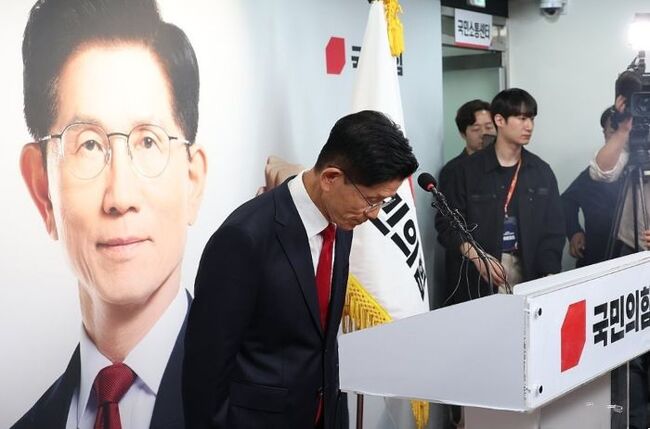 “Too little, too late?…” Kim Moon-soo, who previously conceded his presidential election defeat, now demands a special counsel investigation into ‘allegations of election fraud in the 2025 presidential election’
People Power Party presidential candidate Kim Moon-soo concedes defeat during a press conference at the party headquarters in Yeouido, Seoul, on June 4, 2025. [Joint Press Corps]As allegations emerge
“Too little, too late?…” Kim Moon-soo, who previously conceded his presidential election defeat, now demands a special counsel investigation into ‘allegations of election fraud in the 2025 presidential election’
People Power Party presidential candidate Kim Moon-soo concedes defeat during a press conference at the party headquarters in Yeouido, Seoul, on June 4, 2025. [Joint Press Corps]As allegations emerge
 Stock Market Crash 'Black Tuesday'… KOSPI down 10.8%, KOSDAQ down 7.7%
The KOSPI fell by more than 5% in early trading on the 28th, triggering a sell-side sidecar.On the 28th, the KOSPI plunged by more than 10%.Due to the sharp decline, a sell-side sidecar—a temporary
Stock Market Crash 'Black Tuesday'… KOSPI down 10.8%, KOSDAQ down 7.7%
The KOSPI fell by more than 5% in early trading on the 28th, triggering a sell-side sidecar.On the 28th, the KOSPI plunged by more than 10%.Due to the sharp decline, a sell-side sidecar—a temporary
 [World Heritage Committee] 25 New World Heritage Sites Inscribed in Busan… South Korea Successfully Expands 'Getbol' Listing
The Chairperson of the World Heritage Committee speaks at the plenary session of the 48th session of the World Heritage Committee, held at BEXCO in Busan on the 20th. [Photo: Yonhap News]A total of 25
[World Heritage Committee] 25 New World Heritage Sites Inscribed in Busan… South Korea Successfully Expands 'Getbol' Listing
The Chairperson of the World Heritage Committee speaks at the plenary session of the 48th session of the World Heritage Committee, held at BEXCO in Busan on the 20th. [Photo: Yonhap News]A total of 25
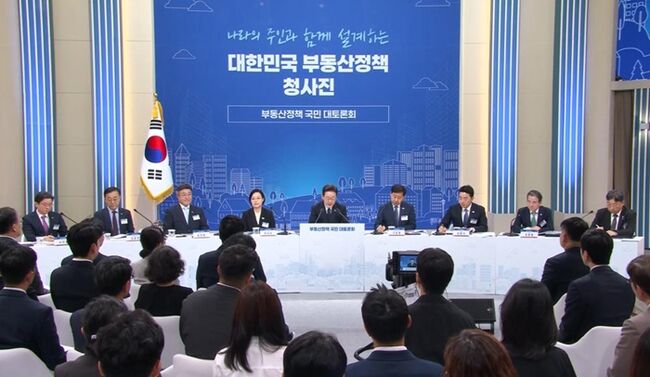 [Liberal Democratic Party Statement] Calling it a Grand Real Estate Debate… It Was Nothing More Than a Private Party Among Themselves
The 'National Grand Debate on Real Estate Policy' held on July 23rd and 27th. [Photo=Yonhap News]The 'National Grand Debate on Real Estate Policy,' hosted by the Lee Jae-myung administration under the
[Liberal Democratic Party Statement] Calling it a Grand Real Estate Debate… It Was Nothing More Than a Private Party Among Themselves
The 'National Grand Debate on Real Estate Policy' held on July 23rd and 27th. [Photo=Yonhap News]The 'National Grand Debate on Real Estate Policy,' hosted by the Lee Jae-myung administration under the
 [Photo] Evidence of Election Fraud Flooding U.S. Media… Trump Had 2.7 Million Votes Stolen
 [Video] U.S. Semiquincentennial Air Show... 'Art in the Sky' streaks across New York
 [Editorial Cartoon] A Draconian Law That Undermines Freedom of Expression

 List
List