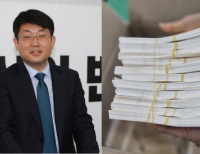
President Lee Jae-myung sent a wreath on behalf of the president to the 151st birthday ceremony of President Syngman Rhee, held at Jeongdong First Methodist Church in Jung-gu, Seoul on the 26th.
At the event venue that day, wreaths were placed in the names of President Lee Jae-myung, Minister of Patriots and Veterans Affairs Kwon Oh-eul, and People Power Party Leader Jang Dong-hyuk.
On the surface, it might seem like a customary courtesy for a head of state. However, the reason this scene particularly catches the eye is that President Lee's past remarks about former President Syngman Rhee were extremely harsh and definitive.
On January 31, 2017, as a presidential candidate for the Democratic Party, President Lee visited the Seoul National Cemetery but only paid respects at the graves of former Presidents Kim Young-sam and Kim Dae-jung, not at the graves of former Presidents Syngman Rhee and Park Chung-hee.
At that time, he referred to former President Syngman Rhee as "the father of pro-Japanese traitorous forces." It was an expression that bordered on historical condemnation rather than simple criticism. These words remain on record even now.
Yet, President Lee Jae-myung has now sent a wreath in the president's name to Syngman Rhee's birthday ceremony. The change itself is clear.
The issue is what that change signifies.
If there has truly been a change in his historical perspective, a clarification of his past harsh remarks should come first.
An explanation of why he made those statements, whether he still upholds that evaluation, or if he believes the expression was excessive, would make the situation coherent. However, what has been confirmed so far is the act of sending a wreath, not an apology or retraction regarding his past remarks.
In this context, the case of former President Park Geun-hye is not an incidental illustration.
In 2021, President Lee referred to former President Park Geun-hye as "our respected former President Park Geun-hye," but later at a lecture at Seoul National University, he remarked something to the effect of, "When I said 'respected President Park Geun-hye,' people actually thought I respected her."
He effectively retracted the expression of 'respect' he had previously used, rendering it a rhetorical device.
This scene illustrates a characteristic of Lee Jae-myung's political language. It's a method of making a broad statement first, and then, if controversy arises, narrowing or twisting the meaning to explain it.
Therefore, this wreath is perceived by many not as a genuine expression but as a political gesture.
This is because in the past, he drew a strong line against Syngman Rhee with the harshest words, and now he has chosen the least costly form of courtesy.
A wreath carries significant symbolism but little responsibility. It is not a weighty choice like an in-person visit, a eulogy, a revision of historical assessment, or an apology for past statements. He has extended an easy courtesy but has not provided a difficult explanation.
What is more noteworthy is that the event was not simply a memorial for a former president, but a ceremony celebrating the birthday of 'Syngman Rhee, the Founding President.'
The designation of Syngman Rhee as the Founding President is intrinsically linked to the legitimacy of the Republic of Korea and its founding narrative.
If there had truly been a change in perspective, his position on Syngman Rhee's historical standing should have accompanied the wreath, at the very least.
However, no such statement was made. Ultimately, it appears he has accepted the symbol while deferring judgment.
Of course, the argument that the president is different from a politician in opposition is also possible.
The claim is that as head of state, one must prioritize protocol and integration over personal sentiment. Indeed, past administrations have also sent wreaths to events related to former presidents.
However, precisely because of this, clarity is even more crucial.
If this wreath is a simple matter of protocol, it should be stated as such. Conversely, if it represents a change in historical perspective, it must be accompanied by appropriate explanations and apologies. If only the symbol is offered without doing either, the public will interpret it as politics.
Ultimately, President Lee Jae-myung's wreath on Syngman Rhee's birthday is closer to the language of politics than a confession of respect.
In the past, he said "the father of pro-Japanese traitorous forces," and regarding Park Geun-hye, he said "respect" and then added, "they thought I really meant it."
Without an apology for the former statement or a sufficient explanation for the latter action, what remains is calculation rather than sincerity.
The wreath has been placed, but evidence of reconciliation with history has yet to emerge.

 [Statement by the Seo-beo-kka Korea Military Academy Save-the-Nation Comrades Association] ㉛ Recount the Votes Publicly, as the Previous Recount Concealed Election Fraud
Tongyeong Mayoral Election Recount [Photo=Yonhap News]South Korea's liberal democracy is dying. The National Election Commission (NEC) and the judiciary, which have plummeted into criminal syndicates
[Statement by the Seo-beo-kka Korea Military Academy Save-the-Nation Comrades Association] ㉛ Recount the Votes Publicly, as the Previous Recount Concealed Election Fraud
Tongyeong Mayoral Election Recount [Photo=Yonhap News]South Korea's liberal democracy is dying. The National Election Commission (NEC) and the judiciary, which have plummeted into criminal syndicates
 What is the significance of the "Trump 2028" red hats that keep making a comeback?
It is noteworthy that President Donald Trump is "intentionally" fueling controversy over whether he can actually run in the 2028 presidential election, even though it is "highly likely he is seriously
What is the significance of the "Trump 2028" red hats that keep making a comeback?
It is noteworthy that President Donald Trump is "intentionally" fueling controversy over whether he can actually run in the 2028 presidential election, even though it is "highly likely he is seriously
 Jin Cummings: “North Korea says it will increase the number of spies, so what is the government doing?”
U.S. political columnist Gene Cummings has publicly questioned the South Korean government, asking, "North Korea is declaring that it will increase its number of spies, so what is the South Kore
Jin Cummings: “North Korea says it will increase the number of spies, so what is the government doing?”
U.S. political columnist Gene Cummings has publicly questioned the South Korean government, asking, "North Korea is declaring that it will increase its number of spies, so what is the South Kore
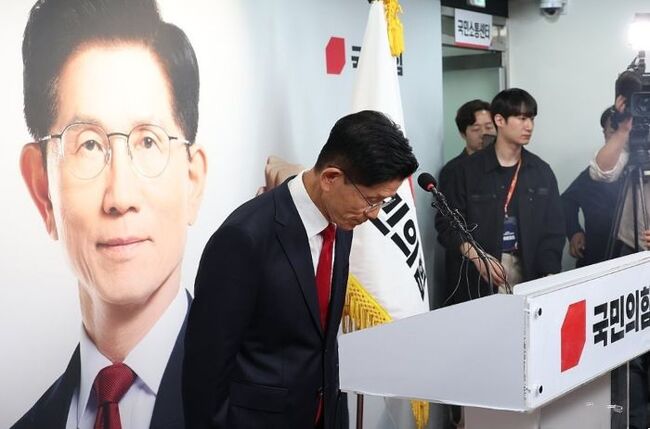 “Too little, too late?…” Kim Moon-soo, who previously conceded his presidential election defeat, now demands a special counsel investigation into ‘allegations of election fraud in the 2025 presidential election’
People Power Party presidential candidate Kim Moon-soo concedes defeat during a press conference at the party headquarters in Yeouido, Seoul, on June 4, 2025. [Joint Press Corps]As allegations emerge
“Too little, too late?…” Kim Moon-soo, who previously conceded his presidential election defeat, now demands a special counsel investigation into ‘allegations of election fraud in the 2025 presidential election’
People Power Party presidential candidate Kim Moon-soo concedes defeat during a press conference at the party headquarters in Yeouido, Seoul, on June 4, 2025. [Joint Press Corps]As allegations emerge
 Stock Market Crash 'Black Tuesday'… KOSPI down 10.8%, KOSDAQ down 7.7%
The KOSPI fell by more than 5% in early trading on the 28th, triggering a sell-side sidecar.On the 28th, the KOSPI plunged by more than 10%.Due to the sharp decline, a sell-side sidecar—a temporary
Stock Market Crash 'Black Tuesday'… KOSPI down 10.8%, KOSDAQ down 7.7%
The KOSPI fell by more than 5% in early trading on the 28th, triggering a sell-side sidecar.On the 28th, the KOSPI plunged by more than 10%.Due to the sharp decline, a sell-side sidecar—a temporary
 [World Heritage Committee] 25 New World Heritage Sites Inscribed in Busan… South Korea Successfully Expands 'Getbol' Listing
The Chairperson of the World Heritage Committee speaks at the plenary session of the 48th session of the World Heritage Committee, held at BEXCO in Busan on the 20th. [Photo: Yonhap News]A total of 25
[World Heritage Committee] 25 New World Heritage Sites Inscribed in Busan… South Korea Successfully Expands 'Getbol' Listing
The Chairperson of the World Heritage Committee speaks at the plenary session of the 48th session of the World Heritage Committee, held at BEXCO in Busan on the 20th. [Photo: Yonhap News]A total of 25
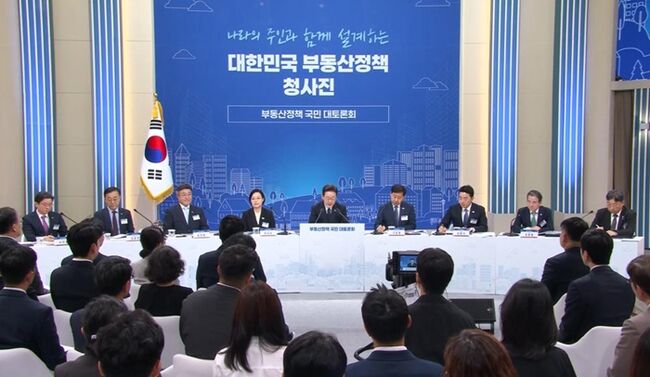 [Liberal Democratic Party Statement] Calling it a Grand Real Estate Debate… It Was Nothing More Than a Private Party Among Themselves
The 'National Grand Debate on Real Estate Policy' held on July 23rd and 27th. [Photo=Yonhap News]The 'National Grand Debate on Real Estate Policy,' hosted by the Lee Jae-myung administration under the
[Liberal Democratic Party Statement] Calling it a Grand Real Estate Debate… It Was Nothing More Than a Private Party Among Themselves
The 'National Grand Debate on Real Estate Policy' held on July 23rd and 27th. [Photo=Yonhap News]The 'National Grand Debate on Real Estate Policy,' hosted by the Lee Jae-myung administration under the
 [Photo] Evidence of Election Fraud Flooding U.S. Media… Trump Had 2.7 Million Votes Stolen
 [Video] U.S. Semiquincentennial Air Show... 'Art in the Sky' streaks across New York
 [Editorial Cartoon] A Draconian Law That Undermines Freedom of Expression

 List
List