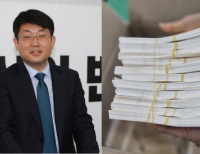
Prime Minister Benjamin Netanyahu (right) served in an elite special forces unit.
Of the 110 individuals recently referred for investigation by the government's task force on sedition involvement, 108 were military personnel. Among the 89 who faced disciplinary requests, 48 were also military. Investigations targeting the military are said to continue.
Accountability is necessary. However, the reality of a group on the front lines of national security becoming a target of collective suspicion and summons is a matter that warrants sober reflection. Is it truly desirable for the military, which should be focused on combat readiness and maintaining its strength, to be repeatedly placed at the center of investigations and pressure amidst the vortex of politics?
The Republic of Korea, with a military of less than 500,000 personnel, confronts North Korea's 1 million-strong army, which possesses weapons of mass destruction, including dozens of tactical nuclear weapons.
Under these circumstances, the military should stand on a foundation of trust, not be a constant object of suspicion. The moment power, lacking an understanding of the weight of security, views the military solely as an object of control, the nation's deterrence power is subtly weakened.
A Matter of 'Qualification,' Not Legality
Lee Jae-myung, Kim Min-seok, Jeong Cheong-rae, and Ahn Gyu-baek – their commonality is that they have not completed their mandatory military service. Regardless of how legitimate the reasons may be within legal procedures, public perception and moral standards are never confined within the text of a law book.
The Buddhist concept of dependent origination (연기) is the principle of interdependence and responsibility: "This exists, therefore that exists." The peace and power that someone enjoys are invariably rooted in the sacrifice and dedication of others.
The peace enjoyed today exists because of the soldiers enduring biting cold at General Outposts (GOPs), the Air Force risking their lives in the skies, and the Navy battling against rough waves.
To discuss national security without embodying this dependent connection is the arrogance of someone who, indebted to the suffering of others, forgets that debt and wields only their rights.
The military is not a battlefield of abstract concepts. It is a place where young lives are dedicated to the nation. Security strategies that have not personally experienced patrolling the DMZ, airborne training, ranger training, or the UDT experience in harsh waves are merely empty performances that ignore the realities on the ground.
The weight of orders that will decide the lives and deaths of tens of thousands must stem not from abstract legality but from the profound empathy and understanding that comes from personally experiencing the hardships of training on the front lines.
The veneer of legality does not mask moral deficiencies. A leader who discusses politics by leveraging the dedication of soldiers, yet fails to grasp the weight of that dedication, is as precarious as a mud wall built on a weak foundation during the rainy season.
Entrusting the nation's safety to those who lack dependent origination awareness goes against public common sense and moral expectations. Instead of hiding behind legal immunity, they must now demonstrate their qualifications to the public regarding the embodied experiences they have not undertaken.
The Question Israel Poses
Look at Israel. Israeli political leaders generally undergo the rigors of military service.
Yitzhak Rabin was a former general who fought in the War of Independence and the Six-Day War. Ehud Barak was a special forces commander with extensive combat experience.
The current Prime Minister, Benjamin Netanyahu, also served in an elite special forces unit and lost his brother in combat. For them, security is not theory but memory; not policy, but wounds.
In a society surrounded by hostile environments, security is not an abstract concept but a condition of life. A significant number of political leaders experience the weight of national defense through military service. A cultural foundation clearly exists where those who know the battlefield chart the nation's course.
For them, security is not an election strategy but a matter of survival.
"What have you sacrificed for this country?"
South Korea must also ask this.
Military experience is not a private resume item but the foundation of public responsibility. If one has not experienced it, they should be more humble; if one does not know it, they should strive to learn more.
Power that is ignorant of the military – does it truly have the right to speak of national security?
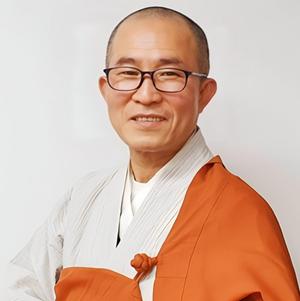
◆ Monk Eungcheon
Secretary-General of the Korean Buddhist National Defense Association
First Commander of the National Defense Monk Corps

 [Statement by the Seo-beo-kka Korea Military Academy Save-the-Nation Comrades Association] ㉛ Recount the Votes Publicly, as the Previous Recount Concealed Election Fraud
Tongyeong Mayoral Election Recount [Photo=Yonhap News]South Korea's liberal democracy is dying. The National Election Commission (NEC) and the judiciary, which have plummeted into criminal syndicates
[Statement by the Seo-beo-kka Korea Military Academy Save-the-Nation Comrades Association] ㉛ Recount the Votes Publicly, as the Previous Recount Concealed Election Fraud
Tongyeong Mayoral Election Recount [Photo=Yonhap News]South Korea's liberal democracy is dying. The National Election Commission (NEC) and the judiciary, which have plummeted into criminal syndicates
 What is the significance of the "Trump 2028" red hats that keep making a comeback?
It is noteworthy that President Donald Trump is "intentionally" fueling controversy over whether he can actually run in the 2028 presidential election, even though it is "highly likely he is seriously
What is the significance of the "Trump 2028" red hats that keep making a comeback?
It is noteworthy that President Donald Trump is "intentionally" fueling controversy over whether he can actually run in the 2028 presidential election, even though it is "highly likely he is seriously
 Jin Cummings: “North Korea says it will increase the number of spies, so what is the government doing?”
U.S. political columnist Gene Cummings has publicly questioned the South Korean government, asking, "North Korea is declaring that it will increase its number of spies, so what is the South Kore
Jin Cummings: “North Korea says it will increase the number of spies, so what is the government doing?”
U.S. political columnist Gene Cummings has publicly questioned the South Korean government, asking, "North Korea is declaring that it will increase its number of spies, so what is the South Kore
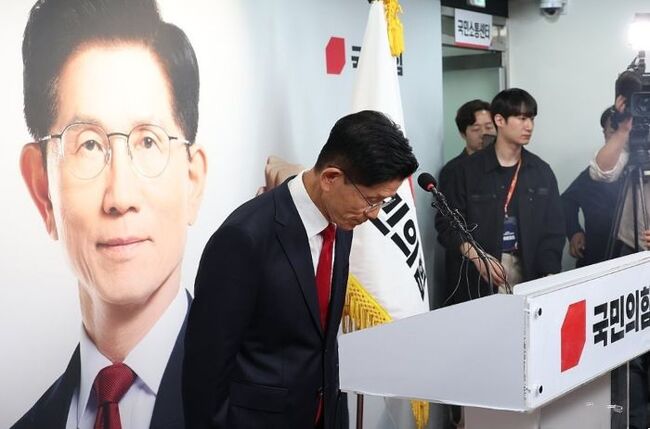 “Too little, too late?…” Kim Moon-soo, who previously conceded his presidential election defeat, now demands a special counsel investigation into ‘allegations of election fraud in the 2025 presidential election’
People Power Party presidential candidate Kim Moon-soo concedes defeat during a press conference at the party headquarters in Yeouido, Seoul, on June 4, 2025. [Joint Press Corps]As allegations emerge
“Too little, too late?…” Kim Moon-soo, who previously conceded his presidential election defeat, now demands a special counsel investigation into ‘allegations of election fraud in the 2025 presidential election’
People Power Party presidential candidate Kim Moon-soo concedes defeat during a press conference at the party headquarters in Yeouido, Seoul, on June 4, 2025. [Joint Press Corps]As allegations emerge
 Stock Market Crash 'Black Tuesday'… KOSPI down 10.8%, KOSDAQ down 7.7%
The KOSPI fell by more than 5% in early trading on the 28th, triggering a sell-side sidecar.On the 28th, the KOSPI plunged by more than 10%.Due to the sharp decline, a sell-side sidecar—a temporary
Stock Market Crash 'Black Tuesday'… KOSPI down 10.8%, KOSDAQ down 7.7%
The KOSPI fell by more than 5% in early trading on the 28th, triggering a sell-side sidecar.On the 28th, the KOSPI plunged by more than 10%.Due to the sharp decline, a sell-side sidecar—a temporary
 [World Heritage Committee] 25 New World Heritage Sites Inscribed in Busan… South Korea Successfully Expands 'Getbol' Listing
The Chairperson of the World Heritage Committee speaks at the plenary session of the 48th session of the World Heritage Committee, held at BEXCO in Busan on the 20th. [Photo: Yonhap News]A total of 25
[World Heritage Committee] 25 New World Heritage Sites Inscribed in Busan… South Korea Successfully Expands 'Getbol' Listing
The Chairperson of the World Heritage Committee speaks at the plenary session of the 48th session of the World Heritage Committee, held at BEXCO in Busan on the 20th. [Photo: Yonhap News]A total of 25
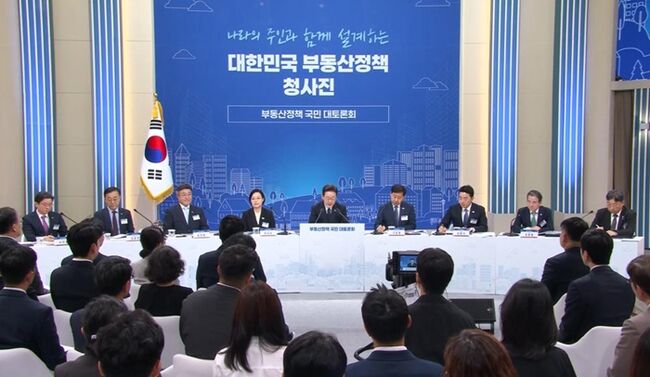 [Liberal Democratic Party Statement] Calling it a Grand Real Estate Debate… It Was Nothing More Than a Private Party Among Themselves
The 'National Grand Debate on Real Estate Policy' held on July 23rd and 27th. [Photo=Yonhap News]The 'National Grand Debate on Real Estate Policy,' hosted by the Lee Jae-myung administration under the
[Liberal Democratic Party Statement] Calling it a Grand Real Estate Debate… It Was Nothing More Than a Private Party Among Themselves
The 'National Grand Debate on Real Estate Policy' held on July 23rd and 27th. [Photo=Yonhap News]The 'National Grand Debate on Real Estate Policy,' hosted by the Lee Jae-myung administration under the
 [Photo] Evidence of Election Fraud Flooding U.S. Media… Trump Had 2.7 Million Votes Stolen
 [Video] U.S. Semiquincentennial Air Show... 'Art in the Sky' streaks across New York
 [Editorial Cartoon] A Draconian Law That Undermines Freedom of Expression

 List
List