March 27, Seoul, Jung-gu, Hana Bank Headquarters Dealing Room Main Screen [Photo=Yonhap News]
War, Oil Prices, and Interest Rates: The Three Variables That Shook the Stock Market This Week
The global stock market in the fifth week of March 2026 was not in a phase where direction could be discussed first. This week, the market's focus was less on the rise and fall itself, and more on which variables became the center of price movements.
Superficially, the Middle East conflict appeared to be the most significant factor. However, what truly shook the stock market was not the war itself, but the structure where the war drove up oil prices, and rising oil prices, in turn, unsettled interest rate expectations.
This week, the market reacted more strongly to the connections than to the events.
This week's trend can be summarized by a relatively simple chain: the war drove up oil prices, rising oil prices stimulated inflation concerns, and inflation concerns pushed back expectations for interest rate cuts.
Ultimately, the stock market did not react to war news, but rather to the reassessment of interest rates triggered by the war. In this regard, this week's stock market was both a geopolitical and a monetary policy market.
In the early part of the week, the market was significantly swayed by strong remarks from U.S. President Donald Trump directed at Iran. With statements changing daily, from demanding the full opening of the Strait of Hormuz to warning of attacks on Iranian power plants and energy facilities, and then hinting at a delay and renegotiation of attacks, the market had to constantly recalculate its direction.
The issue was not the intensity of the remarks, but rather how much those remarks increased the possibility of energy supply disruptions. As international oil prices surged, the market immediately recalled inflationary pressures and began to lower expectations for interest rate cuts. The war was the headline, but prices moved with interest rates.
The first variable that shook the stock market this week was oil prices.
Oil prices were the central axis of the market throughout the week. As Middle East risks grew, oil prices soared, and they retreated whenever the possibility of negotiations arose. However, what was important was not the short-term fluctuations themselves, but the change in the meaning of oil prices.
Oil prices were no longer simply commodity prices. This week, oil prices acted as a mediating variable connecting war, inflation, and interest rates. The moment oil prices rose, the market not only saw an improvement in the profitability of the energy sector but also factored in the possibility of the Federal Reserve's policy room narrowing.
The second variable was interest rates.
This week, interest rates were the final point where market interpretations converged. As inflation concerns due to rising oil prices grew, Treasury yields faced upward pressure, and the impact was immediately reflected in technology and growth stocks. Conversely, when news of attack deferrals or negotiations emerged, oil prices and interest rates stabilized together, leading to a stock market rebound.
However, this rebound was not one of conviction. The market was not betting on the end of the war but was relieved by the deferral, which indicated no immediate worsening. This week's rebound was not a rebound of optimism, but a rebound of eased tensions.
The third variable was the credibility of Trump's remarks.
This week, the market not only looked at geopolitical variables but also assessed the credibility capital of the person making those statements. With a cycle of hawkish remarks one day, deferrals the next, and then pressure the day after, the market began to consider the likelihood of action rather than the remarks themselves.
Therefore, the market impact of the same hawkish remarks was shorter than before, and the same deferral remarks were not perceived as a trend reversal. The market is now looking at the persistence of words rather than the direction of words.
In this regard, this week's stock market did not show a clear trending phase.
Rather, it was closer to a phase of testing what would become the new standard as the existing price order was shaken.
Technology stocks were weak due to interest rate burdens, while energy and utilities were relatively strong, and some funds even moved into cash-like assets. Instead of the entire market running in one direction, the priority of variables was being reordered.
Reading this week solely as a Middle East risk market would only be seeing half the picture.
A more accurate interpretation is as follows: Middle East risks pushed up oil prices, oil prices stimulated interest rates, and interest rates, in turn, divided sectors and fund flows. Ultimately, the market reflected the price path created by the events before the events themselves.
The essence of this week's stock market was not the volume of war news, but the fact that the war changed the hierarchy of price variables.
Next Week's Checkpoints are also clear.
First, whether oil prices will rise to new highs again.
Second, how long Treasury yields will reflect that impact.
Third, whether Trump's hawkish remarks will translate into actual actions.
If these three move in the same direction again, market volatility could increase further. Conversely, if oil prices and interest rates stabilize, this week's shock could potentially conclude at the level of structural readjustment.
In summary, this week's stock market had the war as its starting point, oil prices as the messenger, and interest rates as the ultimate price setter. The three variables that shook the market did not move independently. This week, the financial markets were in the process of inscribing that interconnected structure onto prices once again.

 [Statement by the Seo-beo-kka Korea Military Academy Save-the-Nation Comrades Association] ㉛ Recount the Votes Publicly, as the Previous Recount Concealed Election Fraud
Tongyeong Mayoral Election Recount [Photo=Yonhap News]South Korea's liberal democracy is dying. The National Election Commission (NEC) and the judiciary, which have plummeted into criminal syndicates
[Statement by the Seo-beo-kka Korea Military Academy Save-the-Nation Comrades Association] ㉛ Recount the Votes Publicly, as the Previous Recount Concealed Election Fraud
Tongyeong Mayoral Election Recount [Photo=Yonhap News]South Korea's liberal democracy is dying. The National Election Commission (NEC) and the judiciary, which have plummeted into criminal syndicates
 What is the significance of the "Trump 2028" red hats that keep making a comeback?
It is noteworthy that President Donald Trump is "intentionally" fueling controversy over whether he can actually run in the 2028 presidential election, even though it is "highly likely he is seriously
What is the significance of the "Trump 2028" red hats that keep making a comeback?
It is noteworthy that President Donald Trump is "intentionally" fueling controversy over whether he can actually run in the 2028 presidential election, even though it is "highly likely he is seriously
 Jin Cummings: “North Korea says it will increase the number of spies, so what is the government doing?”
U.S. political columnist Gene Cummings has publicly questioned the South Korean government, asking, "North Korea is declaring that it will increase its number of spies, so what is the South Kore
Jin Cummings: “North Korea says it will increase the number of spies, so what is the government doing?”
U.S. political columnist Gene Cummings has publicly questioned the South Korean government, asking, "North Korea is declaring that it will increase its number of spies, so what is the South Kore
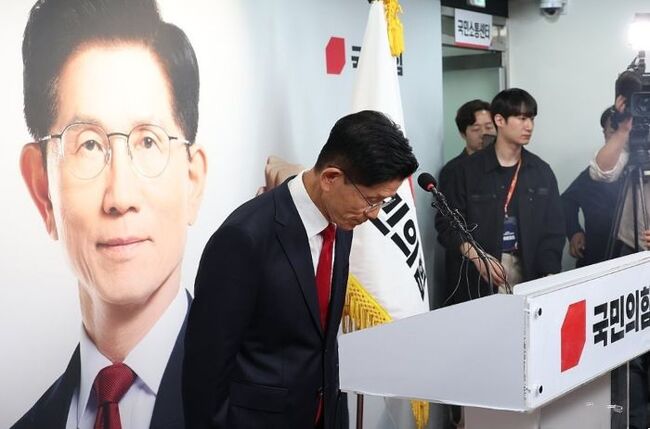 “Too little, too late?…” Kim Moon-soo, who previously conceded his presidential election defeat, now demands a special counsel investigation into ‘allegations of election fraud in the 2025 presidential election’
People Power Party presidential candidate Kim Moon-soo concedes defeat during a press conference at the party headquarters in Yeouido, Seoul, on June 4, 2025. [Joint Press Corps]As allegations emerge
“Too little, too late?…” Kim Moon-soo, who previously conceded his presidential election defeat, now demands a special counsel investigation into ‘allegations of election fraud in the 2025 presidential election’
People Power Party presidential candidate Kim Moon-soo concedes defeat during a press conference at the party headquarters in Yeouido, Seoul, on June 4, 2025. [Joint Press Corps]As allegations emerge
 Stock Market Crash 'Black Tuesday'… KOSPI down 10.8%, KOSDAQ down 7.7%
The KOSPI fell by more than 5% in early trading on the 28th, triggering a sell-side sidecar.On the 28th, the KOSPI plunged by more than 10%.Due to the sharp decline, a sell-side sidecar—a temporary
Stock Market Crash 'Black Tuesday'… KOSPI down 10.8%, KOSDAQ down 7.7%
The KOSPI fell by more than 5% in early trading on the 28th, triggering a sell-side sidecar.On the 28th, the KOSPI plunged by more than 10%.Due to the sharp decline, a sell-side sidecar—a temporary
 [World Heritage Committee] 25 New World Heritage Sites Inscribed in Busan… South Korea Successfully Expands 'Getbol' Listing
The Chairperson of the World Heritage Committee speaks at the plenary session of the 48th session of the World Heritage Committee, held at BEXCO in Busan on the 20th. [Photo: Yonhap News]A total of 25
[World Heritage Committee] 25 New World Heritage Sites Inscribed in Busan… South Korea Successfully Expands 'Getbol' Listing
The Chairperson of the World Heritage Committee speaks at the plenary session of the 48th session of the World Heritage Committee, held at BEXCO in Busan on the 20th. [Photo: Yonhap News]A total of 25
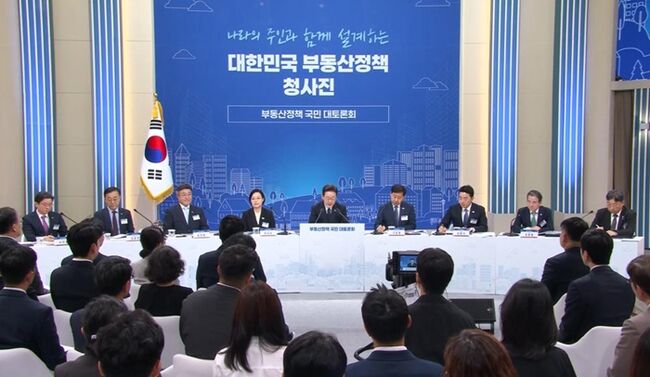 [Liberal Democratic Party Statement] Calling it a Grand Real Estate Debate… It Was Nothing More Than a Private Party Among Themselves
The 'National Grand Debate on Real Estate Policy' held on July 23rd and 27th. [Photo=Yonhap News]The 'National Grand Debate on Real Estate Policy,' hosted by the Lee Jae-myung administration under the
[Liberal Democratic Party Statement] Calling it a Grand Real Estate Debate… It Was Nothing More Than a Private Party Among Themselves
The 'National Grand Debate on Real Estate Policy' held on July 23rd and 27th. [Photo=Yonhap News]The 'National Grand Debate on Real Estate Policy,' hosted by the Lee Jae-myung administration under the
 [Photo] Evidence of Election Fraud Flooding U.S. Media… Trump Had 2.7 Million Votes Stolen
 [Video] U.S. Semiquincentennial Air Show... 'Art in the Sky' streaks across New York
 [Editorial Cartoon] A Draconian Law That Undermines Freedom of Expression

 List
List