New York Stock Exchange [Photo=Yonhap News]
Why Did Some AI Stocks Fluctuate While Others Held Firm This Week?
This week's market performance was more indicative of individual stock movements than sector trends.
Even within the same AI, tech stock, or Big Tech categories, stock price trajectories diverged significantly. Some plummeted, some held relatively steady, and others even rebounded.
This divergence was not merely a matter of random supply and demand but a signal of what the market was worried about and what it still held hope for.
The core theme of this week's stock radar was the market's divided selection even within the same thematic groups.
The semiconductor and hardware sectors were the first to feel the pressure.
Stocks directly linked to AI infrastructure, such as Nvidia, Micron, Broadcom, and Intel, faced both interest rate burdens and sector-specific headwinds. As these stocks have strongly benefited from AI optimism, they were also significantly impacted when the market began to reassess valuations.
Notably, rising oil prices this week pushed back interest rate cut expectations, which first impacted stocks heavily reliant on future growth premiums. Among tech stocks, the most overvalued segment faced the initial pressure.
The announcement from TurboQuant further added to the burden for memory-related stocks. While Google's announcement could be interpreted as a long-term factor to reduce AI diffusion costs, the market this week reacted more to the immediate fear of "will memory requirements decrease?"
Consequently, memory-related stocks like Micron experienced direct selling pressure. The market was more sensitive to potential short-term decreases in demand per unit rather than long-term overall increases.
In contrast, stocks with different characteristics within the tech sector, such as Tesla, Apple, and Salesforce, received relatively different evaluations.
Tesla showed a rebound trend driven by individual catalysts like Elon Musk's vision for Terafab for AI chip production. Apple performed relatively well compared to stock groups directly linked to hardware supply chain instability. Salesforce, seen as a prime example of applying AI to actual business and services, was placed on a different evaluation axis than infrastructure builders.
This reveals a partial shift in the market's focus from simple AI hardware expansion to AI utilization and monetization structures.
The weakness in Alphabet and Meta carries another meaning.
These companies faced not only the general interest rate burden affecting all tech stocks but also individual negative news. Meta was burdened by litigation issues and news of recommended punitive damages, while Alphabet, separate from the technical implications of the TurboQuant announcement, became a focal point amplifying market anxiety.
In essence, this week's market perceived even companies announcing technological innovations not as subjects of good news but as variables disrupting the existing order. This is a typical characteristic of a risk-averse market, where the market becomes more sensitive to the magnitude of the impact a development might bring than its direction.
SMCI was the most dramatic example in this week's stock radar. Allegations of technology smuggling to China and indictments of related individuals were perceived not just as individual setbacks but as incidents symbolizing policy risks across the entire AI server and semiconductor supply chain.
The market did not view this solely as an SMCI-specific issue but as a signal of larger risks related to semiconductor security and supply chain control. Therefore, SMCI's sharp decline was both a stock event and an industry event.
In summary, the market's criteria were clear this week.
First, overvalued hardware stocks vulnerable to interest rate burdens were the first to falter.
Second, stocks with distinct individual catalysts or those closer to the AI utilization phase held up relatively well.
Third, stocks linked to policy risks acted as catalysts exacerbating the sentiment across the entire industry.
Ultimately, the same AI began to be differentiated into stocks of 'equipment and expectations' for some, and stocks of 'utilization and monetization' for others.
In this regard, this week's stock radar delivers an important message.
The market no longer lumps all tech stocks together under the single term "AI." Evaluations are now divided based on who is closer to actual profits, who is still merely expensive with a premium, and who is exposed to policy risks. This is why, even with the same AI, some stocks faltered while others held strong this week.
Stock differentiation is likely to continue next week.
If oil prices and interest rates remain volatile, the pressure on hardware and highly valued growth stocks will likely persist.
Conversely, if interest rates stabilize, stocks that saw sharp declines this week may attempt a technical rebound. However, such a rebound is less likely to lead to a uniform AI rally as before; instead, it is more probable to be more finely differentiated based on earnings, policy, and monetization potential.
Ultimately, this week's stock movements can be summarized in one sentence: The market has not abandoned AI, but it has begun to re-evaluate what within AI is more robust.

 [Statement by the Seo-beo-kka Korea Military Academy Save-the-Nation Comrades Association] ㉛ Recount the Votes Publicly, as the Previous Recount Concealed Election Fraud
Tongyeong Mayoral Election Recount [Photo=Yonhap News]South Korea's liberal democracy is dying. The National Election Commission (NEC) and the judiciary, which have plummeted into criminal syndicates
[Statement by the Seo-beo-kka Korea Military Academy Save-the-Nation Comrades Association] ㉛ Recount the Votes Publicly, as the Previous Recount Concealed Election Fraud
Tongyeong Mayoral Election Recount [Photo=Yonhap News]South Korea's liberal democracy is dying. The National Election Commission (NEC) and the judiciary, which have plummeted into criminal syndicates
 What is the significance of the "Trump 2028" red hats that keep making a comeback?
It is noteworthy that President Donald Trump is "intentionally" fueling controversy over whether he can actually run in the 2028 presidential election, even though it is "highly likely he is seriously
What is the significance of the "Trump 2028" red hats that keep making a comeback?
It is noteworthy that President Donald Trump is "intentionally" fueling controversy over whether he can actually run in the 2028 presidential election, even though it is "highly likely he is seriously
 Jin Cummings: “North Korea says it will increase the number of spies, so what is the government doing?”
U.S. political columnist Gene Cummings has publicly questioned the South Korean government, asking, "North Korea is declaring that it will increase its number of spies, so what is the South Kore
Jin Cummings: “North Korea says it will increase the number of spies, so what is the government doing?”
U.S. political columnist Gene Cummings has publicly questioned the South Korean government, asking, "North Korea is declaring that it will increase its number of spies, so what is the South Kore
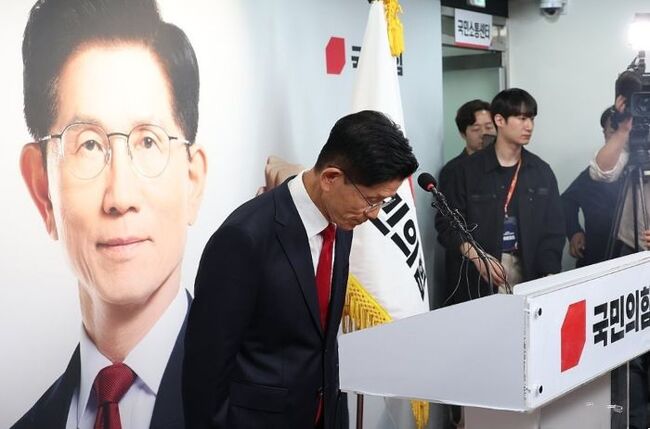 “Too little, too late?…” Kim Moon-soo, who previously conceded his presidential election defeat, now demands a special counsel investigation into ‘allegations of election fraud in the 2025 presidential election’
People Power Party presidential candidate Kim Moon-soo concedes defeat during a press conference at the party headquarters in Yeouido, Seoul, on June 4, 2025. [Joint Press Corps]As allegations emerge
“Too little, too late?…” Kim Moon-soo, who previously conceded his presidential election defeat, now demands a special counsel investigation into ‘allegations of election fraud in the 2025 presidential election’
People Power Party presidential candidate Kim Moon-soo concedes defeat during a press conference at the party headquarters in Yeouido, Seoul, on June 4, 2025. [Joint Press Corps]As allegations emerge
 Stock Market Crash 'Black Tuesday'… KOSPI down 10.8%, KOSDAQ down 7.7%
The KOSPI fell by more than 5% in early trading on the 28th, triggering a sell-side sidecar.On the 28th, the KOSPI plunged by more than 10%.Due to the sharp decline, a sell-side sidecar—a temporary
Stock Market Crash 'Black Tuesday'… KOSPI down 10.8%, KOSDAQ down 7.7%
The KOSPI fell by more than 5% in early trading on the 28th, triggering a sell-side sidecar.On the 28th, the KOSPI plunged by more than 10%.Due to the sharp decline, a sell-side sidecar—a temporary
 [World Heritage Committee] 25 New World Heritage Sites Inscribed in Busan… South Korea Successfully Expands 'Getbol' Listing
The Chairperson of the World Heritage Committee speaks at the plenary session of the 48th session of the World Heritage Committee, held at BEXCO in Busan on the 20th. [Photo: Yonhap News]A total of 25
[World Heritage Committee] 25 New World Heritage Sites Inscribed in Busan… South Korea Successfully Expands 'Getbol' Listing
The Chairperson of the World Heritage Committee speaks at the plenary session of the 48th session of the World Heritage Committee, held at BEXCO in Busan on the 20th. [Photo: Yonhap News]A total of 25
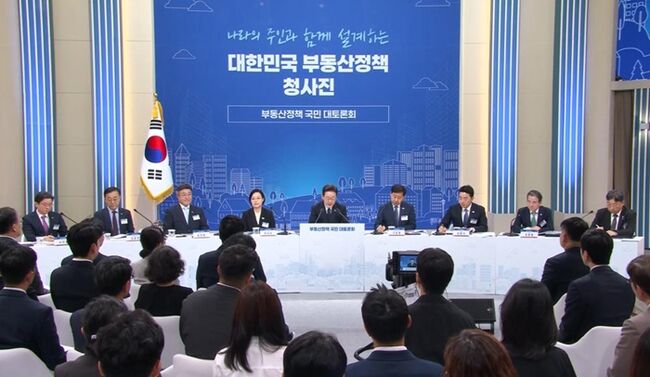 [Liberal Democratic Party Statement] Calling it a Grand Real Estate Debate… It Was Nothing More Than a Private Party Among Themselves
The 'National Grand Debate on Real Estate Policy' held on July 23rd and 27th. [Photo=Yonhap News]The 'National Grand Debate on Real Estate Policy,' hosted by the Lee Jae-myung administration under the
[Liberal Democratic Party Statement] Calling it a Grand Real Estate Debate… It Was Nothing More Than a Private Party Among Themselves
The 'National Grand Debate on Real Estate Policy' held on July 23rd and 27th. [Photo=Yonhap News]The 'National Grand Debate on Real Estate Policy,' hosted by the Lee Jae-myung administration under the
 [Photo] Evidence of Election Fraud Flooding U.S. Media… Trump Had 2.7 Million Votes Stolen
 [Video] U.S. Semiquincentennial Air Show... 'Art in the Sky' streaks across New York
 [Editorial Cartoon] A Draconian Law That Undermines Freedom of Expression

 List
List