U.S. President Donald Trump [Photo: Yonhap News]
Why Trump's Words No Longer Move Markets for Long
This week, markets seemed to sway significantly with the words of U.S. President Donald Trump.
One day, he demanded the full opening of the Strait of Hormuz and threatened to destroy Iran's power and energy facilities. The next, he announced a pause in attacks and stated that very productive talks had taken place. A few days later, he extended the pause on attacks, speaking of both pressure and negotiation.
On the surface, markets still appear to be swayed by Trump's every word. However, a closer look at this week's market reveals a different picture. While markets still react to his statements, they no longer believe them for long. This is the core of this week's Money Insight.
The power of Trump's remarks to move markets has not disappeared. The issue is the duration of that power.
Strong words cause oil prices to rise, stock prices to fall, and interest rates to react. However, soon after, when a pause in attacks or the possibility of negotiations is mentioned, markets quickly reverse. In the past, a single hawkish statement might have dictated market direction for days, but now the half-life of the shock is short. Markets are surprised by his words but quickly ask, "Will it really happen this time?"
What this week's markets demonstrated was not the demise of fear, but the erosion of trust.
This is underpinned by repeated learning.
Trump has a pattern of first making strong statements – on tariffs, pressuring allies, diplomatic negotiations, and military threats – and then adjusting the tone or seeking an exit.
The pattern was similar in the recent Middle East situation. After raising tensions with hawkish remarks, he would, after a certain period, hint at a pause in attacks or the possibility of dialogue. Markets have experienced this pattern multiple times.
Therefore, they now look beyond the intensity of the words themselves to whether those words will translate into actual actions, and if so, how long those actions will be sustained.
This is precisely what was repeatedly revealed in this week's data.
Markets reacted immediately to Trump's hawkish remarks but found relief again with each report of negotiations or a pause in attacks. The problem is that this relief also did not last long. When Iran denied any possibility of negotiations, or when reports emerged of the U.S. deploying additional troops, markets began to waver again.
In other words, markets no longer view Trump's words as a directional signal. Hawkish remarks are not interpreted as a definitive signal for war, nor are statements of a pause seen as a definitive signal for resolution. Markets have begun to treat statements not as the start of a trend, but as a source of volatility.
The expression that best explains this is TACO (Trump Always Chickens Out).
The learning effect that "Trump ultimately backs down" has already spread through the markets. While this expression may sound somewhat derisive, it is a fairly accurate description when considering how markets operate. Each time markets hear strong threats, they briefly price in the worst-case scenario, but simultaneously factor in the expectation that "an exit will open up somewhere this time too."
Therefore, while the initial shock of hawkish remarks may linger, it does not translate into a long-lasting premium.
What is important here is not that the market is ignoring Trump, but that the market's evaluation criteria have changed.
Previous markets reacted more strongly to the intensity of words. Today's markets place more emphasis on the sustainability and feasibility of words. This difference is not insignificant. The intensity of a statement makes headlines, but sustainability and feasibility create price trends. This week's markets moved precisely on that boundary.
Therefore, the central variable in this week's markets was not Trump's words themselves. It was more important how long his words could drive up oil prices and how long those oil prices could alter interest rate expectations.
Markets are increasingly looking at the economic transmission channels before political rhetoric. Even when hawkish remarks are made, they calculate "how much will oil prices rise," "how much will treasury yields jump," and "how much will the tech stock premium compress" before considering "a war is breaking out."
This is why this week's markets, while appearing to be about war news, were essentially about oil prices and interest rates.
This change could become even more significant going forward. Players with weakened trust capital require stronger stimuli to achieve the same effect. As markets become less sensitive to strong words, actual actions or higher levels of threats will be needed to create a similar shock.
The problem lies precisely there. As the power of words weakens, the incentive for action may increase.
Therefore, the fact that this week's markets did not believe Trump's words for long may act as a shock absorber in the short term, but it could also paradoxically foster the possibility of more dangerous actions in the medium term.
However, it is difficult to say that markets have become completely rational. This week, indices moved sensitively with each report of an attack pause, the possibility of negotiations, and the conditions for ending the conflict.
However, markets now simply do not link these movements to a trend. Hawkish remarks cause short-term shocks, statements of a pause bring short-term relief, and in between, oil prices and interest rates determine the real direction. Words still shake markets, but they no longer dominate them for long.
Ultimately, the conclusion of this week's Money Insight is clear.
Markets have come to trust Trump's strong words less.
As a result, the market's focus has also shifted. Markets now look beyond the level of statements to their sustainability in leading to actual supply disruptions, oil price increases, and interest rate re-evaluations.
This does not mean the era of words is over. It means that words alone are no longer enough.
This week's markets clearly demonstrated that.
A single word from Trump still shakes the market. However, what holds prices for a long time is not the word itself, but the lingering traces of oil prices and interest rates left behind by that word.
Markets are now valuing sustainability over headlines and feasibility over rhetoric at higher prices.

 [Statement by the Seo-beo-kka Korea Military Academy Save-the-Nation Comrades Association] ㉛ Recount the Votes Publicly, as the Previous Recount Concealed Election Fraud
Tongyeong Mayoral Election Recount [Photo=Yonhap News]South Korea's liberal democracy is dying. The National Election Commission (NEC) and the judiciary, which have plummeted into criminal syndicates
[Statement by the Seo-beo-kka Korea Military Academy Save-the-Nation Comrades Association] ㉛ Recount the Votes Publicly, as the Previous Recount Concealed Election Fraud
Tongyeong Mayoral Election Recount [Photo=Yonhap News]South Korea's liberal democracy is dying. The National Election Commission (NEC) and the judiciary, which have plummeted into criminal syndicates
 What is the significance of the "Trump 2028" red hats that keep making a comeback?
It is noteworthy that President Donald Trump is "intentionally" fueling controversy over whether he can actually run in the 2028 presidential election, even though it is "highly likely he is seriously
What is the significance of the "Trump 2028" red hats that keep making a comeback?
It is noteworthy that President Donald Trump is "intentionally" fueling controversy over whether he can actually run in the 2028 presidential election, even though it is "highly likely he is seriously
 Jin Cummings: “North Korea says it will increase the number of spies, so what is the government doing?”
U.S. political columnist Gene Cummings has publicly questioned the South Korean government, asking, "North Korea is declaring that it will increase its number of spies, so what is the South Kore
Jin Cummings: “North Korea says it will increase the number of spies, so what is the government doing?”
U.S. political columnist Gene Cummings has publicly questioned the South Korean government, asking, "North Korea is declaring that it will increase its number of spies, so what is the South Kore
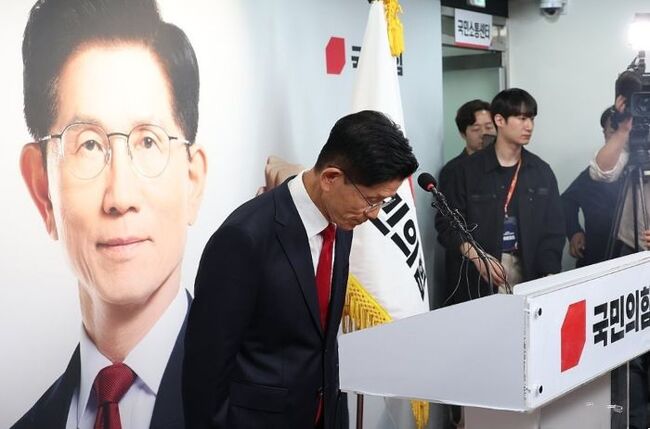 “Too little, too late?…” Kim Moon-soo, who previously conceded his presidential election defeat, now demands a special counsel investigation into ‘allegations of election fraud in the 2025 presidential election’
People Power Party presidential candidate Kim Moon-soo concedes defeat during a press conference at the party headquarters in Yeouido, Seoul, on June 4, 2025. [Joint Press Corps]As allegations emerge
“Too little, too late?…” Kim Moon-soo, who previously conceded his presidential election defeat, now demands a special counsel investigation into ‘allegations of election fraud in the 2025 presidential election’
People Power Party presidential candidate Kim Moon-soo concedes defeat during a press conference at the party headquarters in Yeouido, Seoul, on June 4, 2025. [Joint Press Corps]As allegations emerge
 Stock Market Crash 'Black Tuesday'… KOSPI down 10.8%, KOSDAQ down 7.7%
The KOSPI fell by more than 5% in early trading on the 28th, triggering a sell-side sidecar.On the 28th, the KOSPI plunged by more than 10%.Due to the sharp decline, a sell-side sidecar—a temporary
Stock Market Crash 'Black Tuesday'… KOSPI down 10.8%, KOSDAQ down 7.7%
The KOSPI fell by more than 5% in early trading on the 28th, triggering a sell-side sidecar.On the 28th, the KOSPI plunged by more than 10%.Due to the sharp decline, a sell-side sidecar—a temporary
 [World Heritage Committee] 25 New World Heritage Sites Inscribed in Busan… South Korea Successfully Expands 'Getbol' Listing
The Chairperson of the World Heritage Committee speaks at the plenary session of the 48th session of the World Heritage Committee, held at BEXCO in Busan on the 20th. [Photo: Yonhap News]A total of 25
[World Heritage Committee] 25 New World Heritage Sites Inscribed in Busan… South Korea Successfully Expands 'Getbol' Listing
The Chairperson of the World Heritage Committee speaks at the plenary session of the 48th session of the World Heritage Committee, held at BEXCO in Busan on the 20th. [Photo: Yonhap News]A total of 25
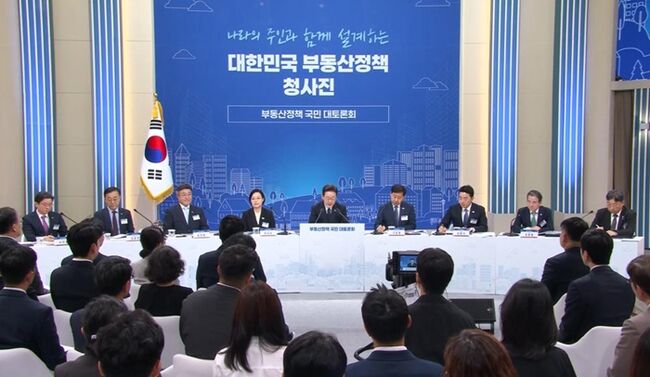 [Liberal Democratic Party Statement] Calling it a Grand Real Estate Debate… It Was Nothing More Than a Private Party Among Themselves
The 'National Grand Debate on Real Estate Policy' held on July 23rd and 27th. [Photo=Yonhap News]The 'National Grand Debate on Real Estate Policy,' hosted by the Lee Jae-myung administration under the
[Liberal Democratic Party Statement] Calling it a Grand Real Estate Debate… It Was Nothing More Than a Private Party Among Themselves
The 'National Grand Debate on Real Estate Policy' held on July 23rd and 27th. [Photo=Yonhap News]The 'National Grand Debate on Real Estate Policy,' hosted by the Lee Jae-myung administration under the
 [Photo] Evidence of Election Fraud Flooding U.S. Media… Trump Had 2.7 Million Votes Stolen
 [Video] U.S. Semiquincentennial Air Show... 'Art in the Sky' streaks across New York
 [Editorial Cartoon] A Draconian Law That Undermines Freedom of Expression

 List
List