Months have passed since the government announced its countermeasures against false and misleading advertising on platforms, yet consumer harm continues to increase rather than decrease, raising doubts about the effectiveness of these measures.
Although the government unveiled its response plan to false and misleading advertising late last year, promising pre-vention, swift blocking, and strengthened sanctions, there are reports that exaggerated advertisements continue to circulate on social media and video platforms.
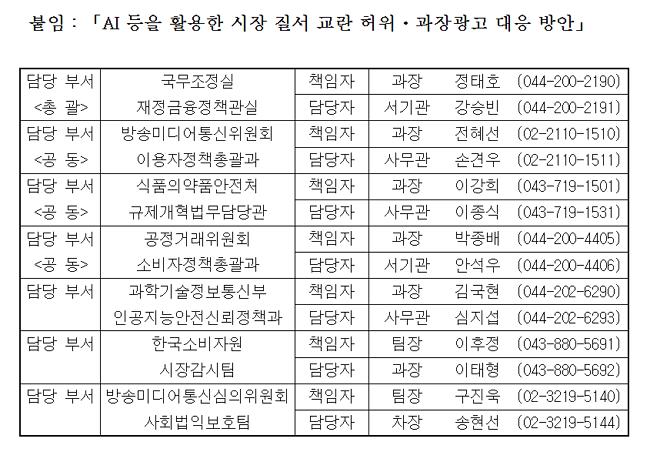
On December 10, 2025, relevant ministries, including the Fair Trade Commission, announced the 'Countermeasures Against False and Misleading Advertising Disrupting Market Order Using AI, etc.' at the National Policy Coordination Meeting chaired by Prime Minister Kim Min-seok.
At the time, the government emphasized the need for countermeasures, stating that false and misleading advertisements, often using AI-generated fake experts or deepfakes of celebrities, were rampant, particularly in the food and pharmaceutical sectors. The main pillars of the countermeasures were pre-vention before distribution, swift blocking during distribution, and strengthened sanctions and expanded enforcement capabilities.
In these measures, the government proposed introducing an AI-generated content labeling system for platforms, continuous monitoring through an AI-based information collection and analysis system, and pushing for punitive damages and increased fines.
Subsequently, in its public agency work report in January of this year, the government stated it would continuously monitor fabricated and misleading advertisements using AI and utilize AI for analyzing consumer damages and resolution cases to expedite dispute resolution processes.
The Korea Consumer Agency also reported that it would establish the basis for a collective remedy system for similar consumer damages, introduce a simplified dispute resolution system for small claims, and expand legal support.
However, criticisms persist that exaggerated efficacy and effect advertisements and misleading advertisements that cause consumer confusion are still rapidly spreading through platforms in the actual market.
The fact that the government has reiterated the emphasis on continuous monitoring and expedited dispute resolution this year can be interpreted as an indication that the relevant systems are not yet fully established.
Mr. A, whom Hankook Ilbo met, said, "I recently bought a product after seeing a YouTube advertisement, but the difference between the advertisement and the actual product was so large that I requested a return, but I couldn't contact the seller."
Mr. B also pointed out, "The method for reporting false and misleading advertisements is too complicated, so I gave up. Isn't changing things like this real reform?"
The issue is pointed out to be more about the effectiveness of enforcement rather than a lack of laws.
Systems prohibiting false and misleading advertising already exist, and the government has also announced separate countermeasures. Experts point out that if advertisements continue to flood the market despite this, it reveals systemic loopholes such as 'confusion of responsible parties and inadequate pre-vention mechanisms.'
While the primary entities that design, approve, and profit from advertisements are typically advertisers, the responsibility is often dispersed in the distribution process involving advertising agencies, influencers, and platforms. This is also why the government has presented strengthening platform responsibility and supplementing swift blocking systems as major countermeasures.
Mr. C, who runs an online advertising agency, emphasized, "It will take considerable time to build and establish the system," adding, "We need a system where the three principles of advertiser obligations, platform distribution responsibility, and consumer protection are realized in a one-stop manner."
Platform responsibility is also gaining renewed attention. Based on the government's countermeasures announced in December last year and subsequent work reports, the current government stance places more emphasis on labeling obligations, continuous monitoring, swift blocking, and efficient dispute resolution, rather than a centralized pre-screening system.
However, within and outside the industry, there are growing demands that for substantial reduction of false and misleading advertisements, platforms must be more proactive in pre-screening advertisement content and blocking repeated violations, going beyond their role as mere distribution channels. The direction of e-commerce law amendments also aims to strengthen platforms' information provision and consumer protection responsibilities.
Meanwhile, the focus of these countermeasures is not on preventing the use of AI itself. The government explains that its objective is not to regulate all AI advertisements but to prevent the creation and spread of false and misleading advertisements that exploit AI and deepfakes.
Accordingly, there is growing consensus that in future discussions on improving the system, the key judgment criterion should be 'whether consumers were misled by false or exaggerated content,' rather than 'whether AI was used.'
Ultimately, the success of the government's response plan announced late last year will likely be determined by the speed of execution and the perceived impact on the ground, rather than further announcements. If consumer harm does not actually decrease, demands for supplementary measures concerning the clarification of advertiser responsibility and platforms' obligations for pre-screening and immediate blocking are expected to intensify.

 [Statement by the Seo-beo-kka Korea Military Academy Save-the-Nation Comrades Association] ㉛ Recount the Votes Publicly, as the Previous Recount Concealed Election Fraud
Tongyeong Mayoral Election Recount [Photo=Yonhap News]South Korea's liberal democracy is dying. The National Election Commission (NEC) and the judiciary, which have plummeted into criminal syndicates
[Statement by the Seo-beo-kka Korea Military Academy Save-the-Nation Comrades Association] ㉛ Recount the Votes Publicly, as the Previous Recount Concealed Election Fraud
Tongyeong Mayoral Election Recount [Photo=Yonhap News]South Korea's liberal democracy is dying. The National Election Commission (NEC) and the judiciary, which have plummeted into criminal syndicates
 What is the significance of the "Trump 2028" red hats that keep making a comeback?
It is noteworthy that President Donald Trump is "intentionally" fueling controversy over whether he can actually run in the 2028 presidential election, even though it is "highly likely he is seriously
What is the significance of the "Trump 2028" red hats that keep making a comeback?
It is noteworthy that President Donald Trump is "intentionally" fueling controversy over whether he can actually run in the 2028 presidential election, even though it is "highly likely he is seriously
 Jin Cummings: “North Korea says it will increase the number of spies, so what is the government doing?”
U.S. political columnist Gene Cummings has publicly questioned the South Korean government, asking, "North Korea is declaring that it will increase its number of spies, so what is the South Kore
Jin Cummings: “North Korea says it will increase the number of spies, so what is the government doing?”
U.S. political columnist Gene Cummings has publicly questioned the South Korean government, asking, "North Korea is declaring that it will increase its number of spies, so what is the South Kore
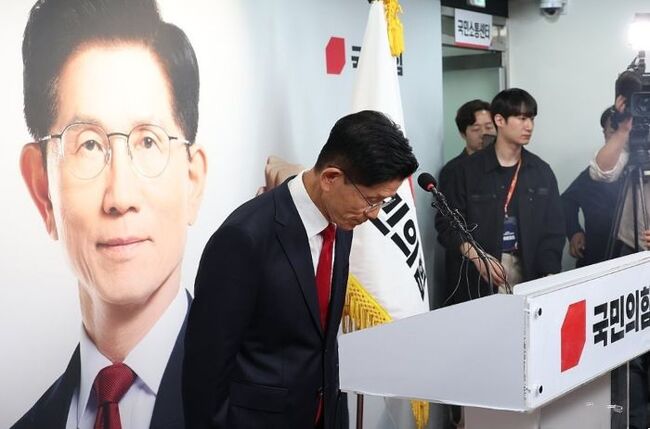 “Too little, too late?…” Kim Moon-soo, who previously conceded his presidential election defeat, now demands a special counsel investigation into ‘allegations of election fraud in the 2025 presidential election’
People Power Party presidential candidate Kim Moon-soo concedes defeat during a press conference at the party headquarters in Yeouido, Seoul, on June 4, 2025. [Joint Press Corps]As allegations emerge
“Too little, too late?…” Kim Moon-soo, who previously conceded his presidential election defeat, now demands a special counsel investigation into ‘allegations of election fraud in the 2025 presidential election’
People Power Party presidential candidate Kim Moon-soo concedes defeat during a press conference at the party headquarters in Yeouido, Seoul, on June 4, 2025. [Joint Press Corps]As allegations emerge
 Stock Market Crash 'Black Tuesday'… KOSPI down 10.8%, KOSDAQ down 7.7%
The KOSPI fell by more than 5% in early trading on the 28th, triggering a sell-side sidecar.On the 28th, the KOSPI plunged by more than 10%.Due to the sharp decline, a sell-side sidecar—a temporary
Stock Market Crash 'Black Tuesday'… KOSPI down 10.8%, KOSDAQ down 7.7%
The KOSPI fell by more than 5% in early trading on the 28th, triggering a sell-side sidecar.On the 28th, the KOSPI plunged by more than 10%.Due to the sharp decline, a sell-side sidecar—a temporary
 [World Heritage Committee] 25 New World Heritage Sites Inscribed in Busan… South Korea Successfully Expands 'Getbol' Listing
The Chairperson of the World Heritage Committee speaks at the plenary session of the 48th session of the World Heritage Committee, held at BEXCO in Busan on the 20th. [Photo: Yonhap News]A total of 25
[World Heritage Committee] 25 New World Heritage Sites Inscribed in Busan… South Korea Successfully Expands 'Getbol' Listing
The Chairperson of the World Heritage Committee speaks at the plenary session of the 48th session of the World Heritage Committee, held at BEXCO in Busan on the 20th. [Photo: Yonhap News]A total of 25
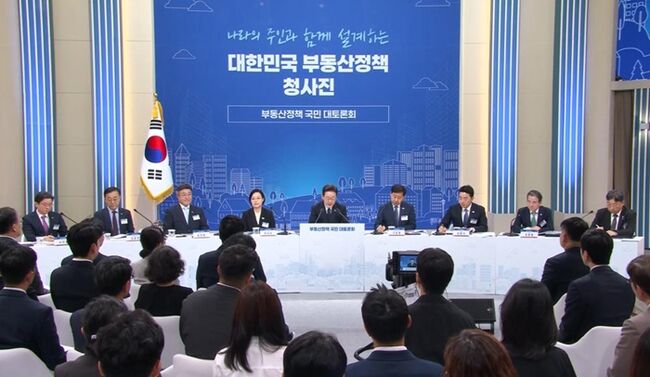 [Liberal Democratic Party Statement] Calling it a Grand Real Estate Debate… It Was Nothing More Than a Private Party Among Themselves
The 'National Grand Debate on Real Estate Policy' held on July 23rd and 27th. [Photo=Yonhap News]The 'National Grand Debate on Real Estate Policy,' hosted by the Lee Jae-myung administration under the
[Liberal Democratic Party Statement] Calling it a Grand Real Estate Debate… It Was Nothing More Than a Private Party Among Themselves
The 'National Grand Debate on Real Estate Policy' held on July 23rd and 27th. [Photo=Yonhap News]The 'National Grand Debate on Real Estate Policy,' hosted by the Lee Jae-myung administration under the
 [Photo] Evidence of Election Fraud Flooding U.S. Media… Trump Had 2.7 Million Votes Stolen
 [Video] U.S. Semiquincentennial Air Show... 'Art in the Sky' streaks across New York
 [Editorial Cartoon] A Draconian Law That Undermines Freedom of Expression

 List
List