The National Institute for Unification Education of the Ministry of Unification published 'Understanding Unification Issues 2026' and 'Understanding North Korea 2026' on the 30th, reflecting changes in the policy environment and international affairs. This is the first set of basic unification education materials published under the Lee Jae-myung administration. [Photo=Yonhap News]
It has been revealed that the basic unification education materials, first published under the Lee Jae-myung administration, have shifted their core value of unification from 'basic order of liberal democracy' to 'peace'.
The Ministry of Unification announced on the 30th that it had published 'Understanding Unification Issues 2026' and 'Understanding North Korea 2026', explaining that the materials reflect a "vision of peaceful coexistence and joint growth" and recent changes in international affairs.
On the surface, this might appear to be a mere adjustment in wording. However, this change is not simply a linguistic revision but rather a directional shift in how unification should be pursued as a value.
According to Yonhap News, this year's textbook states, "Peace is the value that should be prioritized above all in the unification of the Korean Peninsula." In contrast, last year's textbook explained, "Unification that we should pursue must be based on the fundamental order of liberal democracy."
In essence, the principle guiding unification has changed, rather than the statement about the goal of unification.
The description of the state has also changed. While last year's textbook described unification as "integration on the basis of the fundamental order of liberal democracy and a market economy," this year's reportedly describes it as "a process of being reborn as a new, unified community."
Furthermore, the vision for a unified Korean Peninsula has shifted from a 'liberal democratic state' to a 'democratic state that respects universal values such as freedom, equality, and human rights.'
Ultimately, the new community envisioned by these textbooks can be seen as one that prioritizes peaceful coexistence and joint growth, with its political form described as democracy that respects universal values.
The problem is that this description is in direct tension with the current reality of North Korea.
Kim Jong Un has already stated in his 2024 Supreme People's Assembly policy speech that the Republic of Korea should be designated in the constitution as the "number one hostile country" and the "immutable main enemy." And as recently as last March, North Korea reiterated its stance that South Korea is recognized as the "most hostile country."
In the face of an adversary pushing inter-Korean relations into a de facto relationship of 'two hostile states,' critics point out that South Korea's unification education materials placing peaceful coexistence as a top priority highlights a gap between the recognition of reality and policy language.
A greater controversy arises regarding human rights. While this year's textbook refers to 'human rights' as a universal value, the reported changes in its structure show a reduction in the independent emphasis on North Korean human rights.
According to Yonhap News and Yonhap News TV, while 'North Korean Human Rights' was introduced as a separate chapter of 11 pages in last year's 'Understanding Unification Issues,' this year it is covered under 'Efforts to Resolve Humanitarian Issues between North and South' as a sub-topic of 'North-South Human Rights Cooperation' for only about 3 pages. In the 'Understanding North Korea' textbook, related descriptions were also reduced from 19 pages last year to about 4 pages this year.
While speaking of human rights, the rights of North Korean residents have receded from the forefront.
This change becomes clearer when viewed in conjunction with the new term 'Bukhyangmin' (북향민). The Ministry of Unification explained that by designating the English name for 'Bukhyangmin,' a substitute term for defectors, as 'North Korean-born citizens,' it emphasized that they are equal citizens protected by South Korea's constitution and laws.
From the perspective of constitutional integration, this terminology is certainly significant. However, it is also possible to criticize that if citizens are referred to as such without providing a more robust explanation of their rights and human rights, then the advancement of terminology might only serve as a facade to cover up a retreat in content.
Ultimately, the core changes in this year's textbooks are clear.
'Peace' is no longer a term referring to the state after unification, but has risen to become the core method and priority value in achieving unification.
Conversely, the 'basic order of liberal democracy' has become less explicit, and North Korean human rights have been repositioned from an independent core agenda to a subordinate item under cooperation and humanitarianism.
The first unification textbooks of the Lee Jae-myung administration are, in themselves, documents that showcase a government's philosophy on unification. And that philosophy is read as follows:
To the extent that peace has been prioritized, vigilance regarding the human rights of North Korean residents and the North Korean regime's hostile stance has been pushed to the back.
Now, only one question remains. Can peace be the highest value even in a reality where North Korea has defined us as its main enemy? And the moment that peace takes precedence over the freedom and human rights of North Korean residents, for whom does that unification education become?

 [Statement by the Seo-beo-kka Korea Military Academy Save-the-Nation Comrades Association] ㉛ Recount the Votes Publicly, as the Previous Recount Concealed Election Fraud
Tongyeong Mayoral Election Recount [Photo=Yonhap News]South Korea's liberal democracy is dying. The National Election Commission (NEC) and the judiciary, which have plummeted into criminal syndicates
[Statement by the Seo-beo-kka Korea Military Academy Save-the-Nation Comrades Association] ㉛ Recount the Votes Publicly, as the Previous Recount Concealed Election Fraud
Tongyeong Mayoral Election Recount [Photo=Yonhap News]South Korea's liberal democracy is dying. The National Election Commission (NEC) and the judiciary, which have plummeted into criminal syndicates
 What is the significance of the "Trump 2028" red hats that keep making a comeback?
It is noteworthy that President Donald Trump is "intentionally" fueling controversy over whether he can actually run in the 2028 presidential election, even though it is "highly likely he is seriously
What is the significance of the "Trump 2028" red hats that keep making a comeback?
It is noteworthy that President Donald Trump is "intentionally" fueling controversy over whether he can actually run in the 2028 presidential election, even though it is "highly likely he is seriously
 Jin Cummings: “North Korea says it will increase the number of spies, so what is the government doing?”
U.S. political columnist Gene Cummings has publicly questioned the South Korean government, asking, "North Korea is declaring that it will increase its number of spies, so what is the South Kore
Jin Cummings: “North Korea says it will increase the number of spies, so what is the government doing?”
U.S. political columnist Gene Cummings has publicly questioned the South Korean government, asking, "North Korea is declaring that it will increase its number of spies, so what is the South Kore
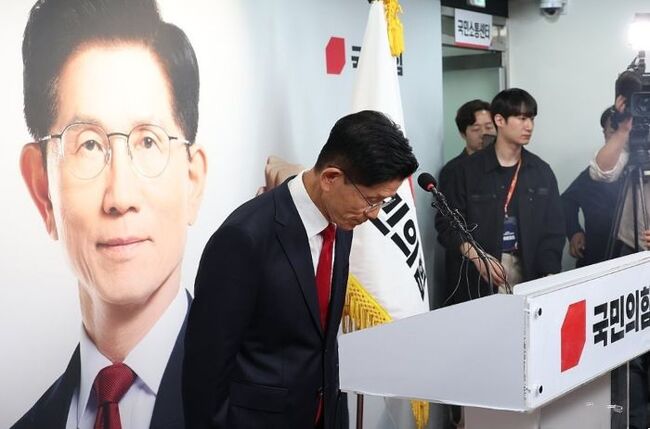 “Too little, too late?…” Kim Moon-soo, who previously conceded his presidential election defeat, now demands a special counsel investigation into ‘allegations of election fraud in the 2025 presidential election’
People Power Party presidential candidate Kim Moon-soo concedes defeat during a press conference at the party headquarters in Yeouido, Seoul, on June 4, 2025. [Joint Press Corps]As allegations emerge
“Too little, too late?…” Kim Moon-soo, who previously conceded his presidential election defeat, now demands a special counsel investigation into ‘allegations of election fraud in the 2025 presidential election’
People Power Party presidential candidate Kim Moon-soo concedes defeat during a press conference at the party headquarters in Yeouido, Seoul, on June 4, 2025. [Joint Press Corps]As allegations emerge
 Stock Market Crash 'Black Tuesday'… KOSPI down 10.8%, KOSDAQ down 7.7%
The KOSPI fell by more than 5% in early trading on the 28th, triggering a sell-side sidecar.On the 28th, the KOSPI plunged by more than 10%.Due to the sharp decline, a sell-side sidecar—a temporary
Stock Market Crash 'Black Tuesday'… KOSPI down 10.8%, KOSDAQ down 7.7%
The KOSPI fell by more than 5% in early trading on the 28th, triggering a sell-side sidecar.On the 28th, the KOSPI plunged by more than 10%.Due to the sharp decline, a sell-side sidecar—a temporary
 [World Heritage Committee] 25 New World Heritage Sites Inscribed in Busan… South Korea Successfully Expands 'Getbol' Listing
The Chairperson of the World Heritage Committee speaks at the plenary session of the 48th session of the World Heritage Committee, held at BEXCO in Busan on the 20th. [Photo: Yonhap News]A total of 25
[World Heritage Committee] 25 New World Heritage Sites Inscribed in Busan… South Korea Successfully Expands 'Getbol' Listing
The Chairperson of the World Heritage Committee speaks at the plenary session of the 48th session of the World Heritage Committee, held at BEXCO in Busan on the 20th. [Photo: Yonhap News]A total of 25
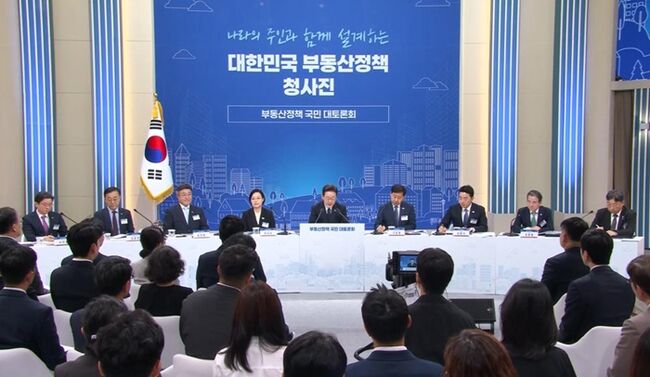 [Liberal Democratic Party Statement] Calling it a Grand Real Estate Debate… It Was Nothing More Than a Private Party Among Themselves
The 'National Grand Debate on Real Estate Policy' held on July 23rd and 27th. [Photo=Yonhap News]The 'National Grand Debate on Real Estate Policy,' hosted by the Lee Jae-myung administration under the
[Liberal Democratic Party Statement] Calling it a Grand Real Estate Debate… It Was Nothing More Than a Private Party Among Themselves
The 'National Grand Debate on Real Estate Policy' held on July 23rd and 27th. [Photo=Yonhap News]The 'National Grand Debate on Real Estate Policy,' hosted by the Lee Jae-myung administration under the
 [Photo] Evidence of Election Fraud Flooding U.S. Media… Trump Had 2.7 Million Votes Stolen
 [Video] U.S. Semiquincentennial Air Show... 'Art in the Sky' streaks across New York
 [Editorial Cartoon] A Draconian Law That Undermines Freedom of Expression

 List
List