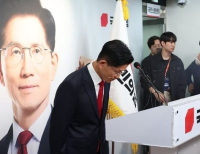
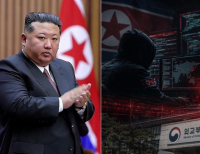
President Lee Jae-myung and Prime Minister Kim Min-seok listen to a report on the Ministry of Economy and Finance's emergency national operation and response status related to the Middle East war at a Cabinet meeting held at the Blue House on March 31. [Photo=Yonhap News]
Following the prolonged Middle East war, President Lee Jae-myung's crisis response remarks have increasingly shifted to strong emergency language.
The President's message, which began with market stabilization and supply chain management, has now expanded to include emergency response systems, wartime supplementary budgets, management of wartime material levels, emergency financial orders, and strict responses to fake information.
The issue is not just the level of intensity. When statements like "inventories are sufficient" and "emergency financial order" are made on the same day, and when the response of investigative agencies is mentioned while discussing living anxieties, the signal received by the public is not stability but an emergency.
This is why it sounds like the language of politics using the crisis, rather than the language of crisis response.
The actual flow of remarks is clear.
At a Cabinet meeting on March 24, President Lee stated that the "expansion and prolongation of the Middle East war" are increasing instability in the supply of oil and natural gas, and that the government must proactively activate an emergency response system. At this meeting, he also ordered preparations assuming "worst-case scenarios" and the swift compilation of a wartime supplementary budget.
Subsequently, at a Cabinet meeting on March 31, he said that while "inventories are sufficient on a national level" for volume-based trash bags, an emergency financial order, as stipulated by the Constitution, could be utilized if necessary. He also instructed that key raw materials such as urea solution, helium, and aluminum be managed strictly at a level "equivalent to wartime materials," and ordered investigative agencies to respond strictly and swiftly to false and fake information related to crisis response.
Within a few days, the President's crisis communication style rapidly expanded from finance and energy to everyday goods and control.
Of course, counterarguments are possible. In a situation where the Middle East war is prolonged and instability in oil prices, exchange rates, and raw material supply overlaps, it is difficult to criticize the President for emphasizing proactive response.
Indeed, on March 24, the government ordered the proactive activation of an emergency response system and preparations for the worst-case scenario, and also outlined the direction for a wartime supplementary budget. In this context, the mention of an emergency financial order on March 31 can also be interpreted as a warning rather than an immediate activation, stating that it "can be utilized if necessary."
However, the issue is not proactive response itself, but the way proactive response is communicated.
If it is proactive response, then it is necessary to first calmly explain what is lacking and what is sufficient, what measures will be taken in what situations, and what the public does not need to worry about.
Yet, the remarks stated that "inventories are sufficient" while mentioning an "emergency financial order," and while explaining issues with everyday goods, also brought up "strict responses to fake information."
In this case, the impression the public receives is closer to a call for emergency powers rather than prepared administration. The symbolism of emergency language has been conveyed more strongly than the substance of proactive response.
Political science has already explained this process.
A prime example is 'securitization.' This theory suggests that when an issue is reframed using the language of security threats, rather than being handled as an ordinary administrative or economic problem, exceptional measures that might seem excessive in peacetime can be easily justified.
Furthermore, the so-called 'rally-round-the-flag effect,' where public opinion temporarily coalesces around a leader as external threats grow, is also an old concept in political science.
'How external crises are framed' always yields political effects. The moment issues of market stability and management of everyday goods are elevated to the language of war and emergency powers, the crisis becomes both an object of response and an asset for governance.
At this point, it is not unreasonable to recall the COVID-19 situation during the left-wing Moon Jae-in administration.
Although the actual risk of infectious diseases existed at the time, there were significant controversies surrounding excessive responses to assembly bans, business restrictions, and vaccine passes, and the limits of state measures became a point of contention in the Constitutional Court and court rulings.
This means that even if a crisis is real, how power expands that crisis with certain language and justifies certain exceptional measures is a separate issue.
Lee Jae-myung's current communication style stands precisely on that boundary.
Above all, the phrase "emergency financial order" is not something that can be casually uttered.
Article 76 of the Constitution stipulates that in cases of internal and external strife, natural calamity, or grave financial or economic crisis, if urgent measures are necessary to maintain national security or public peace and order, and there is no time to wait for the convocation of the National Assembly, the President may issue orders with the force of law concerning the minimum necessary financial or economic measures.
After taking such measures or issuing such orders, the President must report them to the National Assembly without delay and obtain its approval.
The National Archives of Korea explains that the current regulations on emergency orders have a framework that is almost identical to those of the Third Republic's Constitution. It is not unreasonable for many citizens to recall the emergency governance rhetoric of the military government era when this expression is publicly invoked alongside discussions of everyday goods supply.
Direct institutional comparisons should be made cautiously. This does not mean that the current situation is equivalent to a military government.
However, the approach of elevating issues of everyday goods and supply chains to the language of emergency powers, while simultaneously sending signals of information control, is certainly closer to a governance rhetoric reminiscent of the military government era.
The rhetoric of mentioning an emergency financial order while stating that inventories are sufficient, and mobilizing investigative agencies to calm anxieties, sounds like the language of emergency, control, and order maintenance rather than the communication style of a democratic government.
Therefore, rather than reassurance that "the government is managing the situation," the public is more likely to first harbor suspicion about "how far the government intends to politicize the crisis."
Ultimately, what is needed now is more precise explanation, not stronger words.
A counterargument that proactive response is necessary is possible. However, the moment emergency power language is put forward in the name of proactive response, the response begins to be read as politics, not preparation.
A leader who manages a crisis restrains the alarm. Power that exploits a crisis for political gain repeats the alarm.
What the public needs to hear now is the language of trust, not the language of emergency.

 [Statement by the Seo-beo-kka Korea Military Academy Save-the-Nation Comrades Association] ㉛ Recount the Votes Publicly, as the Previous Recount Concealed Election Fraud
Tongyeong Mayoral Election Recount [Photo=Yonhap News]South Korea's liberal democracy is dying. The National Election Commission (NEC) and the judiciary, which have plummeted into criminal syndicates
[Statement by the Seo-beo-kka Korea Military Academy Save-the-Nation Comrades Association] ㉛ Recount the Votes Publicly, as the Previous Recount Concealed Election Fraud
Tongyeong Mayoral Election Recount [Photo=Yonhap News]South Korea's liberal democracy is dying. The National Election Commission (NEC) and the judiciary, which have plummeted into criminal syndicates
 What is the significance of the "Trump 2028" red hats that keep making a comeback?
It is noteworthy that President Donald Trump is "intentionally" fueling controversy over whether he can actually run in the 2028 presidential election, even though it is "highly likely he is seriously
What is the significance of the "Trump 2028" red hats that keep making a comeback?
It is noteworthy that President Donald Trump is "intentionally" fueling controversy over whether he can actually run in the 2028 presidential election, even though it is "highly likely he is seriously
 Jin Cummings: “North Korea says it will increase the number of spies, so what is the government doing?”
U.S. political columnist Gene Cummings has publicly questioned the South Korean government, asking, "North Korea is declaring that it will increase its number of spies, so what is the South Kore
Jin Cummings: “North Korea says it will increase the number of spies, so what is the government doing?”
U.S. political columnist Gene Cummings has publicly questioned the South Korean government, asking, "North Korea is declaring that it will increase its number of spies, so what is the South Kore
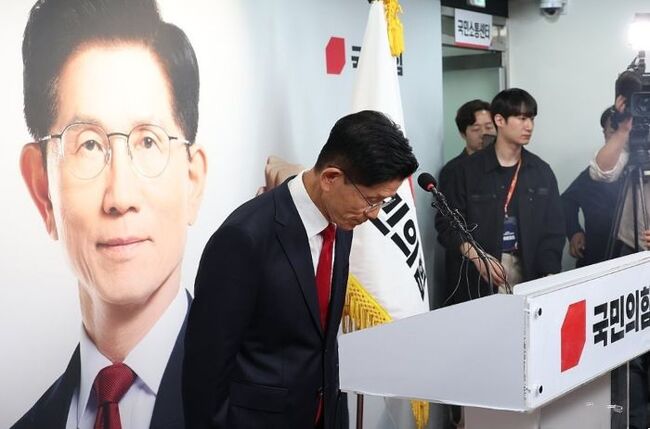 “Too little, too late?…” Kim Moon-soo, who previously conceded his presidential election defeat, now demands a special counsel investigation into ‘allegations of election fraud in the 2025 presidential election’
People Power Party presidential candidate Kim Moon-soo concedes defeat during a press conference at the party headquarters in Yeouido, Seoul, on June 4, 2025. [Joint Press Corps]As allegations emerge
“Too little, too late?…” Kim Moon-soo, who previously conceded his presidential election defeat, now demands a special counsel investigation into ‘allegations of election fraud in the 2025 presidential election’
People Power Party presidential candidate Kim Moon-soo concedes defeat during a press conference at the party headquarters in Yeouido, Seoul, on June 4, 2025. [Joint Press Corps]As allegations emerge
 Stock Market Crash 'Black Tuesday'… KOSPI down 10.8%, KOSDAQ down 7.7%
The KOSPI fell by more than 5% in early trading on the 28th, triggering a sell-side sidecar.On the 28th, the KOSPI plunged by more than 10%.Due to the sharp decline, a sell-side sidecar—a temporary
Stock Market Crash 'Black Tuesday'… KOSPI down 10.8%, KOSDAQ down 7.7%
The KOSPI fell by more than 5% in early trading on the 28th, triggering a sell-side sidecar.On the 28th, the KOSPI plunged by more than 10%.Due to the sharp decline, a sell-side sidecar—a temporary
 [World Heritage Committee] 25 New World Heritage Sites Inscribed in Busan… South Korea Successfully Expands 'Getbol' Listing
The Chairperson of the World Heritage Committee speaks at the plenary session of the 48th session of the World Heritage Committee, held at BEXCO in Busan on the 20th. [Photo: Yonhap News]A total of 25
[World Heritage Committee] 25 New World Heritage Sites Inscribed in Busan… South Korea Successfully Expands 'Getbol' Listing
The Chairperson of the World Heritage Committee speaks at the plenary session of the 48th session of the World Heritage Committee, held at BEXCO in Busan on the 20th. [Photo: Yonhap News]A total of 25
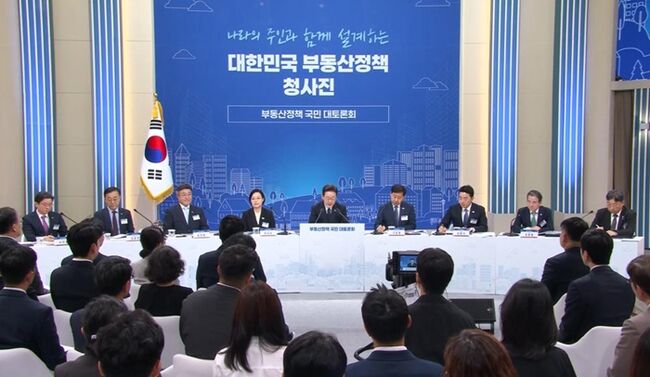 [Liberal Democratic Party Statement] Calling it a Grand Real Estate Debate… It Was Nothing More Than a Private Party Among Themselves
The 'National Grand Debate on Real Estate Policy' held on July 23rd and 27th. [Photo=Yonhap News]The 'National Grand Debate on Real Estate Policy,' hosted by the Lee Jae-myung administration under the
[Liberal Democratic Party Statement] Calling it a Grand Real Estate Debate… It Was Nothing More Than a Private Party Among Themselves
The 'National Grand Debate on Real Estate Policy' held on July 23rd and 27th. [Photo=Yonhap News]The 'National Grand Debate on Real Estate Policy,' hosted by the Lee Jae-myung administration under the
 [Photo] Evidence of Election Fraud Flooding U.S. Media… Trump Had 2.7 Million Votes Stolen
 [Video] U.S. Semiquincentennial Air Show... 'Art in the Sky' streaks across New York
 [Editorial Cartoon] A Draconian Law That Undermines Freedom of Expression

 List
List