Humanity has long called writers 'the salt of the era.'
Writers are creative strategists who diagnose and prescribe the pains and conflicts of their time.
Writers are warriors for the public good, who sensuously detect the contradictions and fissures in society and, sometimes at great personal cost, sublimate the suffering of the masses into language to resolve them. Writers are entertainers who record and interpret facts as they are, and sometimes use the tools of imagination to convey truth without confrontation.
Freedom of expression is a constitutionally guaranteed right.
Therefore, writers are not just novelists or poets, but all those who ask questions and create discourse, such as various columnists, essayists, and commentators.
The position of a writer is where conscience first reacts when society is in turmoil.
The heavier power becomes, and the more silence is enforced, the sharper the writer's pen becomes. A writer's words do not flatter anyone or show off oneself. Through a desperate struggle with oneself, they reveal unseen wounds, pose uncomfortable questions, and make us confront truths that those in power have ignored. This is why humanity has long called writers 'the salt of the era.'
However, we are now witnessing a strange scene of ashes being sprinkled on the salt.
In a society that guarantees freedom of expression, writers who practice that freedom are being shackled invisibly. Furthermore, even diversity in historical interpretation and academic debate are becoming subject to criminal punishment for 'spreading false information.' Freedom of expression is confined within the constitution, narrowing the space for our society to self-reflect.
When writers can speak freely, they can correct the prejudices and misunderstandings of the masses, criticize the self-interest of public figures, and engage in social participation by chastising self-righteous power. When writers' critical engagement with reality is applauded and guaranteed, society can correct its own problems and conflicts.
Silence imposed by shackles is not true peace.
The amendment to the Information and Communications Network Act is scheduled to pass the National Assembly in December of last year, and will be implemented six months after its promulgation. While the Information and Communications Network Act advocates for 'transparency,' it will operate as a surveillance mechanism that stifles critical writing.
If a law becomes a wall that confines the voices of the era rather than a fence that protects the community, it will degrade the present world and civilization into an animal farm, accumulating conflicts and risks that will eventually explode. Silence imposed by shackles is not peace; it is merely an ugly curtain hiding problems with a wave of the hand.
If freedom of expression is the soil that nourishes the writer's intellect, then a writer's engagement with reality is the seed sown on that soil.
If the farmer managing the soil rejects certain seeds of freedom, allowing only a single variety to grow, the soil's immunity will weaken. Similarly, by preventing critical writing, we lose a public asset that allows the community to breathe healthily. Any legal mechanism that narrows freedom of expression blurs the spirit of the times and weakens society's ability to self-correct.
Using the case of writer Kim Gyu-na as an opportunity, we must ensure conditions where writers can speak freely and applaud and support their engagement with reality through writing. Protecting that freedom is the writer's resolve and a temporal mission and responsibility for all of us.
Park Pil-kyu, Columnist

 [Statement by the Seo-beo-kka Korea Military Academy Save-the-Nation Comrades Association] ㉛ Recount the Votes Publicly, as the Previous Recount Concealed Election Fraud
Tongyeong Mayoral Election Recount [Photo=Yonhap News]South Korea's liberal democracy is dying. The National Election Commission (NEC) and the judiciary, which have plummeted into criminal syndicates
[Statement by the Seo-beo-kka Korea Military Academy Save-the-Nation Comrades Association] ㉛ Recount the Votes Publicly, as the Previous Recount Concealed Election Fraud
Tongyeong Mayoral Election Recount [Photo=Yonhap News]South Korea's liberal democracy is dying. The National Election Commission (NEC) and the judiciary, which have plummeted into criminal syndicates
 What is the significance of the "Trump 2028" red hats that keep making a comeback?
It is noteworthy that President Donald Trump is "intentionally" fueling controversy over whether he can actually run in the 2028 presidential election, even though it is "highly likely he is seriously
What is the significance of the "Trump 2028" red hats that keep making a comeback?
It is noteworthy that President Donald Trump is "intentionally" fueling controversy over whether he can actually run in the 2028 presidential election, even though it is "highly likely he is seriously
 Jin Cummings: “North Korea says it will increase the number of spies, so what is the government doing?”
U.S. political columnist Gene Cummings has publicly questioned the South Korean government, asking, "North Korea is declaring that it will increase its number of spies, so what is the South Kore
Jin Cummings: “North Korea says it will increase the number of spies, so what is the government doing?”
U.S. political columnist Gene Cummings has publicly questioned the South Korean government, asking, "North Korea is declaring that it will increase its number of spies, so what is the South Kore
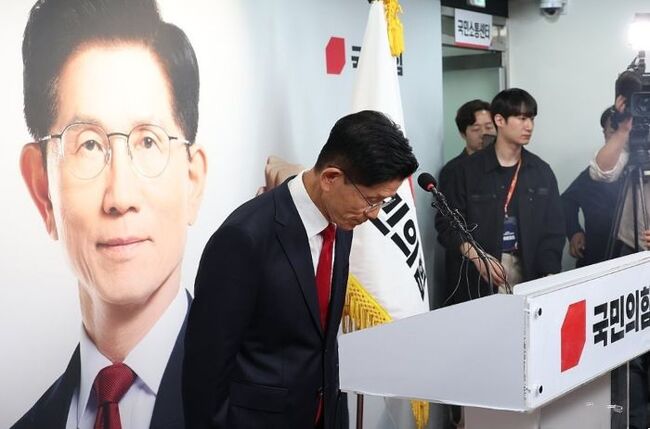 “Too little, too late?…” Kim Moon-soo, who previously conceded his presidential election defeat, now demands a special counsel investigation into ‘allegations of election fraud in the 2025 presidential election’
People Power Party presidential candidate Kim Moon-soo concedes defeat during a press conference at the party headquarters in Yeouido, Seoul, on June 4, 2025. [Joint Press Corps]As allegations emerge
“Too little, too late?…” Kim Moon-soo, who previously conceded his presidential election defeat, now demands a special counsel investigation into ‘allegations of election fraud in the 2025 presidential election’
People Power Party presidential candidate Kim Moon-soo concedes defeat during a press conference at the party headquarters in Yeouido, Seoul, on June 4, 2025. [Joint Press Corps]As allegations emerge
 Stock Market Crash 'Black Tuesday'… KOSPI down 10.8%, KOSDAQ down 7.7%
The KOSPI fell by more than 5% in early trading on the 28th, triggering a sell-side sidecar.On the 28th, the KOSPI plunged by more than 10%.Due to the sharp decline, a sell-side sidecar—a temporary
Stock Market Crash 'Black Tuesday'… KOSPI down 10.8%, KOSDAQ down 7.7%
The KOSPI fell by more than 5% in early trading on the 28th, triggering a sell-side sidecar.On the 28th, the KOSPI plunged by more than 10%.Due to the sharp decline, a sell-side sidecar—a temporary
 [World Heritage Committee] 25 New World Heritage Sites Inscribed in Busan… South Korea Successfully Expands 'Getbol' Listing
The Chairperson of the World Heritage Committee speaks at the plenary session of the 48th session of the World Heritage Committee, held at BEXCO in Busan on the 20th. [Photo: Yonhap News]A total of 25
[World Heritage Committee] 25 New World Heritage Sites Inscribed in Busan… South Korea Successfully Expands 'Getbol' Listing
The Chairperson of the World Heritage Committee speaks at the plenary session of the 48th session of the World Heritage Committee, held at BEXCO in Busan on the 20th. [Photo: Yonhap News]A total of 25
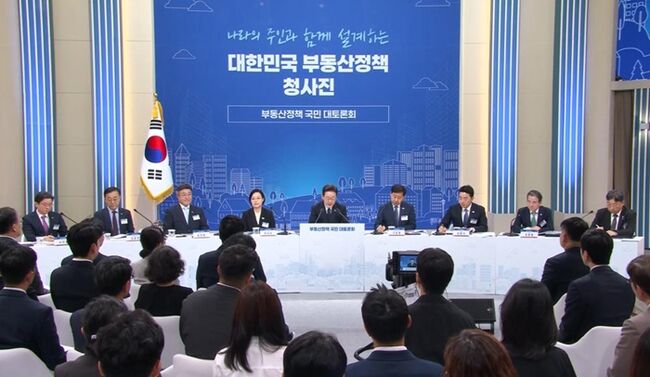 [Liberal Democratic Party Statement] Calling it a Grand Real Estate Debate… It Was Nothing More Than a Private Party Among Themselves
The 'National Grand Debate on Real Estate Policy' held on July 23rd and 27th. [Photo=Yonhap News]The 'National Grand Debate on Real Estate Policy,' hosted by the Lee Jae-myung administration under the
[Liberal Democratic Party Statement] Calling it a Grand Real Estate Debate… It Was Nothing More Than a Private Party Among Themselves
The 'National Grand Debate on Real Estate Policy' held on July 23rd and 27th. [Photo=Yonhap News]The 'National Grand Debate on Real Estate Policy,' hosted by the Lee Jae-myung administration under the
 [Photo] Evidence of Election Fraud Flooding U.S. Media… Trump Had 2.7 Million Votes Stolen
 [Video] U.S. Semiquincentennial Air Show... 'Art in the Sky' streaks across New York
 [Editorial Cartoon] A Draconian Law That Undermines Freedom of Expression

 List
List