 U.S. President Donald Trump [Photo = Yonhap News]
Table of Contents
Prologue
Why Does This War Look Different?
Chapter 1: Why Did the War Start?
Chapter 2: How Did the War Start?
Chapter 3: Why Did the War Seem to Stop?
Chapter 4: Why Were Nuclear Facilities Left Behind?
Chapter 5: Same War, Different Calculations
Chapter 6: What Does Negotiation Change?
Chapter 7: The Moment Negotiations Break Down
Chapter 8: How Does Act III Begin?
Chapter 9: The Significance of Power Grid Strikes
Chapter 10: Why Do Oil and Energy Facilities Become the Next Target?
Chapter 11: What Does the Revolutionary Guard Choose?
Chapter 12: What Do Saudi Arabia and Israel Gain?
Chapter 13: What is Victory According to the United States?
Chapter 14: Conclusion – Where Does This War End?
Prologue This war looks strange. There were strong airstrikes, but they didn't immediately escalate into full-scale war, and while nuclear facilities were at the center of the conflict, they weren't dismantled all at once.
It appears to have paused, but it hasn't actually stopped. Negotiations seem to be ongoing, yet the shadow of the next phase is also darkening. Therefore, the core question of this war is not simple. It's not about whether the war continues, but rather about the way it is heading towards its end. This report begins with that question. Why did the war start now, why does it seem to have stopped, why were nuclear facilities left intact, and what options actually remain between negotiation and Act III?
Although it appears to have two paths, a war always moves according to the number of remaining options. What is happening in the Middle East now is precisely the process of those options rapidly decreasing. |
Chapter 10. Why Do Oil and Energy Facilities Become the Next Target?
If power grids halt cities, oil facilities halt nations.
Energy is the regime's lifeline and survival line.
The greatest pressure is the disruption of production and exports, not military facilities.
While striking power grids is a means to disrupt urban functions and the daily operations of a regime, targeting oil and energy facilities is closer to undermining the very foundation of a nation's survival.
If electricity disrupts the rhythm of daily life, then oil, gas, storage, and export facilities cut into the time a nation can endure. This is especially true for countries like Iran, where energy production and exports are central to maintaining the regime.
The Iranian economy is structurally dependent on energy. Crude oil and gas are not merely export items but are central to foreign currency inflows, and they are the last pillar that allows the regime to secure minimal financial space even under sanctions.
Therefore, the shaking of energy infrastructure does not simply mean the destruction of some production facilities. It means that the financial time available for the regime to survive is reduced.
In this regard, oil and energy facilities can have a much more direct strategic effect than military facilities. Attacking missile bases reduces military response capabilities, and disrupting power grids paralyzes urban functions.
However, when oil facilities, storage facilities, and export terminals are shaken, the nation's finances, industry, logistics, and foreign exchange flows are all destabilized simultaneously. The regime may be able to withstand military pressure, but it will face much faster economic pressure.
Actual cases have repeatedly confirmed this effect.
When Saudi Aramco facilities were attacked in 2019, supply disruptions were quickly restored, but the market reacted immediately. Even though only a few facilities were shaken, international oil prices surged, highlighting the vulnerability of the entire energy supply chain.
This demonstrates that oil facilities are not just industrial facilities but strategically central assets. It is not the destruction of a single facility, but the 'supply uncertainty' that facility symbolizes that shakes the world.
In Iran's case, the symbolic and actual effects are even greater.
Hubs like Abadan, Bandar Abbas, and Assaluyeh are not just production bases but are central pillars of Iran's energy flow.
Abadan possesses both symbolic significance and production capacity. Bandar Abbas is a gateway for exports and logistics connected to Hormuz, and Assaluyeh is a key hub for gas and petrochemicals.
These facilities are important individually, but together they are close to the lifeline of the Iranian economy.
The reason these facilities are emerging as the next targets is clear.
If power grid strikes shake the regime's functions, strikes on energy infrastructure shake the regime's ability to sustain itself.
With limited oil, gas, storage, and export capabilities, Iran's internal economic operations and its negotiating power externally can both weaken. As the regime's breathing room shrinks, the "endurance" strategy becomes more expensive.
Ultimately, this also influences the decision of whether to continue military responses or lean towards negotiation.
Another important point is that oil and energy facilities yield more tangible economic results than power grids.
Power instability quickly fuels discontent and chaos, but attacks on oil facilities lead to visible losses in production and exports. This affects not only domestic politics but also external finances, military funding, and import capabilities.
If power grids increase the regime's perceived costs, energy facilities increase the regime's calculation costs.
However, this phase does not immediately imply total destruction.
Oil and energy infrastructure can also be shaken selectively. The intensity of the pressure varies depending on which point is targeted among storage facilities, refining capacity, port logistics, export terminals, and pipeline systems.
In this regard, attacks on energy facilities can also be a controllable tool, similar to airstrikes.
The fact that these targets do not carry the same significant political taboos as nuclear facilities, while exerting much more direct pressure than military facilities, makes them a more realistic objective.
At this stage, the nature of the war becomes clearer.
The goal is no longer to reduce the opponent's military capabilities but to make it impossible for the opponent to continue enduring the war.
When power grids shake the regime's daily life and oil facilities shake its financial lifeline, the war is no longer an external conflict. It shifts to a situation where the entire nation must recalculate.
Ultimately, the reason oil and energy facilities become the next target is simple.
They can create the greatest systemic costs with the least military intervention.
Without occupation, a nation can be pressured. The risk of international disaster is relatively low compared to nuclear facilities, and it can shake both markets and finances simultaneously.
This is why the logic of Act III continues from power grids to energy facilities.
Now, only one question remains.
Who is the group that makes the actual decisions amidst all this pressure?
Ultimately, the side making the final judgment between enduring and trading is likely not the official Iranian government, but a group located deeper within.
 Logo of the Islamic Revolutionary Guard Corps of Iran. [Photo = Telegram Capture]
Chapter 11. What Does the Revolutionary Guard Choose?
The final decision in war is made from deeper within than the government.
The Revolutionary Guard is closer to the reality of power than a military force.
The choice between endurance and trade is a calculation for survival.
Iran's official government has a diplomatic face.
However, if asked where the direction of the war is actually decided, the answer must go much deeper. In Iran, the final decision is not solely explained by the presidential office or the foreign affairs authorities. The actual weight of decision-making lies closer to the Revolutionary Guard.
The reason this is important is clear: the Revolutionary Guard is not simply a military organization. If it were just a group with military power, the war would be relatively simple. However, the Revolutionary Guard is an organization that combines military, intelligence, economic, and internal control functions.
In other words, in Iran, the Revolutionary Guard is not just a group with "force" but is closer to the operational mechanism that actually sustains the regime.
This is why its criteria for viewing the war differ from those of a general government.
While the official government gives greater weight to economic sanctions, diplomatic pressure, and international public opinion, the Revolutionary Guard looks more directly at regime maintenance, internal control, and long-term survival prospects.
For them, war is not a diplomatic issue but a matter of power preservation. Therefore, the criteria for choice are simple: can we endure in the current state, or will we give up some things to protect the whole?
The first option is endurance.
This option is familiar. Iran has maintained its regime for a long time by enduring sanctions and pressure. This involves controlling the pace of nuclear development, converting external pressure into internal cohesion, and using the Strait and proxy networks as leverage.
From the Revolutionary Guard's perspective, as long as this strategy is perceived to be working, there is no reason to easily concede. Especially since they view the nuclear program as a security safeguard, excessive concessions could be seen as disarming themselves.
The second option is trade.
However, this trade is different from surrender. If the Revolutionary Guard accepts negotiations, it will only be on the premise that regime survival is guaranteed.
In other words, even if some nuclear material is relinquished or inspections are accepted, trade becomes a realistic option if the organization's economic power, internal control, and the basic form of the regime can be maintained.
The easing of sanctions is also important here. If sanctions are lifted, the Revolutionary Guard will not just see an improved economy but will regain the funding and time needed to sustain the organization.
Ultimately, their choice is closer to self-interest than ideology.
The reason the Revolutionary Guard appears hardline is not because they are radical, but because they are the group most sensitive to the survival of the regime and the organization. And precisely because of this, there is a possibility that the most hardline group may, at some point, choose the most pragmatic trade.
They endure when they can, but the moment they deem they can no longer endure, they may rapidly change their calculations.
The problem is that the criteria for that judgment may seem slow to outsiders.
Even if power grids are shaken, energy facilities are pressured, and the variables of the Strait begin to weigh heavily, the Revolutionary Guard may not back down immediately. They prioritize long-term survival over short-term shocks. Therefore, a certain level of damage can be considered an acceptable cost.
However, if that damage begins to shake internal control, cash flow, and the command structure of the organization simultaneously, the story changes.
This is where the real turning point of the war occurs.
From the outside, it appears as "Will Iran negotiate or endure?" but in reality, it is a question of "Does the Revolutionary Guard still believe it can endure, or does it feel that trading is cheaper?"
The moment this judgment changes, the nature of the war also changes. Both the resurgence of negotiations and the full-scale progression of Act III are ultimately linked to this point.
Therefore, the final choice in this war is closer to the calculations of the Revolutionary Guard than to the language of the official government.
And where those calculations lean depends not on the intensity of external pressure, but on how quickly the cost of endurance rises.
When power, energy, internal control, and financial lifelines are all shaken simultaneously, the Revolutionary Guard can no longer view the war solely as a matter of ideology.
What remains now is the external perspective.
If the final decision is made within Iran, what do outsiders gain?
Especially Saudi Arabia, Israel, and the United States are likely to reap different benefits from the end of this war.
 Composite of Israeli and Saudi Arabian flags.
Chapter 12. What Do Saudi Arabia and Israel Gain?
It's the same war, but their desired outcomes differ.
Israel wants to delay the time of threat.
Saudi Arabia looks beyond Iran's weakening to the subsequent order.
This war can easily be seen as a conflict solely between the United States and Iran. However, it is also a process of reconfiguring the balance of power in the entire Middle East.
In particular, Saudi Arabia and Israel are likely to face the greatest strategic changes depending on the unfolding and outcome of this war. The problem is that both countries are looking at the same war but do not desire the same outcome.
Israel's objective is relatively clear.
It is to push back the timeline of the nuclear threat as far as possible. For Israel, Iran's nuclear issue is not merely a negotiation subject. Regardless of whether it actually possesses nuclear weapons, the mere existence of a state that can transition to their possession at any time is perceived as a security threat.
Therefore, Israel is closer to the expression "delaying or eliminating the actualization of the threat" than "managing the threat."
Past precedents also show this direction. The 1981 bombing of the Osirak nuclear reactor and the 2007 bombing of a Syrian nuclear facility were both choices aimed at buying time before the opponent completed its nuclear capabilities.
In this war as well, from Israel's perspective, it can expect the effect of pushing back the time for Iran's nuclear program to reach completion. Whether it's the recovery of nuclear material, a halt in enrichment, or a limitation on facility functions, any form of speed reduction buys Israel strategic time.
Another effect is pressure on the regional proxy network.
If Iran faces military and economic pressure, its network of proxies such as Hezbollah, the Houthis, and Iraqi Shiite militias will inevitably feel the strain. This has the effect of temporarily reducing the intensity of direct military threats to Israel.
In other words, this war can bring Israel the ancillary benefit of weakening Iran's regional influence, not just addressing the nuclear issue.
Conversely, Saudi Arabia's calculations differ from Israel's.
Saudi Arabia also does not want Iran to possess nuclear weapons. However, what Saudi Arabia desires is a state of controllable weakening rather than Iran's complete collapse.
This is because if Iran completely collapses, the balance in the Middle East will be shaken, potentially leading to greater instability. Saudi Arabia is closer to viewing the current war as an opportunity for "reordering the order" rather than "eliminating a threat."
In this regard, the first benefit Saudi Arabia gains is price.
As tensions rise in the Middle East, oil prices face upward pressure. Even if actual supply disruptions are limited, the price moves first the moment a risk premium is added.
For countries like Saudi Arabia, whose energy exports are a significant proportion, this can translate into short-term fiscal gains. In the past, during the 2019 Aramco facility attack, production disruptions were quickly restored, but the market immediately raised prices and reflected the uncertainty. A similar mechanism is likely to operate in the current situation.
However, price is not all that Saudi Arabia gains.
More important is the change in its position within the Middle East. As Iran faces military and economic pressure, Saudi Arabia can relatively emerge as a more stable central country.
If the flow of the U.S. stepping back from directly designing and maintaining order and demanding greater roles from regional powers strengthens, Saudi Arabia is likely to become a key country to fill that vacuum.
In this case, this war serves not just as a military conflict but as an opportunity to elevate Saudi Arabia's standing.
In particular, the optimal outcome desired by Saudi Arabia is clear.
Iran's nuclear capabilities are practically constrained, the Strait variable is weakened, and at the same time, the regime does not completely collapse. In this scenario, Saudi Arabia can avoid the chaos of a full-scale war, reduce its rival Iran's influence, and position itself as the central country of the Middle East.
In this sense, Saudi Arabia can be seen as a country more interested in the "post-war arrangement" than in "victory in war."
Ultimately, even though it is the same war, the benefits reaped by Israel and Saudi Arabia differ.
Israel gains time, and Saudi Arabia gains position.
While Israel is more sensitive to delaying the actualization of the threat, Saudi Arabia is more sensitive to where the center of the Middle East shifts afterward.
This is why this war appears not just as a military conflict but as a process of reconfiguring the Middle Eastern order.
And all these external interests ultimately meet with America's calculations.
What can the United States call victory at the end of this war?
That question will be addressed in the next chapter.
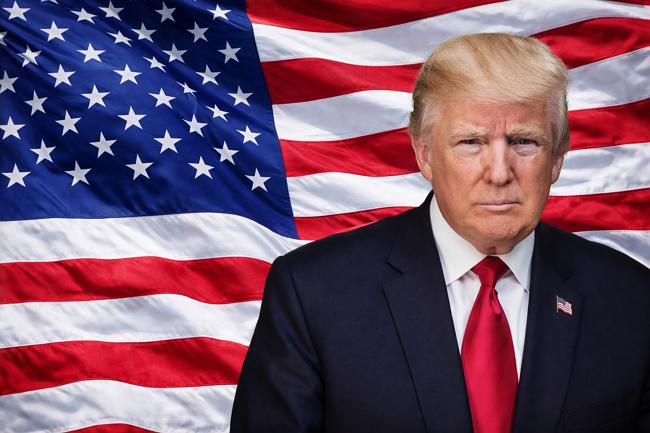 Composite of the American flag and U.S. President Donald Trump.
Chapter 13. What is Victory According to the United States?
Victory is not occupation, but outcome.
Costs must be controlled for it to be a political victory.
Trump-style wars prioritize연출 (stage management/연출) over conclusion.
Wars are interpreted differently even for the same outcome.
Some countries say victory means capturing the enemy's capital, while others consider reducing the opponent's capabilities to a certain level sufficient.
The victory the United States can claim from this war is quite different from the traditional meaning of victory. It is not regime change, not territorial acquisition, and certainly not long-term occupation. The victory the United States seeks in this war is much narrower, and at the same time, more political.
The first clear point is that what the United States seeks to gain from this war is not "complete destruction" but a controllable outcome.
If nuclear capabilities are no longer maintained at their current level, threats to control of the Strait are weakened, and Iran finds it difficult to endure in the same way as before, the United States can present this as an achievement.
In other words, the success or failure of the war is evaluated not by how much was destroyed, but by how much the opponent's behavior was changed.
This concept of victory comes from the opposite side of the failures the United States has experienced.
The Iraq War ended quickly militarily, but it left a long and heavy political burden. Afghanistan also allowed for regime removal, but the subsequent cost of maintenance swallowed up the war itself.
The lesson learned by the United States after these experiences is clear: occupation does not guarantee victory, and sometimes the moment of ending a war is more dangerous than the moment of starting it.
Therefore, the victory in this war must be defined differently from the outset.
The most important criterion is cost. This includes not only military costs but also political costs, market costs, and alliance management costs.
If ground troops are deployed, long-term occupation begins, oil prices skyrocket beyond control, and allies begin to waver, the war, even if militarily successful, is politically close to failure.
Conversely, if visible results are secured with limited means and the scope of the war can be controlled, the United States can call it victory.
In this sense, this war is one where "outcomes that can appear as victory" are more important than "victory."
This characteristic becomes even clearer when considering the political style of U.S. President Trump.
What Trump wants is not a complex strategic concept itself, but an outcome that the public can immediately understand. "Nuclear material has been recovered," "inspections have resumed," "the Strait is open," "the U.S. did not occupy," "U.S. military casualties were minimized." Achievements that can be summarized in such sentences are needed.
For this reason, American victory does not necessarily coincide with military conclusion.
Even if the war does not completely end, or if tensions remain at a certain level, the U.S. can declare that "the objectives have been achieved."
In reality, in modern warfare, conclusions are often determined by political narrative rather than military fact. Even if there are a few more bombings, or if negotiations are not complete, the moment it is judged that the opponent's actions are more restricted than before and the risks have been reduced to a manageable level, the U.S. can draw a political semicolon to the war.
Here, the interests of Saudi Arabia and Israel also intersect with America's victory narrative.
If Israel can delay the time of the nuclear threat, and Saudi Arabia can gain Iran's weakening and an elevated position in the Middle East, the U.S. can frame the outcome as "alliances have become safer."
This can be used not only as a Middle East achievement but also as a message to showcase America's ability to maintain global order.
The market can also support this narrative.
If oil prices stabilize within a certain range, the Strait does not face complete blockade, and the risk premium remains at a manageable level, the U.S. can claim to have "maintained order" from an economic perspective as well.
The fact that the war did not completely destroy the market itself becomes an achievement.
The problem is that such a victory is not complete.
The Iranian regime may remain, the Revolutionary Guard may not easily disappear, and the nuclear issue may not be completely resolved.
However, from the U.S. perspective, this may not be a fatal flaw. If the objective of this war was always to manage risks rather than regime elimination, then incomplete control can actually be the form of a realistic victory.
Ultimately, the victory the U.S. speaks of is simple.
To secure visible results while controlling costs.
To limit nuclear capabilities without completely dismantling the opponent,
to lower Strait risks, and to reduce allies' anxieties,
and simultaneously avoid deep U.S. military involvement,
The U.S. can say that is enough.
Therefore, the end of this war is likely not a "complete conclusion."
Rather, a more realistic picture is this:
The war stops at a certain level, the outcome is politically confirmed, and the U.S. calls it victory.
This is because victory in modern times is sometimes defined not by a perfect resolution, but by avoiding the most expensive failures and achieving the most visible results.
Now, only one thing remains.
Where, then, does all this flow converge?
Negotiations and Act III, markets and order, Saudi Arabia and Israel, and America's victory narrative must eventually meet at one point and come to a conclusion.
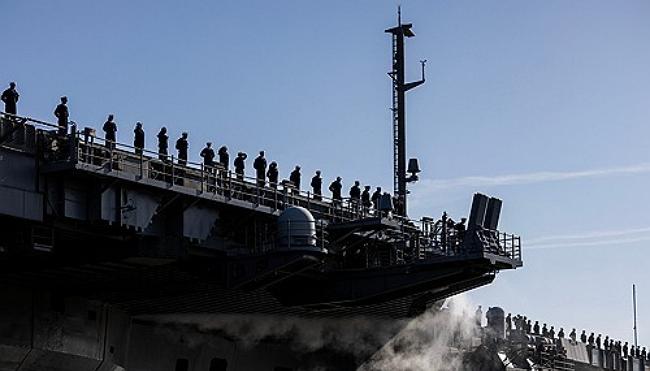 According to reports from the U.S. Wall Street Journal (WSJ) and the Associated Press on March 31 (local time), the Nimitz-class aircraft carrier USS George H.W. Bush and its escort group departed from Norfolk Naval Base, Virginia, and headed for the Middle East. [Photo = Yonhap News]
Chapter 14. Conclusion – Where Does This War End?
The war appears to have two paths, but its end narrows to one.
Negotiations are alive, but they cannot stop the war on their own.
Ultimately, the question remains: "In what way does it stop?"
This war carried two possibilities from the outset.
One is negotiation. A path leading to the recovery of nuclear material, restoration of inspections, adjustment of sanctions, and management of tensions.
The other is Act III. A phase that moves towards directly targeting the power grid and energy infrastructure, the regime's functions, and its ability to sustain itself.
Superficially, both are open. The reason this war has seemed to pause until now is precisely because both of these paths were simultaneously alive.
However, a war moves not by the number of possibilities, but by the number of remaining options.
What is actually sustainable is more important than what is theoretically possible. In this regard, the outcome of this war has narrowed considerably from the beginning.
Negotiations are clearly alive. The U.S. does not want full occupation, and Iran cannot afford regime collapse. Saudi Arabia and surrounding countries also do not desire prolonged instability. Oil prices and financial markets also prefer a manageable conclusion.
All these factors leave negotiation as a realistic option.
The problem lies in the difference between negotiation being "rational" and it actually "being established."
This negotiation is not a simple ceasefire or de-escalation.
It requires the simultaneous alignment of four pillars: the handling of nuclear material, international inspections, sanctions adjustments, and regime security guarantees.
However, these four, while interlocking, also conflict with each other. Iran cannot give up too much nuclear material while trying to protect its regime, and the U.S. needs visible concessions to explain its achievements. The Revolutionary Guard is likely to endure as long as it can, and Israel may lean towards stronger elimination logic as time goes on.
Negotiations are alive, but the threshold for them is continuously rising.
What changes the direction of the war at this point is not will, but conditions.
A full strike on nuclear facilities is limited due to radiation concerns, and ground troop deployment is excluded due to costs. Current limited airstrikes alone are difficult to produce decisive results, and instability in the Strait continues to agitate markets and energy order.
When all these conditions converge, the war naturally seeks a different objective. That objective becomes the power grid, oil and energy facilities, and the very functions of the regime that enable command and control.
This is where the significance of Act III becomes clear.
Act III is not the war initially desired, but a path that becomes more realistic as other options weaken.
If nuclear facilities must be left intact for negotiations to be possible, ground troops cannot be deployed, and striking only military facilities is insufficient to change the opponent's calculations, then the only remaining method is to increase the costs for the entire regime.
Cutting off power, shaking the energy lifeline, and changing the Revolutionary Guard's calculation for endurance. This is the essence of Act III.
This does not mean that negotiation is meaningless.
In fact, negotiations are likely to remain alive until the very end.
However, such negotiations are closer to an option that gains realism only after sufficient pressure has been applied, rather than a force that stops the war beforehand.
In other words, in this war, negotiation is not the starting point but the outcome. The war does not replace negotiation; rather, the war creates the conditions under which negotiation can be established.
Therefore, the true conclusion of this war should not be viewed as a simple binary choice between "negotiation or Act III."
A more accurate question is this: Does negotiation stop the war, or does a result that resembles negotiation emerge only at the threshold of Act III?
This difference is significant. If the former is managed termination, the latter is a late termination achieved after deep pressure. Based on the flow so far, the latter is gaining more weight.
Iran's default is to endure, and the U.S. cannot afford a retreat without results.
Israel is likely to be eager to eliminate the threat, and Saudi Arabia is looking at the order of the Middle East after Iran's weakening.
The market has already priced the direction of risk.
When all these flows are synthesized, we approach the conclusion that the war is open to negotiation but will not be closed solely by simple negotiation. Negotiations, if they occur, are likely to be in a form that holds meaning only after sufficient pressure.
Ultimately, this war is likely to end in this way:
Without immediately destroying nuclear facilities, by pressuring the regime's overall functions and sustainability, and at some point, the handling of nuclear material, inspections, sanctions adjustments, and regime maintenance become tied together in a late transaction.
In other words, the war can end in negotiation, but that negotiation may be closer to a result created after passing the threshold of Act III, rather than the soft exit initially anticipated.
Therefore, the only remaining question now is:
It is not whether the war stops. It is after what level of cost it stops.
The end of this war is already roughly visible.
However, what remains is whether that end comes first under the name of negotiation, or after experiencing the pressure of Act III, it earns the same name.

 Iranian Foreign Ministry: "Continuing Message Exchanges with the U.S. and Activities of Mediating Countries"
Esmaeil Baghaei, Spokesperson for the Iranian Ministry of Foreign Affairs [Xinhua, Yonhap News file photo]Esmaeil Baghaei, spokesperson for the Iranian Ministry of Foreign Affairs, stated on the 26th
Iranian Foreign Ministry: "Continuing Message Exchanges with the U.S. and Activities of Mediating Countries"
Esmaeil Baghaei, Spokesperson for the Iranian Ministry of Foreign Affairs [Xinhua, Yonhap News file photo]Esmaeil Baghaei, spokesperson for the Iranian Ministry of Foreign Affairs, stated on the 26th
 President Yoon: "Do You Think You Are Safe from the Special Counsel?"... Final Statement Video Released
President Yoon Suk Yeol rebuking the special prosecutor on the 24th. [Court video / @birds_justice X account subtitle GIF] A video of President Yoon Suk Yeol's closing statement at his trial rega
President Yoon: "Do You Think You Are Safe from the Special Counsel?"... Final Statement Video Released
President Yoon Suk Yeol rebuking the special prosecutor on the 24th. [Court video / @birds_justice X account subtitle GIF] A video of President Yoon Suk Yeol's closing statement at his trial rega
 President Yoon, regarding the first-instance ruling on the Public Official Election Act: “An excessive political verdict that distorts the facts… We will appeal immediately.”
The first-instance sentencing hearing for President Yoon Suk Yeol regarding violations of the Public Official Election Act is being broadcast live at Seoul Station on the 27th. [Photo=Yonhap News]Pres
President Yoon, regarding the first-instance ruling on the Public Official Election Act: “An excessive political verdict that distorts the facts… We will appeal immediately.”
The first-instance sentencing hearing for President Yoon Suk Yeol regarding violations of the Public Official Election Act is being broadcast live at Seoul Station on the 27th. [Photo=Yonhap News]Pres
 WSJ: "SK Hynix ADR Premium Is a Sign of AI Trading Overheat"
Advertisement for SK Hynix ADR listing in New York's Times Square [Reuters=Yonhap News file photo]The Wall Street Journal (WSJ) has pointed out that the price of SK Hynix’s American Depositary Recei
WSJ: "SK Hynix ADR Premium Is a Sign of AI Trading Overheat"
Advertisement for SK Hynix ADR listing in New York's Times Square [Reuters=Yonhap News file photo]The Wall Street Journal (WSJ) has pointed out that the price of SK Hynix’s American Depositary Recei
 'Godfather of Japanese Mystery Novels' Keigo Higashino Passes Away After Battle with Cancer at 68
Famous Japanese mystery novelist Keigo Higashino [AFP=Yonhap News]It has been belatedly reported that Keigo Higashino, the "godfather of Japanese mystery novels" and author of bestsellers such as "The
'Godfather of Japanese Mystery Novels' Keigo Higashino Passes Away After Battle with Cancer at 68
Famous Japanese mystery novelist Keigo Higashino [AFP=Yonhap News]It has been belatedly reported that Keigo Higashino, the "godfather of Japanese mystery novels" and author of bestsellers such as "The
 [Park Pil-kyu Security Column] To the Ignorant Trying to Clothe a Beast in Sheep's Clothing
Rep. Kim Byung-joo of the Democratic Party of Korea [Photo=Yonhap News]“The Air Force Academy doesn't teach you how to fly a plane!” “The Army, Navy, and Air Force academies are exactly the
[Park Pil-kyu Security Column] To the Ignorant Trying to Clothe a Beast in Sheep's Clothing
Rep. Kim Byung-joo of the Democratic Party of Korea [Photo=Yonhap News]“The Air Force Academy doesn't teach you how to fly a plane!” “The Army, Navy, and Air Force academies are exactly the
 [Issue Diagnosis] Two Effects of the Election Petition Review
 [Photo] Evidence of Election Fraud Flooding U.S. Media… Trump Had 2.7 Million Votes Stolen
 [Video] U.S. Semiquincentennial Air Show... 'Art in the Sky' streaks across New York
 [Editorial Cartoon] A Draconian Law That Undermines Freedom of Expression

 List
List









