An effort by President Trump to change the policy of birthright citizenship, one of his most ambitious initiatives, is set to face a significant hurdle on Wednesday (April 1) at the Supreme Court.
Just over a month after the Supreme Court struck down the core of his tariff policy, there is growing interest in whether it will again tie the hands of the Trump administration’s policies.
The Supreme Court is expected to decide whether President Trump’s attempt to prevent children of undocumented immigrants born on U.S. soil from automatically gaining citizenship falls within his authority. This is considered one of the most important cases before the Supreme Court.
Mike Davis, a strong supporter of Donald Trump and founder of the judicial advocacy group Article III Project, told The Washington Post, "It's a clear red line for the justices that you can't just strip away citizenship. They don't have that authority," adding, "Our people have never agreed to give this away."
He added, "These justices have to follow the law. Otherwise, they will lose their legitimacy," and stated, "There is no more important case pending before the Supreme Court."
Trump wrote angrily last month on Truth Social, "Our incompetent Supreme Court has done a great job for the wrong people, and for that they should be ashamed of themselves (except for the 'great 3'!)." He added, "Soon they will rule in favor of other countries like China, who are making a fortune through the birthright citizenship system."
He emphasized on Truth Social on Tuesday (31st), "Birthright citizenship applies to the children of slaves, not to a Chinese billionaire with 56 children 'acquiring' all of them as American citizens." He declared, "This is one of the many great scams of our time!"
President Trump considered abolishing the birthright citizenship system during his first term, but it ultimately did not come to fruition. At the time, many conservative legal scholars expressed deep skepticism about whether he could eliminate birthright citizenship for undocumented immigrants with a single signature.
Some have reacted with surprise, saying, "It is somewhat surprising that the Supreme Court is taking up this case for substantive review." This implies that the ruling is too obvious.
The 14th Amendment states, "All persons born or naturalized in the United States, and subject to the jurisdiction thereof, are citizens of the United States and of the State wherein they reside."
Trump's side has focused on the word "jurisdiction," arguing that undocumented immigrants do not precisely fall under U.S. jurisdiction. They also referred to the Supreme Court's 1884 ruling in Elk v. Wilkins, which stated that birthright citizenship was not guaranteed to the children of Native Americans.
In their lawsuit filings, Trump's legal team argued, "Historical evidence, particularly from the critical period immediately preceding ratification, shows that the children of temporary sojourners or those residing unlawfully are not 'subject to' the 'jurisdiction' of the United States."
Congress passed the Nationality Act of 1940 to grant citizenship to Native American children.
Proponents of the executive order argue that the 1940 Nationality Act supports the claim that there are more gray areas in the 14th Amendment. Opponents, however, argue that President Trump is violating both the Constitution and the Nationality Act.
The Supreme Court is reviewing whether President Trump's executive order complies with both the relevant laws and the 14th Amendment.
The Supreme Court also addressed the citizenship of a man born to Chinese immigrant parents in the 1898 case United States v. Wong Kim Ark. The Supreme Court ruled in his favor, stating that nearly all U.S.-born children automatically acquire citizenship, with a few exceptions such as the children of foreign sovereigns, diplomats, and hostile foreign invaders.
Given that China's standing at the time was completely different from its current position, and the precedent mentioned exceptions, it is unlikely to have a significant impact.
However, some legal experts believe that the biggest obstacle in President Trump's efforts to abolish birthright citizenship for undocumented immigrants is the fact that he used an executive order to terminate it.
Davis argued, "There is absolutely no possibility that the clear language or original public meaning of the 14th Amendment intended to grant birthright citizenship to those residing unlawfully."
He asks, "Invading armies do not get birthright citizenship. The children of foreign ambassadors do not get birthright citizenship. So why on earth should Chinese birth tourists get birthright citizenship?"
President Trump emphasized on Truth Social on Monday (30th), "The birthright citizenship system is not about wealthy people from around the world, including China, paying money to make their children, and hundreds of thousands of other children, inexplicably American citizens. This system is about the children of slaves!"
The President added, "We are the only country in the world seriously discussing this issue," and "The whole world is laughing at how foolish our judicial system has become (tariffs!) while profiting by selling citizenship to our country."
By Sung Ku Hong, Editor-in-Chief of American NNP / Special Dispatch NNP info@newsandpost.com

 [Statement by the Seo-beo-kka Korea Military Academy Save-the-Nation Comrades Association] ㉛ Recount the Votes Publicly, as the Previous Recount Concealed Election Fraud
Tongyeong Mayoral Election Recount [Photo=Yonhap News]South Korea's liberal democracy is dying. The National Election Commission (NEC) and the judiciary, which have plummeted into criminal syndicates
[Statement by the Seo-beo-kka Korea Military Academy Save-the-Nation Comrades Association] ㉛ Recount the Votes Publicly, as the Previous Recount Concealed Election Fraud
Tongyeong Mayoral Election Recount [Photo=Yonhap News]South Korea's liberal democracy is dying. The National Election Commission (NEC) and the judiciary, which have plummeted into criminal syndicates
 What is the significance of the "Trump 2028" red hats that keep making a comeback?
It is noteworthy that President Donald Trump is "intentionally" fueling controversy over whether he can actually run in the 2028 presidential election, even though it is "highly likely he is seriously
What is the significance of the "Trump 2028" red hats that keep making a comeback?
It is noteworthy that President Donald Trump is "intentionally" fueling controversy over whether he can actually run in the 2028 presidential election, even though it is "highly likely he is seriously
 Jin Cummings: “North Korea says it will increase the number of spies, so what is the government doing?”
U.S. political columnist Gene Cummings has publicly questioned the South Korean government, asking, "North Korea is declaring that it will increase its number of spies, so what is the South Kore
Jin Cummings: “North Korea says it will increase the number of spies, so what is the government doing?”
U.S. political columnist Gene Cummings has publicly questioned the South Korean government, asking, "North Korea is declaring that it will increase its number of spies, so what is the South Kore
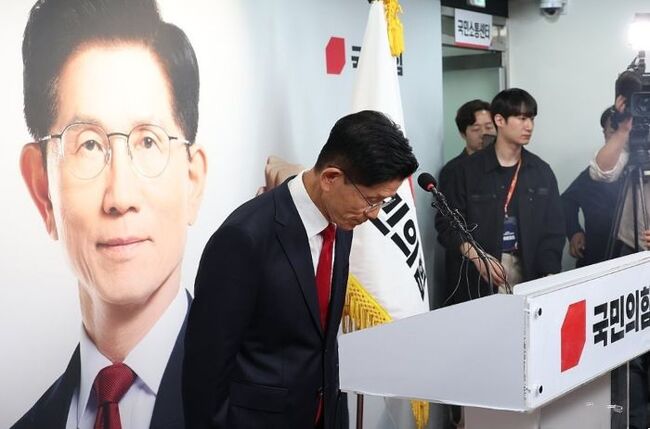 “Too little, too late?…” Kim Moon-soo, who previously conceded his presidential election defeat, now demands a special counsel investigation into ‘allegations of election fraud in the 2025 presidential election’
People Power Party presidential candidate Kim Moon-soo concedes defeat during a press conference at the party headquarters in Yeouido, Seoul, on June 4, 2025. [Joint Press Corps]As allegations emerge
“Too little, too late?…” Kim Moon-soo, who previously conceded his presidential election defeat, now demands a special counsel investigation into ‘allegations of election fraud in the 2025 presidential election’
People Power Party presidential candidate Kim Moon-soo concedes defeat during a press conference at the party headquarters in Yeouido, Seoul, on June 4, 2025. [Joint Press Corps]As allegations emerge
 Stock Market Crash 'Black Tuesday'… KOSPI down 10.8%, KOSDAQ down 7.7%
The KOSPI fell by more than 5% in early trading on the 28th, triggering a sell-side sidecar.On the 28th, the KOSPI plunged by more than 10%.Due to the sharp decline, a sell-side sidecar—a temporary
Stock Market Crash 'Black Tuesday'… KOSPI down 10.8%, KOSDAQ down 7.7%
The KOSPI fell by more than 5% in early trading on the 28th, triggering a sell-side sidecar.On the 28th, the KOSPI plunged by more than 10%.Due to the sharp decline, a sell-side sidecar—a temporary
 [World Heritage Committee] 25 New World Heritage Sites Inscribed in Busan… South Korea Successfully Expands 'Getbol' Listing
The Chairperson of the World Heritage Committee speaks at the plenary session of the 48th session of the World Heritage Committee, held at BEXCO in Busan on the 20th. [Photo: Yonhap News]A total of 25
[World Heritage Committee] 25 New World Heritage Sites Inscribed in Busan… South Korea Successfully Expands 'Getbol' Listing
The Chairperson of the World Heritage Committee speaks at the plenary session of the 48th session of the World Heritage Committee, held at BEXCO in Busan on the 20th. [Photo: Yonhap News]A total of 25
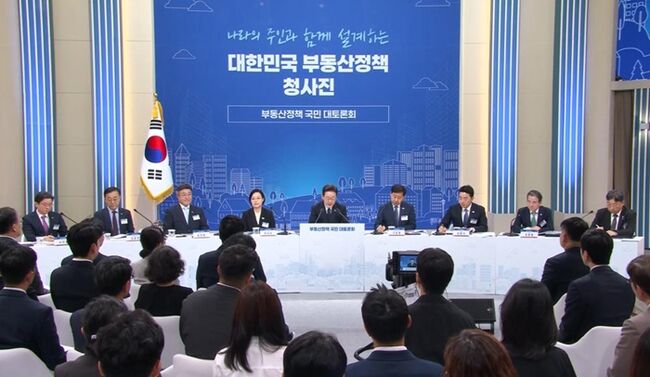 [Liberal Democratic Party Statement] Calling it a Grand Real Estate Debate… It Was Nothing More Than a Private Party Among Themselves
The 'National Grand Debate on Real Estate Policy' held on July 23rd and 27th. [Photo=Yonhap News]The 'National Grand Debate on Real Estate Policy,' hosted by the Lee Jae-myung administration under the
[Liberal Democratic Party Statement] Calling it a Grand Real Estate Debate… It Was Nothing More Than a Private Party Among Themselves
The 'National Grand Debate on Real Estate Policy' held on July 23rd and 27th. [Photo=Yonhap News]The 'National Grand Debate on Real Estate Policy,' hosted by the Lee Jae-myung administration under the
 [Photo] Evidence of Election Fraud Flooding U.S. Media… Trump Had 2.7 Million Votes Stolen
 [Video] U.S. Semiquincentennial Air Show... 'Art in the Sky' streaks across New York
 [Editorial Cartoon] A Draconian Law That Undermines Freedom of Expression

 List
List