On the 3rd, the Won/Dollar exchange rate, KOSPI, and KOSDAQ indices are displayed on the status board in the dealing room of Hana Bank's headquarters in Jung-gu, Seoul. [Photo=Yonhap News]Even among large-cap stocks, why did some falter while others held firm?
This week, the Korean stock market's focus was on individual stocks rather than the indices. Although the KOSPI experienced sharp declines and rebounds, the true nature of the market was more clearly revealed in the speed of individual stock reactions than in index figures.
This week's stock performance can be summarized in one sentence:
Stocks sensitive to exchange rates and foreign inflows/outflows faltered more significantly, while stocks with a "war beneficiary" narrative showed relative resilience.
The first notable movement was the sharp decline in large-cap semiconductor stocks.
On March 31st, Samsung Electronics fell 5.2%, and SK Hynix dropped 7.6%. As a large-scale foreign net selling at the end of the month coincided with a weakening Won, the core stocks of the Korean market were the first to falter. This was not simply an adjustment in a specific sector, but rather indicated that foreign capital was reducing its holdings in the most liquid and index-influential stocks first.
Early this week in the Korean market, the phrase "the index is falling" was virtually synonymous with Samsung Electronics and SK Hynix falling first.
The next scene was the sharp rebound of large-cap semiconductor stocks.
On April 1st, the day the KOSPI surged 8.44%, Samsung Electronics rose 13.4% and SK Hynix climbed 10.66%. Samsung Electronics' daily gain was evaluated as the largest since December 2001. As previous expectations revived, the market first reversed the decline in large-cap stocks that had fallen the most.
This was not a result of optimism broadly spreading throughout the market, but rather a confirmation that semiconductors were once again the leading stocks capable of driving the index higher. The particularly strong momentum of Samsung Electronics and SK Hynix even during the rebound was due to their prices having been heavily suppressed during the preceding adjustment phase and their absolute contribution to the index.
However, the stock market dynamics this week did not end there.
On April 2nd, as US President Trump's hawkish remarks re-emerged, Samsung Electronics and SK Hynix again fell by over 5%. In contrast, Hanwha Aerospace rose over 5%, and Hyundai Rotem showed strong performance of over 7%. On the same day, Samsung Biologics and Samsung SDI performed relatively well.
This point is crucial. This week's market was not a scenario where all large-cap stocks were bought and sold simultaneously. Instead, even within the same large-cap stocks, what was sensitive to exchange rates and foreign selling, and what could benefit from geopolitical premiums, differentiated the returns.
Narrowing down this trend, this week's Korean stock market prioritized individual stock narratives over sectors.
Large-cap semiconductor stocks had a long-term narrative of AI demand and earnings expectations, but in the short term, they were most exposed to changes in exchange rates and foreign supply and demand. In fact, despite projections that Samsung Electronics' first-quarter operating profit would approach a record high of around 40.5 trillion won, its stock price could not escape short-term volatility amidst Middle East risks, energy cost concerns, and debates about memory demand following TurboQuant.
Conversely, defense stocks had a narrative directly linked to war news, and thus could serve as a safe haven even during the same unfavorable market conditions.
Ultimately, the essence of stock differentiation this week was not solely about good or bad earnings, but about which stocks were directly connected to specific news events.
On April 3rd, the differences between individual stocks became apparent again.
As foreigners turned to net buying and the KOSPI rebounded by 2.74%, the market began to buy large-cap stocks across the board again. However, that rebound was not evenly distributed. Semiconductor stocks like Samsung Electronics and SK Hynix once again stood at the forefront of the rebound, and shipbuilding, defense, and nuclear power-related stocks also rose in tandem.
In contrast, some secondary battery, bio, and financial stocks showed relatively less strength even during the same rebound. This means that the market in the latter half of this week showed more clearly "which stocks to buy first" than "what are good stocks."
When foreigners returned, the Korean market first reacted to semiconductors and large-cap stocks, and only then did the warmth spread to other sectors.
Ultimately, the nature of this week's stock movements can be summarized in three points.
First, Samsung Electronics and SK Hynix were leading stocks that most significantly reflected the direction of the index.
Second, defense stocks like Hanwha Aerospace and Hyundai Rotem showed relative strength as war news intensified.
Third, even among large-cap stocks, secondary battery, bio, and financial stocks did not show the same momentum as the leading stocks during the rebound.
This was not a strong thematic market. More precisely, this week's Korean stock market revealed which large-cap stocks would be the vanguard of index recovery, which would be defensive havens, and which would lag behind in a rebound.
The market did not evaluate entire sectors uniformly. It more meticulously considered individual stock sensitivity, news connectivity, and supply/demand momentum.
The check points for next week are also clear.
First, if foreign net buying continues, whether large-cap semiconductor stocks will regain leadership of the index.
Second, whether the relative strength of defense stocks will be a short-term reaction to war news or evolve into a structural premium.
Third, whether secondary battery, bio, and financial stocks will continue to remain in the back row even during a rebound.
If these three align in the same direction, the Korean stock market could move beyond a simple index rebound into a phase of restructuring leading stocks. Conversely, if exchange rates falter again and foreign supply/demand weakens, the stock differentiation seen this week is likely to widen even further.
In summary, this week's Korean stock market showed that even among large-cap stocks, not all moved in the same way.
Samsung Electronics and SK Hynix first indicated the direction of the index, Hanwha Aerospace and Hyundai Rotem acted as intermediate havens, and other stocks revealed the difference between leading and non-leading stocks even during the rebound.
This week's market more clearly highlighted differences in individual stocks over sectors, and sensitivity over themes.

 [Statement by the Seo-beo-kka Korea Military Academy Save-the-Nation Comrades Association] ㉛ Recount the Votes Publicly, as the Previous Recount Concealed Election Fraud
Tongyeong Mayoral Election Recount [Photo=Yonhap News]South Korea's liberal democracy is dying. The National Election Commission (NEC) and the judiciary, which have plummeted into criminal syndicates
[Statement by the Seo-beo-kka Korea Military Academy Save-the-Nation Comrades Association] ㉛ Recount the Votes Publicly, as the Previous Recount Concealed Election Fraud
Tongyeong Mayoral Election Recount [Photo=Yonhap News]South Korea's liberal democracy is dying. The National Election Commission (NEC) and the judiciary, which have plummeted into criminal syndicates
 What is the significance of the "Trump 2028" red hats that keep making a comeback?
It is noteworthy that President Donald Trump is "intentionally" fueling controversy over whether he can actually run in the 2028 presidential election, even though it is "highly likely he is seriously
What is the significance of the "Trump 2028" red hats that keep making a comeback?
It is noteworthy that President Donald Trump is "intentionally" fueling controversy over whether he can actually run in the 2028 presidential election, even though it is "highly likely he is seriously
 Jin Cummings: “North Korea says it will increase the number of spies, so what is the government doing?”
U.S. political columnist Gene Cummings has publicly questioned the South Korean government, asking, "North Korea is declaring that it will increase its number of spies, so what is the South Kore
Jin Cummings: “North Korea says it will increase the number of spies, so what is the government doing?”
U.S. political columnist Gene Cummings has publicly questioned the South Korean government, asking, "North Korea is declaring that it will increase its number of spies, so what is the South Kore
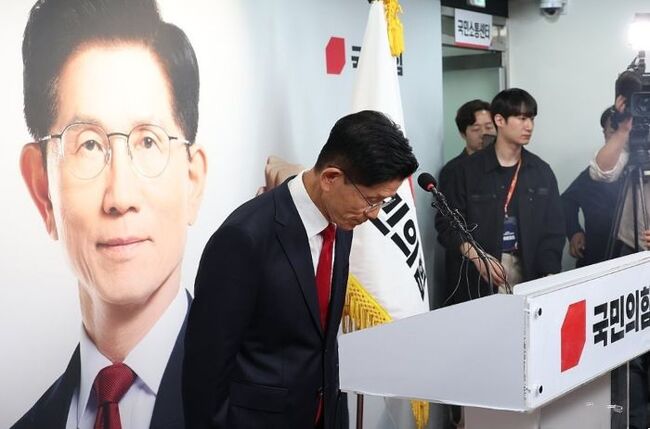 “Too little, too late?…” Kim Moon-soo, who previously conceded his presidential election defeat, now demands a special counsel investigation into ‘allegations of election fraud in the 2025 presidential election’
People Power Party presidential candidate Kim Moon-soo concedes defeat during a press conference at the party headquarters in Yeouido, Seoul, on June 4, 2025. [Joint Press Corps]As allegations emerge
“Too little, too late?…” Kim Moon-soo, who previously conceded his presidential election defeat, now demands a special counsel investigation into ‘allegations of election fraud in the 2025 presidential election’
People Power Party presidential candidate Kim Moon-soo concedes defeat during a press conference at the party headquarters in Yeouido, Seoul, on June 4, 2025. [Joint Press Corps]As allegations emerge
 Stock Market Crash 'Black Tuesday'… KOSPI down 10.8%, KOSDAQ down 7.7%
The KOSPI fell by more than 5% in early trading on the 28th, triggering a sell-side sidecar.On the 28th, the KOSPI plunged by more than 10%.Due to the sharp decline, a sell-side sidecar—a temporary
Stock Market Crash 'Black Tuesday'… KOSPI down 10.8%, KOSDAQ down 7.7%
The KOSPI fell by more than 5% in early trading on the 28th, triggering a sell-side sidecar.On the 28th, the KOSPI plunged by more than 10%.Due to the sharp decline, a sell-side sidecar—a temporary
 [World Heritage Committee] 25 New World Heritage Sites Inscribed in Busan… South Korea Successfully Expands 'Getbol' Listing
The Chairperson of the World Heritage Committee speaks at the plenary session of the 48th session of the World Heritage Committee, held at BEXCO in Busan on the 20th. [Photo: Yonhap News]A total of 25
[World Heritage Committee] 25 New World Heritage Sites Inscribed in Busan… South Korea Successfully Expands 'Getbol' Listing
The Chairperson of the World Heritage Committee speaks at the plenary session of the 48th session of the World Heritage Committee, held at BEXCO in Busan on the 20th. [Photo: Yonhap News]A total of 25
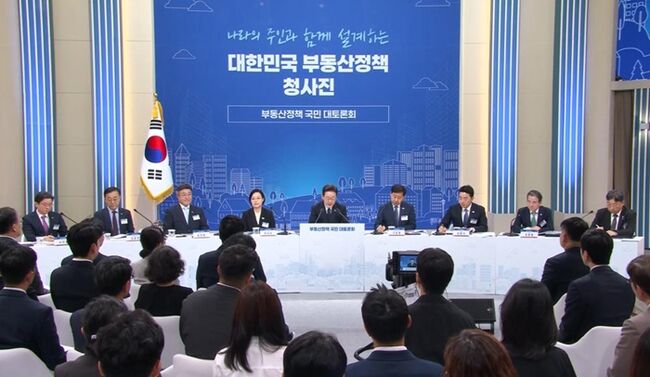 [Liberal Democratic Party Statement] Calling it a Grand Real Estate Debate… It Was Nothing More Than a Private Party Among Themselves
The 'National Grand Debate on Real Estate Policy' held on July 23rd and 27th. [Photo=Yonhap News]The 'National Grand Debate on Real Estate Policy,' hosted by the Lee Jae-myung administration under the
[Liberal Democratic Party Statement] Calling it a Grand Real Estate Debate… It Was Nothing More Than a Private Party Among Themselves
The 'National Grand Debate on Real Estate Policy' held on July 23rd and 27th. [Photo=Yonhap News]The 'National Grand Debate on Real Estate Policy,' hosted by the Lee Jae-myung administration under the
 [Photo] Evidence of Election Fraud Flooding U.S. Media… Trump Had 2.7 Million Votes Stolen
 [Video] U.S. Semiquincentennial Air Show... 'Art in the Sky' streaks across New York
 [Editorial Cartoon] A Draconian Law That Undermines Freedom of Expression

 List
List