① Simultaneous Local Elections: Expansion of Participation or Voter Turnout Calculation?
② Bumah and 5·18 in the Preamble to the Constitution: Commemoration or Re-narration of Legitimacy?
③ Constitutional Amendment on Martial Law Approval: Prevention of Recurrence or Shift to Parliamentary Supremacy?
④ A Single Line in the Supplementary Provisions: A Transitional Rule or Justification for the Trial Court's Logic?
⑤ The Pitfall of 'Equal Quality of Life': Regional Development or Constitutionalization of Statism?
⑥ Summary - What is the Problem?
 National Assembly Speaker Woo Won-shik is meeting with the floor leaders of each party at his office on the 3rd, holding a draft constitutional amendment bill. [Photo=Yonhap News]
① Simultaneous Local Elections: Expansion of Participation or Voter Turnout Calculation?
The statement that it is difficult without linking it to local elections means the constitutional amendment bill has weak independent momentum. What may increase is not only national referendum participation but also local election turnout. Why does constitutional amendment rely on local elections, and why must local elections ride on constitutional amendment again? |
The first point of contention surrounding this constitutional amendment bill is not its content but its procedure.
National Assembly Speaker Woo Won-shik stated that there could be a voter turnout issue if it is not held simultaneously with local elections. The proposal's stated reason also indicates that holding the national referendum for constitutional amendment concurrently with local elections can “increase public participation while also” reducing costs.
This single sentence almost reveals the calculation behind the current push for constitutional amendment. It implies that voter turnout is calculated before the persuasiveness of the amendment bill itself.
Why is voter turnout so important?
Article 130, Paragraph 2 of the Constitution stipulates that a constitutional amendment bill must obtain both the participation of a majority of the electorate with the right to vote in National Assembly elections and the approval of a majority of those who voted. Article 50, Paragraph 1 of the current National Referendum Act also confirms this.
Constitutional amendment is not a process that simply requires more 'yes' votes than 'no' votes. The deliberation begins only when more than half of the eligible voters actually go to the polls. This high threshold is not decorative; it is the Constitution's intent that the supreme norm should not be changed without broad public interest and participation.
In this regard, Speaker Woo's remarks are quite candid.
The statement, “If it is not held concurrently with national elections, there will be a voter turnout problem,” implies that it is difficult to be confident about reaching the majority threshold with a separate national referendum.
Of course, this does not mean that the amendment bill itself is unnecessary. However, it does suggest that the momentum to independently move the public and generate a majority turnout for the amendment bill has not yet been sufficiently confirmed.
If constitutional amendment is truly a public demand, the question arises: why must it rely on the basic participation rate of local elections?
In the past, voter turnout has never been an issue for constitutional amendment referendums.
According to the National Election Commission's Election History Office, the turnout rates for past constitutional amendment referendums were: 85.3% in 1962, 77.1% in 1969, 91.9% in 1972, 79.8% in 1975, 95.5% in 1980, and 78.2% in 1987. All significantly exceeded 50%.
In contrast, recent local election turnout rates were: 56.8% in 2014, 60.2% in 2018, and 50.9% in 2022. Consequently, the current proposal for simultaneous implementation can only be interpreted as a calculation to overcome the constitutional threshold for validity by relying on the basic turnout rate of local elections, rather than the independent mobilization power of the amendment bill itself.
However, we need to delve a step further.
This proposal is not simply aimed at increasing national referendum turnout.
Looking only at the outcome, the constitutional amendment referendum relies on the participation rate of local elections, while local elections, in turn, leverage the mobilization effect of constitutional amendment issues to boost turnout.
Originally, local elections should be about asking about regional issues, focusing on regional administration, local councils, and superintendent elections. However, the moment a national political agenda like constitutional amendment is superimposed, local elections can transform from a forum for electing local representatives into a stage for national political mobilization.
This is precisely where the question arises.
Why is the goal to increase local election turnout?
Local elections are fundamentally a process of selecting local representatives and local power. However, when a national political issue like constitutional amendment is added, local elections are more likely to be swayed by opinions on the current administration or the national political landscape rather than by local considerations.
Placing local elections under the umbrella of constitutional amendment is not just a calculation to clear the hurdle for constitutional amendment; it can also be interpreted as an attempt to simultaneously boost the participation rate and political engagement of local elections themselves.
Ultimately, it is difficult to escape the suspicion that behind the phrase "expansion of public participation," there is a calculation to utilize local elections as a stage for political mobilization.
A common counterargument is that simultaneous implementation merely enhances participation convenience.
Formally, this is correct. Holding multiple elections on a single election day can reduce administrative costs and increase convenience for voters.
However, a national referendum for constitutional amendment is different from a general election. It is an act of changing the supreme norm of the Constitution, not a competition to select candidates. Therefore, the Constitution sets a higher threshold for validity than for general elections.
If the aim is to overcome this threshold by using the basic participation rate of local elections instead of generating separate public enthusiasm, and furthermore, to enhance mobilization by overlaying local elections with constitutional amendment issues, then it can only be understood as a calculation disguised in the language of convenience.
At this point, the phrase "the people's veto power" also needs re-examination.
Legally, non-participation is not equivalent to a 'no' vote. The will of those who do not vote cannot all be interpreted as a rejection. However, the system is designed that way.
Since a majority turnout is required for a constitutional amendment bill to be finalized, non-participation ultimately acts in a way that prevents the amendment from being enacted. In other words, non-participation may be a sign of indifference, but it also functions as a passive obstruction mechanism intended by the Constitution.
In that sense, simultaneous implementation with local elections moves in a direction that weakens not only active opposition from the public but also the choice to prevent constitutional amendment by not voting.
Ultimately, this is the first fact surrounding the current constitutional amendment push.
The Constitution places a high threshold on constitutional amendment, and this threshold is a mechanism to confirm public interest and participation.
However, the moment it is deemed that this threshold is unstable with a separate national referendum and the decision is made to combine it with local elections, it becomes an admission that the amendment bill itself has weak independent public momentum.
Furthermore, if the combination ultimately leads to an increase in local election turnout as well, this is not merely an expansion of participation but a calculated mobilization.
Why must constitutional amendment rely on local elections, and why must local elections ride on constitutional amendment again? This is the first problem with the current amendment bill.
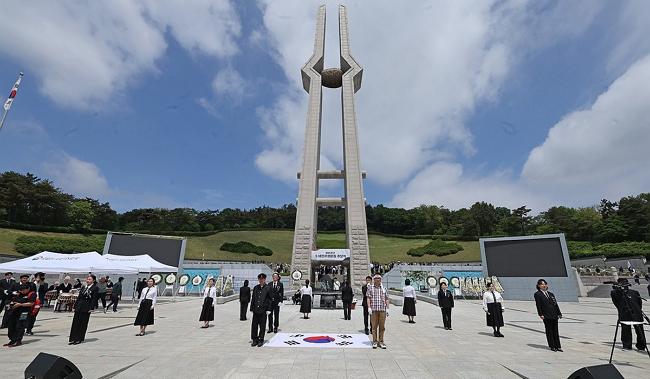 45th Anniversary Memorial Ceremony of the May 18 Democratization Movement [Photo=Yonhap News]
② Bumah and 5·18 in the Preamble to the Constitution: Commemoration or Re-narration of Legitimacy?
The current preamble only mentions the March 1st Movement, the legitimacy of the Provisional Government, and the democratic ideals of the April 19th Revolution. The amendment bill adds the Bumah Democratic Uprising and the May 18 Democratization Movement. The issue is not commemoration but fixing a specific historical interpretation into constitutional text. |
Much attention is focused on the martial law provisions and supplementary provisions in this amendment bill. However, there may be a sentence that will endure the longest over time.
It is the amendment to the preamble of the Constitution.
The proposal states that the section of the current preamble, "the legitimacy of the Provisional Government established by the March 1st Movement and the democratic ideals of the April 19th Revolution in defiance of injustice," will be changed to "the legitimacy of the Provisional Government established by the March 1st Movement, and the democratic ideals of the April 19th Revolution, the Bumah Democratic Uprising, and the May 18 Democratization Movement."
The proposal presents this as one of the core contents of this constitutional amendment, explaining that the current preamble does not reflect the history of democracy after the April 19th Revolution.
Viewing this provision as mere commemorative wording misses its essence.
The preamble of the Constitution is not a commemorative text. The preamble is a statement declaring what historical experiences the nation uses as the basis of its legitimacy and on what values the constitutional order stands.
The moment an event is included in the preamble, it ceases to be merely an important historical event. It becomes the nation's officially chosen constitutional historical narrative.
Therefore, the preamble provision in this amendment bill should be read not as a simple addition but as an act of rewriting the lineage of national legitimacy.
The stated reasons for the proposal do not hide this fact.
The proposal explains that by citing the history of democracy from the April 19th Revolution to the Bumah Democratic Uprising and the May 18 Democratization Movement, enshrining their spirit in the Constitution is an expression of respect for the historical legitimacy of the Republic of Korea's democracy.
This is not a matter of simply adding missing names. It is a choice about what the current constitutional order inherits and which political memories will be endorsed at the constitutional level.
This is precisely where the question arises.
Why specifically Bumah and 5·18?
This question is not meant to deny the historical importance of these two events.
Rather, it is the opposite. The more important an event is, the greater caution is needed when placing it in the highest national document, the preamble of the Constitution. The moment an event is included in the preamble, it becomes not just a historical memory but a sentence that defines constitutional interpretation and the identity of the political community.
In other words, this amendment bill is not performing historical commemoration; it is seeking to establish a specific narrative of democratization as the official lineage of national legitimacy.
Some may say that 5·18 is an event whose truth has already been revealed.
However, this is a partially true and partially false answer. Under the guise of uncovering the truth, special laws have been enacted, state investigative bodies have been established, and spreading false information about 5·18 has become a criminal offense.
In other words, today's "uncovering" is not the result of open questions and free verification but also a product of the process where the government has fixed official conclusions through laws and institutions.
The "Act on the May 18 Democratization Movement, etc.," revised in 2021, includes provisions for punishing the spread of false information, and the separate "Act on Uncovering the Truth of the May 18 Democratization Movement" stipulates the establishment and procedures of a truth-finding committee.
What makes this issue even more sensitive is that this amendment bill describes itself as a "constitutional amendment pursued step-by-step within the scope of consensus."
The proposal states that because comprehensive constitutional amendments have failed multiple times, this time the amendment will be pursued step-by-step, focusing on issues on which there is high public consensus and no disagreement between the ruling and opposition parties.
However, precisely that amendment bill touches upon the most symbolic, most political, and most interpretable area in its preamble.
The martial law provision or the national referendum procedure can be explained as institutional issues.
However, amending the preamble is an issue of historical perception, not institutional improvement.
The term "minimum constitutional amendment" and the amendment to the preamble do not easily harmonize.
It is also important that the current preamble already includes the March 1st Movement, the legitimacy of the Provisional Government of the Republic of Korea, and the democratic ideals of the April 19th Revolution. This is the structure that shows where the 1987 Constitution places the roots of national legitimacy.
However, this amendment bill does not simply supplement that structure; it essentially edits it anew. By adding Bumah and 5·18 after April 19th, it realigns the lineage of modern democratization.
Editing always involves choices. What is included and what is excluded, which events are considered constitutional inheritances and which are not, all change how the nation understands itself.
This amendment to the preamble is precisely a matter of choice.
This leads to a more fundamental question.
Should the preamble of the Constitution be a minimum consensus document that binds the entire nation, or should it continuously expand to more concretely state specific historical interpretations for each era?
If it is the latter, then demands to include other historical events will not cease in the future. Someone will demand to include other democratization events, someone the achievements of industrialization, and someone the memories of war and security in the preamble of the Constitution.
In that case, the preamble of the Constitution may become less an epitome of legitimacy and more a list of memories rewritten each era.
This also means that amending the preamble is not a matter of simple symbolic politics but of how the nation manages its memories and which interpretations will be sealed into the Constitution.
Ultimately, the issue with amending the preamble this time is not "whether Bumah and 5·18 are important or not."
The real question is this: does it help national integration for the state to fix specific historical interpretations into constitutional text?
The preamble of the Constitution is not a monument to commemoration.
It is a statement defining the community from which the nation originates and what it defends. Adding new events to such a place is always political, always selective, and always binds subsequent interpretations.
Therefore, this amendment to the preamble, while appearing to be the most symbolic sentence, could in fact become the most enduring political choice. That is precisely why this provision cannot be taken lightly.
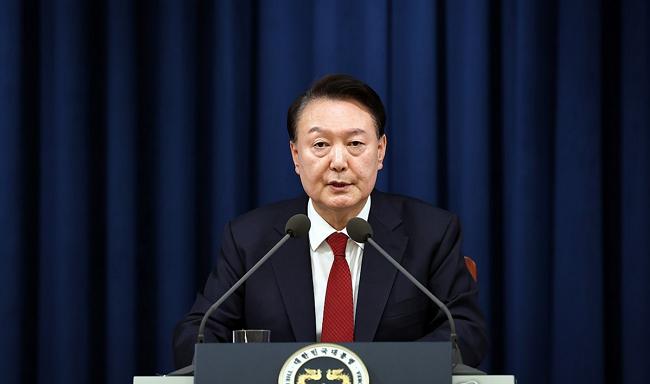 President Yoon Suk-yeol delivers an emergency special address to the nation at the Yongsan Presidential Office in Seoul on the night of December 3, 2024.
③ Constitutional Amendment on Martial Law Approval: Prevention of Recurrence or Shift to Parliamentary Supremacy?
The current Constitution has a structure of 'parliamentary notification' and 'dissolution request'. The amendment bill transitions to a structure of 'parliamentary approval' and 'immediate loss of effect'. The issue is not the strengthening of martial law control, but the change in power balance and emergency response capabilities. |
The substantive core of this amendment bill is the revision of Article 77.
The proposal changes the wording of the current Constitution, "When martial law is proclaimed, the President shall without delay notify the National Assembly," to "shall without delay notify the National Assembly and obtain approval." It also states that if the approval is rejected or if approval is not obtained within 48 hours of the proclamation of martial law, the martial law shall immediately lose its effect.
Furthermore, unlike the current Constitution, which provides for parliamentary "request for dissolution" and the President's "obligation to dissolve," the amendment bill changes it so that martial law immediately loses its effect if the National Assembly resolves to dissolve it with the concurrence of a majority of its members. It overhauls the notification-request structure to an approval-effectuation structure.
The proponents of the bill clearly state the reasons for this.
The stated reason directly refers to the "12·3 emergency martial law," stating that the current Constitution lacks adequate measures against unconstitutional or illegal attempts at martial law and that if the martial law forces block the National Assembly or arrest/detain a majority of National Assembly members, the National Assembly's process for requesting the dissolution of martial law could itself be rendered ineffective.
Therefore, they argue that the right to request martial law dissolution should be strengthened into a right to dissolve, and an approval right should be introduced.
Based solely on this explanation, this revision reads like a measure to prevent recurrence, stating, "We will ensure that such martial law is never repeated."
However, stopping the reading at this point only provides half the picture.
The current Constitution already grants the National Assembly the power to control the dissolution of martial law. The amendment bill goes a step further by making the continued existence of martial law conditional on parliamentary approval.
The significance of this change is not merely a procedural enhancement. It is an adjustment of the power structure that places the President's emergency powers within the framework of parliamentary ex-post facto approval.
The proponents themselves define this as "strengthening parliamentary control over martial law."
This is precisely where the issue transcends a formal debate on the separation of powers and becomes a substantive issue of power balance.
In our constitutional order, the National Assembly already has the power to impeach the President. Article 65, Paragraph 3 of the Constitution stipulates that the exercise of powers by the impeached person is suspended upon the resolution of impeachment. Indeed, Yoon Suk-yeol's duties were suspended due to the National Assembly's impeachment resolution in December 2024.
The 1987 constitutional system was not one that unleashed presidential power. Chun Doo-hwan and Roh Tae-woo received final judgments from the Supreme Court en banc in 1997, and Lee Myung-bak's 17-year prison sentence was finalized by the Supreme Court in 2020. The duties of incumbent presidents Park Geun-hye and Yoon Suk-yeol were suspended by the National Assembly's impeachment resolution.
Conversely, the President does not have the power to dissolve the National Assembly. In such a structure, subordinating emergency powers even further to parliamentary approval can only be read as an adjustment that tips the balance of presidential power further towards parliament, beyond a mere safeguard against abuse.
A more fundamental issue is the emergency response structure.
Emergencies, by their nature, require swift judgment and immediate response. Therefore, martial law has been designed as a special constitutional emergency power distinct from ordinary administrative powers.
However, if its continued existence after proclamation is tied to parliamentary approval, then in future national crises, the continuity of emergency response will be increasingly susceptible to the political judgments of the majority party or parliamentary stalemates.
The rationale for preventing the abuse of martial law is understandable. However, a provision is not justified by its rationale alone. For every control mechanism added, it must also be considered how much it could weaken the nation's response capability in a real crisis situation.
The Constitution must serve as a safeguard against abuse and, simultaneously, as a mechanism for preserving state functions.
In this regard, this amendment bill harbors a dangerous paradox.
While it aims to prevent unconstitutional martial law, it could also make legitimate emergency responses difficult.
If the structure is such that the continuation of emergency powers is impossible without parliamentary approval, then in actual crisis situations, the President and the administration will be more conscious of the political calculations of the parliamentary majority than of the nature and speed of the situation.
In that case, the Constitution could function not only as a mechanism to prevent the abuse of emergency powers but, in some instances, as a mechanism that paralyzes the response to emergency situations.
Control and paralysis are separated by a single character, but they lead to entirely different outcomes in state operations.
The issue is not solely about the rationale of preventing recurrence.
Given that we have already witnessed how the parliamentary dominance of the majority party can neutralize the President and the administration, the more fundamental question remains: is a constitutional amendment that ties even the power of martial law to parliamentary approval consistent with power balance?
The current Constitution grants the National Assembly the power of impeachment, but it does not grant the President the power to dissolve the National Assembly. In such a structure, making the proclamation and continuation of martial law dependent on parliamentary approval cannot but be read as a constitutional amendment that pushes the emergency powers of the presidency one step further toward a parliamentary-dominant order, regardless of its constitutionality.
Ultimately, the issue with the revision of Article 77 this time is not the strengthening of martial law control itself.
The real issue lies in how that control method changes the current power balance of the presidential system and, simultaneously, how much it can shake the nation's emergency response capabilities.
The phrase "prevention of recurrence" is difficult to refute. However, the Constitution is not a document amended solely for good reasons. It must be thoroughly examined to see which power it further empowers and how much it can weaken the nation's crisis response structure.
In that regard, this constitutional amendment regarding the approval of martial law is not merely a preventive provision but a significant amendment that touches upon both the power structure and state functions.

 Iranian Foreign Ministry: "Continuing Message Exchanges with the U.S. and Activities of Mediating Countries"
Esmaeil Baghaei, Spokesperson for the Iranian Ministry of Foreign Affairs [Xinhua, Yonhap News file photo]Esmaeil Baghaei, spokesperson for the Iranian Ministry of Foreign Affairs, stated on the 26th
Iranian Foreign Ministry: "Continuing Message Exchanges with the U.S. and Activities of Mediating Countries"
Esmaeil Baghaei, Spokesperson for the Iranian Ministry of Foreign Affairs [Xinhua, Yonhap News file photo]Esmaeil Baghaei, spokesperson for the Iranian Ministry of Foreign Affairs, stated on the 26th
 President Yoon: "Do You Think You Are Safe from the Special Counsel?"... Final Statement Video Released
President Yoon Suk Yeol rebuking the special prosecutor on the 24th. [Court video / @birds_justice X account subtitle GIF] A video of President Yoon Suk Yeol's closing statement at his trial rega
President Yoon: "Do You Think You Are Safe from the Special Counsel?"... Final Statement Video Released
President Yoon Suk Yeol rebuking the special prosecutor on the 24th. [Court video / @birds_justice X account subtitle GIF] A video of President Yoon Suk Yeol's closing statement at his trial rega
 President Yoon, regarding the first-instance ruling on the Public Official Election Act: “An excessive political verdict that distorts the facts… We will appeal immediately.”
The first-instance sentencing hearing for President Yoon Suk Yeol regarding violations of the Public Official Election Act is being broadcast live at Seoul Station on the 27th. [Photo=Yonhap News]Pres
President Yoon, regarding the first-instance ruling on the Public Official Election Act: “An excessive political verdict that distorts the facts… We will appeal immediately.”
The first-instance sentencing hearing for President Yoon Suk Yeol regarding violations of the Public Official Election Act is being broadcast live at Seoul Station on the 27th. [Photo=Yonhap News]Pres
 WSJ: "SK Hynix ADR Premium Is a Sign of AI Trading Overheat"
Advertisement for SK Hynix ADR listing in New York's Times Square [Reuters=Yonhap News file photo]The Wall Street Journal (WSJ) has pointed out that the price of SK Hynix’s American Depositary Recei
WSJ: "SK Hynix ADR Premium Is a Sign of AI Trading Overheat"
Advertisement for SK Hynix ADR listing in New York's Times Square [Reuters=Yonhap News file photo]The Wall Street Journal (WSJ) has pointed out that the price of SK Hynix’s American Depositary Recei
 'Godfather of Japanese Mystery Novels' Keigo Higashino Passes Away After Battle with Cancer at 68
Famous Japanese mystery novelist Keigo Higashino [AFP=Yonhap News]It has been belatedly reported that Keigo Higashino, the "godfather of Japanese mystery novels" and author of bestsellers such as "The
'Godfather of Japanese Mystery Novels' Keigo Higashino Passes Away After Battle with Cancer at 68
Famous Japanese mystery novelist Keigo Higashino [AFP=Yonhap News]It has been belatedly reported that Keigo Higashino, the "godfather of Japanese mystery novels" and author of bestsellers such as "The
 [Park Pil-kyu Security Column] To the Ignorant Trying to Clothe a Beast in Sheep's Clothing
Rep. Kim Byung-joo of the Democratic Party of Korea [Photo=Yonhap News]“The Air Force Academy doesn't teach you how to fly a plane!” “The Army, Navy, and Air Force academies are exactly the
[Park Pil-kyu Security Column] To the Ignorant Trying to Clothe a Beast in Sheep's Clothing
Rep. Kim Byung-joo of the Democratic Party of Korea [Photo=Yonhap News]“The Air Force Academy doesn't teach you how to fly a plane!” “The Army, Navy, and Air Force academies are exactly the
 [Issue Diagnosis] Two Effects of the Election Petition Review
 [Photo] Evidence of Election Fraud Flooding U.S. Media… Trump Had 2.7 Million Votes Stolen
 [Video] U.S. Semiquincentennial Air Show... 'Art in the Sky' streaks across New York
 [Editorial Cartoon] A Draconian Law That Undermines Freedom of Expression

 List
List