2nd Meeting of the Special Committee on Economic Response to the Middle East War
The Democratic Party of Korea and the government have decided to send special envoys for crude oil to Saudi Arabia, Oman, and Algeria, and to push for the deployment of five national flag carriers on an alternative Red Sea route utilizing the Saudi port of Yanbu.
Ahn Do-geol, the coordinator for the Democratic Party's 'Special Committee on Economic Response to the Middle East Situation', told reporters after a party-government consultation meeting held at the National Assembly on the 6th that securing alternative crude oil supplies is the most urgent priority, announcing this plan. The party and government also discussed a plan to effectively abolish the ex-post settlement system for oil refineries and gas stations and reduce the settlement cycle to within one week.
Based solely on the government's explanation, this measure is a follow-up to reduce anxieties in crude oil supply and demand caused by the Middle East war and the potential blockade of the Strait of Hormuz. However, considering only the timing, this announcement is more of a late response than the presentation of a new measure.
The government had already explained on March 31st, when it implemented the reserve oil swap system, that refineries had secured more than 20 million barrels of alternative crude oil to arrive by the end of June and that there would be no major supply disruptions before June.
Prior to that, on March 26th, the government first announced emergency measures including an extended reduction in oil taxes, adjustments to oil price caps, controls on naphtha exports, and the purchase of 5 trillion won worth of government bonds. On March 31st, it activated the reserve oil swap, and on the same day, Lee Jae-myung ordered a more proactive response to the energy supply and demand situation.
In essence, the government's response had already been escalating step-by-step since late March.
The President's message quickly intensified. In his parliamentary address on April 2nd, Lee Jae-myung described the shock from the Middle East as the most severe energy security threat in recent history and urged the swift processing of a supplementary budget bill of 26.2 trillion won.
The government included 10.1 trillion won for responding to high oil prices, 2.8 trillion won for stabilizing livelihoods, and 2.6 trillion won for minimizing industrial damage and stabilizing supply chains in this supplementary budget bill.
Subsequently, on April 5th, Deputy Prime Minister Koo Yoon-cheol met with ambassadors from Gulf Cooperation Council (GCC) member states to request stable supplies of crude oil, liquefied natural gas (LNG), naphtha, and urea, as well as the safety of Korean ships and crew. Reuters reported at the time that 26 Korean ships were stranded in areas related to Hormuz.
On the 6th, the plans for sending special envoys and deploying national flag carriers were announced again. The level of response has rapidly increased in a short period, from utilizing reserve oil to diplomatic requests, supplementary budgets, special envoys, and national flag carriers.
The issue is not that the crisis suddenly emerged within a few days. The government itself was aware of the severity of the situation, having introduced a series of emergency measures since late March.
This leaves the question of why measures like dispatching special envoys, securing alternative routes, and deploying national flag carriers were only revealed now. If the situation was serious from the beginning, then the response was late. Conversely, if supply and demand management was possible until June as explained on March 31st, then the current announcement reveals that the initial judgment was excessively complacent.
It is difficult to deny the energy shock itself. Korea relies significantly on the Middle East for its crude oil imports, and the Strait of Hormuz is a crucial passage through which approximately 20% of the world's oil cargo flows.
However, separate from the actual crisis, the speed and intensity with which the government explained and amplified it is another matter.
The government, which had been talking about manageability, then redefined it within a few days as the 'worst energy security threat' and simultaneously deployed a supplementary budget, special envoys, and national flag carriers. This progression can be read as both an escalation in crisis response and a revision of the initial message.
Ultimately, this party-government announcement, before being a declaration of full-scale response, shows traces of delayed judgment.
It's not that there was no crisis and the government claimed there was. However, after confirming the existence of the crisis, the government initially emphasized manageability and then belatedly brought out special envoys and national flag carriers, revealing wavering judgment rather than precision in its response.
What is needed now is to heed the point that 'an explanation for why the government's judgment and messages have changed so rapidly is needed more than extraordinary rhetoric.'

 [Statement by the Seo-beo-kka Korea Military Academy Save-the-Nation Comrades Association] ㉛ Recount the Votes Publicly, as the Previous Recount Concealed Election Fraud
Tongyeong Mayoral Election Recount [Photo=Yonhap News]South Korea's liberal democracy is dying. The National Election Commission (NEC) and the judiciary, which have plummeted into criminal syndicates
[Statement by the Seo-beo-kka Korea Military Academy Save-the-Nation Comrades Association] ㉛ Recount the Votes Publicly, as the Previous Recount Concealed Election Fraud
Tongyeong Mayoral Election Recount [Photo=Yonhap News]South Korea's liberal democracy is dying. The National Election Commission (NEC) and the judiciary, which have plummeted into criminal syndicates
 What is the significance of the "Trump 2028" red hats that keep making a comeback?
It is noteworthy that President Donald Trump is "intentionally" fueling controversy over whether he can actually run in the 2028 presidential election, even though it is "highly likely he is seriously
What is the significance of the "Trump 2028" red hats that keep making a comeback?
It is noteworthy that President Donald Trump is "intentionally" fueling controversy over whether he can actually run in the 2028 presidential election, even though it is "highly likely he is seriously
 Jin Cummings: “North Korea says it will increase the number of spies, so what is the government doing?”
U.S. political columnist Gene Cummings has publicly questioned the South Korean government, asking, "North Korea is declaring that it will increase its number of spies, so what is the South Kore
Jin Cummings: “North Korea says it will increase the number of spies, so what is the government doing?”
U.S. political columnist Gene Cummings has publicly questioned the South Korean government, asking, "North Korea is declaring that it will increase its number of spies, so what is the South Kore
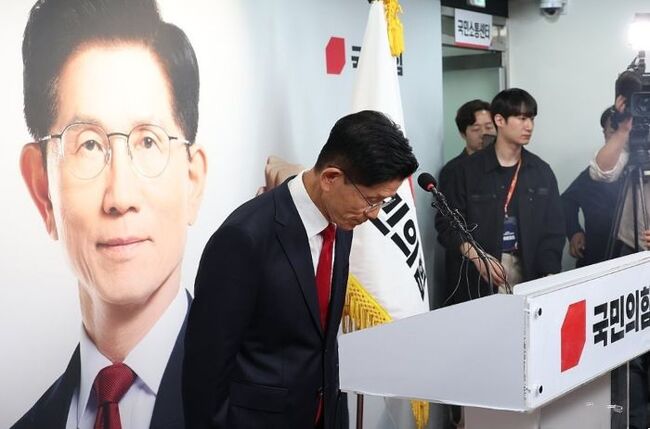 “Too little, too late?…” Kim Moon-soo, who previously conceded his presidential election defeat, now demands a special counsel investigation into ‘allegations of election fraud in the 2025 presidential election’
People Power Party presidential candidate Kim Moon-soo concedes defeat during a press conference at the party headquarters in Yeouido, Seoul, on June 4, 2025. [Joint Press Corps]As allegations emerge
“Too little, too late?…” Kim Moon-soo, who previously conceded his presidential election defeat, now demands a special counsel investigation into ‘allegations of election fraud in the 2025 presidential election’
People Power Party presidential candidate Kim Moon-soo concedes defeat during a press conference at the party headquarters in Yeouido, Seoul, on June 4, 2025. [Joint Press Corps]As allegations emerge
 Stock Market Crash 'Black Tuesday'… KOSPI down 10.8%, KOSDAQ down 7.7%
The KOSPI fell by more than 5% in early trading on the 28th, triggering a sell-side sidecar.On the 28th, the KOSPI plunged by more than 10%.Due to the sharp decline, a sell-side sidecar—a temporary
Stock Market Crash 'Black Tuesday'… KOSPI down 10.8%, KOSDAQ down 7.7%
The KOSPI fell by more than 5% in early trading on the 28th, triggering a sell-side sidecar.On the 28th, the KOSPI plunged by more than 10%.Due to the sharp decline, a sell-side sidecar—a temporary
 [World Heritage Committee] 25 New World Heritage Sites Inscribed in Busan… South Korea Successfully Expands 'Getbol' Listing
The Chairperson of the World Heritage Committee speaks at the plenary session of the 48th session of the World Heritage Committee, held at BEXCO in Busan on the 20th. [Photo: Yonhap News]A total of 25
[World Heritage Committee] 25 New World Heritage Sites Inscribed in Busan… South Korea Successfully Expands 'Getbol' Listing
The Chairperson of the World Heritage Committee speaks at the plenary session of the 48th session of the World Heritage Committee, held at BEXCO in Busan on the 20th. [Photo: Yonhap News]A total of 25
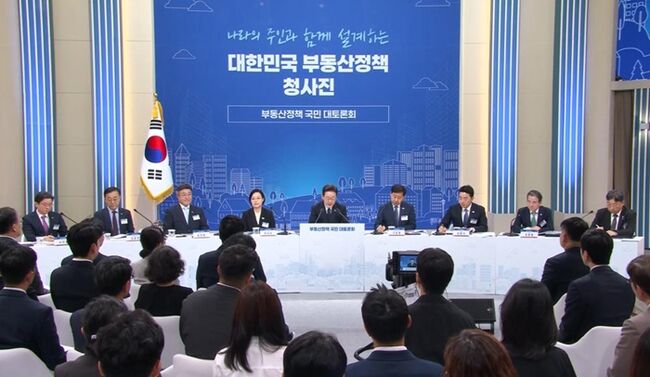 [Liberal Democratic Party Statement] Calling it a Grand Real Estate Debate… It Was Nothing More Than a Private Party Among Themselves
The 'National Grand Debate on Real Estate Policy' held on July 23rd and 27th. [Photo=Yonhap News]The 'National Grand Debate on Real Estate Policy,' hosted by the Lee Jae-myung administration under the
[Liberal Democratic Party Statement] Calling it a Grand Real Estate Debate… It Was Nothing More Than a Private Party Among Themselves
The 'National Grand Debate on Real Estate Policy' held on July 23rd and 27th. [Photo=Yonhap News]The 'National Grand Debate on Real Estate Policy,' hosted by the Lee Jae-myung administration under the
 [Photo] Evidence of Election Fraud Flooding U.S. Media… Trump Had 2.7 Million Votes Stolen
 [Video] U.S. Semiquincentennial Air Show... 'Art in the Sky' streaks across New York
 [Editorial Cartoon] A Draconian Law That Undermines Freedom of Expression

 List
List