In the Netflix drama 'Less is More' (少主且慢行), only the maids are depicted wearing skirts and blouses similar to hanbok, leading to suspicions that this was an attempt to portray hanbok as a subculture of China. [Photo=Netflix]
President Lee Jae-myung recently raised a question during a briefing by the Northeast Asian History Foundation regarding the controversy surrounding the 'Hwanppa Debate' related to the 'Hwandangogi', with the mainstream academic and media circles criticizing Lee Jae-myung for not properly understanding that the Hwandangogi, already declared a forgery by mainstream academia, is being perceived as an actual historical document.
The very next day, the spokesperson for the Blue House stated that Lee Jae-myung "did not agree with or order research or review of the Hwandangogi." Lee Jae-myung retracted his statement just one day after raising the issue.
As always, this is an anecdote that illustrates Lee Jae-myung's superficial knowledge and shallow thinking, as well as his flippant remarks and actions. According to media reports, Lee Jae-myung raised the issue based on what he heard from a member of a religious group that supports him.
The Hwandangogi is a reliable historical text of Goguryeo.
If Lee Jae-myung had read the Hwandangogi multiple times and fully absorbed its contents through deep contemplation and meditation, it would not have been something he could back down from in just one day.
If Lee Jae-myung possessed accurate knowledge and wisdom about the history, philosophy, religion, and culture of the Korean people, passed down by his ancestors, not just superficial hearsay, he would have escaped the foolishness of ruining the Republic of Korea, being brainwashed by the communist ideology of Marx or Lenin, who were mere fantasists, or by the nonsensical logic of pro-North Korea leftist factions.
Unlike the modern and contemporary history where left and right ideologies clash sharply, the Hwandangogi is not just about the ancient history of the Korean people but also about establishing our nation's history, philosophy, culture, ideology, and identity.
It is also about overcoming the manipulation and obliteration of Korean history by the current mainstream academia, contaminated by colonial historical theories, the remnants of the Japanese colonial era, following the officials and scholars of the Joseon Dynasty who were steeped in Sinocentrism, and about responding to the Northeast Project, which is unfolding as part of China's non-military political, economic, social, and cultural invasion, known as 'unrestricted warfare' (超限戰).
China's Northeast Project is also being pursued at the summit level. U.S. President Trump, in an interview with The Wall Street Journal (WSJ) after his meeting with Chinese President Xi Jinping in 2017, said, "President Xi talked about the history of China and Korea. It was about the history of the Korean Peninsula, not North Korea. Korea was actually part of China in the past."
However, the Hwandangogi and many other historical texts tell the opposite of Xi Jinping's claims. Rather, for thousands of years in ancient times, China was part of Korea (China used to be a part of Korea during the Goguryeo and preceding Korean dynasties for thousands of years).
The Hwandangogi is a historical text compiled in 1911 by Gye Yeon-su, who combined the Samseonggi, Dangun Segi, Bukbuyeogi, and Taebaek Ilsaser, and it was published in 1979 by his disciple Lee Yu-rip.
The author of the first volume of Samseonggi is the Silla monk Anham-ro, the author of the second volume of Samseonggi is the late Goryeo scholar Won Dong-jung, the author of Dangun Segi is the late Goryeo minister Lee Am, the author of Bukbuyeogi is the late Goryeo scholar Beomjang, and the author of Taebaek Ilsaser is Ilshipdang Lee Maek, a scholar and official during the reign of King Yeonsan and King Jungjong of Joseon.
Lee Maek is Lee Am's great-grandson. Lee Maek states that while serving as a curator, he read classified documents deep within the palace and wrote about the ancient history of the Korean people, from Hanin's Korea to Hanung's Baedal Kingdom, and down to Dangun Joseon.
The classified documents Lee Maek read were forbidden books that had been confiscated from private homes multiple times by the Joseon Dynasty, which served the Ming Dynasty as the Son of Heaven's state. Therefore, Lee Maek read the classified documents in the palace, went home, and wrote them down from memory, then returned to read them again and repeat the process.
The classified documents that Lee Maek read are various ancient texts that are also cited in Kim Bu-sik's Samguk Sagi, all of which are historical texts of Goguryeo that have now disappeared.
The Samguk Sagi is an edited version of those lost ancient texts and a Sinocentric historical text created by excerpting only the parts that suited the taste of the pro-China sycophant Kim Bu-sik. The epitaph of King Gwanggaeto of Goguryeo is inscribed on a stone as large as a house, recording the history of Goguryeo and King Gwanggaeto's achievements.
Why did the Goguryeo people, who carved letters on rocks, leave behind no historical texts recorded on paper? The historical texts of Goguryeo were all burned by the Tang Dynasty after the fall of Goguryeo.
There are records of the burning of Goguryeo historical texts that lasted for several months. After the fall of Goguryeo, the Tang Dynasty and Silla fabricated distorted historical texts based on Sinocentrism, aiming to erase traces of Goguryeo, an Asian hegemonic power boasting a thousand years of glorious history. Among these, the Hwandangogi is a collection of several surviving historical texts of Goguryeo.
Focus on the content before debating authenticity
The existing academic circles reject the Hwandangogi as a forgery, arguing that some words used in the text are modern terms, that it suddenly appeared without prior mention in historical records, or that some of its records do not align with existing Chinese historical texts. Such claims are all baseless.
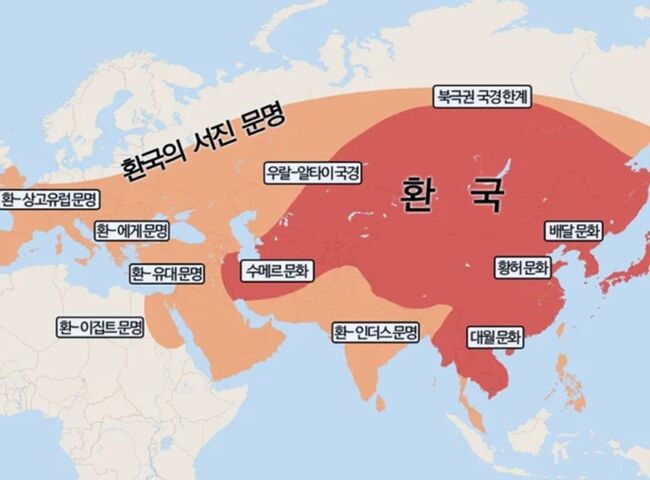 The Hwan-guk is claimed in the Hwandangogi to be the first nation in human history, and can be called the primordial Korea.
Words such as 'world,' 'nation,' 'industry,' 'freedom,' 'equality,' 'humanity,' 'constitution,' 'manbang,' 'civilization,' and 'gaebyeok' (creation/revolution), which they question, all appear in ancient Chinese or Korean records.
Furthermore, historical records contain numerous mentions of documents included in the Hwandangogi, such as the royal decree in the Annals of King Yejong stating that rewards would be given for submitting books like the Samseonggi and Pyoheun Cheonsa to the state, and that those who hid them would be executed. The Annals of King Sejo also contain records ordering the submission of books like the Jodae-gi, Samseonggi, Daebyeonseol, and Gojoseon Bisea to government offices.
In his 'Gamsiman-eo' (感時漫語), written during his time as Vice President in the Provisional Government in 1934, Lee Si-yeong stated that Choi Chi-won of Silla obtained an ancient stele of the Cheonbugeong from the Dangun era, translated it into Chinese with a preface, and inscribed it on the stone wall of Myohyangsan. He also mentioned that in 4250 Dangi (1917), Gye Yeon-su discovered the Cheonbugeong in the forest of Myohyangsan.
The list of forbidden books mentioned in Lee Si-yeong's 'Gamsiman-eo' includes △Sinji Bisea (神誌秘詞), △Daebyeonseol (大辨說), △Jodae-gi (朝代記), △Junan Ilsa-gi (周南逸士記), △Jigong-gi (誌公記), △Pyoheun Cheonsa (表訓天詞), △Samseong Milgi (三聖密記), △Dojeng-gi (道證記), △Dongcheon-rok (動天錄), △Gonjung-rok (壼中錄), △Jihwa-rok (地華錄), △Seoun-gwan Bigi (書雲觀秘記), and △Samseonggi (三聖記). Many of these are included in the Hwandangogi.
Furthermore, are Sima Qian's Records of the Grand Historian or Kim Bu-sik's Samguk Sagi infallible historical texts? Historical texts from thousands of years ago are primarily manuscripts, and during the process of transcription, expressions familiar to the people of that era are naturally incorporated.
What about Sima Qian's Records of the Grand Historian, which critics call a fraud (詐欺)? Over two thousand years of copying manuscripts have involved continuous additions and revisions by later generations, and Chinese historical texts abound with conflicting facts and terminology.
Whether it be the Bible, Buddhist scriptures, the writings of Confucius, or historical texts, writings from thousands of years ago are all transmitted as manuscripts, constantly changing to fit the language and environment of the time of transcription; the original is lost. Even the words of Shakyamuni Buddha were transmitted orally in the form of "Thus I have heard" after his passing and were only written down hundreds of years later.
The credibility of these books is not due to their clear origin but to the value of their content. Similarly, the reason we must focus on the content of the Hwandangogi, a historical text from thousands of years ago, rather than debating its authenticity and genuineness by questioning some of its parts, is that its content holds value.
Prevent China's Northeast Project from solidifying into history
Archaeological excavations supporting the Hwandangogi are found in the Hongshan Culture ruins in Liaoning Province, China, which predate the Yellow River Civilization by thousands of years. Relics of the Korean Peninsula, such as stone tombs, which are an extension of dolmens, as well as various altars, jade products, and pottery with linear patterns, have been unearthed at the Hongshan ruins near the Liao River.
Rice husks, evidence of rice cultivation, and oracle bone script on pottery all indicate that the origin of East Asian civilization is not the Yellow River Civilization but the Korean Hongshan Civilization.
Confucius lamented the Spring and Autumn and Warring States periods in China, which were filled with constant warfare, and is recorded to have said that since there is no Tao in China, he wished to live in Cheongu, the land of gentlemen. China calls the Korean people Dongyi (東夷), meaning a fearsome people from the east who use large bows. The character 'Yi' (夷) is a combination of the characters 'Da' (大) and 'Gong' (弓).
There is a record that the Korean people, who enjoyed yielding and did not quarrel, did not look down on or invade large or small countries, were willing to yield the way easily, enjoyed offering food, and observed separate etiquette for men and women, thus earning the title of "Eastern Land of Etiquette and Gentlemen" (東方禮儀君子之國).
According to Jang In-yong's book "Zhou Dynasty and Joseon," Confucius was the son of Shu Liang He, a descendant of Wei Zi, a royal of the Yin Dynasty. Shu Liang He was a renowned warrior who displayed military prowess in many battles. As he only had daughters, he took a young bride at the age of seventy and had Confucius, a son to carry on the family line.
The reason Confucius clung to the Zhou Dynasty's patriarchal lineage, unlike the Xia and Yin dynasties which transferred the throne to wise men regardless of blood ties, following the precedent of Dangun Joseon, can be inferred from Confucius's birth.
Wei Zi, along with Ji Zi, was considered a wise man of the Yin Dynasty at the end of the Yin Dynasty. As the half-brother of King Zhou of Yin, he betrayed his brother King Zhou and sided with King Wu of Zhou, who invaded and destroyed the Yin Dynasty.
After King Wu of Zhou's conquest of the Yin Dynasty, Wei Zi was enfeoffed as the first lord of the state of Song, which was established around the remaining Yin people. Unlike Wei Zi, Ji Zi refused to stay in the state of Song, ruled by the Han Chinese Zhou Dynasty, and went to Dangun Joseon, where he was appointed as a feudal lord of Gojoseon.
Ji Zi, like Bo Yi and Shu Qi, was someone who refused to live under the rule of the Han Chinese Zhou Dynasty, whereas Wei Zi betrayed his own people and surrendered to the Han Chinese. This is the background for the birth of Confucius's Spring and Autumn Annals, a Sinocentric ideology that emerged from descendants of Dongyi.
Although the glory of the Korean Baedal Kingdom, Gojoseon, and Goguryeo has been repeatedly lost and manipulated for thousands of years by China and Silla after the fall of Goguryeo, the Hwandangogi has survived, allowing us to reconstruct the ancient history of the Korean people by supplementing it with fragmented records found in China's official histories, including Sima Qian's Records of the Grand Historian, and some historical texts.
The younger generation in China, known as "Little Pinks" (小粉红), who have been brainwashed by the Chinese Communist Party's thorough patriotic education, are united by Sinocentrism and are attempting the Northeast Project. Even when Xi Jinping tells Trump that "Korea was historically part of China," there is no reaction within Korea.
Meanwhile, China's Northeast Project is spreading globally, and after one or two generations, manipulated history becomes established theory. This is an old method of China's historical manipulation.
China was part of Goguryeo and Dangun Joseon for thousands of years.
For thousands of years, China was part of Goguryeo and Dangun Joseon. China's Xia and Yin (Shang) dynasties were Dongyi nations and vassal states of Dangun Joseon. According to Liu Xiang's "Shuyuan" (說苑), when King Tang of Yin attacked King Jie of Xia, he requested approval and support from Joseon. According to "Dangun Segi," Xia, Yin, and Zhou paid tribute to Joseon, and the 13th Dangun Heuldae conquered the regions of Xia and Yin at King Jie's request. The 23rd Dangun Ahleul pacified a war in Yin and established six prefectures. The "Book of Sui," "Book of Song," "Book of Liang," and "Book of Southern Qi" describe Goguryeo's occupation of Liaodong (present-day Beijing area) and Baekje's occupation of the Liaoxi, Hunan, and Japan regions. The reason why Jeolla Province, which lacks large lakes, is called Honam today is because Baekje dominated the southern part of Dongting Lake, China's largest freshwater lake, and Hunan Province (Hunan Province), after ruling Shandong, Jiangsu, and Zhejiang.
According to Im Seung-guk's translation of the 'Hwandangogi', Yeon Gaesomun proposed to Kim Chunchu, the envoy of Silla, that Goguryeo, Baekje, and Silla unite to destroy the Tang Dynasty and divide China according to the ancient territories since Dangun Joseon. However, Kim Chunchu refused.
"The people of the Tang Dynasty are akin to beasts in their rebelliousness. I implore you, let us forget our private grudges and, from now on, let the three kingdoms unite the will of the people and join forces to directly attack the Tang capital Chang'an and slaughter them, so that we may capture the Tang leader. After the victory, let us establish a joint government according to the ancient territories and rule together with benevolence, making a promise not to encroach upon each other. Would this not be a plan for eternal adherence?" He repeatedly urged this, but Kim Chunchu ultimately did not listen, which was a pitiable and regrettable matter.
Bukaenoin (北崖老人) wrote in 'Gyuwonsahwa' (揆園史話), "Kim Yu-sin's regret in his lingering desire to conquer Goguryeo and Baekje with Emperor Taizong of Tang was his indignation at his failure to observe the nation's power, thus drawing in the Tang army to destroy his own people and accepting titles, thereby disgracing his ancestors. In reality, this is the beginning of a disgrace that cannot be washed away for ten thousand years."
According to Yeonan Park Ji-won's 'Yeolha Ilgi' (熱河日記), Yeonan was accompanying his paternal cousin, who was the head of an envoy mission to Qing China, and traveled to Yanjing (Beijing). However, he received word to come to the Qing Emperor's summer palace in Rehe, 300 km to the north, and set out again.
During the journey, there is a description of crossing the Gobeokgu Zhahe. Everywhere he went, Yeonan, deeply moved by emotions, would extensively recite related historical anecdotes from various Chinese historical texts and the writings of Confucius, Mencius, and Zhu Xi. However, when crossing the Zhahe, he makes no mention of it. Zhahe is the changed name of Joseonhe. This was done by the Han Chinese to erase traces of Joseon.
The area around Beijing and Hebei Province, including Gobeokgu, was the territory of Gojoseon and Goguryeo, and later became the territory of the state of Guchuk, founded by Bai Yi and Shu Qi, and then the state of Yan.
When the Yin (Shang) dynasty, a Dongyi nation and a vassal state of Dangun Joseon, was destroyed by the Han Chinese Zhou dynasty, the princes Bai Yi and Shu Qi of Guchuk, which belonged to the Yin dynasty, refused to live under the wicked rule of the Han Chinese and retreated to the mountains, where they lived on bracken and died.
Yeonan, a scholar of Joseon brainwashed by the Sinocentric ideology of the Spring and Autumn Annals, had no knowledge of this history and constantly disparaged the Manchus and praised the Han Chinese. Yeonan's assertion that the Paesu, which formed the border between Goguryeo and China, was not the Yalu River or the Taedong River but the Liao River in Manchuria, and that Goguryeo's Pyongyangseong was also near the Liao River, is plausible but also stems from his disdain for the Manchus. He was unaware of the fact that the territories of Dangun Joseon, Goguryeo, Baekje, and Silla extended beyond Beijing to the heartland of China.
Emperor Taizong of Tang invaded Yeon Gaesomun's Goguryeo but failed to capture Liaodong Fortress, was hit by an arrow in his left eye, and retreated. Yeon Gaesomun, upon entering Chang'an, negotiated an agreement to incorporate the northern regions, including present-day Beijing, into Goguryeo, excluding the southern parts like Chang'an and Luoyang.
"Taizong was desperate and had no means to act, so he sent people to beg for surrender. Yeon Gaesomun, leading tens of thousands of cavalry, including Yang Man-chun, the governor of Liaoning, entered the Tang capital Chang'an and concluded an agreement ceding Shanxi, Hebei, Shandong, and Jiangzuo provinces to Goguryeo. Yeon Gaesomun was an extraordinary talent. After the death of Prime Minister Yeon Gaesomun, Baekje and Goguryeo, which had depended on Goguryeo, both perished." (Translated by Kim Eun-su, 'Hwandangogi')
Cheonbugeong included in Hwandangogi, translated by Choi Chi-won
Gaecheonjeol is a day to commemorate the founding of Gojoseon by Dangun Wanggeom on October 3rd, 2333 BCE. It was designated and commemorated as a national holiday by the Shanghai Provisional Government and the Republic of Korea government after its establishment in 1948.
The phrase "4252 Dangi" appears in the March 1st Movement Declaration of Independence in 1919, and after liberation, the Dangi era became the official era of the government. However, with the wave of modernization, the Dangi era was replaced by the Gregorian calendar in 1962.
Dangun Wanggeom's founding ideology of "Benefiting Humanity Widely" (Hongik Ingan) is legislated as the educational ideology of the Republic of Korea Basic Education Act.
While the Olympic torch is lit at the Temple of Hera in Olympia, Greece, the torch for the National Sports Festival of the Republic of Korea is lit at Chamseongdan on Ganghwado Island, where Dangun offered sacrifices to heaven.
In 1993, North Korea announced the discovery of Dangun's remains in the Dangun Tomb in Pyongyang and undertook extensive construction work on the tomb. Even in Joseon, a Confucian state, national shrines to Dangun were established, and sacrifices were offered.
However, Gaecheonjeol does not commemorate the founding of Dangun's Gojoseon in 2333 BCE, but rather the day when Hanung, the son of Hanin (a phonetic transliteration of God), founded the Baedal Kingdom by descending from Taebaek Mountain in the nation of Hwan-guk (桓囯), which existed thousands of years before. It commemorates the founding of the Baedal Kingdom.
The Baedal Kingdom, which began with the descent of the national founder Hanung, is followed by Dangun Joseon, Buyeo, Goguryeo, Balhae, Silla, Goryeo, Joseon, and finally the Republic of Korea. The reason the Korean people are called the Baedal people, not the Dangun people, is that our nation's origin is not Dangun Joseon but Hanung's Baedal Kingdom.
After the divine descent, our national name that we have regained is the Republic of Korea. It is Korea. It is the heavenly kingdom. Korea is a concept superior to the Republic of Korea or the Great Korea. No matter how large, it cannot be as vast as the heavens, so the character 'Great' (大) is superfluous.
Hongik Ingan is a core concept of the teachings of Shin-gyo (神敎), which has been passed down from the Baedal Kingdom during the divine descent. These teachings are found in the Hwandangogi's Cheonbugeong (天符經), Samilsingo (三一神誥), and Samjeon Gyeong (參佺戒經), which include Ilshin Gangchung (一神降衷), Seongtong Gongwan (性通功完), Jesae Iwha (濟世理化), and Hongik Ingan (弘益人間). Ilshin Gangchung means that the will of heaven fills our hearts. Seongtong Gongwan means achieving complete enlightenment by connecting the mind with the will of heaven. Jesae Iwha means saving the world and realizing it according to the principles of heaven. Hongik Ingan means widely benefiting the human world. The Confucian version of Hongik Ingan is Susinjeuga-gukpyeongcheonha (修身齊家治國平天下), meaning cultivating oneself, regulating the family, governing the state, and bringing peace to the world.
There is a saying that if tangerines cross the Huai River, they become trifoliate oranges. Confucianism, which fails to understand the teachings of Hongik Ingan and remains at a worldly level of thinking, and Confucianism, which is at a level of answering disciples' questions about the afterlife by saying, "We don't even know about life, how can we discuss the afterlife?"
Among the three Samsung (三聖), Hanin, the first, is a Chinese character transcription, and in Korean, it means God. We take only the sound of God in Chinese characters. Then, Hanung, the son of God, and Dangun, the descendant of Hanung, led the nation of Baedal and Dangun Joseon, which were the lands of the three Samsung and three gods.
In Shin-gyo, which has continued for thousands of years, the three gods also represent the trinity of nature, life, and spirit (性命精). Seong is the mind, myeong is breath, and jeong is the body. This is the practice that our ancestors, including the Jo Ui and Hwarang, performed. As explained in Samilsingo, the goal of life is to reach the principles of heaven by properly controlling the body, mind, and the breath that connects and sustains them.
Buddhism emphasizes the cultivation of the spirit (Seong). Christianity focuses on prayer (Gi). Seon-do (선도), which seeks to reach heaven through breath control, such as in the lower abdomen (Danjeon), focuses on breath (Myeong). Confucianism focuses on posture and demeanor (Jeong).
Choi Chi-won of Silla explained Shin-gyo, stating that there is a profound and wonderful path (賢妙地道) in Korea that integrates Confucianism, Buddhism, and Taoism. Practices seen in Korea, such as Danjeon breathing and Gukseon-do, are all teachings of Shin-gyo that have continued for thousands of years.
The idea of the Three Gods (Samshin), which encompasses nature, life, and spirit, means that these three gods reside within each individual, and anyone can reach the principles of heaven through practice. This is the original form of the Buddhist theory that anyone can become a Buddha. The Cheonbugeong's "One began without beginning, one ended without end" (一始無始一, 一終無終一), meaning that what began has not begun and what ended has not ended, and therefore has no beginning or end, is another expression of past and future lives and reincarnation.
The concept of the Three Gods in Shin-gyo, encompassing nature, life, and spirit, or heaven, earth, and man, also appears in the Donghak concept of "Man is Heaven" (人乃天). Heaven, earth, and man are the principles of the creation of Hangeul. King Sejong and the scholars of the Hall of Worthies created the 28 letters of Hunminjeongeum by combining heaven (•), earth (ㅡ), and man (ㅣ).
"The characters are modeled after ancient seal script" (字倣古篆) in the preface of Hunminjeongeum means that Hunminjeongeum is not a newly created script but a restoration of the ancient seal script used in the Baedal Kingdom and Dangun Joseon, which has now disappeared.
The Cheonbugeong included in the Hwandangogi was translated into Chinese by Choi Chi-won from ancient Korean script. There is a record that Li Bai of the Tang Dynasty translated a state letter sent by Dae Jin-guk Balhae, the successor to Goguryeo, into Chinese and wrote a reply.
In Korean temples, there is a symbol of three small dots above the large circle in the Daeungjeon. This symbolizes the Three Gods concept. Daeungjeon was originally Hanungjeon, where Hanung was enshrined, and its name was changed to Daeungjeon with the introduction of Buddhism. 'Dae' and 'Han' both mean great.
Hanin, Hanung, and Dangun, who were pushed out of Daeungjeon, are enshrined in the Samseonggak next to Daeungjeon. The concept of the Three Gods, which encompasses heaven, earth, and humanity, and the unity of all things through nature, life, and spirit, is also represented in the 81 characters of the Cheonbugeong through multiples of three and nine.
The Manchu people of the Qing Dynasty, whom Yeonan and the scholars of Joseon disparaged, are descendants of Dangun and Goguryeo, and the Manchu etiquette of Samyuk-gu-bae (三六九拜) is also a traditional Korean etiquette since the divine descent.
The Hwandangogi's Cheonbugeong is a numerical representation of the cyclical nature of the universe, heaven, and truth. All things are one. Life and death are also one. It begins from one and returns to one. The teaching of the Hwandangogi's Cheonbugeong is to live a life of Hongik Ingan, realizing that heaven and I are originally one, and the will of heaven has already descended into our bodies, so through study and practice, we should reach enlightenment and widely help others to enlighten, and then return to our original state (복본).
◆ Hwang Doo-hyong
Former Washington Correspondent for Yonhap News
Former Deputy Editor-in-Chief of Yonhap News

 Trump pressures for rate cut again ahead of FOMC... "Should be the lowest in the world"
U.S. President Donald Trump. [Photo = The White House] U.S. President Donald Trump once again pressured the Federal Reserve, the U.S. central bank, to lower interest rates on the 27th (local time
Trump pressures for rate cut again ahead of FOMC... "Should be the lowest in the world"
U.S. President Donald Trump. [Photo = The White House] U.S. President Donald Trump once again pressured the Federal Reserve, the U.S. central bank, to lower interest rates on the 27th (local time
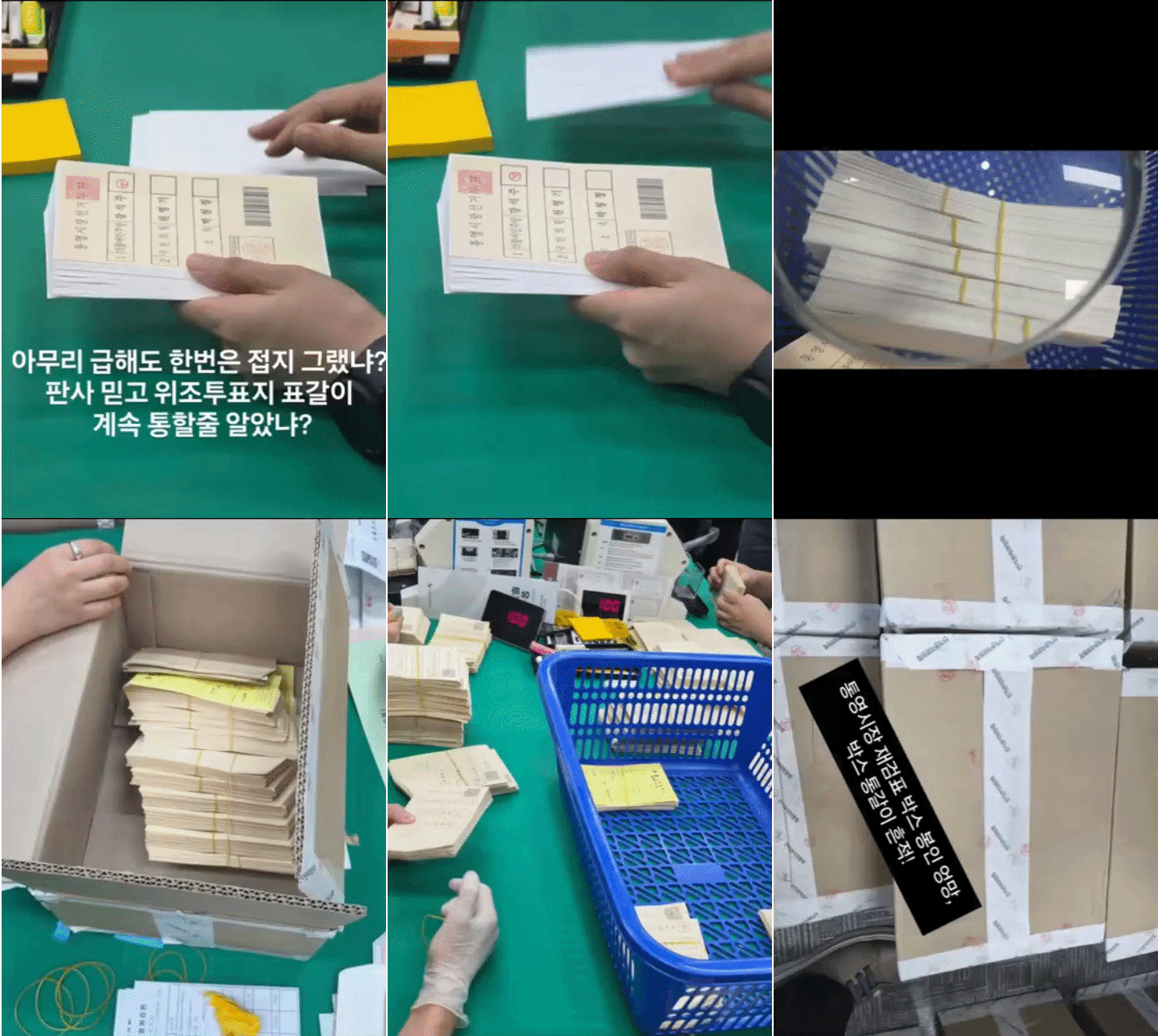 “Ignoring crisp ballots and damaged seals”… Tongyeong mayoral recount concludes with ‘no change in outcome,’ leaving suspicions and public outrage behind
Suspected counterfeit ballots discovered in Tongyeong [GIF from social media of Representative Hwang Kyo-ahn / Attorney Park Joo-hyun]During a recount of the Tongyeong mayoral election in South Gyeong
“Ignoring crisp ballots and damaged seals”… Tongyeong mayoral recount concludes with ‘no change in outcome,’ leaving suspicions and public outrage behind
Suspected counterfeit ballots discovered in Tongyeong [GIF from social media of Representative Hwang Kyo-ahn / Attorney Park Joo-hyun]During a recount of the Tongyeong mayoral election in South Gyeong
 President Yoon, regarding the first-instance ruling on the Public Official Election Act: “An excessive political verdict that distorts the facts… We will appeal immediately.”
The first-instance sentencing hearing for President Yoon Suk Yeol regarding violations of the Public Official Election Act is being broadcast live at Seoul Station on the 27th. [Photo=Yonhap News]Pres
President Yoon, regarding the first-instance ruling on the Public Official Election Act: “An excessive political verdict that distorts the facts… We will appeal immediately.”
The first-instance sentencing hearing for President Yoon Suk Yeol regarding violations of the Public Official Election Act is being broadcast live at Seoul Station on the 27th. [Photo=Yonhap News]Pres
 WSJ: "SK Hynix ADR Premium Is a Sign of AI Trading Overheat"
Advertisement for SK Hynix ADR listing in New York's Times Square [Reuters=Yonhap News file photo]The Wall Street Journal (WSJ) has pointed out that the price of SK Hynix’s American Depositary Recei
WSJ: "SK Hynix ADR Premium Is a Sign of AI Trading Overheat"
Advertisement for SK Hynix ADR listing in New York's Times Square [Reuters=Yonhap News file photo]The Wall Street Journal (WSJ) has pointed out that the price of SK Hynix’s American Depositary Recei
 'Godfather of Japanese Mystery Novels' Keigo Higashino Passes Away After Battle with Cancer at 68
Famous Japanese mystery novelist Keigo Higashino [AFP=Yonhap News]It has been belatedly reported that Keigo Higashino, the "godfather of Japanese mystery novels" and author of bestsellers such as "The
'Godfather of Japanese Mystery Novels' Keigo Higashino Passes Away After Battle with Cancer at 68
Famous Japanese mystery novelist Keigo Higashino [AFP=Yonhap News]It has been belatedly reported that Keigo Higashino, the "godfather of Japanese mystery novels" and author of bestsellers such as "The
 [Park Pil-kyu Security Column] To the Ignorant Trying to Clothe a Beast in Sheep's Clothing
Rep. Kim Byung-joo of the Democratic Party of Korea [Photo=Yonhap News]“The Air Force Academy doesn't teach you how to fly a plane!” “The Army, Navy, and Air Force academies are exactly the
[Park Pil-kyu Security Column] To the Ignorant Trying to Clothe a Beast in Sheep's Clothing
Rep. Kim Byung-joo of the Democratic Party of Korea [Photo=Yonhap News]“The Air Force Academy doesn't teach you how to fly a plane!” “The Army, Navy, and Air Force academies are exactly the
 [Issue Diagnosis] Two Effects of the Election Petition Review
 [Photo] Evidence of Election Fraud Flooding U.S. Media… Trump Had 2.7 Million Votes Stolen
 [Video] U.S. Semiquincentennial Air Show... 'Art in the Sky' streaks across New York
 [Editorial Cartoon] A Draconian Law That Undermines Freedom of Expression

 List
List