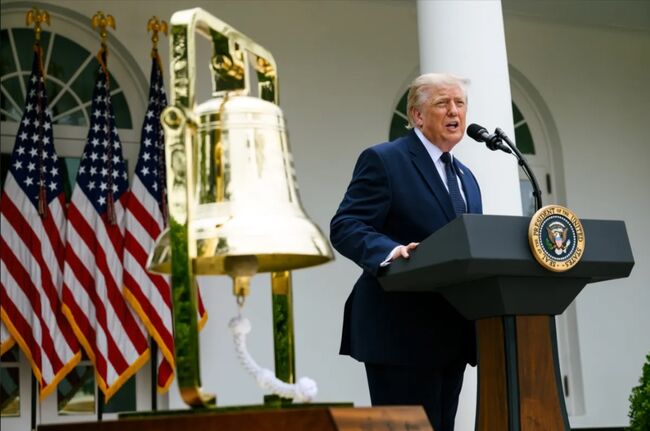
WTI futures prices plummeted immediately after President Trump announced his agreement to a two-week truce. At one point, it fell to $91.05, a decline of 19%. [Photo=The White House]
International oil prices took a sharp turn as the United States and Iran agreed to a two-week truce on the 8th (local time).
According to Reuters, immediately after the truce announcement, Brent crude fell 13.6% to $94.43 per barrel, and WTI dropped to $96.82, down 14.3%.
The market's initial reaction was not due to a confirmed end to the conflict, but rather the expectation that the Strait of Hormuz, through which approximately 20% of global crude oil trade passes, could reopen.
However, it is premature to interpret this development as an immediate "oil price stabilization."
While Brent and WTI are futures prices that reflect market sentiment of expectation and fear, physical crude prices in the Middle East are more closely watched by actual demand countries in Asia, including South Korea. Korea National Oil Corporation's Oil-Price.com also categorizes international crude oil prices as Dubai (spot), WTI (futures), and Brent (futures).
In fact, the prices released by the Korea National Oil Corporation on the 8th are still far from "stable."
According to Oil-Price.com, prices as of the 7th, announced on the 8th, were $121.86 for Dubai crude, $109.27 for Brent crude, and $112.95 for WTI. Compared to the previous day, Dubai crude rose by $1.66 from $120.20 to $121.86, while Brent crude fell by $0.50 from $109.77 to $109.27.
At least based on the official disclosure that South Korea refers to, Dubai crude actually increased further as Brent declined.
The atmosphere in the Asian physical market reported by Reuters is similar. In its report on the 8th, Reuters noted that while Brent futures plummeted to $91.70 during the trading session, the physical crude market remained under significant stress.
Saudi Aramco raised its official selling price (OSP) for Arab Light for May to Asian customers by a premium of $19.50 per barrel above the average of Oman and Dubai. This is interpreted as a sign that the burden of physical procurement for Asian importers has not yet eased.
Ultimately, from South Korea's perspective, the key is not the daily drop in Brent's chart.
What is truly important is whether passage through the Strait of Hormuz actually stabilizes, and whether that stability is maintained after two weeks.
If the truce holds and shipping routes, insurance, and loading schedules normalize, Dubai crude could also face downward pressure later. However, if the truce falters, the sharp decline in Brent crude is likely to be reversed first.
The daily disclosure is worth noting. Oil-Price.com states that "prices at time T are surveyed on day T+1 due to the time difference with the location." This structure means that the truce reaction seen in today's market will be fully reflected in tomorrow's Korea National Oil Corporation disclosure.
In other words, until today, it was "Brent plummeted, but what about Dubai?" However, if Dubai crude starts to decline tomorrow, it could be the first signal that the truce expectations are extending to the physical market.
Conversely, if Dubai crude holds steady or rises further, it means that the oil price stabilization that South Korea experiences is still a long way off.
To summarize in one sentence:
The financial markets have already found relief, but the Middle Eastern physical prices that South Korea monitors are still withholding their response.
The true success or failure of this two-week truce will be determined not by the Brent graph, but by Dubai crude and the flow through the Strait of Hormuz from tomorrow onwards.

 Trump pressures for rate cut again ahead of FOMC... "Should be the lowest in the world"
U.S. President Donald Trump. [Photo = The White House] U.S. President Donald Trump once again pressured the Federal Reserve, the U.S. central bank, to lower interest rates on the 27th (local time
Trump pressures for rate cut again ahead of FOMC... "Should be the lowest in the world"
U.S. President Donald Trump. [Photo = The White House] U.S. President Donald Trump once again pressured the Federal Reserve, the U.S. central bank, to lower interest rates on the 27th (local time
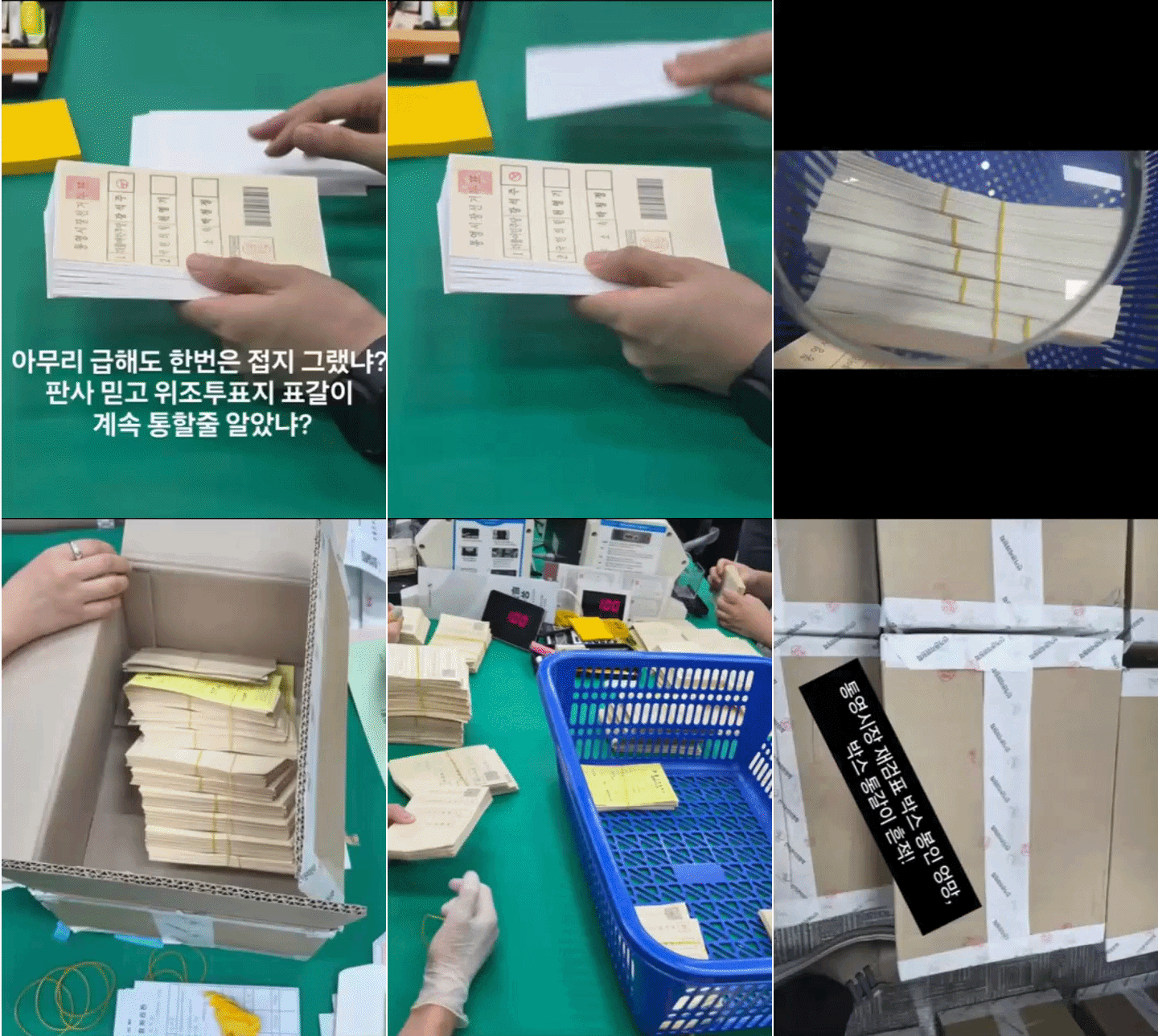 “Ignoring crisp ballots and damaged seals”… Tongyeong mayoral recount concludes with ‘no change in outcome,’ leaving suspicions and public outrage behind
Suspected counterfeit ballots discovered in Tongyeong [GIF from social media of Representative Hwang Kyo-ahn / Attorney Park Joo-hyun]During a recount of the Tongyeong mayoral election in South Gyeong
“Ignoring crisp ballots and damaged seals”… Tongyeong mayoral recount concludes with ‘no change in outcome,’ leaving suspicions and public outrage behind
Suspected counterfeit ballots discovered in Tongyeong [GIF from social media of Representative Hwang Kyo-ahn / Attorney Park Joo-hyun]During a recount of the Tongyeong mayoral election in South Gyeong
 President Yoon, regarding the first-instance ruling on the Public Official Election Act: “An excessive political verdict that distorts the facts… We will appeal immediately.”
The first-instance sentencing hearing for President Yoon Suk Yeol regarding violations of the Public Official Election Act is being broadcast live at Seoul Station on the 27th. [Photo=Yonhap News]Pres
President Yoon, regarding the first-instance ruling on the Public Official Election Act: “An excessive political verdict that distorts the facts… We will appeal immediately.”
The first-instance sentencing hearing for President Yoon Suk Yeol regarding violations of the Public Official Election Act is being broadcast live at Seoul Station on the 27th. [Photo=Yonhap News]Pres
 WSJ: "SK Hynix ADR Premium Is a Sign of AI Trading Overheat"
Advertisement for SK Hynix ADR listing in New York's Times Square [Reuters=Yonhap News file photo]The Wall Street Journal (WSJ) has pointed out that the price of SK Hynix’s American Depositary Recei
WSJ: "SK Hynix ADR Premium Is a Sign of AI Trading Overheat"
Advertisement for SK Hynix ADR listing in New York's Times Square [Reuters=Yonhap News file photo]The Wall Street Journal (WSJ) has pointed out that the price of SK Hynix’s American Depositary Recei
 'Godfather of Japanese Mystery Novels' Keigo Higashino Passes Away After Battle with Cancer at 68
Famous Japanese mystery novelist Keigo Higashino [AFP=Yonhap News]It has been belatedly reported that Keigo Higashino, the "godfather of Japanese mystery novels" and author of bestsellers such as "The
'Godfather of Japanese Mystery Novels' Keigo Higashino Passes Away After Battle with Cancer at 68
Famous Japanese mystery novelist Keigo Higashino [AFP=Yonhap News]It has been belatedly reported that Keigo Higashino, the "godfather of Japanese mystery novels" and author of bestsellers such as "The
 [Park Pil-kyu Security Column] To the Ignorant Trying to Clothe a Beast in Sheep's Clothing
Rep. Kim Byung-joo of the Democratic Party of Korea [Photo=Yonhap News]“The Air Force Academy doesn't teach you how to fly a plane!” “The Army, Navy, and Air Force academies are exactly the
[Park Pil-kyu Security Column] To the Ignorant Trying to Clothe a Beast in Sheep's Clothing
Rep. Kim Byung-joo of the Democratic Party of Korea [Photo=Yonhap News]“The Air Force Academy doesn't teach you how to fly a plane!” “The Army, Navy, and Air Force academies are exactly the
 [Issue Diagnosis] Two Effects of the Election Petition Review
 [Photo] Evidence of Election Fraud Flooding U.S. Media… Trump Had 2.7 Million Votes Stolen
 [Video] U.S. Semiquincentennial Air Show... 'Art in the Sky' streaks across New York
 [Editorial Cartoon] A Draconian Law That Undermines Freedom of Expression

 List
List