Cargo ships near the Strait of Hormuz [Reuters Yonhap News]
With the United States and Iran dramatically agreeing to a two-week truce on the 7th (local time), the closure of the Strait of Hormuz, which has choked global economies and energy supply and demand since the outbreak of war, is expected to ease.
However, this is only a temporary opening during the truce, and passage could be blocked again if negotiations between the US and Iran fail. Furthermore, Iran's stance is to maintain control over the strait in some way even after the war ends, raising concerns that free passage as before the war may not be possible again.
The Strait of Hormuz, located between the Arabian Peninsula and Iran, is a key route for Middle Eastern oil-producing countries adjacent to the Persian Gulf to export crude oil and liquefied natural gas (LNG) by sea. For countries worldwide that depend on Middle Eastern energy, the reopening of the strait has been a major concern.
U.S. President Donald Trump announced on his social media service (SNS) Truth Social that he would halt attacks on Iran for two weeks on the condition that Iran agrees to the "complete, immediate, and safe opening of the Strait of Hormuz."
Subsequently, Iran's Foreign Minister Abbas Araghchi also announced the truce, stating on X (formerly Twitter) that "Through coordination with the Iranian military and with due consideration for technical limitations, safe passage through the Strait of Hormuz will be possible for two weeks."
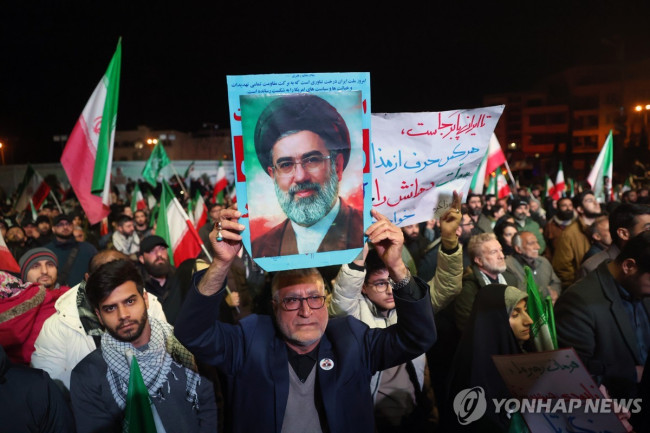 Iranians take to the streets after the ceasefire announcement [EPA Yonhap News]
Iran retaliated against the U.S. by controlling ship traffic in the Strait of Hormuz immediately after being attacked by the U.S. on February 28.
This was an asymmetrical strategy to pressure the U.S. by cutting off energy trade through the strait, effectively holding the global economy hostage, as Iran lacked the military power to confront the U.S. alone. This strategy proved to be highly effective.
Economies in Europe and Asia, heavily reliant on Middle Eastern energy, were hit hard by soaring oil prices, and supply chains for various industries using oil as a raw material experienced disruptions.
President Trump argued that the Strait's closure was a problem for Europe and Asia, as the U.S. does not import much energy through Hormuz. There was speculation that Trump might end the war with the Strait closed, as long as U.S. military objectives were met.
However, ultimately, the U.S. could not remain completely free from the global economic instability caused by the Strait's closure. Therefore, President Trump appears to have prioritized the Strait's reopening while seeking a truce with Iran.
Iran had also been under pressure to quickly reopen the Strait, given the significant damage caused to countries not directly involved in the war.
Approximately 40 countries worldwide, including South Korea, held a video conference hosted by the UK on the 2nd, urging Iran for an "unconditional reopening of the Strait." A resolution calling for the protection of merchant ships and the lifting of the blockade in the Strait was also discussed at the UN Security Council.
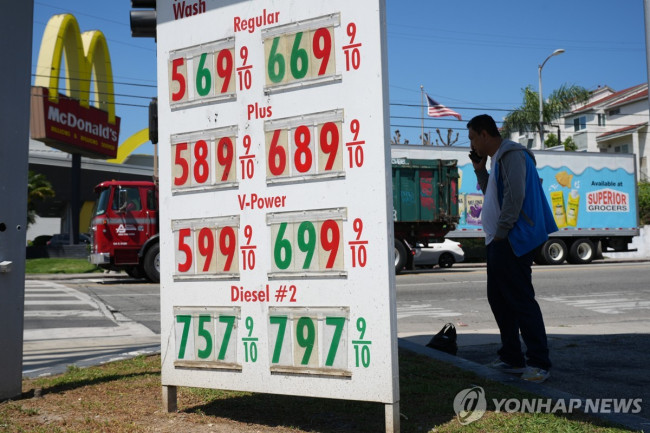 Gasoline prices at a U.S. gas station [AP Yonhap News]
If Iran allows passage through the Strait as announced, energy supply and demand in countries worldwide could become smoother.
Following President Trump's truce announcement on the same day, international oil prices plummeted, with West Texas Intermediate (WTI) and Brent crude futures falling below $100 for the first time since the 2nd.
Global stock markets, including the KOSPI, which had been weighed down by the burden of the Iran war, also entered a rally, relieved by the truce announcement.
However, it remains uncertain whether trade through the Strait will fully normalize to pre-war levels.
Experts have predicted that even if the Strait reopens, it could take a considerable amount of time to restore oil production and exports to their previous levels after the damage caused by the war.
Furthermore, Iran's stance is to continue "managing" the Strait, imposing conditions such as "coordination with the Iranian military" while allowing ship passage. Even during the two-week truce period, the condition of "coordination with the Iranian military" could pose an obstacle.
Iran has been pursuing the imposition of transit fees on ships passing through the Strait and has been discussing regulations with Oman, located across the Strait, to manage passage.
A Middle Eastern official told the Associated Press that Iran's proposed peace terms to the U.S. included provisions for Iran and Oman to collect transit fees from ships passing through the Strait and use the funds for reconstruction.
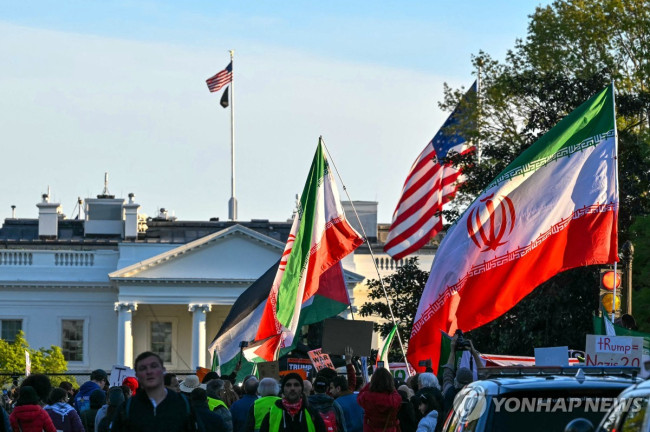 Anti-war demonstration in front of the White House in the U.S. [AFP Yonhap News]
The normalization of passage through the Strait is expected to be determined in the peace negotiations that the U.S. and Iran will conduct going forward.
The two countries are scheduled to negotiate the details in Islamabad, Pakistan, on the 10th, but there are not many expectations for these negotiations to proceed smoothly.
Iran claimed that the U.S. had fully accepted Iran's demands, including the right to enrich uranium and the lifting of sanctions. However, the U.S. has not yet disclosed the terms of the agreement, and President Trump views the peace proposal presented by Iran as a "foundation" for negotiation.
If the two countries fail to find common ground on contentious issues that caused the war, such as Iran's uranium enrichment, the truce could be suspended, and armed conflict could resume, making it impossible to rule out the possibility of Iran blocking the Strait again.
Even after the truce announcement, Iran's Supreme National Security Council warned that "our fingers are on the trigger" and that they could fight again if negotiations do not proceed as planned.
The Strait of Hormuz is a major gateway for oil and LNG exports from oil-producing countries such as Saudi Arabia, the UAE, Kuwait, Bahrain, Qatar, and Iraq. At its narrowest point, it is only 54 km wide, making it easy for Iran to control.
According to the International Energy Agency (IEA), an average of 20 million barrels of crude oil and petroleum products per day were transported through the Strait of Hormuz in 2025.
This accounts for about 25% of global seaborne crude oil trade, with 80% of it destined for Asia.
More than 90% of the LNG exported by Qatar and the UAE passes through the Strait of Hormuz, accounting for 19% of global LNG trade.

 [Statement by the Seo-beo-kka Korea Military Academy Save-the-Nation Comrades Association] ㉛ Recount the Votes Publicly, as the Previous Recount Concealed Election Fraud
Tongyeong Mayoral Election Recount [Photo=Yonhap News]South Korea's liberal democracy is dying. The National Election Commission (NEC) and the judiciary, which have plummeted into criminal syndicates
[Statement by the Seo-beo-kka Korea Military Academy Save-the-Nation Comrades Association] ㉛ Recount the Votes Publicly, as the Previous Recount Concealed Election Fraud
Tongyeong Mayoral Election Recount [Photo=Yonhap News]South Korea's liberal democracy is dying. The National Election Commission (NEC) and the judiciary, which have plummeted into criminal syndicates
 What is the significance of the "Trump 2028" red hats that keep making a comeback?
It is noteworthy that President Donald Trump is "intentionally" fueling controversy over whether he can actually run in the 2028 presidential election, even though it is "highly likely he is seriously
What is the significance of the "Trump 2028" red hats that keep making a comeback?
It is noteworthy that President Donald Trump is "intentionally" fueling controversy over whether he can actually run in the 2028 presidential election, even though it is "highly likely he is seriously
 Jin Cummings: “North Korea says it will increase the number of spies, so what is the government doing?”
U.S. political columnist Gene Cummings has publicly questioned the South Korean government, asking, "North Korea is declaring that it will increase its number of spies, so what is the South Kore
Jin Cummings: “North Korea says it will increase the number of spies, so what is the government doing?”
U.S. political columnist Gene Cummings has publicly questioned the South Korean government, asking, "North Korea is declaring that it will increase its number of spies, so what is the South Kore
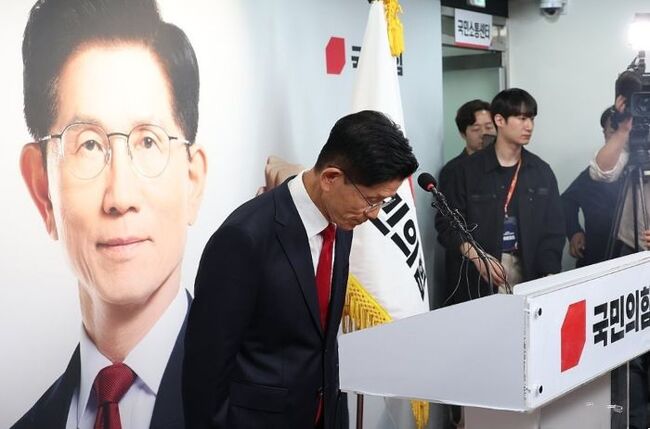 “Too little, too late?…” Kim Moon-soo, who previously conceded his presidential election defeat, now demands a special counsel investigation into ‘allegations of election fraud in the 2025 presidential election’
People Power Party presidential candidate Kim Moon-soo concedes defeat during a press conference at the party headquarters in Yeouido, Seoul, on June 4, 2025. [Joint Press Corps]As allegations emerge
“Too little, too late?…” Kim Moon-soo, who previously conceded his presidential election defeat, now demands a special counsel investigation into ‘allegations of election fraud in the 2025 presidential election’
People Power Party presidential candidate Kim Moon-soo concedes defeat during a press conference at the party headquarters in Yeouido, Seoul, on June 4, 2025. [Joint Press Corps]As allegations emerge
 Stock Market Crash 'Black Tuesday'… KOSPI down 10.8%, KOSDAQ down 7.7%
The KOSPI fell by more than 5% in early trading on the 28th, triggering a sell-side sidecar.On the 28th, the KOSPI plunged by more than 10%.Due to the sharp decline, a sell-side sidecar—a temporary
Stock Market Crash 'Black Tuesday'… KOSPI down 10.8%, KOSDAQ down 7.7%
The KOSPI fell by more than 5% in early trading on the 28th, triggering a sell-side sidecar.On the 28th, the KOSPI plunged by more than 10%.Due to the sharp decline, a sell-side sidecar—a temporary
 [World Heritage Committee] 25 New World Heritage Sites Inscribed in Busan… South Korea Successfully Expands 'Getbol' Listing
The Chairperson of the World Heritage Committee speaks at the plenary session of the 48th session of the World Heritage Committee, held at BEXCO in Busan on the 20th. [Photo: Yonhap News]A total of 25
[World Heritage Committee] 25 New World Heritage Sites Inscribed in Busan… South Korea Successfully Expands 'Getbol' Listing
The Chairperson of the World Heritage Committee speaks at the plenary session of the 48th session of the World Heritage Committee, held at BEXCO in Busan on the 20th. [Photo: Yonhap News]A total of 25
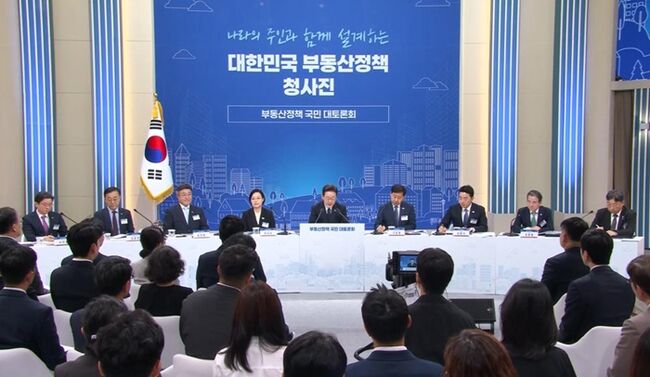 [Liberal Democratic Party Statement] Calling it a Grand Real Estate Debate… It Was Nothing More Than a Private Party Among Themselves
The 'National Grand Debate on Real Estate Policy' held on July 23rd and 27th. [Photo=Yonhap News]The 'National Grand Debate on Real Estate Policy,' hosted by the Lee Jae-myung administration under the
[Liberal Democratic Party Statement] Calling it a Grand Real Estate Debate… It Was Nothing More Than a Private Party Among Themselves
The 'National Grand Debate on Real Estate Policy' held on July 23rd and 27th. [Photo=Yonhap News]The 'National Grand Debate on Real Estate Policy,' hosted by the Lee Jae-myung administration under the
 [Photo] Evidence of Election Fraud Flooding U.S. Media… Trump Had 2.7 Million Votes Stolen
 [Video] U.S. Semiquincentennial Air Show... 'Art in the Sky' streaks across New York
 [Editorial Cartoon] A Draconian Law That Undermines Freedom of Expression

 List
List