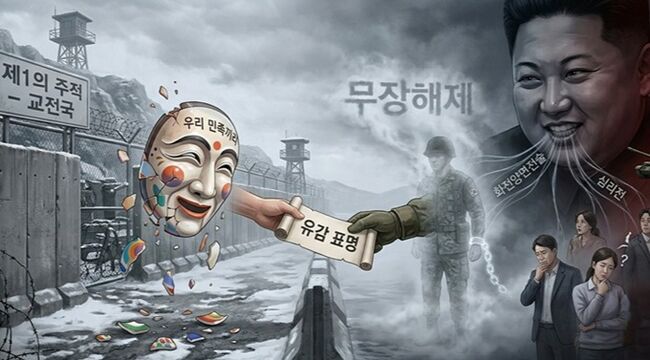
Following President Lee Jae-myung's unprecedented expression of regret over the incursion of civilian drones, Kim Yo-jong, who had been criticizing South Korea, suddenly praised the President as a "frank and bold person," quoting Chairman Kim Jong-un. This is an unfamiliar scene in the grammar of national security, and even more perplexing is that it contradicts North Korea's past actions.
The Strategic Vacuum Left by the Apology
Since 2014, North Korea has violated our airspace more than ten times without a single apology. Despite this, the current government bowing its head over a "personal deviation" has sent a wrong signal to North Korea: that "provocations can yield concessions." Particularly, the fact that the President expressed regret to the North in just ten days, while being skeptical about the demand for an apology from the bereaved families of the Cheonan sinking, undermines the consistency of security principles.
A national leader's apology can be interpreted as an 'admission of responsibility' in the international community. The moment the government expressed regret over the civilian drone issue, North Korea could construe it as an 'admission of South Korea's violation of sovereignty,' which could then be used as a justification for future localized provocations by North Korea.
The core of deterrence lies not in political apologies but in military strength that prevents miscalculation by the adversary. This apology, repeating a pattern of being dragged along by North Korea, could be a dangerous precedent that leads North Korea to underestimate our will to respond.
The Praise of a Communist State is a Tool to Break Down the Other's Defenses
When North Korea, which had declared South Korea an "enemy hostile state," suddenly starts praising us, we must question their intentions. Diplomatic praise from a communist state is often used as a tool to dismantle the opponent's defenses. North Korea's positive remarks are likely not a sign of respect, but part of cognitive warfare aimed at blurring South Korea's sense of security and fostering an illusion that "dialogue can solve problems," thereby dividing public opinion.
Communist language is a subject for verification, not belief. North Korea's strategy has not changed, and our apology may have made their calculations even bolder. In response to their praise of being "frank and bold," we must immediately shift the frame of discourse by saying, "With that boldness, comply with UN Security Council resolutions," to neutralize North Korea's psychological warfare tools.
The Recurrence of the Dual Tactics
North Korea's dual strategy remains unchanged. From the July 4th Joint Communiqué in 1972 to the Panmunjom Declaration in 2018, North Korea has simultaneously employed gestures of dialogue and military threats. For them, language is not a means of conveying truth but a device for deceiving the opponent.
In the winter of 2024, Kim Jong-un shed the guise of "Our Nation" that had maintained the minimum framework of inter-Korean relations for a long time and declared North and South as 'two states' and 'enemy hostile states.' This is a calculated hardline strategy to explicitly designate South Korea as the primary enemy, thereby securing justification for nuclear use and territorial conquest while avoiding criticism of 'fratricidal conflict' in the event of future armed conflict.
The armistice line in 2026 is no longer a temporary demarcation line towards unification. North Korea is building barriers and laying mines along the Military Demarcation Line, creating a physical border. The Korean Peninsula has once again become a frontline of 'state versus state.'
Kim Jong-un's praise and smiles, deployed through Kim Yo-jong, are intended to create cracks in the ROK-US-Japan cooperation system and disrupt internal security discussions in South Korea. An apology offered to an adversary that has declared itself an enemy state is not much different from handing over the keys to your house to a burglar and saying, "It was a misunderstanding." Security is not maintained by goodwill or regret.
Peace is a Product of Strong Power and National Defense Will, Not the Other Side's Benevolence
There are too many instances where pursuing peace led to war. In the Munich Agreement of 1938, Britain and France accepted Hitler's demands in hopes of peace, but this stimulated Germany's aggressive intentions and led to World War II.
Just before the Korean War in 1950, North Korea launched a disruptive "peace offensive" with measures like 'general elections in the North and South' and 'the release and repatriation of Cho Man-sik.' This was a meticulous deception to lower South Korea's vigilance and shift the blame for the war, while in the background, with Soviet support, they had completed preparations for an invasion, a state of 'calm before the storm.'
Peace is maintained only when the adversary is convinced that they cannot dare to trespass. What is needed now is not appeasing rhetoric, but a sober analysis that accurately reads North Korea's strategy and a deterrence strong enough to threaten the regime's existence in the event of an enemy provocation.
Since North Korea has declared South Korea an "enemy hostile state," we should also consider them a "state committing international legal violations" rather than an "illegally occupying group" and employ tactics such as filing lawsuits at the International Court of Justice (ICJ). The issues of Korean War criminals, abductees, and numerous border violations should be transformed into inter-state compensation issues to confine North Korea within an international legal framework and maximize economic and diplomatic pressure.
It is time to tighten the reins of security once again. Peace is the reward for those who defend it with strong power capable of defeating the enemy and with patriotic will. Security failures resulting from complacency about peace lead to national ruin, and this message is conveyed to the security line.

◆ Park Pil-gyu, Committee Member
Editorial Board Member, Hankook Ilbo
ROK Army Academy Class of 40

 Iranian Foreign Ministry: "Continuing Message Exchanges with the U.S. and Activities of Mediating Countries"
Esmaeil Baghaei, Spokesperson for the Iranian Ministry of Foreign Affairs [Xinhua, Yonhap News file photo]Esmaeil Baghaei, spokesperson for the Iranian Ministry of Foreign Affairs, stated on the 26th
Iranian Foreign Ministry: "Continuing Message Exchanges with the U.S. and Activities of Mediating Countries"
Esmaeil Baghaei, Spokesperson for the Iranian Ministry of Foreign Affairs [Xinhua, Yonhap News file photo]Esmaeil Baghaei, spokesperson for the Iranian Ministry of Foreign Affairs, stated on the 26th
 President Yoon: "Do You Think You Are Safe from the Special Counsel?"... Final Statement Video Released
President Yoon Suk Yeol rebuking the special prosecutor on the 24th. [Court video / @birds_justice X account subtitle GIF] A video of President Yoon Suk Yeol's closing statement at his trial rega
President Yoon: "Do You Think You Are Safe from the Special Counsel?"... Final Statement Video Released
President Yoon Suk Yeol rebuking the special prosecutor on the 24th. [Court video / @birds_justice X account subtitle GIF] A video of President Yoon Suk Yeol's closing statement at his trial rega
 President Yoon, regarding the first-instance ruling on the Public Official Election Act: “An excessive political verdict that distorts the facts… We will appeal immediately.”
The first-instance sentencing hearing for President Yoon Suk Yeol regarding violations of the Public Official Election Act is being broadcast live at Seoul Station on the 27th. [Photo=Yonhap News]Pres
President Yoon, regarding the first-instance ruling on the Public Official Election Act: “An excessive political verdict that distorts the facts… We will appeal immediately.”
The first-instance sentencing hearing for President Yoon Suk Yeol regarding violations of the Public Official Election Act is being broadcast live at Seoul Station on the 27th. [Photo=Yonhap News]Pres
 WSJ: "SK Hynix ADR Premium Is a Sign of AI Trading Overheat"
Advertisement for SK Hynix ADR listing in New York's Times Square [Reuters=Yonhap News file photo]The Wall Street Journal (WSJ) has pointed out that the price of SK Hynix’s American Depositary Recei
WSJ: "SK Hynix ADR Premium Is a Sign of AI Trading Overheat"
Advertisement for SK Hynix ADR listing in New York's Times Square [Reuters=Yonhap News file photo]The Wall Street Journal (WSJ) has pointed out that the price of SK Hynix’s American Depositary Recei
 'Godfather of Japanese Mystery Novels' Keigo Higashino Passes Away After Battle with Cancer at 68
Famous Japanese mystery novelist Keigo Higashino [AFP=Yonhap News]It has been belatedly reported that Keigo Higashino, the "godfather of Japanese mystery novels" and author of bestsellers such as "The
'Godfather of Japanese Mystery Novels' Keigo Higashino Passes Away After Battle with Cancer at 68
Famous Japanese mystery novelist Keigo Higashino [AFP=Yonhap News]It has been belatedly reported that Keigo Higashino, the "godfather of Japanese mystery novels" and author of bestsellers such as "The
 [Park Pil-kyu Security Column] To the Ignorant Trying to Clothe a Beast in Sheep's Clothing
Rep. Kim Byung-joo of the Democratic Party of Korea [Photo=Yonhap News]“The Air Force Academy doesn't teach you how to fly a plane!” “The Army, Navy, and Air Force academies are exactly the
[Park Pil-kyu Security Column] To the Ignorant Trying to Clothe a Beast in Sheep's Clothing
Rep. Kim Byung-joo of the Democratic Party of Korea [Photo=Yonhap News]“The Air Force Academy doesn't teach you how to fly a plane!” “The Army, Navy, and Air Force academies are exactly the
 [Issue Diagnosis] Two Effects of the Election Petition Review
 [Photo] Evidence of Election Fraud Flooding U.S. Media… Trump Had 2.7 Million Votes Stolen
 [Video] U.S. Semiquincentennial Air Show... 'Art in the Sky' streaks across New York
 [Editorial Cartoon] A Draconian Law That Undermines Freedom of Expression

 List
List









