U.S. Vice President Vance leaves Pakistan after talks with Iran break down. [Islamabad AFP=Yonhap News]
The United States and Iran engaged in marathon peace talks for 21 hours in Islamabad, the capital of Pakistan, on the 11th-12th (local time), but ultimately failed to reach an agreement.
While this outcome was somewhat expected, given that both countries are adopting a "victor nation" stance and their disagreement over whether to include Israel's attacks on Hezbollah in Lebanon in the ceasefire scope, international concern about the resumption of war is expected to grow as the two-week ceasefire period enters its final countdown.
Based on the joint statements released by both sides after the talks, it is presumed that the significant gap in their positions regarding Iran's denuclearization and the opening of the Strait of Hormuz was the main reason for the breakdown.
At a press conference following the negotiations, U.S. chief negotiator Vice President JD Vance stated, "The simple question is whether we see a fundamental commitment from the Iranians that they will not develop nuclear weapons, not now, not in two years, but for a long period of time. We haven't seen that yet."
Furthermore, Iran's semi-official Tasnim News Agency reported, "The U.S. intended to secure concessions in negotiations that it could not achieve on the battlefield, including issues related to the Strait of Hormuz and the removal of nuclear materials, but the Iranian delegation blocked this."
Ultimately, it appears the U.S. aimed to eliminate Iran's "present nuclear capability" by facilitating the export of all its highly enriched uranium to the U.S., while also suppressing its "future nuclear capability" or "nuclear weapon potential" by restricting Iran's uranium enrichment program, which could be used to produce nuclear materials.
However, Iran, operating under the perception that it suffered successive attacks from the U.S. and Israel last year and this year precisely because it did not possess nuclear weapons, has likely viewed the U.S. demand to abandon even the potential for nuclear weapon development as an "incitement to surrender." Consequently, Iran has maintained its stance that it cannot give up its "right to use peaceful nuclear energy" and has stated it will not abandon uranium enrichment.
Moreover, regarding the Strait of Hormuz, which Iran has blockaded since the outbreak of hostilities, the U.S. is demanding its immediate reopening, while Iran's position is that the strait can only be opened after a final agreement is reached, the U.S. daily New York Times (NYT) reported on the 11th, citing multiple senior Iranian officials familiar with the negotiation process.
For Iran, which is using the blockade of the Strait of Hormuz as a key leverage against the U.S., it appears that the moment the strait is fully opened, it would cede the initiative in the war and negotiations to the U.S., and also lose its most significant bargaining chip.
Conversely, the U.S., which has repeatedly stated it has largely achieved its war objectives, is presumed to have prioritized the lifting of the Strait of Hormuz blockade, which is contributing to rising oil prices and the subsequent deterioration of the U.S. and global economic situation, as the most urgent objective of this negotiation.
The U.S. naval vessels passing through the Strait of Hormuz and preparing for mine countermeasures on the day of the negotiations may have been a pressure tactic against Iran from the U.S. perspective, but Iran could have interpreted this as a sign of American "impatience."
Although the initial negotiations failed, both sides have likely gained insight into each other's positions and narrowed down the key issues to a few critical points, such as Iran's nuclear materials and the opening of the Strait of Hormuz. Therefore, the possibility of the two sides reaching a dramatic agreement through subsequent negotiations cannot be ruled out.
However, given the significant gap in positions on the core issues, it remains uncertain whether an agreement can be reached within the two-week ceasefire period, which ends on the 21st.
Particularly noteworthy is the assessment that Iran, despite facing relentless offensives from the U.S. and Israel, appears to believe that a "race against time" is not disadvantageous to them, considering the "pain" the blockade of Hormuz is inflicting on the U.S.
If the U.S. and Israel intend to retain the option of attacking Iran at any time to prevent nuclear weapons development, Iran's intention may be to prolong the war and endure further damage in order to secure a firm promise of non-aggression by using Hormuz as leverage.
Ultimately, the future negotiation prospects between the U.S. and Iran can be described as "foggy," offering no room for optimism.
Israel could significantly intensify its attacks on Lebanon, targeting the pro-Iranian armed group Hezbollah under the pretext of the U.S. and Iran's "Nodle" (likely a reference to a specific event or agreement not fully explained here, but implied to be a cause for Israeli action), which could then act as another negative factor in the negotiations.
With U.S. President Donald Trump's threat to destroy Iran's civilian infrastructure and Iran's card of long-term blockade of Hormuz causing concern not only to the parties involved in the war but also to the entire world, it is expected that the two sides will frantically oscillate between "crisis of catastrophe" and "seeking dialogue" amidst international mediation efforts.
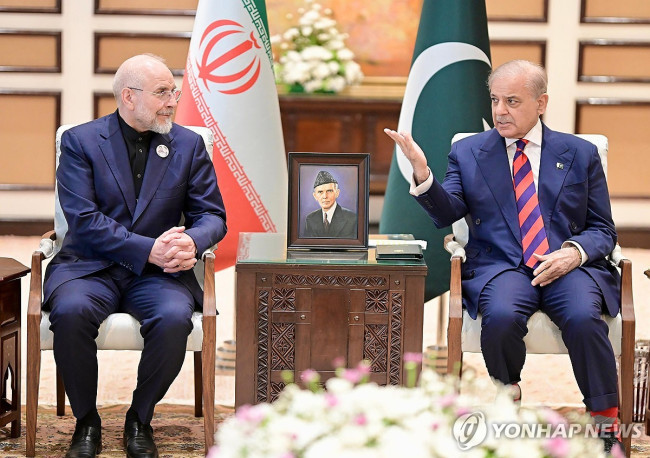 Iranian chief negotiator Ghalibaf (left) meets with Pakistani Prime Minister. [Islamabad UPI=Yonhap News]

 [Statement by the Seo-beo-kka Korea Military Academy Save-the-Nation Comrades Association] ㉛ Recount the Votes Publicly, as the Previous Recount Concealed Election Fraud
Tongyeong Mayoral Election Recount [Photo=Yonhap News]South Korea's liberal democracy is dying. The National Election Commission (NEC) and the judiciary, which have plummeted into criminal syndicates
[Statement by the Seo-beo-kka Korea Military Academy Save-the-Nation Comrades Association] ㉛ Recount the Votes Publicly, as the Previous Recount Concealed Election Fraud
Tongyeong Mayoral Election Recount [Photo=Yonhap News]South Korea's liberal democracy is dying. The National Election Commission (NEC) and the judiciary, which have plummeted into criminal syndicates
 What is the significance of the "Trump 2028" red hats that keep making a comeback?
It is noteworthy that President Donald Trump is "intentionally" fueling controversy over whether he can actually run in the 2028 presidential election, even though it is "highly likely he is seriously
What is the significance of the "Trump 2028" red hats that keep making a comeback?
It is noteworthy that President Donald Trump is "intentionally" fueling controversy over whether he can actually run in the 2028 presidential election, even though it is "highly likely he is seriously
 Jin Cummings: “North Korea says it will increase the number of spies, so what is the government doing?”
U.S. political columnist Gene Cummings has publicly questioned the South Korean government, asking, "North Korea is declaring that it will increase its number of spies, so what is the South Kore
Jin Cummings: “North Korea says it will increase the number of spies, so what is the government doing?”
U.S. political columnist Gene Cummings has publicly questioned the South Korean government, asking, "North Korea is declaring that it will increase its number of spies, so what is the South Kore
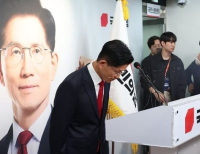
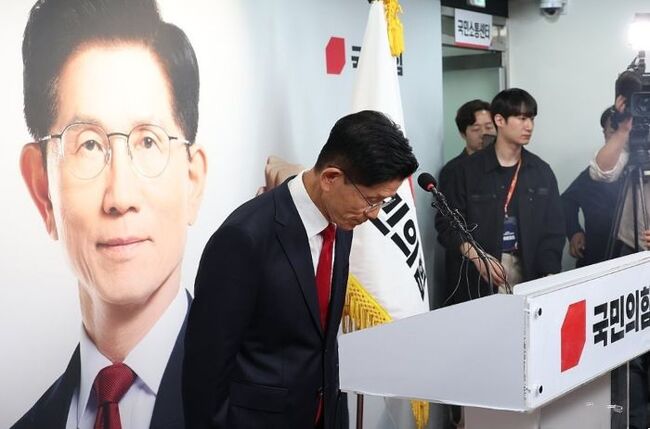 “Too little, too late?…” Kim Moon-soo, who previously conceded his presidential election defeat, now demands a special counsel investigation into ‘allegations of election fraud in the 2025 presidential election’
People Power Party presidential candidate Kim Moon-soo concedes defeat during a press conference at the party headquarters in Yeouido, Seoul, on June 4, 2025. [Joint Press Corps]As allegations emerge
“Too little, too late?…” Kim Moon-soo, who previously conceded his presidential election defeat, now demands a special counsel investigation into ‘allegations of election fraud in the 2025 presidential election’
People Power Party presidential candidate Kim Moon-soo concedes defeat during a press conference at the party headquarters in Yeouido, Seoul, on June 4, 2025. [Joint Press Corps]As allegations emerge
 Stock Market Crash 'Black Tuesday'… KOSPI down 10.8%, KOSDAQ down 7.7%
The KOSPI fell by more than 5% in early trading on the 28th, triggering a sell-side sidecar.On the 28th, the KOSPI plunged by more than 10%.Due to the sharp decline, a sell-side sidecar—a temporary
Stock Market Crash 'Black Tuesday'… KOSPI down 10.8%, KOSDAQ down 7.7%
The KOSPI fell by more than 5% in early trading on the 28th, triggering a sell-side sidecar.On the 28th, the KOSPI plunged by more than 10%.Due to the sharp decline, a sell-side sidecar—a temporary
 [World Heritage Committee] 25 New World Heritage Sites Inscribed in Busan… South Korea Successfully Expands 'Getbol' Listing
The Chairperson of the World Heritage Committee speaks at the plenary session of the 48th session of the World Heritage Committee, held at BEXCO in Busan on the 20th. [Photo: Yonhap News]A total of 25
[World Heritage Committee] 25 New World Heritage Sites Inscribed in Busan… South Korea Successfully Expands 'Getbol' Listing
The Chairperson of the World Heritage Committee speaks at the plenary session of the 48th session of the World Heritage Committee, held at BEXCO in Busan on the 20th. [Photo: Yonhap News]A total of 25
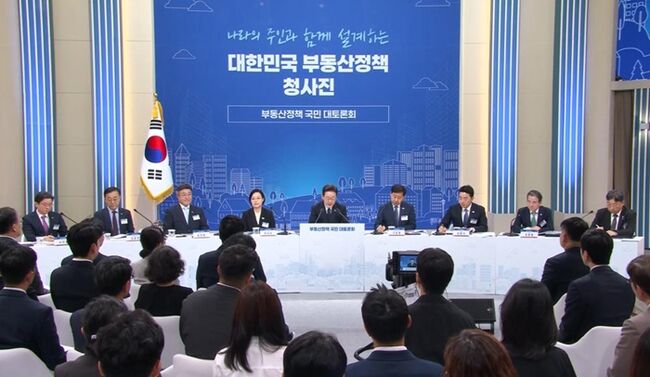 [Liberal Democratic Party Statement] Calling it a Grand Real Estate Debate… It Was Nothing More Than a Private Party Among Themselves
The 'National Grand Debate on Real Estate Policy' held on July 23rd and 27th. [Photo=Yonhap News]The 'National Grand Debate on Real Estate Policy,' hosted by the Lee Jae-myung administration under the
[Liberal Democratic Party Statement] Calling it a Grand Real Estate Debate… It Was Nothing More Than a Private Party Among Themselves
The 'National Grand Debate on Real Estate Policy' held on July 23rd and 27th. [Photo=Yonhap News]The 'National Grand Debate on Real Estate Policy,' hosted by the Lee Jae-myung administration under the
 [Photo] Evidence of Election Fraud Flooding U.S. Media… Trump Had 2.7 Million Votes Stolen
 [Video] U.S. Semiquincentennial Air Show... 'Art in the Sky' streaks across New York
 [Editorial Cartoon] A Draconian Law That Undermines Freedom of Expression

 List
List