President Trump [AP=Yonhap News]
Following the breakdown of ceasefire negotiations between the United States and Iran, U.S. President Donald Trump announced on the 12th (local time) that he would initiate procedures to blockade ships passing through the Strait of Hormuz, in his first message after the talks collapsed.
The U.S.'s decision to directly blockade the Strait of Hormuz, which it had been pressuring Iran to keep open, is interpreted as an intention to maximize pressure by cutting off Iran's primary source of funding.
According to U.S. CNN, Iran had been allowing passage for some oil tankers since the start of the war with the U.S., in exchange for blocking the Strait of Hormuz and charging up to $2 million per ship for passage.
Additionally, Iran exported an average of 1.85 million barrels of crude oil per day during the war, an increase of 100,000 barrels per day compared to the preceding three months.
The U.S., which had been blocking Iranian crude oil sales citing Iran's withdrawal from the nuclear deal, partially eased sanctions on Iranian crude oil during this war, concerned about a surge in international oil prices.
This decision was based on the assessment that a complete blockade of Iranian crude oil could further increase pressure for global oil price hikes.
In particular, last month, the U.S. allowed Iranian crude oil waiting at sea on tankers to be sold for one month.
The U.S. Energy Information Administration (EIA) estimated that approximately 140 million barrels of Iranian crude oil were supplied to the market during this period, enough to meet global demand for about 1.5 days.
During this process, Iran reportedly secured substantial profits by selling its crude oil at a premium above the international benchmark Brent crude price.
Sales channels, which were previously limited primarily to China, expanded to Western countries, enabling more stable funding for the war.
It appears that the U.S.'s tolerance for the distribution of Iranian crude oil was a reluctant measure to minimize domestic and international backlash resulting from rising oil prices.
The Trump administration also lifted sanctions on hundreds of millions of barrels of Russian crude oil last month.
Amidst this, Trump's announcement of a counter-blockade of Hormuz on this day has led to interpretations that it aims to increase negotiating leverage, even at the cost of short-term oil price increases, as ceasefire negotiations reach an impasse.
The analysis suggests this is a strategy to block Iran's use of the threat of blocking the strait as a bargaining chip and instead for the U.S. to gain leverage by securing control of the strait.
While this could provoke market instability, including short-term oil price hikes, it appears to be based on a calculation to create a more favorable negotiation landscape by cutting off Iran's oil exports and toll revenue in the long run.
Some speculate that President Trump's intention is not to implement a full blockade, but rather to maximize the "deterrent effect" to enhance negotiating power.
However, concerns are also being raised that if the U.S.'s Hormuz blockade measure becomes a reality, global energy markets could become even more unstable, and the burden on economies worldwide could increase.
Furthermore, the geographical characteristics of the narrow strait make U.S. Navy ships vulnerable to drone or missile attacks, which is also cited as a risk factor.
Senator Mark Warner, the ranking Democrat on the Senate Intelligence Committee, told CNN, "I don't understand how blockading the strait is going to pressure Iran to open up the strait," adding, "There's no connection whatsoever."

 [Statement by the Seo-beo-kka Korea Military Academy Save-the-Nation Comrades Association] ㉛ Recount the Votes Publicly, as the Previous Recount Concealed Election Fraud
Tongyeong Mayoral Election Recount [Photo=Yonhap News]South Korea's liberal democracy is dying. The National Election Commission (NEC) and the judiciary, which have plummeted into criminal syndicates
[Statement by the Seo-beo-kka Korea Military Academy Save-the-Nation Comrades Association] ㉛ Recount the Votes Publicly, as the Previous Recount Concealed Election Fraud
Tongyeong Mayoral Election Recount [Photo=Yonhap News]South Korea's liberal democracy is dying. The National Election Commission (NEC) and the judiciary, which have plummeted into criminal syndicates
 What is the significance of the "Trump 2028" red hats that keep making a comeback?
It is noteworthy that President Donald Trump is "intentionally" fueling controversy over whether he can actually run in the 2028 presidential election, even though it is "highly likely he is seriously
What is the significance of the "Trump 2028" red hats that keep making a comeback?
It is noteworthy that President Donald Trump is "intentionally" fueling controversy over whether he can actually run in the 2028 presidential election, even though it is "highly likely he is seriously
 Jin Cummings: “North Korea says it will increase the number of spies, so what is the government doing?”
U.S. political columnist Gene Cummings has publicly questioned the South Korean government, asking, "North Korea is declaring that it will increase its number of spies, so what is the South Kore
Jin Cummings: “North Korea says it will increase the number of spies, so what is the government doing?”
U.S. political columnist Gene Cummings has publicly questioned the South Korean government, asking, "North Korea is declaring that it will increase its number of spies, so what is the South Kore
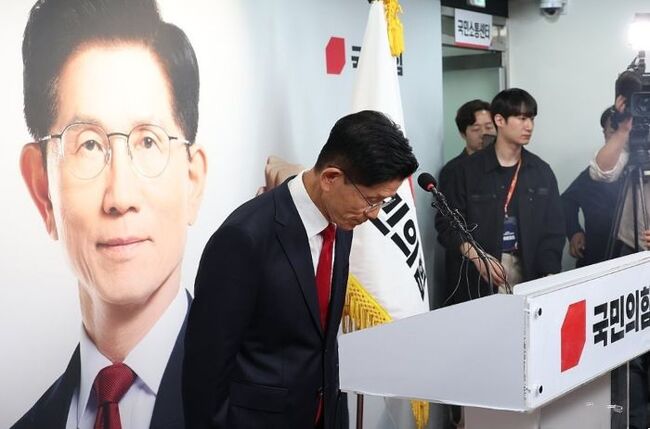 “Too little, too late?…” Kim Moon-soo, who previously conceded his presidential election defeat, now demands a special counsel investigation into ‘allegations of election fraud in the 2025 presidential election’
People Power Party presidential candidate Kim Moon-soo concedes defeat during a press conference at the party headquarters in Yeouido, Seoul, on June 4, 2025. [Joint Press Corps]As allegations emerge
“Too little, too late?…” Kim Moon-soo, who previously conceded his presidential election defeat, now demands a special counsel investigation into ‘allegations of election fraud in the 2025 presidential election’
People Power Party presidential candidate Kim Moon-soo concedes defeat during a press conference at the party headquarters in Yeouido, Seoul, on June 4, 2025. [Joint Press Corps]As allegations emerge
 Stock Market Crash 'Black Tuesday'… KOSPI down 10.8%, KOSDAQ down 7.7%
The KOSPI fell by more than 5% in early trading on the 28th, triggering a sell-side sidecar.On the 28th, the KOSPI plunged by more than 10%.Due to the sharp decline, a sell-side sidecar—a temporary
Stock Market Crash 'Black Tuesday'… KOSPI down 10.8%, KOSDAQ down 7.7%
The KOSPI fell by more than 5% in early trading on the 28th, triggering a sell-side sidecar.On the 28th, the KOSPI plunged by more than 10%.Due to the sharp decline, a sell-side sidecar—a temporary
 [World Heritage Committee] 25 New World Heritage Sites Inscribed in Busan… South Korea Successfully Expands 'Getbol' Listing
The Chairperson of the World Heritage Committee speaks at the plenary session of the 48th session of the World Heritage Committee, held at BEXCO in Busan on the 20th. [Photo: Yonhap News]A total of 25
[World Heritage Committee] 25 New World Heritage Sites Inscribed in Busan… South Korea Successfully Expands 'Getbol' Listing
The Chairperson of the World Heritage Committee speaks at the plenary session of the 48th session of the World Heritage Committee, held at BEXCO in Busan on the 20th. [Photo: Yonhap News]A total of 25
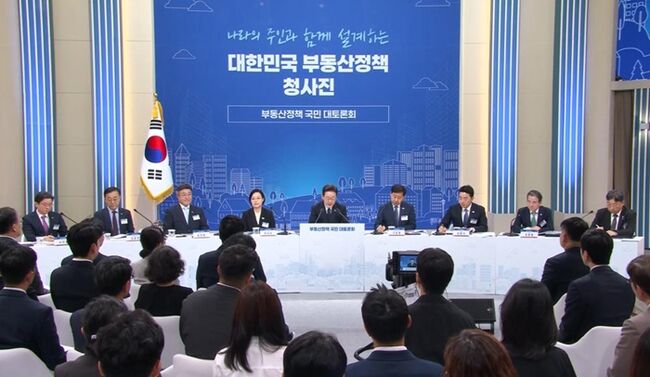 [Liberal Democratic Party Statement] Calling it a Grand Real Estate Debate… It Was Nothing More Than a Private Party Among Themselves
The 'National Grand Debate on Real Estate Policy' held on July 23rd and 27th. [Photo=Yonhap News]The 'National Grand Debate on Real Estate Policy,' hosted by the Lee Jae-myung administration under the
[Liberal Democratic Party Statement] Calling it a Grand Real Estate Debate… It Was Nothing More Than a Private Party Among Themselves
The 'National Grand Debate on Real Estate Policy' held on July 23rd and 27th. [Photo=Yonhap News]The 'National Grand Debate on Real Estate Policy,' hosted by the Lee Jae-myung administration under the
 [Photo] Evidence of Election Fraud Flooding U.S. Media… Trump Had 2.7 Million Votes Stolen
 [Video] U.S. Semiquincentennial Air Show... 'Art in the Sky' streaks across New York
 [Editorial Cartoon] A Draconian Law That Undermines Freedom of Expression

 List
List