The 'rejection' of the arrest warrant for Heo Gyeom, CEO of 'Hanmi Ilbo', signifies more than just a legal procedure to determine the detention of a journalist.
Firstly, we are relieved that the South Korean judiciary is functioning as the last bastion of the rule of law. The state's attempt to mobilize criminal power and detain individuals under the pretext of media reporting or uncomfortable expressions is a regressive idea aimed at preemptively suppressing uncomfortable questions to power, thereby turning the entire society into a 'silent, vast cave'.
As one of the editors of 'Hanmi Ilbo', I am compelled to ask whether our community is a 'developed nation that defends freedom' or a 'developing nation where the state controls truth'.
1. The Depth of Questions is the Measure of a Community's Freedom
Historically, the core engine that has sustained democracy has been 'uncomfortable questions' that challenge the sensibilities of power. The Socratic method (Elenchus) that Socrates engaged in with the youth in the ancient Greek agora, while shaking the authority of the vested interests with uncomfortable questions at the time, became the foundation of Western intellectual history.
The act of preventing uncomfortable questions is not a mere absence of communication. It is a fatal toxin that causes constipation of public opinion and arteriosclerosis of decision-making, paralyzes collective intelligence, and slowly leads the organism called a nation into a state of brain death.
In George Orwell's novel '1984', one of the slogans of Oceania, ruled by 'Big Brother', was "Ignorance is Strength." We are concerned that the signs of suppression of press and expression freedoms occurring in our society today may be a harbinger of that ominous fictional imagination projecting itself into reality.
For a power that seeks to control the future by unilaterally interpreting and controlling the past, citizens' questions filled with doubt and suspicion are merely tumors to be removed. The lifeline of liberal democracy does not lie in the distorted justice proclaimed by the government, but in the depth of questions citizens can pose to the government and the state, and the extent to which those questions are protected.
2. Biased Interpretation and Monopoly of History Lead to Bankruptcy of Freedom and Entry into Totalitarianism
John Milton, a pioneer of freedom of the press in the 17th century, argued in 'Areopagitica' to "Let truth and falsehood grapple; who ever knew truth put to the worse, in a free and open encounter?" This is based on the belief that truth has the inherent ability to defend itself, and human reason has the capacity to correct errors. However, the moment the government intervenes with criminal power and silences one side, it ceases to be universal truth and devolves into a doctrine enforced by law, a mere 'dogma' dictated by the state.
History is not a preserved relic but a living organism that breathes through continuous reinterpretation. Human civilization could only move forward because Galileo Galilei challenged the official truth of his time, the 'geocentric theory.' Had the Roman Holy See at the time, with logic akin to today's 'laws punishing historical distortion' or 'special laws,' preemptively blocked questions, humanity would still be trapped in the darkness of the geocentric theory.
Allowing the state to permit only a single 'official narrative' on a specific event and criminalizing dissent as 'spreading false information' is 'intellectual totalitarianism.'
Truth does not hide behind legal texts. Rather, truth gains its legitimacy only when it is tempered in the fire of harsh rebuttal and verification. Attempts to bind uncomfortable historical questions with the law paradoxically reveal how logically fragile the truth they seek to protect is.
3. The Collapse of Trust in the Free System Caused by the Avoidance of Verification
When distrust arises in the electoral system and procedures, the bedrock of liberal democracy, a healthy democracy responds with 'transparent information disclosure' and 'unrestricted debate.' Look at the Dreyfus Affair that shook 19th-century France.
At the time, the French military concealed the truth and suppressed critics, citing national security and military honor. However, Émile Zola's cry of 'J'accuse' exposed how fragile the state's monopolized truth was, like a sandcastle.
The same principle should apply to electoral procedures or policy suspicions raised in our society today. Silencing those who raise suspicions with the label of 'fake news' and mobilizing prosecutorial power may quell immediate disturbances, but it only nurtures the monster of distrust growing in the shadows. When distrust surpasses a critical point, the social capital of 'trust' evaporates instantaneously, leading to the collapse of the free system.
If one truly wishes to defend the system, instead of silencing it with laws and sending critics to prison, one must bring clear and objective evidence to the tribunal of verification and persuade the people.
4. The State Should Be a Tribunal, Not a Judge of Truth
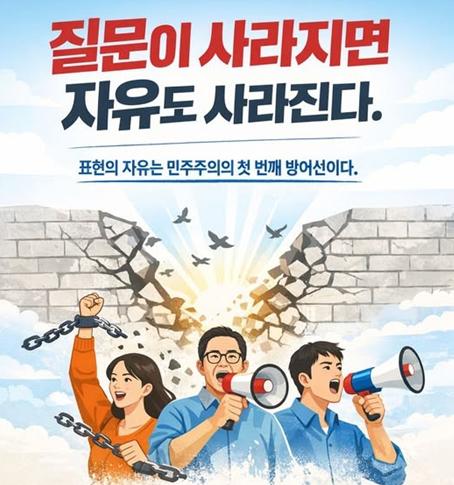
The rejection of the warrant for CEO Heo Gyeom is a stern warning against all attempts to enforce authoritarian silence. The state should not be a 'judge' that proclaims truth, but a 'tribunal' that ensures diverse opinions can be verified. Depriving people of the right to question is an act that severs the lifeline of liberal democracy.
We must take this incident as an opportunity to reaffirm that freedom of expression is not merely political rhetoric, but a fundamental principle that sustains our civilization. A society where questions cease to be asked is intellectually bankrupt, and power that seeks to castrate criticism is bound to perish through corruption.
We must unite to defend the right to question and shatter the language of fear wielded by power with the language of reason and truth. This is the appearance of a 'normal state' that we must protect in this era.

◆ Park Pil-kyu, Committee Member
Editor, Hanmi Ilbo
40th graduating class, Korea Military Academy

 [Statement by the Seo-beo-kka Korea Military Academy Save-the-Nation Comrades Association] ㉛ Recount the Votes Publicly, as the Previous Recount Concealed Election Fraud
Tongyeong Mayoral Election Recount [Photo=Yonhap News]South Korea's liberal democracy is dying. The National Election Commission (NEC) and the judiciary, which have plummeted into criminal syndicates
[Statement by the Seo-beo-kka Korea Military Academy Save-the-Nation Comrades Association] ㉛ Recount the Votes Publicly, as the Previous Recount Concealed Election Fraud
Tongyeong Mayoral Election Recount [Photo=Yonhap News]South Korea's liberal democracy is dying. The National Election Commission (NEC) and the judiciary, which have plummeted into criminal syndicates
 What is the significance of the "Trump 2028" red hats that keep making a comeback?
It is noteworthy that President Donald Trump is "intentionally" fueling controversy over whether he can actually run in the 2028 presidential election, even though it is "highly likely he is seriously
What is the significance of the "Trump 2028" red hats that keep making a comeback?
It is noteworthy that President Donald Trump is "intentionally" fueling controversy over whether he can actually run in the 2028 presidential election, even though it is "highly likely he is seriously
 Jin Cummings: “North Korea says it will increase the number of spies, so what is the government doing?”
U.S. political columnist Gene Cummings has publicly questioned the South Korean government, asking, "North Korea is declaring that it will increase its number of spies, so what is the South Kore
Jin Cummings: “North Korea says it will increase the number of spies, so what is the government doing?”
U.S. political columnist Gene Cummings has publicly questioned the South Korean government, asking, "North Korea is declaring that it will increase its number of spies, so what is the South Kore
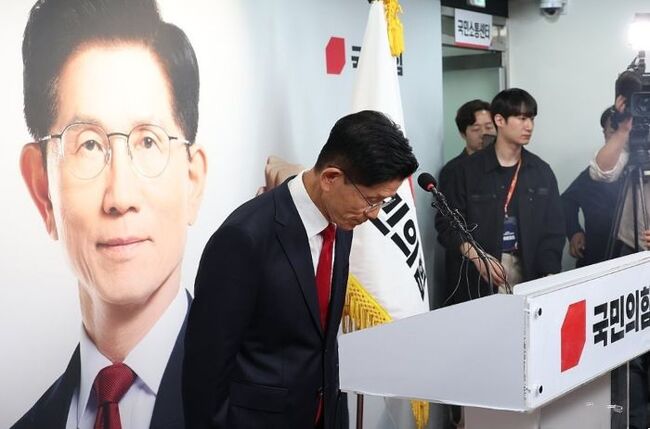 “Too little, too late?…” Kim Moon-soo, who previously conceded his presidential election defeat, now demands a special counsel investigation into ‘allegations of election fraud in the 2025 presidential election’
People Power Party presidential candidate Kim Moon-soo concedes defeat during a press conference at the party headquarters in Yeouido, Seoul, on June 4, 2025. [Joint Press Corps]As allegations emerge
“Too little, too late?…” Kim Moon-soo, who previously conceded his presidential election defeat, now demands a special counsel investigation into ‘allegations of election fraud in the 2025 presidential election’
People Power Party presidential candidate Kim Moon-soo concedes defeat during a press conference at the party headquarters in Yeouido, Seoul, on June 4, 2025. [Joint Press Corps]As allegations emerge
 Stock Market Crash 'Black Tuesday'… KOSPI down 10.8%, KOSDAQ down 7.7%
The KOSPI fell by more than 5% in early trading on the 28th, triggering a sell-side sidecar.On the 28th, the KOSPI plunged by more than 10%.Due to the sharp decline, a sell-side sidecar—a temporary
Stock Market Crash 'Black Tuesday'… KOSPI down 10.8%, KOSDAQ down 7.7%
The KOSPI fell by more than 5% in early trading on the 28th, triggering a sell-side sidecar.On the 28th, the KOSPI plunged by more than 10%.Due to the sharp decline, a sell-side sidecar—a temporary
 [World Heritage Committee] 25 New World Heritage Sites Inscribed in Busan… South Korea Successfully Expands 'Getbol' Listing
The Chairperson of the World Heritage Committee speaks at the plenary session of the 48th session of the World Heritage Committee, held at BEXCO in Busan on the 20th. [Photo: Yonhap News]A total of 25
[World Heritage Committee] 25 New World Heritage Sites Inscribed in Busan… South Korea Successfully Expands 'Getbol' Listing
The Chairperson of the World Heritage Committee speaks at the plenary session of the 48th session of the World Heritage Committee, held at BEXCO in Busan on the 20th. [Photo: Yonhap News]A total of 25
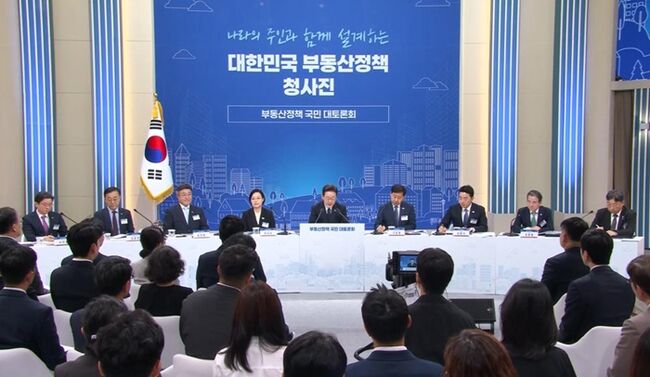 [Liberal Democratic Party Statement] Calling it a Grand Real Estate Debate… It Was Nothing More Than a Private Party Among Themselves
The 'National Grand Debate on Real Estate Policy' held on July 23rd and 27th. [Photo=Yonhap News]The 'National Grand Debate on Real Estate Policy,' hosted by the Lee Jae-myung administration under the
[Liberal Democratic Party Statement] Calling it a Grand Real Estate Debate… It Was Nothing More Than a Private Party Among Themselves
The 'National Grand Debate on Real Estate Policy' held on July 23rd and 27th. [Photo=Yonhap News]The 'National Grand Debate on Real Estate Policy,' hosted by the Lee Jae-myung administration under the
 [Photo] Evidence of Election Fraud Flooding U.S. Media… Trump Had 2.7 Million Votes Stolen
 [Video] U.S. Semiquincentennial Air Show... 'Art in the Sky' streaks across New York
 [Editorial Cartoon] A Draconian Law That Undermines Freedom of Expression

 List
List