U.S. Treasury Secretary Scott Bessant speaks at an economic event in Washington D.C. on the 14th (local time). [Photo=Yonhap News]The key points of the Iran war are not just the movement of the front lines. More importantly, it is how President Trump assessed alliances through this war, and how that assessment will translate into demands after the war.
The reappearance of Treasury Secretary Scott Bessant, who had been out of the spotlight for a while, and his bringing up tariff restoration and U.S.-China negotiation agendas, can be read in the same context.
On April 14th (local time), Bessant stated at a Wall Street Journal event that existing tariffs, which were halted by a Supreme Court ruling, could be restored to their previous levels by early July through measures like a Section 301 investigation under trade law.
On the same day, while criticizing China as an "unreliable global partner," he also mentioned that the relationship between President Trump and Chinese President Xi Jinping is stable and that a visit to Beijing is planned for mid-May.
It was a scene shifting attention back from the war to trade and U.S.-China negotiations.
These remarks were not isolated incidents. In a CNBC interview on March 4th, Bessant had already stated that the provisional global tariff of 10% under Section 122 of the Trade Act could be raised to 15%, outlining what is known as the "5-month bridge" plan to restore the existing tariff system by proceeding with Section 301 and Section 232 investigations over 150 days.
His remarks on April 14th are not a new initiative but rather a re-emergence of the roadmap now that the war situation has subsided.
Therefore, the core issue lies not in Bessant's remarks themselves but in their background.
If what President Trump saw through the war was not only Middle Eastern instability but also the question of "who stood with the U.S. and how much, and who was willing to share the costs," then U.S. pressure after the war may not be limited to military matters.
This suggests that tariffs, trade, supply chains, investments, defense costs, and energy could all be bundled back into a single transaction framework.
This aligns with Trump's publicly stated "one-stop shopping" concept since last year, where issues of defense cost sharing with South Korea and Japan are handled alongside tariff negotiations.
Narrowing the focus to South Korea, the questions become more specific.
In what form will Trump's perception of alliances translate into a bill for South Korea?
In fact, the first installment has already arrived. In March, the South Korean National Assembly passed legislation enabling the fulfillment of agreements, including $200 billion in strategic industry investments and $150 billion in shipbuilding cooperation with the U.S., totaling $350 billion.
While this legislation serves to support existing agreements with the U.S. through domestic systems, it was driven by the reality of Trump's pressure, who threatened higher tariffs on South Korean products if implementation was delayed.
Furthermore, South Korea is also included in the U.S.'s new Section 301 investigation into industrial overcapacity.
The Iran war has added energy costs to this situation. On April 15th, the South Korean government announced that it had secured 273 million barrels of crude oil and 2.1 million tons of naphtha through routes bypassing the Strait of Hormuz.
Based on last year's figures, 61% of South Korea's crude oil imports and 54% of its naphtha imports passed through the Strait of Hormuz. The very fact that the government is rapidly securing alternative supplies indicates that, even if the war ends, South Korea has already entered a phase of recalculating its supply chains, logistics, and energy procurement costs.
Ultimately, in the aftermath of the Iran war, the direction of the invoice is more noteworthy than the wording of any ceasefire.
It is unlikely to be a coincidence that Bessant has re-emerged to simultaneously address tariff restoration, pressure on China, and the possibility of U.S.-China summit diplomacy.
As the war situation has calmed down, this is a signal that the Trump administration's focus is shifting back to trade and cost-sharing negotiations. South Korea is likely to receive a complex invoice that bundles tariffs, U.S. investment, shipbuilding cooperation, defense costs, and energy procurement, rather than facing pressure on individual items.
If what President Trump sought to confirm during the war was not alliance loyalty but the allies' ability to pay and willingness to cooperate, then South Korea must now first consider "how the U.S. will present its next invoice" rather than "whether the war has ended."
The war may cease, but the transactions may just be beginning.

 [Statement by the Seo-beo-kka Korea Military Academy Save-the-Nation Comrades Association] ㉛ Recount the Votes Publicly, as the Previous Recount Concealed Election Fraud
Tongyeong Mayoral Election Recount [Photo=Yonhap News]South Korea's liberal democracy is dying. The National Election Commission (NEC) and the judiciary, which have plummeted into criminal syndicates
[Statement by the Seo-beo-kka Korea Military Academy Save-the-Nation Comrades Association] ㉛ Recount the Votes Publicly, as the Previous Recount Concealed Election Fraud
Tongyeong Mayoral Election Recount [Photo=Yonhap News]South Korea's liberal democracy is dying. The National Election Commission (NEC) and the judiciary, which have plummeted into criminal syndicates
 What is the significance of the "Trump 2028" red hats that keep making a comeback?
It is noteworthy that President Donald Trump is "intentionally" fueling controversy over whether he can actually run in the 2028 presidential election, even though it is "highly likely he is seriously
What is the significance of the "Trump 2028" red hats that keep making a comeback?
It is noteworthy that President Donald Trump is "intentionally" fueling controversy over whether he can actually run in the 2028 presidential election, even though it is "highly likely he is seriously
 Jin Cummings: “North Korea says it will increase the number of spies, so what is the government doing?”
U.S. political columnist Gene Cummings has publicly questioned the South Korean government, asking, "North Korea is declaring that it will increase its number of spies, so what is the South Kore
Jin Cummings: “North Korea says it will increase the number of spies, so what is the government doing?”
U.S. political columnist Gene Cummings has publicly questioned the South Korean government, asking, "North Korea is declaring that it will increase its number of spies, so what is the South Kore
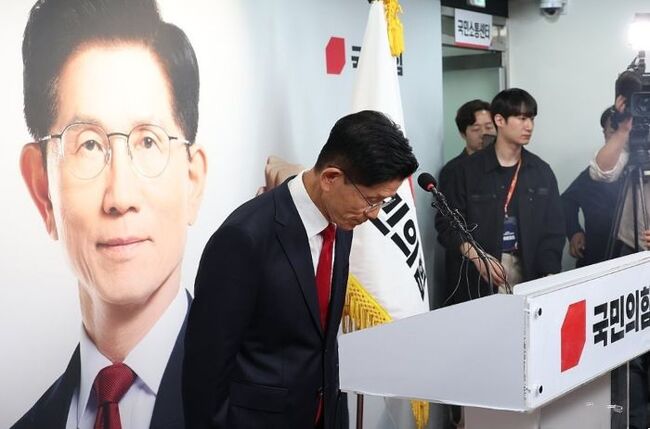 “Too little, too late?…” Kim Moon-soo, who previously conceded his presidential election defeat, now demands a special counsel investigation into ‘allegations of election fraud in the 2025 presidential election’
People Power Party presidential candidate Kim Moon-soo concedes defeat during a press conference at the party headquarters in Yeouido, Seoul, on June 4, 2025. [Joint Press Corps]As allegations emerge
“Too little, too late?…” Kim Moon-soo, who previously conceded his presidential election defeat, now demands a special counsel investigation into ‘allegations of election fraud in the 2025 presidential election’
People Power Party presidential candidate Kim Moon-soo concedes defeat during a press conference at the party headquarters in Yeouido, Seoul, on June 4, 2025. [Joint Press Corps]As allegations emerge
 Stock Market Crash 'Black Tuesday'… KOSPI down 10.8%, KOSDAQ down 7.7%
The KOSPI fell by more than 5% in early trading on the 28th, triggering a sell-side sidecar.On the 28th, the KOSPI plunged by more than 10%.Due to the sharp decline, a sell-side sidecar—a temporary
Stock Market Crash 'Black Tuesday'… KOSPI down 10.8%, KOSDAQ down 7.7%
The KOSPI fell by more than 5% in early trading on the 28th, triggering a sell-side sidecar.On the 28th, the KOSPI plunged by more than 10%.Due to the sharp decline, a sell-side sidecar—a temporary
 [World Heritage Committee] 25 New World Heritage Sites Inscribed in Busan… South Korea Successfully Expands 'Getbol' Listing
The Chairperson of the World Heritage Committee speaks at the plenary session of the 48th session of the World Heritage Committee, held at BEXCO in Busan on the 20th. [Photo: Yonhap News]A total of 25
[World Heritage Committee] 25 New World Heritage Sites Inscribed in Busan… South Korea Successfully Expands 'Getbol' Listing
The Chairperson of the World Heritage Committee speaks at the plenary session of the 48th session of the World Heritage Committee, held at BEXCO in Busan on the 20th. [Photo: Yonhap News]A total of 25
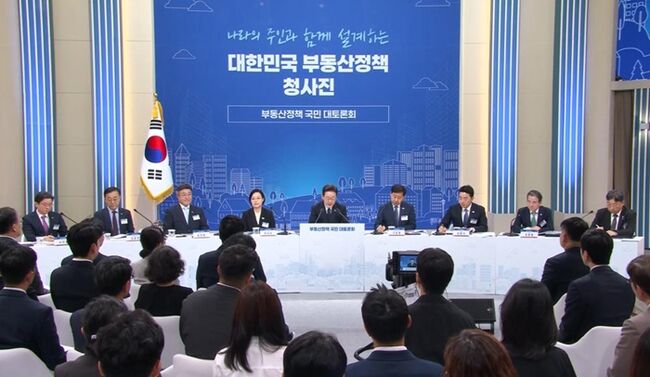 [Liberal Democratic Party Statement] Calling it a Grand Real Estate Debate… It Was Nothing More Than a Private Party Among Themselves
The 'National Grand Debate on Real Estate Policy' held on July 23rd and 27th. [Photo=Yonhap News]The 'National Grand Debate on Real Estate Policy,' hosted by the Lee Jae-myung administration under the
[Liberal Democratic Party Statement] Calling it a Grand Real Estate Debate… It Was Nothing More Than a Private Party Among Themselves
The 'National Grand Debate on Real Estate Policy' held on July 23rd and 27th. [Photo=Yonhap News]The 'National Grand Debate on Real Estate Policy,' hosted by the Lee Jae-myung administration under the
 [Photo] Evidence of Election Fraud Flooding U.S. Media… Trump Had 2.7 Million Votes Stolen
 [Video] U.S. Semiquincentennial Air Show... 'Art in the Sky' streaks across New York
 [Editorial Cartoon] A Draconian Law That Undermines Freedom of Expression

 List
List