The Japanese government has decided to provide financial support totaling $10 billion (approximately 14.7 trillion won) to Southeast Asian countries facing difficulties in procuring crude oil due to the war in Iran.
This move is interpreted as Japan, which relies on Southeast Asia for the import of goods such as surgical gloves and IV bags made from naphtha as raw material, contributing to the stabilization of regional supply chains. This, in turn, aims to strengthen the foundation of Japan's foreign policy promoting a "Free and Open Indo-Pacific" (FOIP) and expand its regional influence.
On the afternoon of the 14th, Prime Minister Kono held an online "AZEC Plus Summit on Energy Resilience" (Asia Zero Emission Community Plus).
Along with leaders from existing AZEC partner countries, including Philippine President Ferdinand Marcos Jr., Malaysian Prime Minister Anwar Ibrahim, Singaporean Prime Minister Lawrence Wong, and Thai Prime Minister Anutin Charnvirakul, Korean Prime Minister Kim Min-seok also attended.
AZEC is a cooperative framework launched and led by Japan in 2023, with 11 countries currently participating. South Korea is not a member but was invited to the meeting.
 Japanese Prime Minister Sanae Takaichi responding in the National Diet [Kyodo=Yonhap News]
This meeting was initiated and led by the Japanese government with the goal of cooperating with Asian countries amid growing concerns over supply chains for energy and key materials due to the Middle East situation.
After the meeting, Prime Minister Kono told reporters, "Our country (Japan) is closely connected with various Asian countries through supply chains and has a relationship of mutual dependence," and announced the launch of "Power Asia," a partnership to strengthen Asia's energy resource supply chains.
The core of this initiative is to pursue cooperation for structural responses, including cooperation on the construction and utilization of stockpiling tanks for the procurement and supply chain maintenance of crude oil and petroleum products within the region, securing critical minerals, and diversifying energy sources.
Furthermore, although it is difficult for the Japanese government to directly provide its own crude oil reserves to Southeast Asian countries, it plans to support these countries in securing crude oil through loans from the Japan Bank for International Cooperation (JBIC), a government-backed policy-based financial institution, and loan guarantees from the Nippon Export and Investment Insurance (NEXI).
The scale of financial cooperation through this initiative was presented as approximately $10 billion (about 14.7 trillion won).
Prime Minister Kono emphasized, "Supporting the strengthening of supply chains in various Asian countries through such cooperation also leads to the strengthening of the Japanese economy," adding, "This also realizes the 'Free and Open Indo-Pacific' that the Kono administration is advocating for."
Local media interpreted this meeting as having a significant aspect of preventing disruptions in the supply of key goods exported from these countries to Japan by financially supporting Southeast Asia's crude oil procurement.
This is because disruptions in the supply of naphtha, a raw material for various plastics, in Southeast Asia, which has insufficient crude oil reserves, are impacting Japan.
In fact, as the supply of medical gloves and tubes imported from Southeast Asia has become unstable, a sense of crisis has grown in Japan's medical field.
Meanwhile, the Asahi Shimbun reported that since the war in Iran, concerns about disruptions in the distribution of various goods based on crude oil have continued in Japan, and production disruptions across industries are also intensifying.
The Japan Paint Manufacturers Association stated that shipments of thinners, paints, and auxiliary materials made from petroleum have been halted, and some companies are feeling a sense of crisis in their operations.
However, the Japanese government maintains that while there are bottlenecks in the distribution process related to concerns about naphtha supply disruptions, the necessary quantities are being secured.

 [Statement by the Seo-beo-kka Korea Military Academy Save-the-Nation Comrades Association] ㉛ Recount the Votes Publicly, as the Previous Recount Concealed Election Fraud
Tongyeong Mayoral Election Recount [Photo=Yonhap News]South Korea's liberal democracy is dying. The National Election Commission (NEC) and the judiciary, which have plummeted into criminal syndicates
[Statement by the Seo-beo-kka Korea Military Academy Save-the-Nation Comrades Association] ㉛ Recount the Votes Publicly, as the Previous Recount Concealed Election Fraud
Tongyeong Mayoral Election Recount [Photo=Yonhap News]South Korea's liberal democracy is dying. The National Election Commission (NEC) and the judiciary, which have plummeted into criminal syndicates
 What is the significance of the "Trump 2028" red hats that keep making a comeback?
It is noteworthy that President Donald Trump is "intentionally" fueling controversy over whether he can actually run in the 2028 presidential election, even though it is "highly likely he is seriously
What is the significance of the "Trump 2028" red hats that keep making a comeback?
It is noteworthy that President Donald Trump is "intentionally" fueling controversy over whether he can actually run in the 2028 presidential election, even though it is "highly likely he is seriously
 Jin Cummings: “North Korea says it will increase the number of spies, so what is the government doing?”
U.S. political columnist Gene Cummings has publicly questioned the South Korean government, asking, "North Korea is declaring that it will increase its number of spies, so what is the South Kore
Jin Cummings: “North Korea says it will increase the number of spies, so what is the government doing?”
U.S. political columnist Gene Cummings has publicly questioned the South Korean government, asking, "North Korea is declaring that it will increase its number of spies, so what is the South Kore
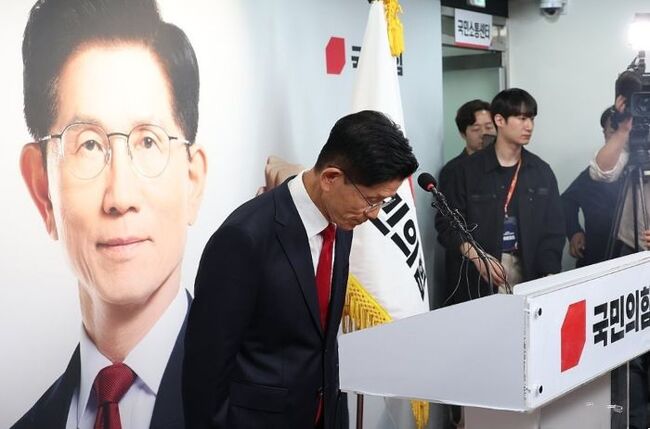 “Too little, too late?…” Kim Moon-soo, who previously conceded his presidential election defeat, now demands a special counsel investigation into ‘allegations of election fraud in the 2025 presidential election’
People Power Party presidential candidate Kim Moon-soo concedes defeat during a press conference at the party headquarters in Yeouido, Seoul, on June 4, 2025. [Joint Press Corps]As allegations emerge
“Too little, too late?…” Kim Moon-soo, who previously conceded his presidential election defeat, now demands a special counsel investigation into ‘allegations of election fraud in the 2025 presidential election’
People Power Party presidential candidate Kim Moon-soo concedes defeat during a press conference at the party headquarters in Yeouido, Seoul, on June 4, 2025. [Joint Press Corps]As allegations emerge
 Stock Market Crash 'Black Tuesday'… KOSPI down 10.8%, KOSDAQ down 7.7%
The KOSPI fell by more than 5% in early trading on the 28th, triggering a sell-side sidecar.On the 28th, the KOSPI plunged by more than 10%.Due to the sharp decline, a sell-side sidecar—a temporary
Stock Market Crash 'Black Tuesday'… KOSPI down 10.8%, KOSDAQ down 7.7%
The KOSPI fell by more than 5% in early trading on the 28th, triggering a sell-side sidecar.On the 28th, the KOSPI plunged by more than 10%.Due to the sharp decline, a sell-side sidecar—a temporary
 [World Heritage Committee] 25 New World Heritage Sites Inscribed in Busan… South Korea Successfully Expands 'Getbol' Listing
The Chairperson of the World Heritage Committee speaks at the plenary session of the 48th session of the World Heritage Committee, held at BEXCO in Busan on the 20th. [Photo: Yonhap News]A total of 25
[World Heritage Committee] 25 New World Heritage Sites Inscribed in Busan… South Korea Successfully Expands 'Getbol' Listing
The Chairperson of the World Heritage Committee speaks at the plenary session of the 48th session of the World Heritage Committee, held at BEXCO in Busan on the 20th. [Photo: Yonhap News]A total of 25
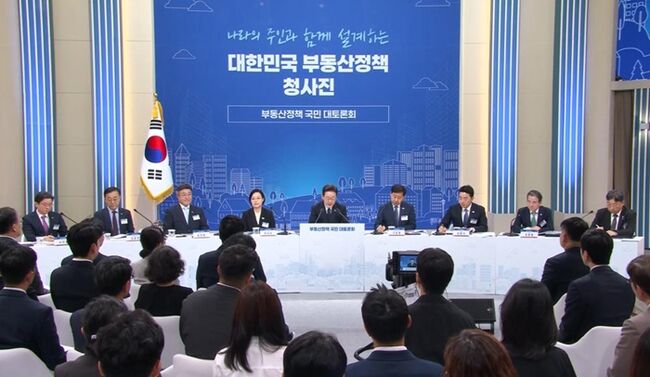 [Liberal Democratic Party Statement] Calling it a Grand Real Estate Debate… It Was Nothing More Than a Private Party Among Themselves
The 'National Grand Debate on Real Estate Policy' held on July 23rd and 27th. [Photo=Yonhap News]The 'National Grand Debate on Real Estate Policy,' hosted by the Lee Jae-myung administration under the
[Liberal Democratic Party Statement] Calling it a Grand Real Estate Debate… It Was Nothing More Than a Private Party Among Themselves
The 'National Grand Debate on Real Estate Policy' held on July 23rd and 27th. [Photo=Yonhap News]The 'National Grand Debate on Real Estate Policy,' hosted by the Lee Jae-myung administration under the
 [Photo] Evidence of Election Fraud Flooding U.S. Media… Trump Had 2.7 Million Votes Stolen
 [Video] U.S. Semiquincentennial Air Show... 'Art in the Sky' streaks across New York
 [Editorial Cartoon] A Draconian Law That Undermines Freedom of Expression

 List
List