 U.S. President Donald Trump nominated former Representative Michelle Steel, a Korean-American politician, as the nominee for the first ambassador to South Korea in his second administration, requesting Senate confirmation on the 13th (local time). [Photo: U.S. Congress]
Michelle Steel (Park Eun-ju), former U.S. Representative and nominee for U.S. Ambassador to South Korea, is facing the Senate confirmation process.
The position, which has been vacant for about 15 months, is now being filled, and the timing is opportune. It appears that a politically appointed individual has been deliberately deployed at a time when tariffs, stationing costs, supply chains, and security issues are being comprehensively readjusted.
How is she different from past U.S. Ambassadors to South Korea?
Let's look at the ambassadors over the past 30-plus years. James Laney, Stephen Bosworth, Thomas Hubbard, Christopher Hill, Alexander Vershbow, Kathleen Stephens, Sung Kim, Mark Lippert, Harry Harris, Philip Goldberg… The mainstream of this flow consists of career diplomats.
Exceptions include the heavyweight external appointee Laney, former President of Emory University; Lippert, a close confidant who served as Obama's National Security Council Chief of Staff; and Harris, a Navy admiral and former Commander of U.S. Indo-Pacific Command. Each was a strategic appointment with a clear purpose: managing the nuclear crisis, managing a close alliance with a trusted aide, or responding to North Korean nuclear and Indo-Pacific military crises.
While the position of U.S. Ambassador to South Korea has always been important, it was typically filled by a career diplomat, with special circumstances calling for an individual with strong presidential backing. Steel belongs to this line of "exceptions." What makes her even more of a direct political appointment is that she is not a general or a diplomat, but a Republican politician who has gone through several elections.
Why Steel and not Mosbacher?
Although she was not on the officially confirmed list of formal nominees, the name of another prominent Korean-American, Mosbacher, had circulated within conservative circles in South Korea. This was due to expectations that she would be a "strong value diplomacy card for the Trump administration." As a legal scholar, she served as a university professor and Ambassador-at-Large for International Criminal Justice during the first Trump administration, taught at Handong International Law School, and is an expert on North Korean human rights and international law.
The issue, however, would have been whether she could actually be deployed to South Korea. During her visit to Seoul last year, she was accused of making claims related to Lee Jae-myung and drew attention for her remarks supporting allegations of election fraud concerning Yoon Suk-yeol. Therefore, sending her to Seoul would have likely embroiled the ambassadorial post itself in the flames of South Korean domestic politics.
In contrast, while Steel clearly represents the Trump Republican Party's colors, she is less likely to be perceived as someone directly intervening in domestic politics. She is a politically appointed individual capable of engaging with the U.S. Congress, the administration, the Korean-American community, and the political circles in Seoul. From Trump's perspective, if Mosbacher was an "ideological signal flare," Steel is a "practical political card" capable of driving actual negotiations.
Steel's Strength Lies in Her Code, Not Her Bloodline
Steel was born in Seoul in 1955 to parents who fled North Korea to escape the Kim Il-sung regime. She was raised as an anti-communist and has maintained that stance to this day. Steel followed her father to his assignment in Japan, completing her middle and high school education there, and attending Nihon University before moving to the United States.
Her fluency in Korean and Japanese means she has the potential to intuitively understand Japanese variables related to South Korean society. She is a valuable asset in U.S. politics in many respects. It is known that witnessing the significant damage to the Korean-American community during the 1992 Los Angeles riots spurred her realization of the need for a representative, which led to her entry into politics.
Her connection with Trump is also significant. In 2018, Steel collaborated with Trump at a roundtable opposing California's sanctuary state policies. Trump praised her at the event, and in 2019, Trump appointed her to the President's Advisory Commission on Asian Americans and Pacific Islanders, with the White House at the time indicating a plan to appoint her as co-chair. Trump also publicly endorsed her for the 2024 U.S. House of Representatives election.
The fact that her husband, Shawn Steel, has served as Chairman of the California Republican Party and as a Republican National Committeeman for California also indicates that her foundation is directly linked to the party organization and the Trump camp.
During her tenure in the House of Representatives, she served on the Select Committee on the Strategic Competition Between the United States and the Chinese Communist Party. In 2024, she participated in introducing legislation to strengthen defense cooperation with Taiwan and submitted a resolution urging action on the issue of North Korean defectors being forcibly repatriated from China in the same year. She does not view North Korean issues separately from South Korea as a U.S. ally, and can be described as a politician who embodies the Republican approach to the Indo-Pacific, viewing China, Taiwan, human rights, alliances, and industrial bases as an interconnected whole. If Mosbacher was the vanguard of the ideological front, Steel is the connector who can link trade, security, and Congress simultaneously.
Signals Seoul Should Read
The nomination of Steel represents one of the most overt reflections of a U.S. president's intentions in the past 30 years of ambassadorial appointments to South Korea. This appointment is geared towards alliance readjustment rather than alliance management, focusing on transactions and pressure rather than diplomatic rhetoric, and encompassing North Korea and China within its scope.
With substantial agendas pending, including trade agreement implementation and tariff pressure related to a promise of $350 billion in U.S. investment, President Yoon Suk-yeol's recent remarks drawing a Holocaust analogy have caused a significant diplomatic stir. This occurred just a few days before Israel's national Holocaust Remembrance Day. News emerged of "de-escalation through diplomatic channels," but it remains to be seen.
For non-Westerners, it may be difficult to grasp the severity of this incident. In the Western world, anti-Semitic behavior is synonymous with barbaric violence. The mainstream American society, in particular, is extremely sensitive to Jewish issues. Anti-Israel sentiment is often intertwined with anti-American sentiment. In this context, a politically appointed U.S. ambassador with direct ties to Trump is coming to Seoul. While the Lee Jae-myung administration may find this predicament extremely awkward, they will likely have few viable options.
◆ Dr. Im Myung-shin
Ph.D. in Chinese Studies, Researcher of Northeast Asia
Former Deputy Director of International Affairs, The SKY Daily

 Trump pressures for rate cut again ahead of FOMC... "Should be the lowest in the world"
U.S. President Donald Trump. [Photo = The White House] U.S. President Donald Trump once again pressured the Federal Reserve, the U.S. central bank, to lower interest rates on the 27th (local time
Trump pressures for rate cut again ahead of FOMC... "Should be the lowest in the world"
U.S. President Donald Trump. [Photo = The White House] U.S. President Donald Trump once again pressured the Federal Reserve, the U.S. central bank, to lower interest rates on the 27th (local time
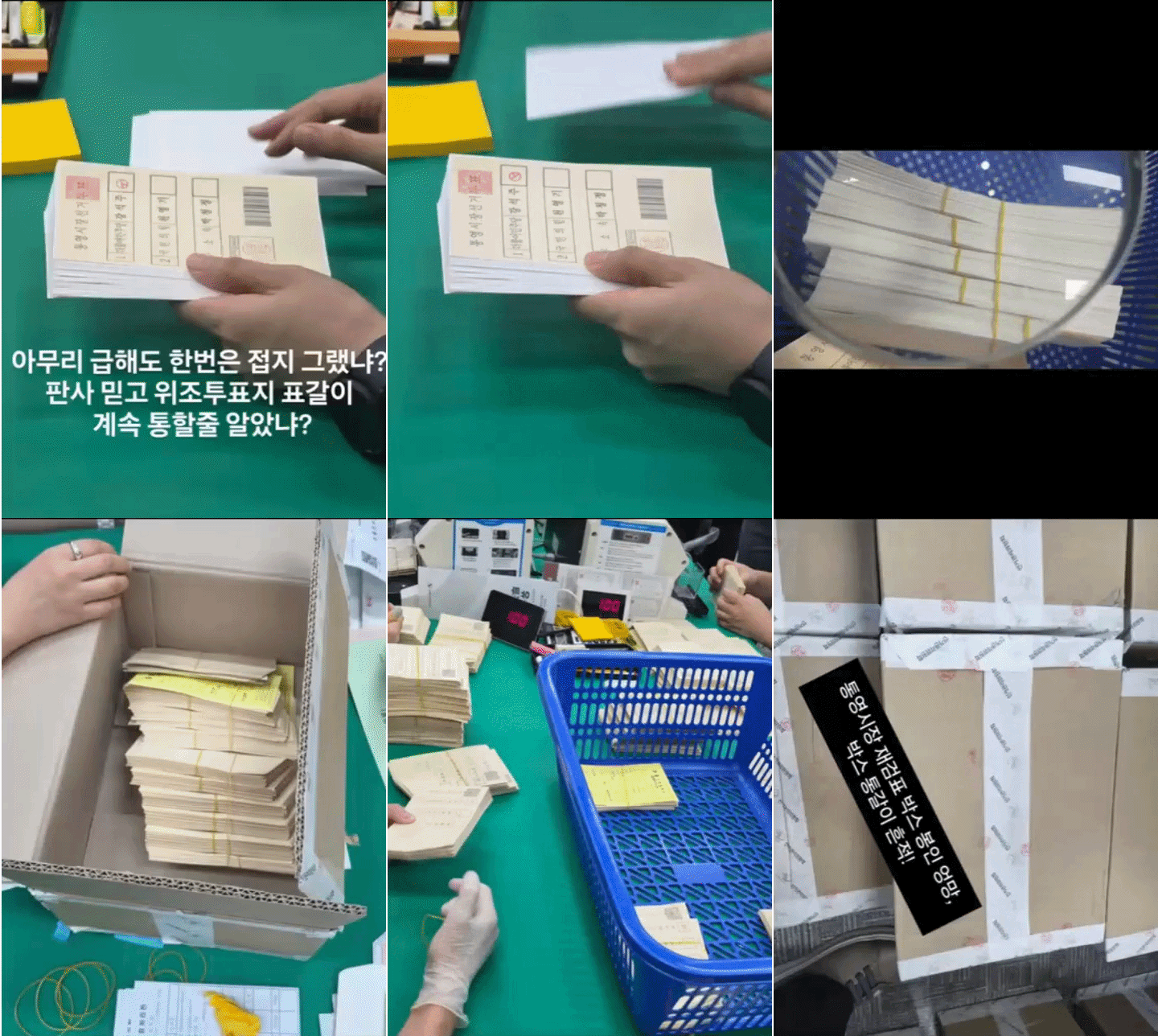 “Ignoring crisp ballots and damaged seals”… Tongyeong mayoral recount concludes with ‘no change in outcome,’ leaving suspicions and public outrage behind
Suspected counterfeit ballots discovered in Tongyeong [GIF from social media of Representative Hwang Kyo-ahn / Attorney Park Joo-hyun]During a recount of the Tongyeong mayoral election in South Gyeong
“Ignoring crisp ballots and damaged seals”… Tongyeong mayoral recount concludes with ‘no change in outcome,’ leaving suspicions and public outrage behind
Suspected counterfeit ballots discovered in Tongyeong [GIF from social media of Representative Hwang Kyo-ahn / Attorney Park Joo-hyun]During a recount of the Tongyeong mayoral election in South Gyeong
 President Yoon, regarding the first-instance ruling on the Public Official Election Act: “An excessive political verdict that distorts the facts… We will appeal immediately.”
The first-instance sentencing hearing for President Yoon Suk Yeol regarding violations of the Public Official Election Act is being broadcast live at Seoul Station on the 27th. [Photo=Yonhap News]Pres
President Yoon, regarding the first-instance ruling on the Public Official Election Act: “An excessive political verdict that distorts the facts… We will appeal immediately.”
The first-instance sentencing hearing for President Yoon Suk Yeol regarding violations of the Public Official Election Act is being broadcast live at Seoul Station on the 27th. [Photo=Yonhap News]Pres
 WSJ: "SK Hynix ADR Premium Is a Sign of AI Trading Overheat"
Advertisement for SK Hynix ADR listing in New York's Times Square [Reuters=Yonhap News file photo]The Wall Street Journal (WSJ) has pointed out that the price of SK Hynix’s American Depositary Recei
WSJ: "SK Hynix ADR Premium Is a Sign of AI Trading Overheat"
Advertisement for SK Hynix ADR listing in New York's Times Square [Reuters=Yonhap News file photo]The Wall Street Journal (WSJ) has pointed out that the price of SK Hynix’s American Depositary Recei
 'Godfather of Japanese Mystery Novels' Keigo Higashino Passes Away After Battle with Cancer at 68
Famous Japanese mystery novelist Keigo Higashino [AFP=Yonhap News]It has been belatedly reported that Keigo Higashino, the "godfather of Japanese mystery novels" and author of bestsellers such as "The
'Godfather of Japanese Mystery Novels' Keigo Higashino Passes Away After Battle with Cancer at 68
Famous Japanese mystery novelist Keigo Higashino [AFP=Yonhap News]It has been belatedly reported that Keigo Higashino, the "godfather of Japanese mystery novels" and author of bestsellers such as "The
 [Park Pil-kyu Security Column] To the Ignorant Trying to Clothe a Beast in Sheep's Clothing
Rep. Kim Byung-joo of the Democratic Party of Korea [Photo=Yonhap News]“The Air Force Academy doesn't teach you how to fly a plane!” “The Army, Navy, and Air Force academies are exactly the
[Park Pil-kyu Security Column] To the Ignorant Trying to Clothe a Beast in Sheep's Clothing
Rep. Kim Byung-joo of the Democratic Party of Korea [Photo=Yonhap News]“The Air Force Academy doesn't teach you how to fly a plane!” “The Army, Navy, and Air Force academies are exactly the
 [Issue Diagnosis] Two Effects of the Election Petition Review
 [Photo] Evidence of Election Fraud Flooding U.S. Media… Trump Had 2.7 Million Votes Stolen
 [Video] U.S. Semiquincentennial Air Show... 'Art in the Sky' streaks across New York
 [Editorial Cartoon] A Draconian Law That Undermines Freedom of Expression

 List
List









