Constitutional Court [Photo=Yonhap News]
The National Referendum Act, fully revised in 2026, is expected to be brought before the Constitutional Court.
The issue at stake is not simply the right to vote in a national referendum. The core issue emerging is the right for citizens to speak, gather, sign petitions, and persuade others regarding proposed constitutional amendments prior to a national referendum – in other words, the "right to public debate."
In a phone call with Hanmi Ilbo on the 30th, lawyer Park Joo-hyun stated, "We plan to file a constitutional appeal on May 4th concerning Articles 37 and 114 of the National Referendum Act, which restrict referendum campaigns."
Lawyer Park added, "Given that the proposed constitutional amendment is expected to pass the National Assembly plenary session between May 7th and 9th, we are also preparing an application for a provisional injunction to contest the validity of the provisions restricting referendum campaigns." He further explained, "Following the constitutional appeal, we plan to form a citizen participation litigation group," emphasizing, "Now is the time for the public to be outraged."
If this appeal is accepted, it will be the first constitutional appeal case to directly challenge the "provisions restricting referendum campaigns" since the "full revision of the National Referendum Act" in 2026.
Past constitutional appeals related to the National Referendum Act primarily focused on restrictions on the voting rights of overseas citizens or the National Assembly's legislative inaction.
In contrast, the current matter concerns the extent to which citizens' freedom to form and express opinions on proposed constitutional amendments should be guaranteed in the pre-referendum stage.
The current National Referendum Act took effect on March 6, 2026. Article 22 of the National Referendum Act defines "referendum campaign" as "an act of causing people to agree or disagree with the matters subject to the national referendum, or to support one of various matters." It also stipulates, "Mere expression of opinions and intentions regarding the matters subject to the national referendum shall not be considered a referendum campaign."
The problem lies with Articles 37 and 114.
Article 37 restricts acts such as marching or shouting in succession by more than five people, door-to-door visits, soliciting signatures or seals, using telecommunication methods, holding assemblies, using loudspeakers or vehicles, and using recording or video equipment. Article 114 stipulates that violations can be punished by imprisonment or fines.
The interpretation by the National Election Commission is further fueling this controversy.
According to the National Election Commission's operational guidelines for the National Referendum Act, the timing for the commencement of referendum campaigns is based on the date the proposed constitutional amendment is publicly announced. In other words, once the President announces the proposed constitutional amendment in accordance with Article 129 of the Constitution, the provisions restricting referendum campaigns can be applied from that point onward, according to this interpretation.
Under the National Election Commission's interpretation, the Presidential announcement becomes both the starting point for public debate and the starting point for restricting public expression of opinions.
At a time when the proposed constitutional amendment should be made public for citizens to review the content and form their opinions for or against it, major means of expression such as assemblies, petitions, and communication, as well as recording and video recording, could be subject to criminal penalties.
It is precisely after the announcement that the public should be informed about the content of the proposed constitutional amendment, share their opinions for and against it, and form public opinion through assemblies and debates.
What the National Referendum Act should prevent are false information, provision of money or valuables, coercion, and violent mobilization, not the public debate itself.
National referendums are different from general elections.
While an election is a process of selecting candidates and political parties, a national referendum on a constitutional amendment is a process by which the sovereign citizens decide whether to ultimately approve the nation's fundamental norms.
Therefore, the process of citizens speaking, listening, and persuading leading up to the decision on the referendum day, not just the choice on that single day, should be considered a part of popular sovereignty.
The Korean Bar Association also issued a statement on the 30th, raising concerns about the infringement of basic rights due to the National Referendum Act and the National Election Commission's interpretation.
The association argued that the current National Referendum Act could fundamentally suppress citizens' expression of opinions for or against constitutional amendments. In particular, it pointed to Articles 37 and 114 of the National Referendum Act as problematic for broadly restricting citizens' means of expression such as assemblies, petitions, communication, loudspeakers, and recording/video recording.
The association stated that since a national referendum is an exceptional procedure where sovereign citizens directly exercise their sovereignty, citizens' expression of opinions should be more broadly recognized than in any other procedure.
Furthermore, they declared their stance to actively protect citizens who are harmed by the National Referendum Act and the National Election Commission's measures, saying, "It is not a national referendum to silence the voices and tie the hands of the sovereign citizens."
If the constitutional appeal is filed, the focus will shift from the "right to vote" to the "right to speak before voting."
While past controversies surrounding the National Referendum Act were about whether overseas citizens could participate in national referendums, the current issue concerns whether citizens can publicly speak, gather, sign petitions, and persuade others regarding proposed constitutional amendments.
If an application for a provisional injunction is filed along with the constitutional appeal, the timeline for the Constitutional Court's decision also becomes important.
If the proposed constitutional amendment passes the National Assembly and moves to the referendum stage, the validity of the provisions restricting referendum campaigns could directly impact the actual process of forming public opinion.
The constitutional appeal announced by Lawyer Park is expected to be the first test case asking whether the revised National Referendum Act aligns with constitutional principles of freedom of expression, freedom of assembly, and popular sovereignty.
It is increasingly likely that the Constitutional Court will deliberate on whether the National Referendum Act is a law that fairly manages national referendums or a law that stifles public debate, which is central to national referendums.

 [Statement by the Seobeokka KMA Patriots Association] ㉛ Recount the ballots openly, as the previous recount covered up election fraud
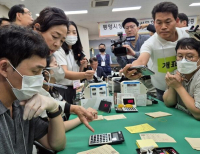
Recount of the Tongyeong mayoral election [Photo=Yonhap News]South Korea's liberal democracy is dying. The National Election Commission (NEC), which has degraded into a criminal organization through t
[Statement by the Seobeokka KMA Patriots Association] ㉛ Recount the ballots openly, as the previous recount covered up election fraud
Recount of the Tongyeong mayoral election [Photo=Yonhap News]South Korea's liberal democracy is dying. The National Election Commission (NEC), which has degraded into a criminal organization through t
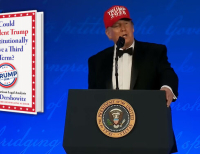
 What is the significance of the "Trump 2028" red hat that keeps reappearing?
It is noteworthy that while it is "highly likely" that President Donald Trump is "seriously considering" a run for the presidency in 2028, he is also "deliberately" fueling speculation regarding wheth
What is the significance of the "Trump 2028" red hat that keeps reappearing?
It is noteworthy that while it is "highly likely" that President Donald Trump is "seriously considering" a run for the presidency in 2028, he is also "deliberately" fueling speculation regarding wheth
 First U.S. Ambassador of Trump's Second Term to Arrive This Week… Will It Provide Momentum to Resolve Pending Issues?
U.S. Ambassador to South Korea Michelle Steel speaks at the opening ceremony of the Korea-U.S. Shipbuilding Cooperation Center held at the Mayflower Hotel in Washington, D.C., on the 23rd (local time)
First U.S. Ambassador of Trump's Second Term to Arrive This Week… Will It Provide Momentum to Resolve Pending Issues?
U.S. Ambassador to South Korea Michelle Steel speaks at the opening ceremony of the Korea-U.S. Shipbuilding Cooperation Center held at the Mayflower Hotel in Washington, D.C., on the 23rd (local time)
 The Korean Peninsula wrapped in a thick blanket of scorching high pressure… Will the 1994 record be broken?
On the 28th, as the heatwave continues, a water sprinkler truck sprays water on Hyowon-ro, Gwonseon-gu, Suwon, Gyeonggi Province. [Photo = Yonhap News]The hottest years on record are considered to be
The Korean Peninsula wrapped in a thick blanket of scorching high pressure… Will the 1994 record be broken?
On the 28th, as the heatwave continues, a water sprinkler truck sprays water on Hyowon-ro, Gwonseon-gu, Suwon, Gyeonggi Province. [Photo = Yonhap News]The hottest years on record are considered to be
 Stock Market Crash 'Black Tuesday'… KOSPI down 10.8%, KOSDAQ down 7.7%
The KOSPI fell by more than 5% in early trading on the 28th, triggering a sell-side sidecar.On the 28th, the KOSPI plunged by more than 10%.Due to the sharp decline, a sell-side sidecar—a temporary
Stock Market Crash 'Black Tuesday'… KOSPI down 10.8%, KOSDAQ down 7.7%
The KOSPI fell by more than 5% in early trading on the 28th, triggering a sell-side sidecar.On the 28th, the KOSPI plunged by more than 10%.Due to the sharp decline, a sell-side sidecar—a temporary
 [World Heritage Committee] 25 New World Heritage Sites Inscribed in Busan… South Korea Successfully Expands 'Getbol' Listing
The Chairperson of the World Heritage Committee speaks at the plenary session of the 48th session of the World Heritage Committee, held at BEXCO in Busan on the 20th. [Photo: Yonhap News]A total of 25
[World Heritage Committee] 25 New World Heritage Sites Inscribed in Busan… South Korea Successfully Expands 'Getbol' Listing
The Chairperson of the World Heritage Committee speaks at the plenary session of the 48th session of the World Heritage Committee, held at BEXCO in Busan on the 20th. [Photo: Yonhap News]A total of 25
 [Cho Yang-geon Column] The NEC: Facing a Fate of "Discarding the Dog After the Hunt"
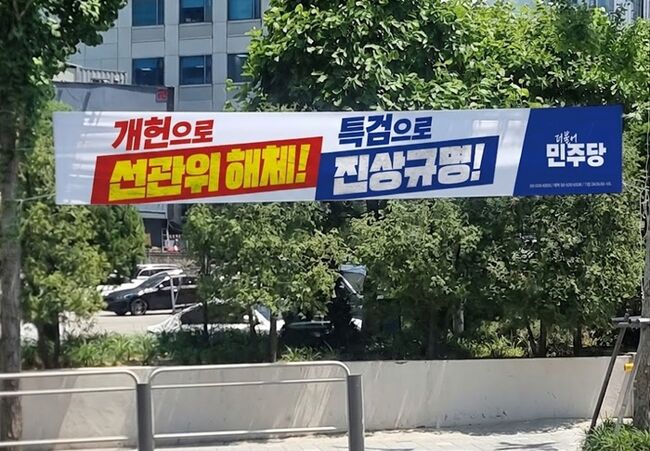
Banner calling for the "dissolution of the NEC" posted by the Democratic Party. [AI-generated image]Banners calling for the "dissolution of the National Election Commission (NEC)" posted by the Democr
[Cho Yang-geon Column] The NEC: Facing a Fate of "Discarding the Dog After the Hunt"
Banner calling for the "dissolution of the NEC" posted by the Democratic Party. [AI-generated image]Banners calling for the "dissolution of the National Election Commission (NEC)" posted by the Democr
 [Photo] Evidence of Election Fraud Flooding U.S. Media… Trump Had 2.7 Million Votes Stolen
 [Video] U.S. Semiquincentennial Air Show... 'Art in the Sky' streaks across New York
 [Editorial Cartoon] A Draconian Law That Undermines Freedom of Expression

 List
List