Hollywood movie 'The Devil Wears Prada 2' garnered a certain amount of revenue in China despite racial controversy. [Photo=Baidu]
The all-out battle for movie consumption during China's May Day holiday ended disappointingly. This year's May Day holiday box office revenue was approximately 750 million yuan (about 150 billion won), similar to last year. This is less than half of the 2023 and 2024 figures, which each surpassed 1.5 billion yuan.
Given that the country's official name, "People's Republic of China," clearly indicates its socialist identity, the May Day holiday is the third-largest holiday after National Day and Lunar New Year. In China, it is observed for five days through compensatory leave. Naturally, it is a peak season for travel and a major period for movie theaters.
What's significant is that this was the outcome despite the government's conscious efforts. Local governments in Beijing, Hebei, Zhejiang, and other regions distributed subsidies and consumption coupons for movie tickets, and online platforms also engaged in discount wars. The year was even designated as the 'Year of Promoting the Film Economy.' The government alone announced 1.2 billion yuan in film viewing subsidies, yet the turnout of audiences fell far short of expectations.
This cannot be solely explained by a simple economic downturn. Most notably, the erosion of the 'culture of watching movies together' is evident. The Chinese film market has long relied on a collective viewing culture for its growth. Consumption was primarily driven by families, couples, and workplace groups, and golden holidays determined box office success. At one point, China experienced the world's largest cinema construction boom, filled with patriotic blockbusters and large-scale domestic commercial films.
Nationalism and Increased Censorship… Propaganda Prioritized Over Humanity
It is possible that the decline of the 'collective viewing culture' in the Chinese film market is intertwined with its industrial limitations. A more fundamental reason cited is the excessive nationalism and reliance on 'safe formulas' within the Chinese film industry. In recent years, there has been a repetition of patriotic war films, historical narratives centered on the Communist Party, and family comedies that have passed censorship. While these films have achieved a certain level of success with Chinese audiences within the 'screen community,' audience fatigue has also accumulated.
It is uncertain how much of the spirit of "human conflict and suffering are the backbone of cinema," as stated by renowned Chinese director Zhang Yimou in a 2007 interview in Korea, remains alive. Among domestic and international film enthusiasts and experts, the prevailing view is that in recent Chinese films, national messages are prioritized over human stories. The fact that Chinese films cannot find avenues beyond their domestic market is ultimately due to this aspect.
In the past, the potential and diversity of Chinese cinema were growth drivers. Throughout the 1990s, the artistry and social relevance of directors like Zhang Yimou and Chen Kaige captivated the world, and the distinctiveness of Hong Kong noir, which had built a unique world since the 1970s, remained. Social changes following the reform and opening-up were well integrated into youth films, martial arts films, and urban romances.
While Jia Zhangke, a director of the Chinese Sixth Generation, stated, "If films cannot keep up with the speed of change in Chinese society, audiences will turn away," it is now difficult to avoid criticism that films are moving much slower than reality. With intensified censorship, charming mid-scale films depicting subtle inner lives and relationships have disappeared. The market seems to be polarizing, with only blockbusters or low-budget comedies remaining. The departure of audiences appears inevitable.
'Unable to See Their Own Era on Screen'
The ranking of this May Day holiday's box office performance in China is symbolic. While crime films and Hong Kong noir dominated the top positions, there were no overwhelmingly successful hits, and Hollywood's 'The Devil Wears Prada 2' generated a certain amount of revenue despite racial controversy. Chinese audiences responded more to global content than to 'politically safe domestic films.'
The decline in cinema audiences is a global phenomenon since the pandemic. Hollywood, too, faces a crisis due to the proliferation of streaming platforms like Netflix. However, China's situation is compounded by systemic issues such as the shrinking of a free creative environment and increased censorship. Director Bong Joon-ho said at the time of his Academy Award win, "The most personal is the most creative." In today's Chinese film industry, that very 'personal story' has become difficult.
Cinema is a field that most sensitively reflects the desires, anxieties, and changes of an era and society. In 21st-century China, uncomfortable truths such as the despair of the youth, the real estate collapse, the severance of social mobility, and cynicism cannot be touched upon. Ultimately, films tend to converge into escapist entertainment or state propaganda.
Although the Chinese government is releasing massive subsidies to stimulate consumption, this does not foster vitality in cultural content. What draws audiences to theaters are 'stories that most sharply illuminate the present.' The fact that people can no longer discover their own era on screen is likely the real crisis for Chinese cinema.

◆ Dr. Im Myung-shin
Ph.D. in Chinese Literature, Northeast Asian Researcher
Former International Deputy Bureau Chief at Sky Daily

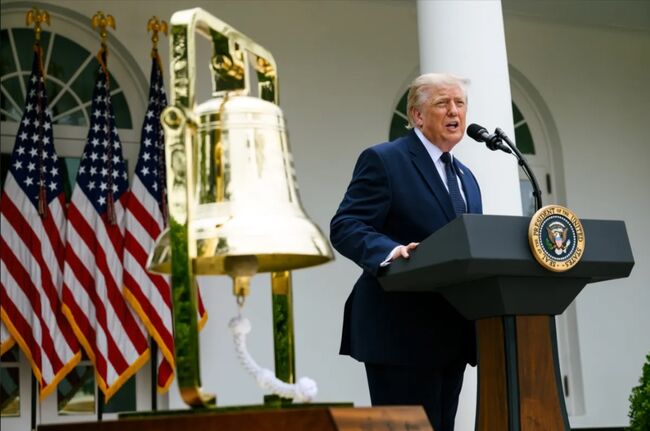 Trump pressures for rate cut again ahead of FOMC... "Should be the lowest in the world"
U.S. President Donald Trump. [Photo = The White House] U.S. President Donald Trump once again pressured the Federal Reserve, the U.S. central bank, to lower interest rates on the 27th (local time
Trump pressures for rate cut again ahead of FOMC... "Should be the lowest in the world"
U.S. President Donald Trump. [Photo = The White House] U.S. President Donald Trump once again pressured the Federal Reserve, the U.S. central bank, to lower interest rates on the 27th (local time
 “Ignoring crisp ballots and damaged seals”… Tongyeong mayoral recount concludes with ‘no change in outcome,’ leaving suspicions and public outrage behind
Suspected counterfeit ballots discovered in Tongyeong [GIF from social media of Representative Hwang Kyo-ahn / Attorney Park Joo-hyun]During a recount of the Tongyeong mayoral election in South Gyeong
“Ignoring crisp ballots and damaged seals”… Tongyeong mayoral recount concludes with ‘no change in outcome,’ leaving suspicions and public outrage behind
Suspected counterfeit ballots discovered in Tongyeong [GIF from social media of Representative Hwang Kyo-ahn / Attorney Park Joo-hyun]During a recount of the Tongyeong mayoral election in South Gyeong
 President Yoon, regarding the first-instance ruling on the Public Official Election Act: “An excessive political verdict that distorts the facts… We will appeal immediately.”
The first-instance sentencing hearing for President Yoon Suk Yeol regarding violations of the Public Official Election Act is being broadcast live at Seoul Station on the 27th. [Photo=Yonhap News]Pres
President Yoon, regarding the first-instance ruling on the Public Official Election Act: “An excessive political verdict that distorts the facts… We will appeal immediately.”
The first-instance sentencing hearing for President Yoon Suk Yeol regarding violations of the Public Official Election Act is being broadcast live at Seoul Station on the 27th. [Photo=Yonhap News]Pres
 WSJ: "SK Hynix ADR Premium Is a Sign of AI Trading Overheat"
Advertisement for SK Hynix ADR listing in New York's Times Square [Reuters=Yonhap News file photo]The Wall Street Journal (WSJ) has pointed out that the price of SK Hynix’s American Depositary Recei
WSJ: "SK Hynix ADR Premium Is a Sign of AI Trading Overheat"
Advertisement for SK Hynix ADR listing in New York's Times Square [Reuters=Yonhap News file photo]The Wall Street Journal (WSJ) has pointed out that the price of SK Hynix’s American Depositary Recei
 'Godfather of Japanese Mystery Novels' Keigo Higashino Passes Away After Battle with Cancer at 68
Famous Japanese mystery novelist Keigo Higashino [AFP=Yonhap News]It has been belatedly reported that Keigo Higashino, the "godfather of Japanese mystery novels" and author of bestsellers such as "The
'Godfather of Japanese Mystery Novels' Keigo Higashino Passes Away After Battle with Cancer at 68
Famous Japanese mystery novelist Keigo Higashino [AFP=Yonhap News]It has been belatedly reported that Keigo Higashino, the "godfather of Japanese mystery novels" and author of bestsellers such as "The
 [Park Pil-kyu Security Column] To the Ignorant Trying to Clothe a Beast in Sheep's Clothing
Rep. Kim Byung-joo of the Democratic Party of Korea [Photo=Yonhap News]“The Air Force Academy doesn't teach you how to fly a plane!” “The Army, Navy, and Air Force academies are exactly the
[Park Pil-kyu Security Column] To the Ignorant Trying to Clothe a Beast in Sheep's Clothing
Rep. Kim Byung-joo of the Democratic Party of Korea [Photo=Yonhap News]“The Air Force Academy doesn't teach you how to fly a plane!” “The Army, Navy, and Air Force academies are exactly the
 [Issue Diagnosis] Two Effects of the Election Petition Review
 [Photo] Evidence of Election Fraud Flooding U.S. Media… Trump Had 2.7 Million Votes Stolen
 [Video] U.S. Semiquincentennial Air Show... 'Art in the Sky' streaks across New York
 [Editorial Cartoon] A Draconian Law That Undermines Freedom of Expression

 List
List