President Park Chung-hee, who laid the foundation for the revival of the Korean people. Black and white photo converted to color.
In the late period of Athenian democracy, after the downfall of his disciples like Alcibiades, Socrates was put on trial by his opponents. He was sentenced to death and executed on charges of rejecting the worship of Athena and Dionysus and corrupting the youth.
This was due to the ostracism system, which had devolved into a tool for eliminating political rivals, the system of electing officials through lotteries favoring commoners over merit, and the rejection of Socrates’ criticism of populism, which was prevalent during the Periclean age, often called the zenith of Athenian democracy. This era saw the introduction of stipends for jurors and parliament members and free theater performances for propaganda praising the Athenian rule.
The Chaos in South Korea After the April 19 Uprising
Despite being able to avoid death through compromise, Socrates refused to abandon his principles and accepted the hemlock. It was a warning against Athenian democracy, whose foundations were collapsing due to populism and the greed of its citizens, leading to frequent changes in its legal system and jeopardizing its very existence. It was a foreshadowing of Athens' demise.
Having witnessed the corruption of Athenian democracy and the absurd death of his teacher Socrates, Plato warned of the dangers of propaganda directed at an ignorant public and the perils of populism, emphasizing the harmony and balance between freedom, the rule of law, and control. Having experienced the downfall of Athenian democracy, where the rule of law and control vanished, leaving only freedom, licentiousness, and greed, Plato advocated for rule by philosopher-kings.
“What further disappointed him was the restoration of democratic rule shortly thereafter. It was precisely this democratic rule that brought his teacher Socrates to court and ultimately sentenced him to death. His direct and indirect political experiences led Plato to conclude that political corruption could not be prevented unless a philosopher-king emerged in the future. From then on, Plato established the Academy and dedicated himself to nurturing philosophers.” (Jeon Kyung-ok et al., ‘History of Ancient and Medieval Western Political Thought’)
This serves as a warning against politicians who, under the guise of democracy and through endless populism, deceive the public and ruin the nation. “Citizens of a democratic country must not be fooled by the words of rulers who constantly invoke ‘for the people’ every time they open their mouths. We must question the hidden intentions behind such statements. How many instances have there been where the claim of acting ‘for the people’ was merely a veil or smoke screen to conceal the exercise of state power that ultimately served the interests of specific individuals and groups?” (Kim Young-pyeong et al., ‘Is Democracy a Panacea?’)
The final stages of Athenian democracy, which collapsed due to populism and mob rule, began to manifest in South Korea after the April 19 Uprising. The Democratic Party government led by Prime Minister Chang Myon, which took power after Syngman Rhee’s resignation, failed to provide stable governance or economic development throughout its term. Instead, severe chaos, stemming from the post-liberation left-right confrontation, repeatedly occurred, and endless protests engulfed the nation, plunging the populace into destitution. Amidst the escalating threat of North Korea’s re-invasion, the May 16 military coup led by Park Chung-hee emerged, based on a national consensus that further chaos was unacceptable.
The May 16 Coup Was Inevitable
Although technically a military coup, Park Chung-hee’s May 16 coup was, in essence, a successful revolution, rare in world history, surpassing the French and Russian Revolutions in its impact on the flow of Korean history. It marked the beginning of a period of national fortune rise for the Korean people, a phenomenon unseen in thousands of years, as they moved away from the Joseon Dynasty, which had fallen to the status of a vassal state, and, after enduring Japanese colonial rule, began to reclaim the glory of the Dangun Joseon and Goguryeo.
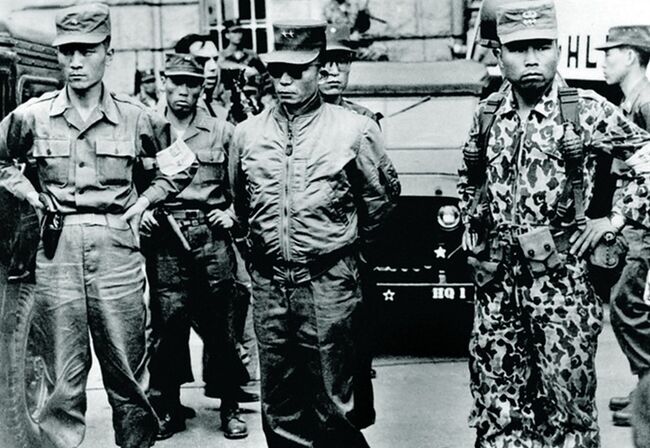 In front of City Hall shortly after the May 16 Revolution. Major General Park Chung-hee (center) stands with Major Park Jong-gyu (left) and Captain Cha Ji-cheol.
When Park Chung-hee’s revolutionary force, numbering only 3,600 men, crossed the Han River Bridge and seized key institutions like the Blue House, Army Headquarters, and broadcasting stations, declaring the revolution, then-President Yun Posun reacted by saying it was inevitable. Prime Minister Chang Myon went missing. Jang Do-young, the Army Chief of Staff, who commanded the divided military forces into pro-coup and anti-coup factions, could not dispatch suppressing troops. The United States tacitly accepted Park Chung-hee’s coup two days later.
As Kim Jong-pil said, “Revolutions are not made by numbers.” Park Chung-hee’s May 16 Revolution was not achieved through the mobilization of a large military force; it was possible due to its righteous cause, despite the meager scale of the troops involved. This is according to the book ‘70 Years of the Republic of Korea: A Personal Account,’ written by Lee Sang-woo, former president of Hallym University, who worked as a reporter for Hankook Ilbo at the time of the May 16 coup.
“On the morning of May 16, Seoul citizens awoke to the news of the military revolution. The general reaction was, ‘It was inevitable.’ Citizens who had worried about the nation’s fate due to the incompetence of the Democratic Party government, social chaos, and economic collapse breathed a sigh of relief. The fact that approximately 3,600 revolutionary soldiers, under the command of Major General Park Chung-hee, crossed the Han River and entered Seoul, successfully completing the revolution within a few hours at dawn, can be described as a bloodless coup rarely seen in history. Why was it possible? Because it was a decision to save the nation, tacitly agreed upon by the soldiers and most of the citizens. This signifies the high level of public dissatisfaction with the situation over the past year since the April 19 Uprising.” (Shin Seung-min, ‘When Breathing Becomes Revolution’)
After Park Chung-hee came to power, he overcame the defeatism of the opposition parties, scholars, and public officials who vehemently opposed projects like the Pohang Iron and Steel Company, the Gyeongbu Expressway, automobiles, petrochemical complexes, and the construction of the Korea Institute of Science and Technology and the Daedeok Research Complex. He then translated creative and positive thinking into action, creating the driving force for South Korea’s current growth. He built infrastructure such as the Pohang Iron and Steel Company and the Gyeongbu Expressway with economic aid funds received from the normalization of relations with Japan and loans from Germany.
Opposition parties and university students held daily street protests, calling the normalization of relations with Japan a humiliating diplomacy. Overcoming the defeatism that argued expressways were unnecessary and Pohang Steel was impossible, the Pohang Steel, built with Japanese funds, became the world’s best steel mill, surpassing Nippon Steel. This was not empty anti-Japanese sentiment expressed through words, but an ‘overcoming Japan’ demonstrated through actions.
It is difficult to find countries that have successfully developed their economies after receiving war reparations or economic loans. Most of these funds end up in the pockets of leaders and those close to power. An executive from a company that manufactured M16 automatic rifles visited Park Chung-hee and offered him a one-million-dollar check as a customary rebate.
Park Chung-hee returned the check and asked for more rifles instead. He could not misuse the precious foreign currency earned through the blood and sweat of Korean miners and nurses dispatched to Germany and soldiers sent to Vietnam. After the American executive left, Park Chung-hee returned to his desk and, even in the sweltering summer heat, turned off the air conditioner again.
The History of South Korea Since Liberation is a History of Miracles
Pro-North Korean leftists claim that the history of South Korea since liberation is a history of opportunism and injustice where righteousness has been defeated. However, the history of South Korea since liberation is a history of glory, a history of miracles, and a history that believes in the power of positivity.
The left claims that modernization would have occurred regardless of who was in power, not just Park Chung-hee. They argue that those with a narrow vision, who opposed Park Chung-hee’s heavy industry promotion and export-oriented industrial policies and advocated for the development of light industries for agriculture and domestic markets, would have achieved it.
The Korean people before Park Chung-hee and the Korean people during the Park Chung-hee era are the same. Only the leader was different. Whether it is a small organization or a nation, the ability demonstrated depends entirely on the leader. With the same army, if General Yi Sun-sin commands, they achieve victory after victory; if Won Gyun commands, they suffer defeat after defeat.
Pro-North Korean leftists criticize Park Chung-hee as a dictator. Economic development is the cornerstone of democratization. Democracy without economic development is impossible and has no precedent. The democratization of South Korea was created by President Park Chung-hee. The left-wing governments after Kim Dae-jung argue that reviving North Korea’s economy is more practical than discussing human rights and that it is a more effective way to care for North Korean human rights, regarding the controversy over excessive aid to North Korea. Pro-North Korean leftists do not apply this logic to the Park Chung-hee regime.
The Park Chung-hee era existed during a transitional period from the feudal Confucian ideology of the Joseon Dynasty to a modern liberal democratic system. It was a time not long after liberation from Japanese colonial rule following the Joseon Dynasty, when the remnants of Confucian authoritarianism from the dynastic era and Japanese colonial rule still lingered for everyone.
Our grandmothers and mothers wore skirts and jackets, never stepped on their teachers’ shadows, and where everything was decided by a single word from their fathers at home. We should not judge the past by the standards of this era, where parents visit schools and slap teachers, and fathers are ostracized at home.
They say Park Chung-hee was a dictator because he ruled for 18 years. Does the United States, with its 8-year presidential term limit, consider longer terms as dictatorships? The U.S. also had President Franklin D. Roosevelt, who served four terms. The incompetent and ignorant pro-North Korean leftists, who advocate for the withdrawal of U.S. troops from Korea and anti-American sentiment while sending their children to study in the U.S., lack historical awareness, philosophy, and consistency. They not only show subservience to North Korea and China but also to America. Whatever the United States does, whether it’s a third term, fourth term, or lifelong presidency, it is up to the people to choose according to the constitution.
Amidst the rapidly changing Northeast Asian security landscape due to President Nixon’s withdrawal of U.S. troops from Korea and the Vietnam War’s conclusion, and the major shift in international relations with the U.S. and China establishing diplomatic ties, Park Chung-hee, in 1972, put to a national referendum a constitutional amendment that would establish a system of indirect presidential elections, where the President, with an unlimited term, would be elected by electors chosen through national elections. The Yushin Constitution passed with a voter turnout of 91.9% and 91.5% in favor.
As social unrest arose due to continuous protests by opposition parties and university students demanding the repeal of the Yushin Constitution, Park Chung-hee, in 1975, put the Yushin Constitution to a national referendum, declaring that if it were rejected, he would consider it a no-confidence vote against himself and immediately resign from the presidency.
The referendum saw a voter turnout of 79.8%. Despite lower approval rates of 58% in Seoul and 62% in Busan, Park Chung-hee and the Yushin Constitution were reconfirmed with a nationwide approval rate of 73.1%.
At the Yushin Constitution promulgation ceremony, Park Chung-hee stated:
“We do not yet have a system superior to the liberal democratic system. However, no matter how excellent a system may be, it is also as fragile as this democratic system when there is no capacity to defend it. I wish to re-emphasize the inevitability of these emergency measures and ask for tomorrow’s stern critique, rather than today’s hasty disputes or slanders, keeping in mind the long future of our nation.”
Heavy and Chemical Industry Development Was Yushin, and Yushin Was Heavy and Chemical Industry Development
In the midst of the complex security and economic crises of the 1970s, Park Chung-hee advocated for the legitimacy of Yushin. He criticized the opposition parties’ mass economic theories as short-sighted and declared ‘heavy and chemical industry’ as a new national task to overcome the limitations of light industry. This aimed at achieving self-defense through arms self-sufficiency and becoming a developed nation through exports of heavy and chemical products.
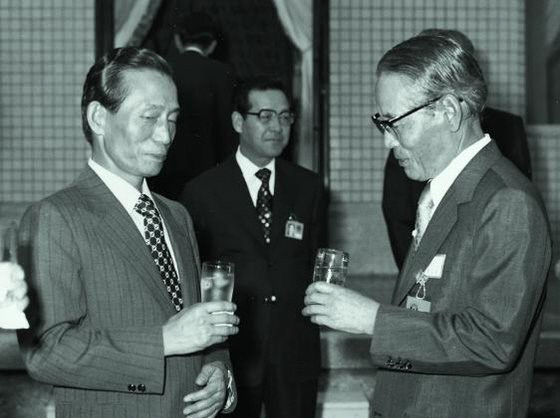 President Park Chung-hee (left) and Chairman Lee Byung-chul
At the time, conservative and defeatist opposition politicians and scholars advocated for a self-sufficient domestic industry centered on small and medium-sized enterprises for agriculture and import substitution, instead of an export-oriented economy driven by foreign capital and large conglomerates. They argued that expressways, steel mills, and shipyards were unnecessary and unfeasible. They were bound by the dependency theory of the South American model, which posited that an export-led open economy would ultimately fail in international competition and lead to dependence on developed nations. Yushin was an expression of the firm resolve that these individuals could not be entrusted with the nation.
This is a testimony from Oh Won-chul, former Senior Secretary for Economic Affairs, as cited in ‘When Breathing Becomes Revolution,’ written by Cho Woo-seok et al.
“If the political will to support economic development had been compromised or interrupted (if the Yushin declaration had not occurred), South Korea in the 1970s would have collapsed. Many people nowadays say that President Park Chung-hee succeeded in economic development but failed in democracy. Even those who served as ministers under President Park publicly discuss heavy and chemical industry development and Yushin reforms as separate issues.
I say this: Heavy and chemical industry development was Yushin, and Yushin was heavy and chemical industry development. That is the truth. One could not have existed without the other. Heavy and chemical industry development succeeded because President Park trained the nation to operate it. Without Yushin, there would have been no national training. To ignore this is unconscionable.”
Park Chung-hee Pushed for Nuclear Weapon Development
If Park Chung-hee had remained in power for a few more years, he would have completed the development of nuclear weapons and long-range missiles for self-defense, and there would be no need to worry about North Korea’s nuclear and missile programs today. There would also be no need for bothersome discussions about burden-sharing for U.S. Forces Korea, the ROK-U.S. alliance, or reaffirming America’s nuclear umbrella.
In 1969, U.S. President Nixon, elected on a promise to end the Vietnam War, announced the Nixon Doctrine, stating that Asian countries must take responsibility for their own security, and began withdrawing U.S. troops from Korea. In response, Park Chung-hee initiated nuclear weapon development, but due to U.S. obstruction, he officially abandoned the program in 1976.
The secret nuclear weapon program, which continued covertly, was eventually abandoned by the Chun Doo-hwan administration at the request of the United States after Park Chung-hee’s death. In 1981, immediately after President Reagan took office, at a ROK-U.S. summit in Washington, Chun Doo-hwan informed Reagan of the termination of Park Chung-hee’s secret nuclear weapon program, and Reagan nullified the previous Carter administration’s plan to withdraw U.S. troops from Korea.
Around the same time, French President de Gaulle pushed for nuclear weapon development, arguing that the U.S. would not sacrifice New York for Paris. During the Cold War, as relations between the Soviet Union and China deteriorated due to mutual accusations of revisionism and dogmatism, and the Soviet Union ceased its support of weapons and industrial facilities to China, China, feeling threatened for its security, proceeded with nuclear weapon development, arguing that without nuclear armament, they would have to submit to the nuclear weapons of their enemies or rely on the mercy of nuclear powers.
Ha Soon-bong, a former four-term National Assembly member, wrote in his memoirs that in response to the rapidly changing Northeast Asian security situation due to U.S. President Nixon’s visit to China, the withdrawal of U.S. troops from Korea, and the U.S. decision to withdraw from Vietnam, Park Chung-hee ordered a secret nuclear weapon development project in early 1972, which reached its completion stage by the late 1970s.
On January 1, 1979, Park Chung-hee summoned Representative Seon Woo-yeon, a former press secretary at the Blue House, and revealed his plan to publicly unveil nuclear weapons at the Armed Forces Day ceremony on October 1, 1981, followed immediately by a resignation statement. “This is a secret decision I made alone. I plan to step down in October of '81, two years from now. I will reveal nuclear weapons to the nation and the world at the Armed Forces Day ceremony on October 1st and then issue a resignation statement right there. That way, even Kim Il-sung won’t be able to launch an invasion.”
After Chun Doo-hwan came to power, under U.S. pressure, Park Chung-hee’s nuclear weapon program was abandoned. However, Chun Doo-hwan focused on supporting the development of Korean reactor technology instead. Chun Doo-hwan, judging it difficult to continue nuclear weapon development under U.S. pressure, accepted expert opinions that acquiring Korean reactor technology would make nuclear weapon manufacturing significantly easier.
In 2000, the Korea Atomic Energy Research Institute succeeded in enriching uranium to 70% in experimental tests. They did not proceed with 90% enrichment, which is used in nuclear weapon manufacturing, and reported the results to the International Atomic Energy Agency (IAEA) for inspections. This is based on an interview with Jang In-soon, then-President of the Korea Atomic Energy Research Institute, with Yonhap News on April 27, 2026.
“We knew the enrichment method, so there was no need to proceed further. Increasing from 70% to over 90% is not difficult. South Korea’s nuclear power plant construction capability is ranked number one in the world. No country can match Korea in terms of construction, reactor design, and operational capability. Nuclear weapon manufacturing technology is not high-tech. It is technology from 80 years ago. Making nuclear weapons is easier than manufacturing reactors. A reactor contains one million parts, but a nuclear weapon has fewer than 2,000. We are not incapable of making nuclear weapons; we choose not to. Among all the presidents, President Park Chung-hee contributed the most to nuclear power development. He initiated the construction of Kori Nuclear Power Plant Unit 1 in 1971. The construction cost was equivalent to one-fourth of the government’s annual budget at the time. It was a decision that ordinary people could hardly imagine.”
The nuclear research of South Korea, which currently possesses the world’s best nuclear power plant construction technology, began during the Syngman Rhee administration. In 1956, Korea signed an “Intergovernmental Agreement Concerning the Peaceful Uses of Atomic Energy” with the United States and joined the International Atomic Energy Agency (IAEA) in 1957. In 1958, it enacted the Atomic Energy Act, sent over 100 atomic energy students to the U.S., and established the Atomic Energy Research Institute.
Syngman Rhee ordered budget support for the introduction of research reactors. At the groundbreaking ceremony for the reactor research institute in 1959, Syngman Rhee stated that the Atomic Energy Research Institute should produce an atomic machine in the near future. Syngman Rhee’s attachment to atomic energy was not only due to nuclear weapons but also to the severe power shortage that restricted electricity supply to three to four hours a day due to the cutoff of electricity from North Korea, which accounted for 80% of South Korea’s power demand in May 1948. Suffering from a severe power crisis, South Korea finally ended rolling blackouts in 1964 with the construction of hydroelectric and thermal power plants.
The research reactor, whose construction began during the Syngman Rhee administration, was completed after Park Chung-hee came to power in 1962. In 1969, Park Chung-hee signed a contract with Westinghouse of the U.S. for the construction of a nuclear power plant, and in 1971, Korea’s first nuclear power plant, Kori Unit 1, was completed. Subsequently, along with the construction of Kori Unit 2 and the Wolsong Nuclear Power Plant, negotiations were held with France to introduce plutonium reprocessing technology, and the introduction of Canada’s CANDU-type reactors was pursued but halted due to U.S. pressure.
Not only nuclear power plants, but Park Chung-hee was also instrumental in the beginning of South Korea’s largest growth engines today: the semiconductor and electronics industries. Recognizing the importance of the electronics industry, Park Chung-hee enacted the Electronics Industry Promotion Law in 1969.
He then established the Korea Institute of Science and Technology (KIST) and invited scientists from overseas, offering them exceptionally high salaries and apartments, thus laying the foundation for the electronics industry’s rise. This is a testimony from Kim Jong-pil regarding the establishment of Samsung Electronics.
“One day in late 1967, President Park Chung-hee, who was focusing on heavy and chemical industries, told me, ‘Ask Chairman Lee Byung-chul to try doing something in heavy and chemical industries now. Go and ask him.’ I met Chairman Lee and conveyed the President’s words. He sat for a long time, deep in thought, and then, as if having made up his mind, stood up saying, ‘Let’s go see the President.’ We went to the Blue House together.
As he had told me, President Park asked Chairman Lee, ‘How about venturing into heavy and chemical industries?’ When Chairman Lee asked, ‘What kind of heavy and chemical industries are you referring to?,’ President Park suggested, ‘Try shipbuilding, automobiles, or electronics.’ This meeting became the catalyst for Chairman Lee to choose the electronics industry. That is none other than today’s Samsung Electronics. Samsung Electronics’ first plant was established in Suwon in 1969.” (‘Kim Jong-pil Testimony: So-i-bu-dap,’ December 11, 2023, JoongAng Ilbo)
Park Chung-hee Laid the Foundation for the Revival of the Korean People
John Stuart Mill, a staunch advocate of freedom, argued that forcing one person to remain silent simply because they think differently is akin to a single dictator forcing the silence of the entire rest of the population.
“Despotism can be a legitimate mode of government in dealing with barbarians, provided the end be their improvement, and the means justified by actually effecting that end. Liberty, as a principle, has no application to any state of things anterior to the time when mankind has become capable of being improved by free and equal discussion. Until then, there is nothing to be said to them but the contrary of what we might say to rational beings. They are capable of help, but not of freedom. Until they have attained that maturity, despotism is a legitimate mode of government, but only in the sight of those who would bend the knee to the Akbar or the Charlemagne of history, were they there. It is a hard thing for the present generation to realize this, but the fact remains, that the great majority of mankind have, and have had, to live under a patriarchal or monarchical government, and that they are not ripe for something better. There are immense difficulties in working out the problem of how to find the appropriate balance between individual independence and societal control. Barring a few very clear cases, it is almost impossible to find the correct answer to this problem. Moreover, the answer always differs depending on the era. Two different societies have rarely arrived at the same answer. The decisions made by one era or society sometimes appear astonishing to people in another era or society.” (Translated by Seo Byung-hoon, John Stuart Mill, ‘On Liberty’)
Unlike the bloody and ultimately failed French Revolution and the Marxist-Leninist Russian Revolution, Park Chung-hee’s May 16 coup was a bloodless and successful revolution.
The propaganda and incitement for violent revolution found in Marx’s Communist Manifesto are irrelevant to the proletariat, whose lives are devoid of the hypocrisy of those who live in luxury with the help of acquaintances rather than through labor.
“The proletarians have nothing to lose but their chains. They have a world to win. Therefore, all of you, proletarians of all countries, unite!” (Lee Jin-woo, ‘Karl Marx, Friedrich Engels, The Communist Manifesto’)
Marx’s incitement, linked to Robespierre’s logic during the French Revolution that violence is necessary for freedom, was directly implemented in the communist regimes established by Lenin, Mao Zedong, and Kim Il-sung.
“Marx’s conception of the French Revolution contributed to his gradual formation of views on revolution, which were ultimately integrated into his overall system of thought.” (Translated by Choi Gap-soo, Albert Soboul, ‘History of the French Revolution’)
During the French Revolution in 1789, the revolutionary army executed not only Louis XVI and Queen Marie Antoinette but also tens of thousands of people at the guillotine. Under the pretext of suppressing opposition, they carried out a reign of terror, cruelly killing hundreds of thousands, including women and children, and even committing rape.
In the 11 years from the French Revolution to Napoleon's rise to power, the people suffered amidst a reign of terror, rebellions, and civil wars unrelated to liberty, equality, and fraternity, which laid the groundwork for Napoleon's dictatorship and imperial rule. Upon coming to power, Napoleon launched conquest wars across Europe and Africa. After being defeated by the allied forces of Britain and Prussia in the Battle of Waterloo in 1815, he was exiled to the island of Saint Helena and died there six years later. Six million French people died during Napoleon’s conquest wars. Napoleon, who revived slavery, is remembered as a warmonger, racist, and sexist comparable to Hitler.
After Napoleon, France reverted to monarchy and engaged in a scramble for colonies in Africa and Southeast Asia, massacring hundreds of thousands of those who resisted colonial rule in its colonies such as Vietnam, Algeria, Senegal, and Madagascar. When the Japanese military withdrew from Vietnam after Japan’s defeat in World War II, France claimed its former colonial rights and sent troops to re-establish colonial rule in Vietnam.
After a nine-year war with Ho Chi Minh's nationalist independence army, France withdrew from Vietnam. Fearing the domino effect of communism in Southeast Asia under Ho Chi Minh, the United States sent troops to Vietnam after France’s withdrawal, intervening in Vietnam. This is the history of the French Revolution, hailed by global leftists since Marx and Lenin as the greatest revolution in human history, which they claim ended the exploitation of the working class by the ruling class and realized the ideals of liberty, equality, and fraternity.
Park Chung-hee, with an army of less than a brigade’s strength, numbering 3,600 men, achieved a bloodless revolution. He rescued a chaotic society, a destitute populace, and an ailing economy, and without personal gain, laid the foundation for the revival of the Korean people, a rare occurrence in thousands of years of Korean history.
Those who criticize Park Chung-hee as a dictator are pro-North Korean leftists, brainwashed by the ideology of the French Revolution, Marx, Lenin, Mao Zedong, and Kim Il-sung, and those who are easily swayed by their propaganda and incitement. Park Chung-hee’s May 16 coup is the implementation of Plato’s rule by philosopher-kings and a true revolution that surpasses the French Revolution and Lenin’s Russian Revolution.
◆ Hwang Doo-hyong
Former Washington Correspondent for Yonhap News
Former Deputy Editor-in-Chief of Yonhap News

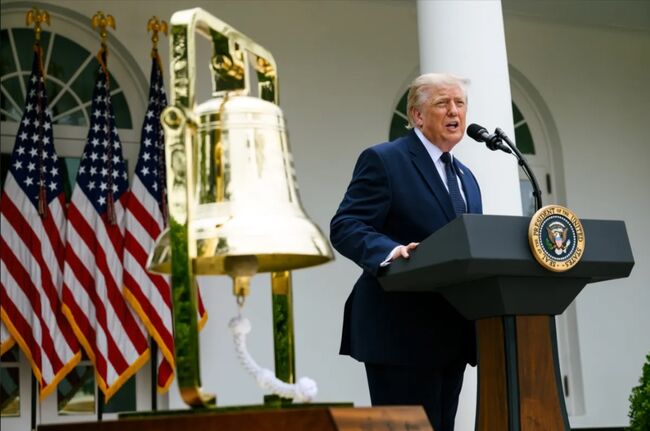 Trump pressures for rate cut again ahead of FOMC... "Should be the lowest in the world"
U.S. President Donald Trump. [Photo = The White House] U.S. President Donald Trump once again pressured the Federal Reserve, the U.S. central bank, to lower interest rates on the 27th (local time
Trump pressures for rate cut again ahead of FOMC... "Should be the lowest in the world"
U.S. President Donald Trump. [Photo = The White House] U.S. President Donald Trump once again pressured the Federal Reserve, the U.S. central bank, to lower interest rates on the 27th (local time
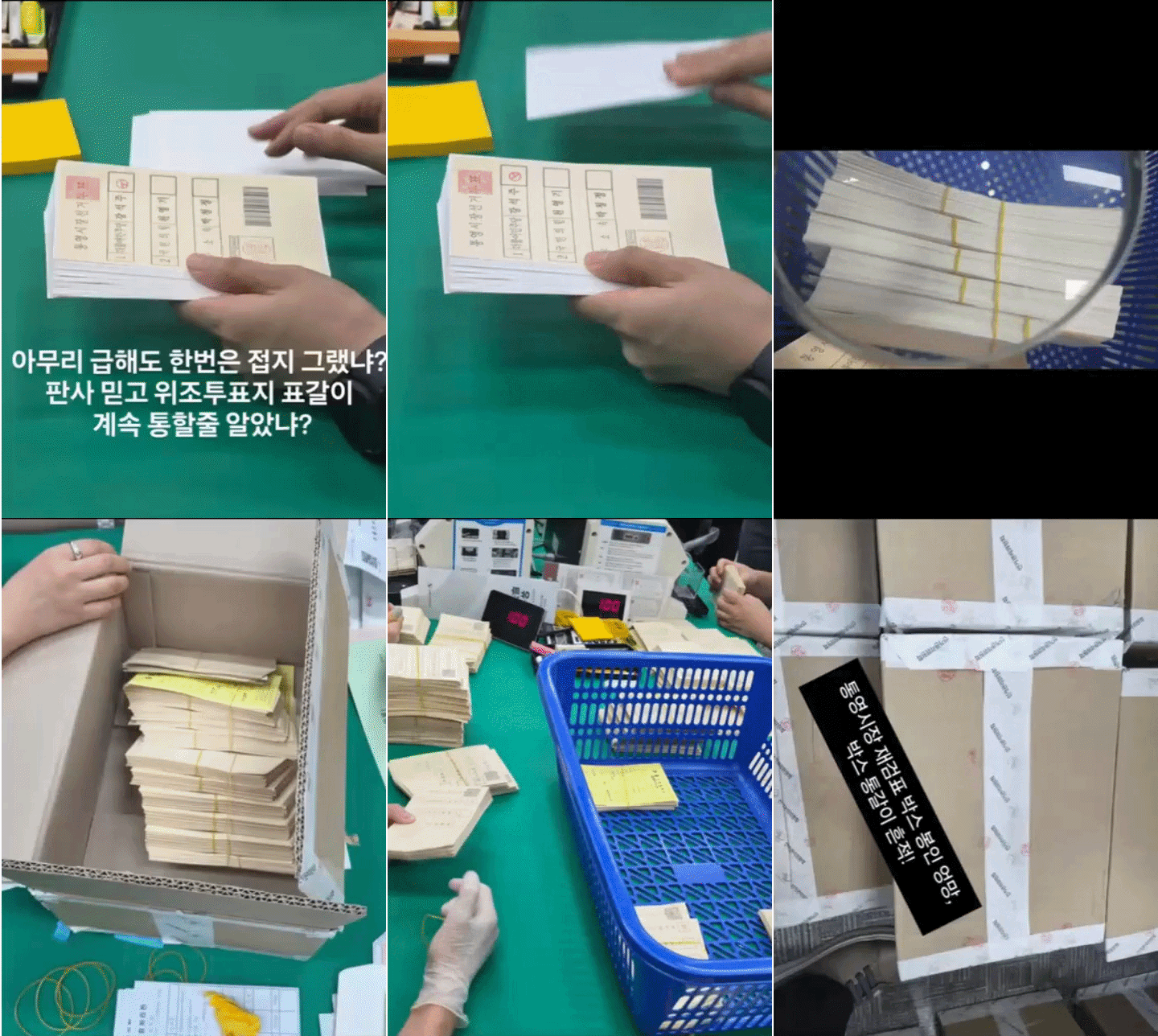 “Ignoring crisp ballots and damaged seals”… Tongyeong mayoral recount concludes with ‘no change in outcome,’ leaving suspicions and public outrage behind
Suspected counterfeit ballots discovered in Tongyeong [GIF from social media of Representative Hwang Kyo-ahn / Attorney Park Joo-hyun]During a recount of the Tongyeong mayoral election in South Gyeong
“Ignoring crisp ballots and damaged seals”… Tongyeong mayoral recount concludes with ‘no change in outcome,’ leaving suspicions and public outrage behind
Suspected counterfeit ballots discovered in Tongyeong [GIF from social media of Representative Hwang Kyo-ahn / Attorney Park Joo-hyun]During a recount of the Tongyeong mayoral election in South Gyeong
 President Yoon, regarding the first-instance ruling on the Public Official Election Act: “An excessive political verdict that distorts the facts… We will appeal immediately.”
The first-instance sentencing hearing for President Yoon Suk Yeol regarding violations of the Public Official Election Act is being broadcast live at Seoul Station on the 27th. [Photo=Yonhap News]Pres
President Yoon, regarding the first-instance ruling on the Public Official Election Act: “An excessive political verdict that distorts the facts… We will appeal immediately.”
The first-instance sentencing hearing for President Yoon Suk Yeol regarding violations of the Public Official Election Act is being broadcast live at Seoul Station on the 27th. [Photo=Yonhap News]Pres
 WSJ: "SK Hynix ADR Premium Is a Sign of AI Trading Overheat"
Advertisement for SK Hynix ADR listing in New York's Times Square [Reuters=Yonhap News file photo]The Wall Street Journal (WSJ) has pointed out that the price of SK Hynix’s American Depositary Recei
WSJ: "SK Hynix ADR Premium Is a Sign of AI Trading Overheat"
Advertisement for SK Hynix ADR listing in New York's Times Square [Reuters=Yonhap News file photo]The Wall Street Journal (WSJ) has pointed out that the price of SK Hynix’s American Depositary Recei
 'Godfather of Japanese Mystery Novels' Keigo Higashino Passes Away After Battle with Cancer at 68
Famous Japanese mystery novelist Keigo Higashino [AFP=Yonhap News]It has been belatedly reported that Keigo Higashino, the "godfather of Japanese mystery novels" and author of bestsellers such as "The
'Godfather of Japanese Mystery Novels' Keigo Higashino Passes Away After Battle with Cancer at 68
Famous Japanese mystery novelist Keigo Higashino [AFP=Yonhap News]It has been belatedly reported that Keigo Higashino, the "godfather of Japanese mystery novels" and author of bestsellers such as "The
 [Park Pil-kyu Security Column] To the Ignorant Trying to Clothe a Beast in Sheep's Clothing
Rep. Kim Byung-joo of the Democratic Party of Korea [Photo=Yonhap News]“The Air Force Academy doesn't teach you how to fly a plane!” “The Army, Navy, and Air Force academies are exactly the
[Park Pil-kyu Security Column] To the Ignorant Trying to Clothe a Beast in Sheep's Clothing
Rep. Kim Byung-joo of the Democratic Party of Korea [Photo=Yonhap News]“The Air Force Academy doesn't teach you how to fly a plane!” “The Army, Navy, and Air Force academies are exactly the
 [Issue Diagnosis] Two Effects of the Election Petition Review
 [Photo] Evidence of Election Fraud Flooding U.S. Media… Trump Had 2.7 Million Votes Stolen
 [Video] U.S. Semiquincentennial Air Show... 'Art in the Sky' streaks across New York
 [Editorial Cartoon] A Draconian Law That Undermines Freedom of Expression

 List
List