 ROK-U.S. Combined Joint Maneuver Crossing Exercise. [Photo: Yonhap News]
An invisible test that shakes the very foundation of South Korea's security has begun. The double-edged sword of the U.S.-China hegemony competition is pointed not only across the Taiwan Strait but also to the doorstep of the Korean Peninsula.
At the recent Beijing summit between the U.S. and China, President Xi Jinping directly addressed the Taiwan issue, warning of "clashes and conflicts," while President Trump responded by suspending arms sales, despite potential backlash from Taiwan.
As the Taiwan Strait crisis has been reconfirmed as a time bomb for a direct clash of global hegemonic powers, South Korea's security is also not immune to the U.S.-China hegemony war. If South Korea becomes involved or drawn into the U.S.-China hegemony war, or if U.S. Forces Korea (USFK) are deployed to a Taiwan Strait war, we must also anticipate North Korean provocations.
In these uncertain times, we must read and confront the strategic shifts emanating from the U.S. Army Association's Land Forces Pacific (LANPAC) Symposium in Hawaii.
1. Is USFK a Deterrent Force Against North Korea or a Maneuver Force Against China?
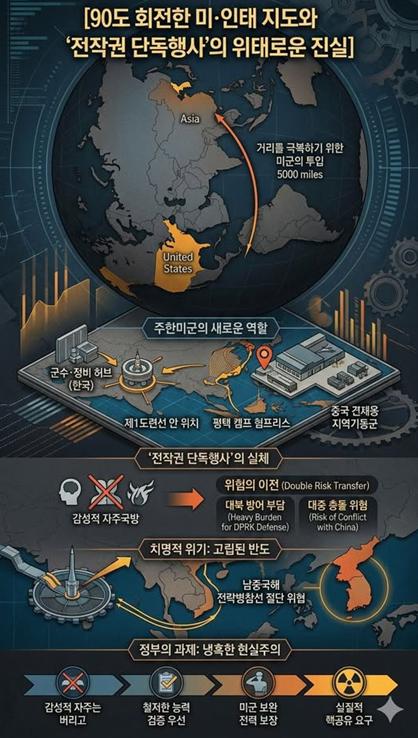
Senior U.S. military officials, including USFK Commander Gen. JB Bronson, have officially defined South Korea not as a defensive base against North Korea, but as a "Regional Maintenance and Overhaul (MRO) Hub" with positional advantages within the "First Island Chain," the frontline of a direct U.S.-China hegemony clash.
Commander Bronson described the greatest enemy of the U.S. military in the Indo-Pacific theater as "runaway distance," asserting that victory is impossible with supply lines originating 5,000 miles away from the U.S. mainland. He declared that logistics support is the "teeth" of deterrence, and that South Korea is the forward operating base for this.
Similarly, U.S. Eighth Army Commander Lt. Gen. Joseph Hilbert stated that confining USFK solely to deter North Korea is a "tragic waste" and urged a viewing of the Korean Peninsula on a map rotated "90 degrees to the left," with the East facing upwards.
This designates Camp Humphreys in Pyeongtaek as the forward terminal of the 5,000-mile long supply line from the U.S. mainland to Asia. This signifies that the U.S. strategic plan to utilize USFK as a regional maneuver force to deter China has already been completed.
2. The Precarious Truth of "Independent Wartime Operational Control (Transition)"
In a situation where U.S.-China hegemony is openly clashing, the independent execution of wartime operational control (transition of wartime operational control) for the ROK military, being pursued on a "90-degree rotated map" with the Korean Peninsula oriented northward, entails the following critical security destructions and disruptions.
∆ The transition of wartime operational control is a burden for independent defense against North Korea and a trap for entanglement in conflict with China.
The transition of wartime operational control, which the government is accelerating with the goal of completing within its term, is not complete military sovereignty as advocated by emotional self-reliant defense. For the U.S. military, it signifies "strategic flexibility" for deterring China, but for the ROK military, it is merely a "transfer of risk" into the dual traps of the heavy burden of independent defense against North Korea and entanglement in conflict with China. Who will fill the defense vacuum on the Korean Peninsula if U.S. forces in Korea are dispersed during a Taiwan contingency?
∆ Independent execution of wartime operational control leads to geographical isolation in case of insufficient stockpiled supplies.
To elevate South Korea to a logistical hub and a "non-sinking aircraft carrier" type rear base, the issue of safe navigation through the South China Sea, which is crucial for the maritime lines of communication (SLOC) for wartime raw materials and supplies, must be resolved. This route is directly under China's nose.
While Japan can serve as a safe base country in a contingency, South Korea, situated in the heart of the "First Island Chain" which acts as a maritime bulwark against Chinese expansion, must traverse the South China Sea. If its supply lines are severed, it will be isolated on all sides. Without perfect pre-positioning of forces and supplies, the concept of a logistics hub becomes a massive trap. The transition of wartime operational control may be nothing more than a flag without military capability.
∆ Independent execution of wartime operational control is a catastrophic handover buried in political schedules.
Our discussions on wartime operational control remain trapped in infantile political agendas and the formal logic of sovereignty. If the military structure reform of reorganizing the Joint Chiefs of Staff into a theater command system is not sufficiently advanced, and the command title is merely changed while the U.S. military holds the reins of Full Operational Capability (FOC) verification, it will not be self-reliance but a "premature handover of disaster."
3. Realistic Alternatives for Survival and a Sober Bill of Demands to the U.S.
Although the U.S. Senate's budget bill has addressed concerns about USFK withdrawal, the real reason the U.S. is not abandoning the ROK-U.S. alliance is not because the current administration has a robust alliance. It is because South Korea's advanced infrastructure and geographical value as a logistics base are desperately needed for the massive gamble of the Indo-Pacific theater. Therefore, the government must immediately abandon the illusion of sentimental self-reliant defense and approach renegotiations with a realistic alternative of security and economy.
∆ Thorough Conditioning of the Transition of Wartime Operational Control
The transition of wartime operational control should not be rushed by even a single step until the Korean-style three-axis system and the capabilities to respond to nuclear weapons and WMDs are fully verified.
Furthermore, we must cease six detrimental security policies that weaken our forces under the guise of peace and operational efficiency: ➀ the transition of wartime operational control, ➁ the restoration of the September 19 Military Agreement, which dissolves the border lines, ➂ the mechanical merger of service academies, which emasculates our elite talent pool, ④ the blind integration of specialized professions, which dismantles specialized functions, ⑤ the personnel disasters and lack of vision in the defense acquisition system, and ⑥ the disruption of the command structure that undermines military discipline of superior-subordinate chain of command. In short, we must stop these treasonous acts that ultimately destroy security.
∆ Documentation of Complementary Forces and Issuance of a Bill for Substantive "Nuclear Sharing"
In exchange for acknowledging the regional maneuver and base utilization of USFK, the scale and timing of complementary forces to be provided by the U.S. military in case of contingency must be clearly stipulated in ROK-U.S. combined documents. Moreover, if the U.S. wishes to borrow our world-class maintenance (MRO), shipbuilding, and ammunition capabilities, we must demand a strategy of "nuclear response to nuclear" in the form of "substantive nuclear sharing," which involves sharing U.S. nuclear umbrella operational procedures from the planning stage, a demand that was never raised by leftist administrations.
4. What if the Role of USFK Transforms into a Maneuver Force to Deter China?
If we fail to restore ROK-U.S. relations, various crises and disasters will converge. To avoid catastrophe, we must completely replace the security apparatus that insists on pro-China policies and is lost in the illusion of self-reliant defense. We must be armed with stark realism and negotiate for "substantive nuclear sharing" equivalent to independent nuclear armament.
If the current administration misses the essence of security and fails to break free from Chinese influence, it will repeat the foolishness of grasping at straws, as it did in the late Joseon Dynasty. I hope that through awakened security thinking that prioritizes the nation and its people, we can prevent wars unrelated to our will amidst the hegemony clash and protect the Republic of Korea.
◆ Park Pil-gyu
Editorial Board Member, The Hankyoreh
40th graduating class, Korea Military Academy

 Trump pressures for rate cut again ahead of FOMC... "Should be the lowest in the world"
U.S. President Donald Trump. [Photo = The White House] U.S. President Donald Trump once again pressured the Federal Reserve, the U.S. central bank, to lower interest rates on the 27th (local time
Trump pressures for rate cut again ahead of FOMC... "Should be the lowest in the world"
U.S. President Donald Trump. [Photo = The White House] U.S. President Donald Trump once again pressured the Federal Reserve, the U.S. central bank, to lower interest rates on the 27th (local time
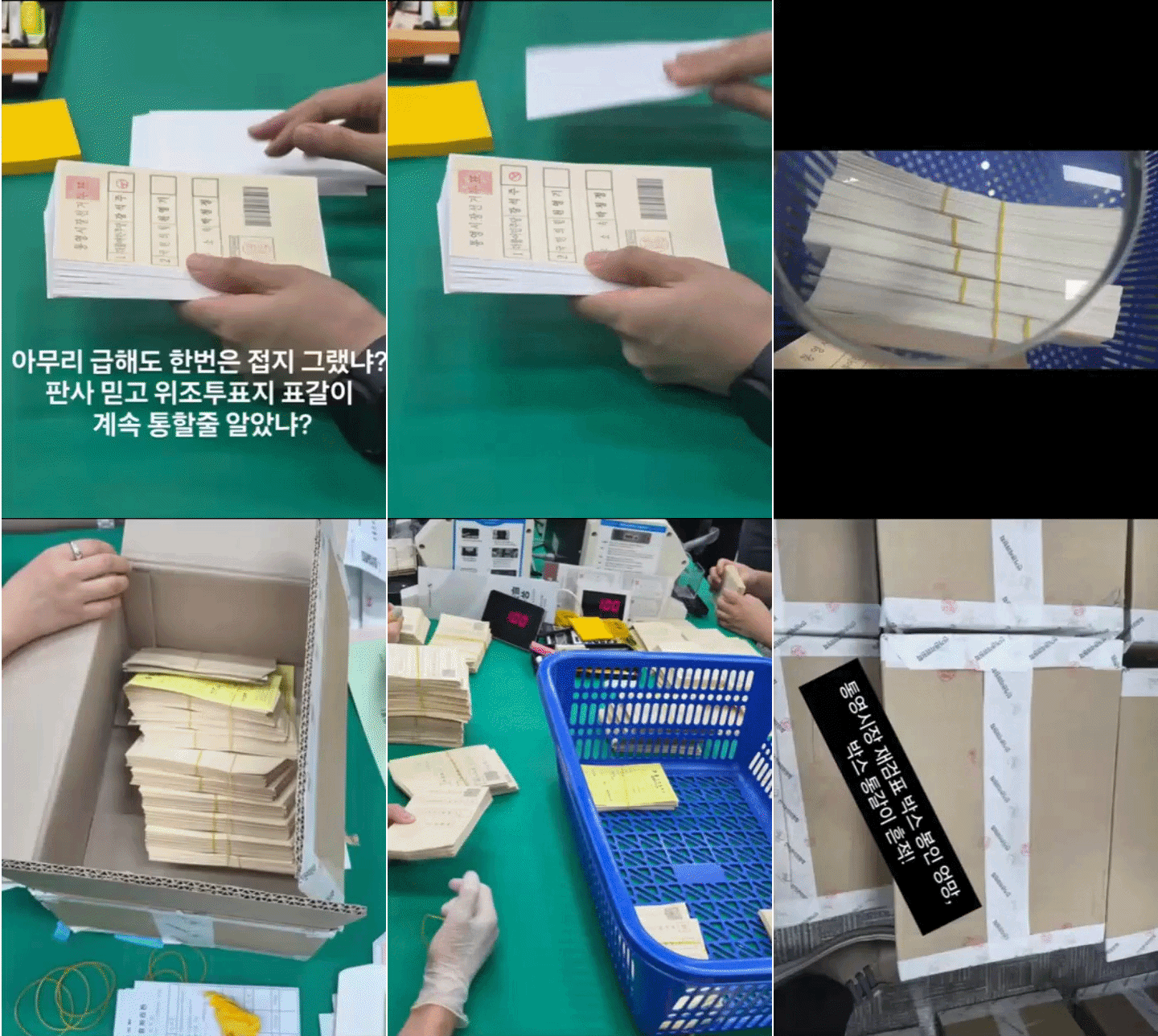 “Ignoring crisp ballots and damaged seals”… Tongyeong mayoral recount concludes with ‘no change in outcome,’ leaving suspicions and public outrage behind
Suspected counterfeit ballots discovered in Tongyeong [GIF from social media of Representative Hwang Kyo-ahn / Attorney Park Joo-hyun]During a recount of the Tongyeong mayoral election in South Gyeong
“Ignoring crisp ballots and damaged seals”… Tongyeong mayoral recount concludes with ‘no change in outcome,’ leaving suspicions and public outrage behind
Suspected counterfeit ballots discovered in Tongyeong [GIF from social media of Representative Hwang Kyo-ahn / Attorney Park Joo-hyun]During a recount of the Tongyeong mayoral election in South Gyeong
 President Yoon, regarding the first-instance ruling on the Public Official Election Act: “An excessive political verdict that distorts the facts… We will appeal immediately.”
The first-instance sentencing hearing for President Yoon Suk Yeol regarding violations of the Public Official Election Act is being broadcast live at Seoul Station on the 27th. [Photo=Yonhap News]Pres
President Yoon, regarding the first-instance ruling on the Public Official Election Act: “An excessive political verdict that distorts the facts… We will appeal immediately.”
The first-instance sentencing hearing for President Yoon Suk Yeol regarding violations of the Public Official Election Act is being broadcast live at Seoul Station on the 27th. [Photo=Yonhap News]Pres
 WSJ: "SK Hynix ADR Premium Is a Sign of AI Trading Overheat"
Advertisement for SK Hynix ADR listing in New York's Times Square [Reuters=Yonhap News file photo]The Wall Street Journal (WSJ) has pointed out that the price of SK Hynix’s American Depositary Recei
WSJ: "SK Hynix ADR Premium Is a Sign of AI Trading Overheat"
Advertisement for SK Hynix ADR listing in New York's Times Square [Reuters=Yonhap News file photo]The Wall Street Journal (WSJ) has pointed out that the price of SK Hynix’s American Depositary Recei
 'Godfather of Japanese Mystery Novels' Keigo Higashino Passes Away After Battle with Cancer at 68
Famous Japanese mystery novelist Keigo Higashino [AFP=Yonhap News]It has been belatedly reported that Keigo Higashino, the "godfather of Japanese mystery novels" and author of bestsellers such as "The
'Godfather of Japanese Mystery Novels' Keigo Higashino Passes Away After Battle with Cancer at 68
Famous Japanese mystery novelist Keigo Higashino [AFP=Yonhap News]It has been belatedly reported that Keigo Higashino, the "godfather of Japanese mystery novels" and author of bestsellers such as "The
 [Park Pil-kyu Security Column] To the Ignorant Trying to Clothe a Beast in Sheep's Clothing
Rep. Kim Byung-joo of the Democratic Party of Korea [Photo=Yonhap News]“The Air Force Academy doesn't teach you how to fly a plane!” “The Army, Navy, and Air Force academies are exactly the
[Park Pil-kyu Security Column] To the Ignorant Trying to Clothe a Beast in Sheep's Clothing
Rep. Kim Byung-joo of the Democratic Party of Korea [Photo=Yonhap News]“The Air Force Academy doesn't teach you how to fly a plane!” “The Army, Navy, and Air Force academies are exactly the
 [Issue Diagnosis] Two Effects of the Election Petition Review
 [Photo] Evidence of Election Fraud Flooding U.S. Media… Trump Had 2.7 Million Votes Stolen
 [Video] U.S. Semiquincentennial Air Show... 'Art in the Sky' streaks across New York
 [Editorial Cartoon] A Draconian Law That Undermines Freedom of Expression

 List
List










