판단은 사람이, 어시스트는 AI가. ALO지식발전소의 모든 콘텐츠는 인간의 결정 아래 제작되며 저작권은 창작자에게 귀속된다. 이번 글은 제임스웹 우주망원경 관측이 던진 초기 은하의 이상현상을 통해, 과학 지식이 어떻게 수정되고 축적되는지를 살펴본다. <편집자 주>
 Observations from the James Webb Space Telescope suggest the possibility that giant galaxies in the early universe may have exhibited mature kinematic characteristics at an earlier stage than expected. Scientific progress begins with documenting and verifying exceptions rather than definitive answers. [Composite by Hanmi Ilbo]Early Galaxies with Weak Rotation: A Moment When Observations Shake Theory
The universe sometimes defies human timelines.
The explanations that stars are born, galaxies rotate, and age through collisions and mergers constitute the grand order built by modern astronomy.
However, observations always pose questions ahead of theory. The universe does not move solely in the order we have organized.
Here, the expression 'the universe aged faster than expected' does not mean that the age of the entire universe has changed. It means that a giant galaxy in the early universe showed mature kinematic characteristics earlier than expected.
It means that characteristics expected from much older, evolved galaxies were observed in a young universe.
Old Galaxies in a Young Universe
Recently, the James Webb Space Telescope (JWST) posed one such question again.
A research team from the University of California, Davis (UC Davis) announced observational results showing that the giant galaxy XMM-VID1-2075 in the early universe did not exhibit a distinct rotational motion.
This research was published in the international journal Nature Astronomy in May 2026.
The researchers explained that this galaxy existed when the universe was less than 2 billion years old, yet it displayed kinematic characteristics typically found in much more mature galaxies.
Strictly speaking, XMM-VID1-2075 is not so much an 'unrotating galaxy' as it is a 'slow rotator' with very weak ordered rotational motion and a large dispersion of disordered stellar velocities.
The 'early galaxy with no rotation' in the title is a condensed expression for public understanding, and scientifically, it is more accurate to consider it a case of a large, mature slow rotator observed in the early universe.
The problem is not simply that 'one galaxy is unusual.' Today, many galaxies exhibit disk structures and rotational order through the rotational motion of stars and gas.
In contrast, galaxies with weak rotation and large disordered stellar motion are generally found in very large and highly evolved galaxies.
These galaxies have been explained as having lost their original rotational order through numerous collisions and mergers over a long period.
This is why the researchers focused on XMM-VID1-2075.
Traces of a galaxy that was too mature were seen in a universe that was too early.
Simply put, the question is: Why was there a depiction of an old galaxy in a young universe?
Not a Collapse of Theory, but the Beginning of Questions
Of course, this does not immediately signify the collapse of cosmology.
In science, an observation is not a conclusion but the beginning of a question.
This discovery is not a declaration that 'all existing theories are wrong.' More precisely, it signals the need to examine the possibility that giant galaxies in the early universe formed, merged, and evolved faster than previously expected.
Whether XMM-VID1-2075 is an exceptional single case or if such galaxies were more numerous in the early universe than thought needs to be confirmed through further observations and simulations.
This is where the power of science lies.
Science does not erase exceptions. It records exceptions, turns them into questions, and re-examines existing explanatory frameworks.
Instead of sealing a once-established theory with authority, it shakes that theory again when new data arrives.
Therefore, science is closer to a modifiable structure of knowledge than a warehouse of definitive answers.
The observation of XMM-VID1-2075 is not just another astronomy news item. This event demonstrates how knowledge is created.
First, observational data arrives. That data conflicts with existing theories. Scientists do not deny the conflict; they re-verify measurements and models.
Then, possible explanations are discussed. They examine whether galactic mergers occurred earlier than expected, whether the early universe environment was more complex than existing models suggest, or whether the observed object is a special case. And they do not rush to close the final conclusion.
This is the ethics of knowledge.
To leave what is unknown as unknown, to not conclude what cannot be concluded, yet to not discard anomalous data and move it to the next question. Science advances in this way.
ALO Looks at the Process, Not Just the Conclusion
This is where the focus of ALO Knowledge Development Institute becomes apparent.
ALO is not a method of looking only at the output.
It is a framework that records what data arrived, what questions were raised, where existing judgments and new evidence conflicted, and to what extent conclusions can be drawn and where judgments must be deferred.
It resembles how scientists handle anomalies.
Knowledge production in the age of AI cannot deviate from this principle.
As AI rapidly generates text, summarizes data, and assembles explanations, what is important is not the speed of the outcome, but the record of the judgment.
What grounds were used? What explanations were adopted? What possibilities were excluded? Where was the potential for error left? Knowledge that does not leave this process, though fast, is not safe.
This is why ALO is necessary.
ALO is not a device that replaces human judgment with AI. It is a device that organizes data, questions, and evidence up to the point of judgment, assisting human decision-making.
It does not decide the conclusion for you, but illuminates the path by which the conclusion is reached.
Just as XMM-VID1-2075 posed a question to astronomy, good knowledge does not end with closing off answers. Rather, it moves to the next stage when it leaves behind more sophisticated questions.
The universe is more complex than human timelines.
The fact that traces of old galaxies were found in a young universe demands humility.
We know much, but there is still more we do not know.
What is important is not the ability to hide what we don't know, but the ability to record that we don't know and to ask again.
An anomaly is not a failure of science. It is a moment when knowledge corrects itself.
Perhaps the universe did not age faster than expected, but rather held a more complex history than the explanatory frameworks established by humans.
Science moves forward by recording these differences.
This is precisely why ALO Knowledge Development Institute views knowledge as a process, not an outcome.
BOX | ‘Anomalies’ from the ALO Perspective An anomaly is not a simple error. It is an observation or data that cannot be fully explained by existing frameworks. What is important is an attitude that neither ignores nor exaggerates it. From the ALO perspective, anomalies can be handled in four stages. First, data recording. The observed values and raw data are documented first. Second, separation of conflict points. The parts that do not align with existing explanations are distinguished. Third, parallelization of interpretations. Instead of rushing to a single conclusion, possible explanations are placed together. Fourth, setting the scope of judgment. What can be concluded and what must be deferred are separated. Science also operates with this structure. Observations shake theories, and theories are modified to explain exceptions. Knowledge is not a completed answer, but a structure accumulated through verification and refinement.
|
※ This article was published in the 10th issue of the Weekly Hanmi Ilbo (3rd week of May).

 [Statement by the Seobeokka KMA Patriots Association] ㉛ Recount the ballots openly, as the previous recount covered up election fraud
Recount of the Tongyeong mayoral election [Photo=Yonhap News]South Korea's liberal democracy is dying. The National Election Commission (NEC), which has degraded into a criminal organization through t
[Statement by the Seobeokka KMA Patriots Association] ㉛ Recount the ballots openly, as the previous recount covered up election fraud
Recount of the Tongyeong mayoral election [Photo=Yonhap News]South Korea's liberal democracy is dying. The National Election Commission (NEC), which has degraded into a criminal organization through t
 Bill Pulte to Restructure ‘Deep State’… Announces 4th Round of Layoffs at the Office of the Director of National Intelligence
Acting Director of National Intelligence Bill Pulte announced Sunday that he has carried out a fourth "deliberate and measured" reduction in personnel since taking office on June 19, as part of the Tr
Bill Pulte to Restructure ‘Deep State’… Announces 4th Round of Layoffs at the Office of the Director of National Intelligence
Acting Director of National Intelligence Bill Pulte announced Sunday that he has carried out a fourth "deliberate and measured" reduction in personnel since taking office on June 19, as part of the Tr
 First U.S. Ambassador of Trump's Second Term to Arrive This Week… Will It Provide Momentum to Resolve Pending Issues?
U.S. Ambassador to South Korea Michelle Steel speaks at the opening ceremony of the Korea-U.S. Shipbuilding Cooperation Center held at the Mayflower Hotel in Washington, D.C., on the 23rd (local time)
First U.S. Ambassador of Trump's Second Term to Arrive This Week… Will It Provide Momentum to Resolve Pending Issues?
U.S. Ambassador to South Korea Michelle Steel speaks at the opening ceremony of the Korea-U.S. Shipbuilding Cooperation Center held at the Mayflower Hotel in Washington, D.C., on the 23rd (local time)
 President Yoon, regarding the first-instance ruling on the Public Official Election Act: “An excessive political verdict that distorts the facts… We will appeal immediately.”
The first-instance sentencing hearing for President Yoon Suk Yeol regarding violations of the Public Official Election Act is being broadcast live at Seoul Station on the 27th. [Photo=Yonhap News]Pres
President Yoon, regarding the first-instance ruling on the Public Official Election Act: “An excessive political verdict that distorts the facts… We will appeal immediately.”
The first-instance sentencing hearing for President Yoon Suk Yeol regarding violations of the Public Official Election Act is being broadcast live at Seoul Station on the 27th. [Photo=Yonhap News]Pres
 91% of Net Influx of MZ Generation Goes to Seoul Metropolitan Area… Population Migration Also Shows 'K-shaped Polarization' by Industry
[Provided by Leaders Index]Over the past four years, the MZ generation population has become increasingly concentrated in the Seoul metropolitan area and the Chungcheong region. While cities cen
91% of Net Influx of MZ Generation Goes to Seoul Metropolitan Area… Population Migration Also Shows 'K-shaped Polarization' by Industry
[Provided by Leaders Index]Over the past four years, the MZ generation population has become increasingly concentrated in the Seoul metropolitan area and the Chungcheong region. While cities cen
 'Godfather of Japanese Mystery Novels' Keigo Higashino Passes Away After Battle with Cancer at 68
Famous Japanese mystery novelist Keigo Higashino [AFP=Yonhap News]It has been belatedly reported that Keigo Higashino, the "godfather of Japanese mystery novels" and author of bestsellers such as "The
'Godfather of Japanese Mystery Novels' Keigo Higashino Passes Away After Battle with Cancer at 68
Famous Japanese mystery novelist Keigo Higashino [AFP=Yonhap News]It has been belatedly reported that Keigo Higashino, the "godfather of Japanese mystery novels" and author of bestsellers such as "The
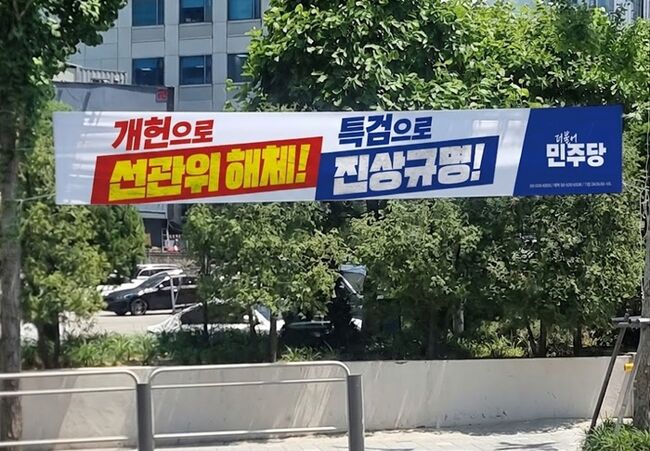 [Cho Yang-geon Column] The NEC: Facing a Fate of "Discarding the Dog After the Hunt"
Banner calling for the "dissolution of the NEC" posted by the Democratic Party. [AI-generated image]Banners calling for the "dissolution of the National Election Commission (NEC)" posted by the Democr
[Cho Yang-geon Column] The NEC: Facing a Fate of "Discarding the Dog After the Hunt"
Banner calling for the "dissolution of the NEC" posted by the Democratic Party. [AI-generated image]Banners calling for the "dissolution of the National Election Commission (NEC)" posted by the Democr
 [Photo] Evidence of Election Fraud Flooding U.S. Media… Trump Had 2.7 Million Votes Stolen
 [Video] U.S. Semiquincentennial Air Show... 'Art in the Sky' streaks across New York
 [Editorial Cartoon] A Draconian Law That Undermines Freedom of Expression

 List
List