"Was it a negotiation or an absorption?" The US-Korea MOU almost perfectly matches the US-Japan MOU in terms of clauses and sentence structure. A controversy is spreading that "half of the government's announcement is false." [Graphic=Hanmiilbo]
The government emphasized that the recent Memorandum of Understanding (MOU) on strategic investment between Korea and the US "does not impose investment obligations," announcing that Korea would lead the future supply chain and that tariff uncertainty had been eliminated.
However, a comparison of the full text of the US-Japan MOU and the English version of the Korea-US MOU obtained by revealed that the recent agreement was not a structure that the Korean government obtained through 'negotiations' with the US, but rather a form of Korea being incorporated into an industrial and tariff template (standardized format) that the US had already established through an agreement with Japan. In other words, there were no negotiations, and the design was already complete. What occurred between Korea and the US was not adjustment, but acceptance.
The Korea-US MOU and the US-Japan MOU are virtually identical in sentence structure, key clauses, and even clause numbers. Except for the difference in investment amounts – $550 billion for Japan and $350 billion for Korea – core clauses such as △no legal binding force △Catch-up settlement upon non-fulfillment of investment △possibility of tariff imposition △conditional entry with "where feasible" are repeated down to the word level.
This means that the Korean government did not create a new framework through negotiations, but simply signed an existing "Up-Front design" after changing the numbers. In fact, the US first signed an MOU with Japan, fixing the linkage structure of industry, tariffs, and investment, and through document comparison, it is clearly confirmed that the same text was likely presented to the Korean government.
The government explains that the MOU is a voluntary agreement and not mandatory, based on "no investment obligation," but this is only half the truth.
The document includes the sentence, "This MOU does not create legally binding rights or obligations." However, immediately following, Section 9 stipulates as follows:
"...the United States may impose tariff rate or rates on Korean imports into the United States at the rate determined by the President."
(The United States may impose tariffs on Korean imports at the rate determined by the President.)
While investment is not mandatory, the structure implies that economic disadvantages, including tariffs, may be imposed if it is not carried out. In other words, it is a design where "there are no legal obligations, but economic coercion exists." This is the core part that the government did not disclose.
In addition, the Catch-up Amount clause, which stipulates that profits are disadvantageously adjusted upon non-fulfillment of investment, is also reflected identically.
Catch-up is not a penalty, but it functions as a de facto penalty by disadvantageously adjusting dividends and profit distribution in case of investment delays. Investment is a choice, but it is designed so that one incurs losses if one does not choose to invest. This structure appears identically in both the US-Japan MOU and the Korea-US MOU, matching even in location and wording.
The government also announced that "our companies' entry into the US was guaranteed," but the actual wording of the document is as follows:
"...the United States will support Korean participation where feasible and available."
(The United States will support Korean participation where feasible and available.)
This means "we can consider it only if the conditions are met," and it is merely a discretionary choice rather than a firm commitment. In international agreements, "where feasible" is widely used as a clause to avoid obligations.
Ultimately, the government called clauses with tariff triggers 'optional' and announced clauses limited by "where feasible" as 'guaranteed'.
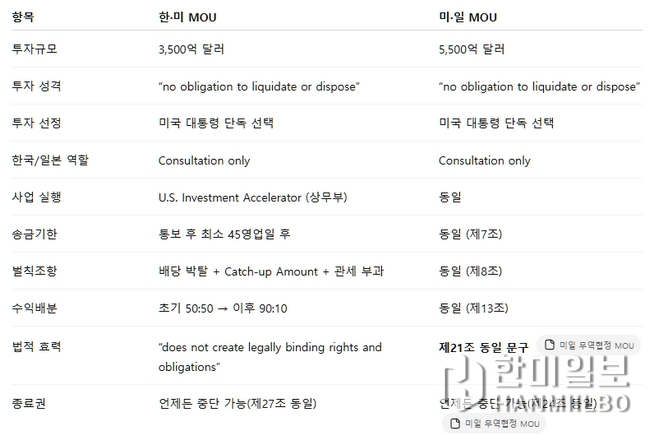 Comparative analysis of Korea-US and US-Japan trade agreement MOUs. [Graphic=Hanmiilbo]
The essence of this MOU lies not in the investment amount, but in the structural design.
Instead of designing a new industrial and tariff system for each country, the US approached it by first creating a single template and then incorporating other countries into it.
This is called upfront design. It is a method of fixing the structure before negotiations and allowing the other country only to choose whether to participate. Japan was the initial experimental subject, and Korea followed suit by being incorporated into the same structure.
In this process, genuine negotiations did not exist. Although the form was a bilateral MOU, the reality was an incorporation into a designed system.
This structure aligns with the US strategy of reallocating global supply chains amidst US-China competition. The US is building a new industrial system that links 'regulations, investment, and tariffs,' and Korea has become a major target after Europe and Japan.
The biggest problem in this process is that the Korean government did not accurately explain the facts to the public, and a bigger problem is that it even included half-truths in its reporting of the outcomes.
The Ministry of Trade, Industry and Energy only disclosed 'no investment obligation' and omitted the most crucial clauses: the possibility of tariff imposition, the Catch-up settlement conditions, and conditional entry expressed as "where feasible." What the public needs is information about the 'structural design,' not just whether there is an 'obligation.' This is why the government's explanation can only be judged as half-false.
If the nature of this agreement is to be accurately defined, it is not a 'Korea-US negotiation' but an 'incorporation into the industrial and tariff system designed by the US.'
In other words, Korea entered into a structure designed by the US, not one that we designed ourselves. While the government showed only the phrase "no obligation," the structure of the choices specified in the actual document is designed in a way that says, "If you invest, we will waive tariffs; if you don't invest, tariffs may be imposed." Understanding this difference is also the key to understanding this MOU.
What is needed now is accurate description, not political rhetoric.
This document is not a 'pledge of investment' but a 'tariff leverage' document, and not an 'autonomous choice' but a 'designed incentive structure.' And the question boils down to one.
"Did we negotiate, or were we incorporated into a designed system?"
Only when this question is answered honestly can evaluation and correction for national interest become possible.
On the 18th, the National Assembly's Special Committee on Strategy and Finance is debating the 'enactment of a special law and ratification consent' while omitting the essence.
※ Reference Materials
Korean and English versions of the Korea-US Trade Agreement MOU
https://www.motir.go.kr/kor/article/ATCL3f49a5a8c/171196/view?mno=&pageIndex=2&rowPageC=0&displayAuthor=&searchCategory=0&schClear=on&startDtD=&endDtD=&searchCondition=1&searchKeyword=
English version of the US-Japan Trade Agreement MOU
https://www.worldtradelaw.net/document.php?id=tradedisputetracker/Japan-US-Investment-MOU-Sep4.pdf&mode=download
Hudson Institute Financing the $550 Billion Strategic Investment Fund: An Update
https://www.hudson.org/economics/financing-550-billion-strategic-investment-fund-update-william-chou
#UpfrontDesign #KoreaUSAgreement #TariffTrigger #CatchUp #USJapanMOU #InvestmentTariffLinkage #LeeJaeMyungAdministration #TradeDiplomacyVerification #DocumentComparison #HanmiilboInvestigation

 [Statement by the Seobeokka KMA Patriots Association] ㉛ Recount the ballots openly, as the previous recount covered up election fraud
Recount of the Tongyeong mayoral election [Photo=Yonhap News]South Korea's liberal democracy is dying. The National Election Commission (NEC), which has degraded into a criminal organization through t
[Statement by the Seobeokka KMA Patriots Association] ㉛ Recount the ballots openly, as the previous recount covered up election fraud
Recount of the Tongyeong mayoral election [Photo=Yonhap News]South Korea's liberal democracy is dying. The National Election Commission (NEC), which has degraded into a criminal organization through t
 What is the significance of the "Trump 2028" red hat that keeps reappearing?
It is noteworthy that while it is "highly likely" that President Donald Trump is "seriously considering" a run for the presidency in 2028, he is also "deliberately" fueling speculation regarding wheth
What is the significance of the "Trump 2028" red hat that keeps reappearing?
It is noteworthy that while it is "highly likely" that President Donald Trump is "seriously considering" a run for the presidency in 2028, he is also "deliberately" fueling speculation regarding wheth
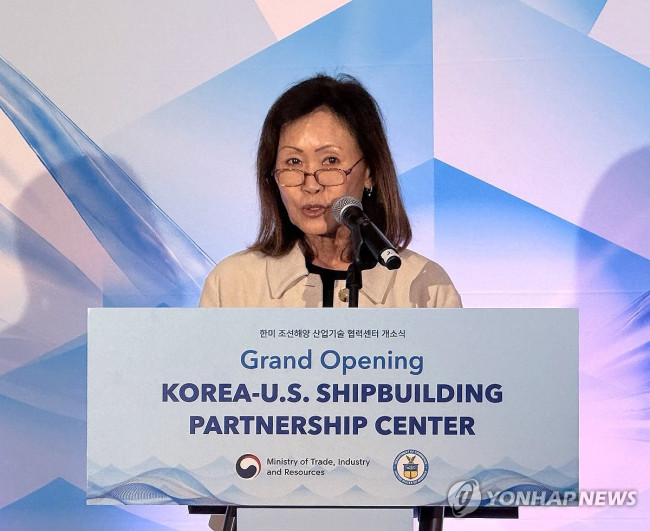 First U.S. Ambassador of Trump's Second Term to Arrive This Week… Will It Provide Momentum to Resolve Pending Issues?
U.S. Ambassador to South Korea Michelle Steel speaks at the opening ceremony of the Korea-U.S. Shipbuilding Cooperation Center held at the Mayflower Hotel in Washington, D.C., on the 23rd (local time)
First U.S. Ambassador of Trump's Second Term to Arrive This Week… Will It Provide Momentum to Resolve Pending Issues?
U.S. Ambassador to South Korea Michelle Steel speaks at the opening ceremony of the Korea-U.S. Shipbuilding Cooperation Center held at the Mayflower Hotel in Washington, D.C., on the 23rd (local time)
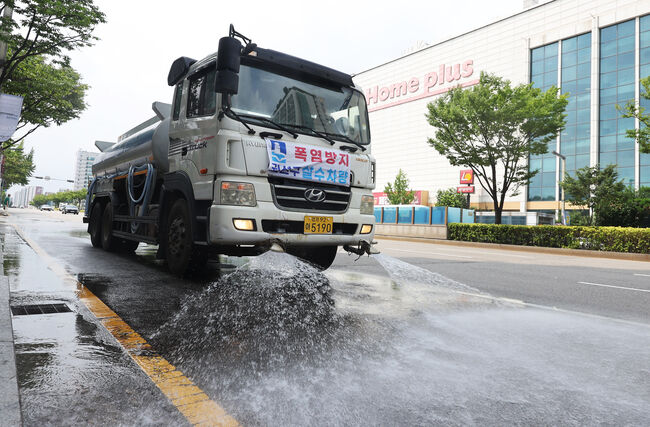 The Korean Peninsula wrapped in a thick blanket of scorching high pressure… Will the 1994 record be broken?
On the 28th, as the heatwave continues, a water sprinkler truck sprays water on Hyowon-ro, Gwonseon-gu, Suwon, Gyeonggi Province. [Photo = Yonhap News]The hottest years on record are considered to be
The Korean Peninsula wrapped in a thick blanket of scorching high pressure… Will the 1994 record be broken?
On the 28th, as the heatwave continues, a water sprinkler truck sprays water on Hyowon-ro, Gwonseon-gu, Suwon, Gyeonggi Province. [Photo = Yonhap News]The hottest years on record are considered to be
 Stock Market Crash 'Black Tuesday'… KOSPI down 10.8%, KOSDAQ down 7.7%
The KOSPI fell by more than 5% in early trading on the 28th, triggering a sell-side sidecar.On the 28th, the KOSPI plunged by more than 10%.Due to the sharp decline, a sell-side sidecar—a temporary
Stock Market Crash 'Black Tuesday'… KOSPI down 10.8%, KOSDAQ down 7.7%
The KOSPI fell by more than 5% in early trading on the 28th, triggering a sell-side sidecar.On the 28th, the KOSPI plunged by more than 10%.Due to the sharp decline, a sell-side sidecar—a temporary
 [World Heritage Committee] 25 New World Heritage Sites Inscribed in Busan… South Korea Successfully Expands 'Getbol' Listing
The Chairperson of the World Heritage Committee speaks at the plenary session of the 48th session of the World Heritage Committee, held at BEXCO in Busan on the 20th. [Photo: Yonhap News]A total of 25
[World Heritage Committee] 25 New World Heritage Sites Inscribed in Busan… South Korea Successfully Expands 'Getbol' Listing
The Chairperson of the World Heritage Committee speaks at the plenary session of the 48th session of the World Heritage Committee, held at BEXCO in Busan on the 20th. [Photo: Yonhap News]A total of 25
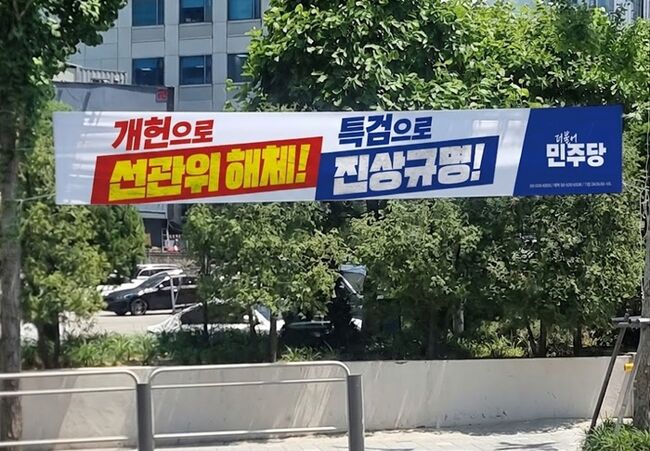 [Cho Yang-geon Column] The NEC: Facing a Fate of "Discarding the Dog After the Hunt"
Banner calling for the "dissolution of the NEC" posted by the Democratic Party. [AI-generated image]Banners calling for the "dissolution of the National Election Commission (NEC)" posted by the Democr
[Cho Yang-geon Column] The NEC: Facing a Fate of "Discarding the Dog After the Hunt"
Banner calling for the "dissolution of the NEC" posted by the Democratic Party. [AI-generated image]Banners calling for the "dissolution of the National Election Commission (NEC)" posted by the Democr
 [Photo] Evidence of Election Fraud Flooding U.S. Media… Trump Had 2.7 Million Votes Stolen
 [Video] U.S. Semiquincentennial Air Show... 'Art in the Sky' streaks across New York
 [Editorial Cartoon] A Draconian Law That Undermines Freedom of Expression

 List
List