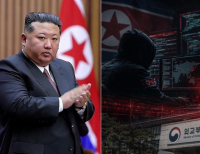
President Lee Jae-myung holds a press conference aboard Air Force One en route to Turkey from South Africa, following his schedule at the G20 Summit on the 23rd (local time). [Photo: Yonhap News]
Controversy is escalating over remarks made by President Lee Jae-myung during an in-flight press conference on the 24th while on his overseas tour. However, domestic media outlets are focusing solely on political disputes, scarcely mentioning how these remarks function as external signals regarding the alliance with the United States, cost-sharing, currency swaps, and exchange rate stability.
The most problematic aspect of President Lee Jae-myung's remarks is the characterization of the ROK-US Combined Military Training as "costly joint military training that President Trump doesn't like much." This single phrase completely distorts the nature of the training.
ROK-US combined training is a core asset for national deterrence and a strategic mechanism for maintaining the combined command system during wartime. The moment it is described as an "event with significant cost burdens," strategy, the essence of security, is transformed into a matter of money. It effectively lowers "national security" to the level of a "negotiation item."
The greater problem lies in the way President Trump was mentioned.
What President Trump pointed out was not that he "dislikes training or dislikes it because it costs money," but rather the "imbalanced cost structure of the burden." In other words, his concern was not the training itself, but the legitimacy of cost-sharing. Trump was not someone who "dislikes specific training," but rather someone who championed the principle that "the other party must bear the burden fairly."
However, President Lee Jae-myung appears to have reduced this to a portrayal of him as someone "who dislikes training because he dislikes spending money." In such a case, it can be seen as downgrading President Trump's policies to the level of "personal preference," which is practically a diplomatic slight.
President Trump is assessed as a figure who is more sensitive to how he is perceived than to institutional structures when it comes to diplomatic matters. As experienced by Japan, Canada, and Germany, when he feels he is "not being respected," this has often been followed by pressure on defense cost negotiations, tariff increases, and trade retaliation.
These remarks directly touch upon the areas of "money, capability, and burden" to which he is most sensitive. If President Trump perceives that South Korea has characterized him as someone who "dislikes training due to money," his response is likely to come back as a cost in some form.
The problem is the timing. The South Korean economy is in dire need of ROK-US currency swaps right now. The exchange rate is not easing from its peak, and global dollar liquidity is tight. The last safety net the market can rely on is a swap, and President Lee Jae-myung's remarks have effectively eliminated this possibility on his own.
The United States views currency swaps not as economic agreements but as a "reward for strategic trust." However, if the South Korean president belittles the US president's policies as being made by someone who "dislikes them due to money," the door to swaps will inevitably narrow further during a second Trump administration. In such a case, both exchange rate stability and the cost of dollar procurement will be passed on as a burden to the public. The effect of ROK-US currency swaps has been immediately demonstrated during the past financial crisis.
Adding to this, President Lee Jae-myung mixed in completely different messages emphasizing "peace achievements" to the domestic public. He described the phenomenon of reduced North Korean jamming signals after halting ROK-US radio broadcasts to North Korea as "immediate reciprocity."
However, this is not a political reaction from North Korea, but a natural consequence of the jamming signals becoming unnecessary once radio transmissions ceased. Nevertheless, packaging this within a peace framework appears to be a matter of political interpretation to create a message for domestic consumption.
The problem is that this "domestic narrative of peace" and the "external signal" clashed within the same statement. Diplomacy is the art of separating audiences. Domestic messages should operate domestically, and external signals should operate externally.
However, these remarks have mixed explanations for domestic politics with signals to the United States, creating a structure that could be perceived as distortion and mockery by President Trump, and as a signal of weakened security strategy to allies. North Korea and China could also interpret this as a "potential weakening of ROK-US combined deterrence." The result is likely to return to the public in the form of military risks and financial market instability.
There is no apparent intention behind these remarks: lowering the strategic asset of ROK-US combined training to the language of cost, reducing the policy logic of the US president to personal preference, and sending signals that could create fissures in alliance trust by mixing domestic and external messages.
Consequently, the possibility has only increased that unfavorable structures will be formed in all diplomatic, economic, and security landscapes facing South Korea, including defense cost negotiations, tariff and trade pressure, currency swaps, and exchange rates.
Ultimately, the essence of this incident is clear.
A single sentence from the president has shaken national strategy, and the public must bear the cost of this shaking.
This is why the public assessment of "Lee Jae-myung's blunder" is not an exaggeration.
#ROKUSCombinedTraining #LeeJaeMyungRemarks #TrumpCostLogic #CurrencySwap #ExchangeRateStability #ROKUSAlliance #DiplomaticBlunder #SecurityStrategy #NationalRisk #ROKUSJapanFocus

 [Statement by the Seobeokka KMA Patriots Association] ㉛ Recount the ballots openly, as the previous recount covered up election fraud
Recount of the Tongyeong mayoral election [Photo=Yonhap News]South Korea's liberal democracy is dying. The National Election Commission (NEC), which has degraded into a criminal organization through t
[Statement by the Seobeokka KMA Patriots Association] ㉛ Recount the ballots openly, as the previous recount covered up election fraud
Recount of the Tongyeong mayoral election [Photo=Yonhap News]South Korea's liberal democracy is dying. The National Election Commission (NEC), which has degraded into a criminal organization through t
 What is the significance of the "Trump 2028" red hat that keeps reappearing?
It is noteworthy that while it is "highly likely" that President Donald Trump is "seriously considering" a run for the presidency in 2028, he is also "deliberately" fueling speculation regarding wheth
What is the significance of the "Trump 2028" red hat that keeps reappearing?
It is noteworthy that while it is "highly likely" that President Donald Trump is "seriously considering" a run for the presidency in 2028, he is also "deliberately" fueling speculation regarding wheth
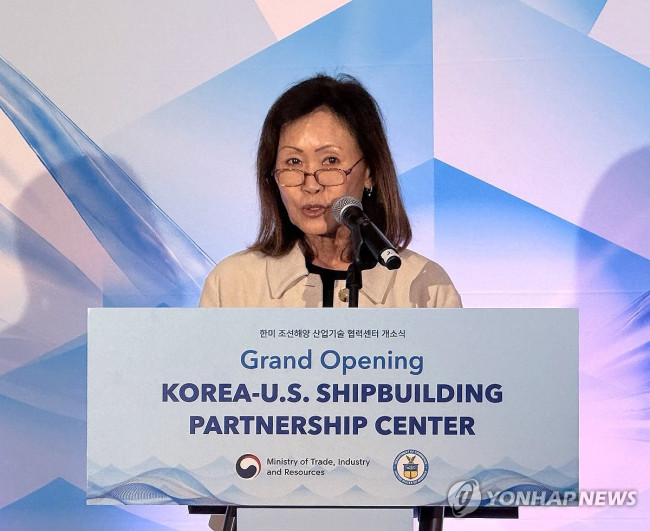 First U.S. Ambassador of Trump's Second Term to Arrive This Week… Will It Provide Momentum to Resolve Pending Issues?
U.S. Ambassador to South Korea Michelle Steel speaks at the opening ceremony of the Korea-U.S. Shipbuilding Cooperation Center held at the Mayflower Hotel in Washington, D.C., on the 23rd (local time)
First U.S. Ambassador of Trump's Second Term to Arrive This Week… Will It Provide Momentum to Resolve Pending Issues?
U.S. Ambassador to South Korea Michelle Steel speaks at the opening ceremony of the Korea-U.S. Shipbuilding Cooperation Center held at the Mayflower Hotel in Washington, D.C., on the 23rd (local time)
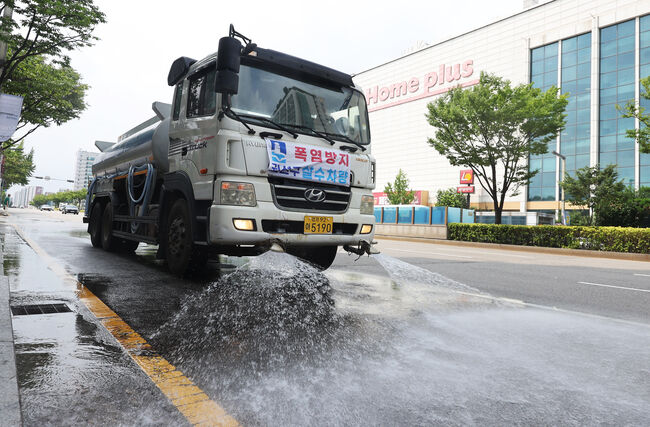 The Korean Peninsula wrapped in a thick blanket of scorching high pressure… Will the 1994 record be broken?
On the 28th, as the heatwave continues, a water sprinkler truck sprays water on Hyowon-ro, Gwonseon-gu, Suwon, Gyeonggi Province. [Photo = Yonhap News]The hottest years on record are considered to be
The Korean Peninsula wrapped in a thick blanket of scorching high pressure… Will the 1994 record be broken?
On the 28th, as the heatwave continues, a water sprinkler truck sprays water on Hyowon-ro, Gwonseon-gu, Suwon, Gyeonggi Province. [Photo = Yonhap News]The hottest years on record are considered to be
 Stock Market Crash 'Black Tuesday'… KOSPI down 10.8%, KOSDAQ down 7.7%
The KOSPI fell by more than 5% in early trading on the 28th, triggering a sell-side sidecar.On the 28th, the KOSPI plunged by more than 10%.Due to the sharp decline, a sell-side sidecar—a temporary
Stock Market Crash 'Black Tuesday'… KOSPI down 10.8%, KOSDAQ down 7.7%
The KOSPI fell by more than 5% in early trading on the 28th, triggering a sell-side sidecar.On the 28th, the KOSPI plunged by more than 10%.Due to the sharp decline, a sell-side sidecar—a temporary
 [World Heritage Committee] 25 New World Heritage Sites Inscribed in Busan… South Korea Successfully Expands 'Getbol' Listing
The Chairperson of the World Heritage Committee speaks at the plenary session of the 48th session of the World Heritage Committee, held at BEXCO in Busan on the 20th. [Photo: Yonhap News]A total of 25
[World Heritage Committee] 25 New World Heritage Sites Inscribed in Busan… South Korea Successfully Expands 'Getbol' Listing
The Chairperson of the World Heritage Committee speaks at the plenary session of the 48th session of the World Heritage Committee, held at BEXCO in Busan on the 20th. [Photo: Yonhap News]A total of 25
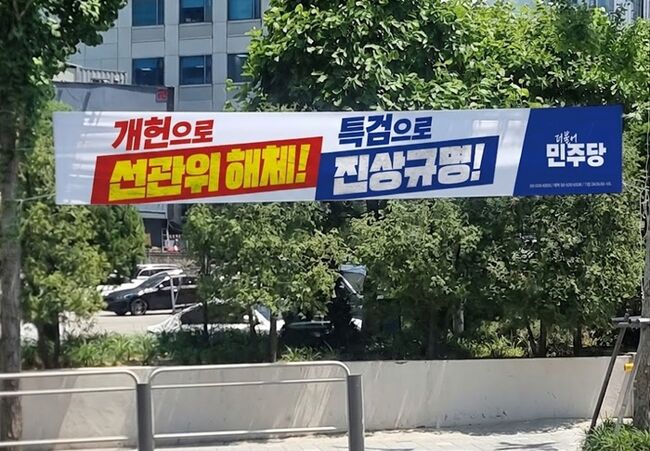 [Cho Yang-geon Column] The NEC: Facing a Fate of "Discarding the Dog After the Hunt"
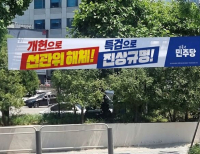
Banner calling for the "dissolution of the NEC" posted by the Democratic Party. [AI-generated image]Banners calling for the "dissolution of the National Election Commission (NEC)" posted by the Democr
[Cho Yang-geon Column] The NEC: Facing a Fate of "Discarding the Dog After the Hunt"
Banner calling for the "dissolution of the NEC" posted by the Democratic Party. [AI-generated image]Banners calling for the "dissolution of the National Election Commission (NEC)" posted by the Democr
 [Photo] Evidence of Election Fraud Flooding U.S. Media… Trump Had 2.7 Million Votes Stolen
 [Video] U.S. Semiquincentennial Air Show... 'Art in the Sky' streaks across New York
 [Editorial Cartoon] A Draconian Law That Undermines Freedom of Expression

 List
List