 Professor Emeritus of Pukyong National University, Director of the UN Research InstituteThe United States operates eighteen diverse and extensive national intelligence agencies. This can be understood, in part, as a manifestation of liberal democracy's unique blend of autonomy and discipline, rights and responsibilities, and defense and industry. In other words, it is explained by the logic that "freedom is not free, and if you want peace, you must prepare for war."
The U.S. Intelligence Community was launched in the immediate post-war period in 1947, reorganized from the U.S. Office of Strategic Services (OSS), with the Central Intelligence Agency (CIA) at its forefront. It expanded significantly with the remarkable advancements in aerospace engineering (science and technology) in the 1970s and is broadly divided into traditional human intelligence (HUMINT) and technical intelligence (TECHINT) agencies.
Technical intelligence is further divided into imagery intelligence (IMINT) and signals intelligence (SIGINT). Imagery intelligence is a broad field encompassing everything from old-fashioned aerial photography to infrared intelligence (IRINT) and today's radar-laser imagery (RADINT-LASINT). Signals intelligence is divided into communications intelligence (COMINT) and electronic intelligence (ELINT). Agencies can also be classified as dedicated intelligence agencies or functional intelligence agencies. The former are independent intelligence organizations, while the latter operate intelligence divisions as part of national bodies.
For example, the Department of Justice, the Department of the Treasury, the Department of Energy, and the Drug Enforcement Administration (DEA) all operate their own intelligence agencies. This is due to their positions as hegemonic powers and the importance of their specialized functions.
Traditional human intelligence (HUMINT) agencies are represented by the CIA and the Defense Intelligence Agency (DIA), which are also major consumers of technical intelligence (TECHINT). Of course, the CIA operates military and paramilitary organizations and also employs personnel in its technical divisions for specific purposes.
Technical intelligence agencies, spearheaded by the National Security Agency (NSA), the National Reconnaissance Office (NRO), the Defense Aerial Reconnaissance Office (DARO), and the National Geospatial-Intelligence Agency (NGA), oversee various sub-organizations involved in integrated military programs (JMIP) and tactical intelligence-related activities (TIARA).
The operation of the U.S. Intelligence Community, which consumes approximately 10% of the defense budget, has undergone changes and adaptations through the post-Cold War era (1989-1991) and 9/11 (2001). For instance, the post-Cold War period saw an increased emphasis on economic intelligence alongside military intelligence, while 9/11 brought renewed attention to the importance of traditional human intelligence (HUMINT).
The origins of intelligence studies are traced back to the dispatch of representatives from the twelve tribes in the Old Testament's Book of Joshua to scout Jericho. The CIA, with its motto "The Truth Shall Set You Free," also emphasizes its Christian heritage.
Recent events, such as the Venezuelan military operations and the Director of the FBI's visit to Korea, coupled with the secret intelligence that KMC (Korea Mission Center) and CMC (China Mission Center) are operating within the CIA in South Korea, are of particular interest beyond mere curiosity.
Professor Emeritus of Pukyong National University, Director of the UN Research Institute
- 관련기사
-
What do you think of this article?

 [Statement by the Seo-beo-kka Korea Military Academy Save-the-Nation Comrades Association] ㉛ Recount the Votes Publicly, as the Previous Recount Concealed Election Fraud
Tongyeong Mayoral Election Recount [Photo=Yonhap News]South Korea's liberal democracy is dying. The National Election Commission (NEC) and the judiciary, which have plummeted into criminal syndicates
[Statement by the Seo-beo-kka Korea Military Academy Save-the-Nation Comrades Association] ㉛ Recount the Votes Publicly, as the Previous Recount Concealed Election Fraud
Tongyeong Mayoral Election Recount [Photo=Yonhap News]South Korea's liberal democracy is dying. The National Election Commission (NEC) and the judiciary, which have plummeted into criminal syndicates
 What is the significance of the "Trump 2028" red hats that keep making a comeback?
It is noteworthy that President Donald Trump is "intentionally" fueling controversy over whether he can actually run in the 2028 presidential election, even though it is "highly likely he is seriously
What is the significance of the "Trump 2028" red hats that keep making a comeback?
It is noteworthy that President Donald Trump is "intentionally" fueling controversy over whether he can actually run in the 2028 presidential election, even though it is "highly likely he is seriously
 Jin Cummings: “North Korea says it will increase the number of spies, so what is the government doing?”
U.S. political columnist Gene Cummings has publicly questioned the South Korean government, asking, "North Korea is declaring that it will increase its number of spies, so what is the South Kore
Jin Cummings: “North Korea says it will increase the number of spies, so what is the government doing?”
U.S. political columnist Gene Cummings has publicly questioned the South Korean government, asking, "North Korea is declaring that it will increase its number of spies, so what is the South Kore
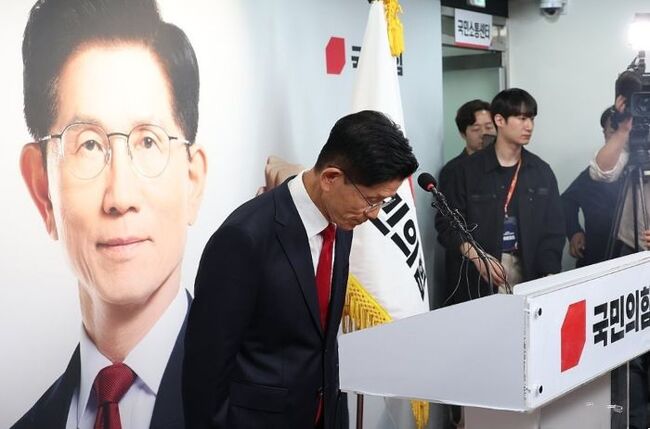 “Too little, too late?…” Kim Moon-soo, who previously conceded his presidential election defeat, now demands a special counsel investigation into ‘allegations of election fraud in the 2025 presidential election’
People Power Party presidential candidate Kim Moon-soo concedes defeat during a press conference at the party headquarters in Yeouido, Seoul, on June 4, 2025. [Joint Press Corps]As allegations emerge
“Too little, too late?…” Kim Moon-soo, who previously conceded his presidential election defeat, now demands a special counsel investigation into ‘allegations of election fraud in the 2025 presidential election’
People Power Party presidential candidate Kim Moon-soo concedes defeat during a press conference at the party headquarters in Yeouido, Seoul, on June 4, 2025. [Joint Press Corps]As allegations emerge
 Stock Market Crash 'Black Tuesday'… KOSPI down 10.8%, KOSDAQ down 7.7%
The KOSPI fell by more than 5% in early trading on the 28th, triggering a sell-side sidecar.On the 28th, the KOSPI plunged by more than 10%.Due to the sharp decline, a sell-side sidecar—a temporary
Stock Market Crash 'Black Tuesday'… KOSPI down 10.8%, KOSDAQ down 7.7%
The KOSPI fell by more than 5% in early trading on the 28th, triggering a sell-side sidecar.On the 28th, the KOSPI plunged by more than 10%.Due to the sharp decline, a sell-side sidecar—a temporary
 [World Heritage Committee] 25 New World Heritage Sites Inscribed in Busan… South Korea Successfully Expands 'Getbol' Listing
The Chairperson of the World Heritage Committee speaks at the plenary session of the 48th session of the World Heritage Committee, held at BEXCO in Busan on the 20th. [Photo: Yonhap News]A total of 25
[World Heritage Committee] 25 New World Heritage Sites Inscribed in Busan… South Korea Successfully Expands 'Getbol' Listing
The Chairperson of the World Heritage Committee speaks at the plenary session of the 48th session of the World Heritage Committee, held at BEXCO in Busan on the 20th. [Photo: Yonhap News]A total of 25
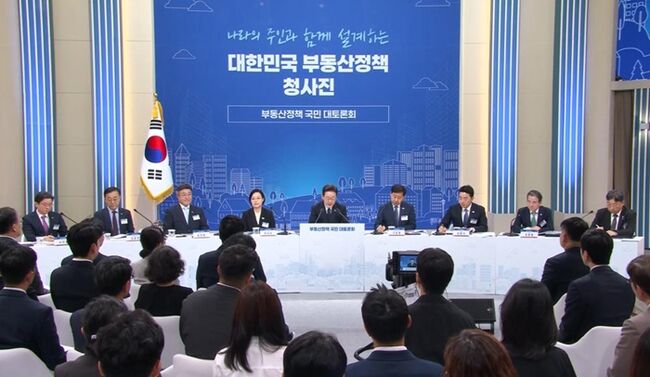 [Liberal Democratic Party Statement] Calling it a Grand Real Estate Debate… It Was Nothing More Than a Private Party Among Themselves
The 'National Grand Debate on Real Estate Policy' held on July 23rd and 27th. [Photo=Yonhap News]The 'National Grand Debate on Real Estate Policy,' hosted by the Lee Jae-myung administration under the
[Liberal Democratic Party Statement] Calling it a Grand Real Estate Debate… It Was Nothing More Than a Private Party Among Themselves
The 'National Grand Debate on Real Estate Policy' held on July 23rd and 27th. [Photo=Yonhap News]The 'National Grand Debate on Real Estate Policy,' hosted by the Lee Jae-myung administration under the
 [Photo] Evidence of Election Fraud Flooding U.S. Media… Trump Had 2.7 Million Votes Stolen
 [Video] U.S. Semiquincentennial Air Show... 'Art in the Sky' streaks across New York
 [Editorial Cartoon] A Draconian Law That Undermines Freedom of Expression

 List
List