 Flags of Taiwan and the United States. Yonhap News
 Editorial Board Member, Chairman of the Korea Military Critics Association, President of the Future Research Institute for the Pan-Yellow Sea RimSanae Takaichi, Japan's Prime Minister, her remarks about "intervening in the event of a Taiwan emergency" are escalating into an extreme confrontation between Japan and China. This is not merely a diplomatic friction between China and Japan. It is an expression of a conflict intertwined with the US-China rivalry, driven by differing perceptions of history and regional hegemonic ambitions, and accompanied by a restructuring of military power and a shift in the power dynamics of Northeast Asia.
Amidst rising tensions between China and Japan, on the 2nd, US President Donald Trump signed the "Taiwan Assurance Implementation Act (H.R. 1512)" to strengthen relations with Taiwan, enacting it into law.
This law mandates and institutionalizes the US Department of State to review and relax regulations that previously restricted high-level exchanges between the US and Taiwan every five years and report to Congress. This is expected to be followed by official visits of Taiwanese ministers to Washington, increased visits of high-ranking US officials to Taiwan, enhanced military and security cooperation, and integration of semiconductor supply chains.
Major media outlets in the US, Japan, China, and South Korea reported that in the context of the Taiwan issue and the conflict between Xi Jinping and Takaichi, Trump supported Xi Jinping and asked Takaichi to exercise restraint on the Taiwan issue, leading to Takaichi being "stabbed in the back" and Xi Jinping winning. This was all a clear misreporting. It was Xi Jinping who was actually betrayed.
While the aforementioned act may appear to be an extension of the "Taiwan Relations Act," enacted in 1979 upon the establishment of diplomatic relations between the US and China and retroactively effective the following year, its underlying intent is different. It conceals an intention to concretize the US's strategy to contain China and elevate Taiwan. It is the core of a comprehensive encirclement of China that the US, including its allies, has been attempting, linked to its support for Tibet, Xinjiang, and Mongolia.
Why does the US support not only Taiwan but also minority ethnic groups within China? The US always acts strategically for its own interests. To achieve its political, diplomatic, and military objectives, it sometimes embraces enemies and abandons allies, oscillating between extremes to leverage surrounding forces. The history of the US's rise as a great power and its expansion into Asia serves as evidence of this. The history of China, Japan, and Tibet becoming allies or enemies as needed, or being abandoned, illustrates this point. Taiwan is the political entity of the Republic of China, which was a staunch ally of the US in the past.
Currently, in the broader picture, Trump absolutely cannot side with Xi Jinping on the Taiwan issue. To do so would be to abandon American interests under the banner of "America First." Furthermore, the US has neither abandoned nor revised its strategy of encircling China.
Since 1979, the US has "acknowledged" China's "One China" principle regarding Taiwan. While stating its position that the Taiwan issue should be resolved peacefully, the US has kept the Taiwan issue shrouded in strategic ambiguity, using it as a bargaining chip for its own interests in negotiations with China. Simultaneously, it has continuously sold weapons and equipment to Taiwan, providing it with defense capabilities while also reaping substantial economic benefits. This time, the US intends to sell weapons to Taiwan in line with this established practice.
As a result, for direct and indirect stakeholders like Taiwan and Japan, the US's commitment to defending liberal democracy and its leadership appeared uncertain, and at times, it seemed as though the US was being swayed by China. Particularly when the Taiwan issue emerged as a key point during recent US-China trade negotiations, Takaichi emphasized to Trump that "the Taiwan issue is not only about Taiwan's own security but also Japan's security, and furthermore, it is directly linked to US security." She strongly urged and pressured the US to actively respond to this issue. The author detailed this in an op-ed published in this newspaper on the 4th ([Volatile Period: A Lone Voice] 'Prime Minister Sanae Takaichi's Double-Edged Sword: How Should South Korea Respond?').
Regarding recent China-Japan friction, the author wishes to address two points: the misreporting by domestic and international media that missed the mark, and the background and repercussions of the enactment of the "Taiwan Assurance Implementation Act." Trump's action implies a strategic counterattack against Xi Jinping's "One China" assertion.
The reason major domestic and international media outlets reported inaccurately is that they did not consider the "broader framework" of the US's strategy to encircle or blockade China. This is partly due to the limited perspective of field reporters, but the desks at media organizations that failed to filter out erroneous articles also bear responsibility.
Ultimately, the problem is not solely with some politicians who lack basic competence, but also with the media. These misreports can be seen as acts of deceiving the public, stemming from their incompetence, or from an intentional disregard or ignorance that is critical of Trump and favorable to China.
The misreporting originated from a series of events in November, during which sharp exchanges occurred between China and Japan. Xi Jinping called Trump to acknowledge that the unification of Taiwan is a non-negotiable core interest for China. The following day, Trump called Takaichi and mentioned the Taiwan issue.
Regarding this, The Wall Street Journal (WSJ) reported in late November that "Trump advised Prime Minister Takaichi not to provoke China and to lower the tone of her remarks regarding Taiwan." This was the first misstep in reporting. Subsequently, major Japanese media outlets such as Mainichi Shimbun and NHK cited this article and reported that "Trump requested Takaichi to refrain from making remarks about Taiwan." The Japanese government vaguely denied this report, stating that it was not a "strong request for restraint" but rather a matter of "tone adjustment."
Chinese state-run media outlets extensively reported it as a "victory for Chinese diplomacy" and "Trump's support for China." This led to some media in Japan publishing articles with a narrative that Takaichi had been betrayed by Trump and should exercise restraint. Major South Korean media outlets, which are aligned with Lee Jae-myung, also amplified and reproduced the misreports from China and Japan. This all stemmed from a negative perception of Trump and Takaichi. These were serial misreports committed by the media of each country as they re-reported the WSJ coverage.
Domestic media outlets are also failing to break free from existing biases, misperceptions, lack of journalistic competence, short-sightedness, self-interest, or ulterior motives driven by personal gain. Particularly when reporting on incidents occurring among South Korea, China, and Japan, they frequently exacerbate the situation rather than contributing to its resolution. They continue to commit the error of concealing the reality from the public and keeping their eyes closed to public awareness.
This case is no different. Ultimately, the victims of the misreporting, who were denied their right to know the reality of the US's concrete actions in its strategy to encircle China, are the citizens. The US's encirclement of China cannot be understood without considering the US's support for other regions besides Taiwan. One can make the mistake of seeing the trees but not the forest. The US's strategy to encircle China and Trump's "Taiwan Assurance Implementation Act" represent the relationship between the forest and the trees.
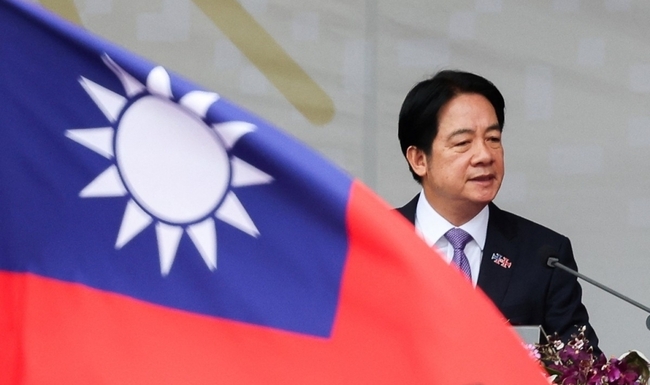 Lai Ching-te, President of Taiwan. Yonhap News
The US's strategy to encircle China has a long history. Starting with simple military blockade in the early 1950s during the Cold War, it has evolved into a multi-dimensional and comprehensive competition for value superiority and strategic competition, encompassing military, economic, technological, and ideological aspects. It gained momentum particularly with the Obama administration's "Rebalance to Asia" and "Pivot to Asia" strategies and has become more solidified through the Trump and Biden administrations.
This strategy seeks to deter China's expansion and maintain the status quo of the international order through an alliance network such as the Quad (US, Japan, Australia, India) and AUKUS (Australia, UK, US). Simultaneously, it carries risks such as escalating military tensions between the US and China and fragmenting global supply chains, adding uncertainty to the world economy.
Various methods, including military, economic, diplomatic, and ideological approaches, are employed in the execution of the US's strategy to encircle China. Furthermore, the US is building solidarity with countries that share universal values such as democracy, rule of law, and human rights, thereby tightening the net around China. This includes expanding cooperation with India, Vietnam, and the Philippines, which share borders or maritime boundaries with China, as well as with ethnically or nationally significant groups and countries such as Tibet, Xinjiang, and Mongolia.
Support acts for Tibet, Mongolia, Xinjiang, and Taiwan are a link in the strategy of encircling China. The US is using these regions' claims to autonomy and democratic rights on the international stage to counter China's assertions of territorial sovereignty. Trump's signing of the "Taiwan Assurance Implementation Act" is also part of this strategy against China.
In response to Xi Jinping's strategy of expanding influence under the guise of the "Chinese Dream," which is another name for world domination, the US has developed a multifaceted strategy to encircle China and has implemented various legislative and policy measures supporting human rights and autonomy in Tibet, Xinjiang, and Mongolia. This raises international awareness of the issues concerning minority groups within China and serves as a means of pressure against China. It is similar in nature to how Vladimir Lenin supported numerous minority groups within Russia before the Russian Revolution to undermine the Tsarist regime and encourage their independence. The US is also implicitly encouraging the Tibetan, Xinjiang, and Inner Mongolian peoples within China to break away from China.
Trump's recent signing, like the "Resolve Tibet Act" enacted in 2024, utilizes a human rights framework. This act includes provisions for promoting negotiations between China and the Dalai Lama and declaring the US's official policy to counter China's disinformation.
Specifically, through this act, the US government refutes the Chinese government's disinformation regarding Tibet and supports the position of the Dalai Lama or the democratic representatives of the Tibetan "government-in-exile" in unconditional negotiations with the Chinese government, supporting Tibetan human rights and self-determination.
Meanwhile, in the Xinjiang Uyghur region, the "Uyghur Forced Labor Prevention Act" has been expanded to strengthen pressure on China regarding issues such as forced labor prohibition and human rights. In Mongolia, the "Mongolian Democracy Support Act" expands support for autonomy and democracy, checking China's inland expansion.
These legislative acts are linked to the "Taiwan Assurance Implementation Act" and are used as leverage in trade negotiations with China, balancing China's claims of territorial sovereignty with human rights and self-determination issues. Consequently, they contribute to amplifying regional instability along with China.
The US strategy to encircle China will continue. Within this dynamic, future US-China relations are expected to see a prolonged period of fierce strategic competition, characterized by a coexistence of conflict and reconciliation, and competition and cooperation, rather than a unilateral victory for either side. As the US takes measures to officially ease restrictions on contact and exchange with Taiwan, China has strongly reacted, calling it "interference in China's internal affairs" and escalating military demonstrations around Taiwan on a larger scale than before, leading to unprecedented tension. China clearly defines the Taiwan issue as a "red line" between the US and China and demands the utmost caution from the US, but the US appears unwilling to listen.
Taiwan also welcomed the "Taiwan Assurance Implementation Act" as a "symbol of democratic and free values," calling it a "significant step." Taiwan, particularly through the Democratic Progressive Party, views increased exchanges with the US as a primary stepping stone for its policy towards China, and Trump's latest move can be likened to providing water to a fish gasping on land.
Until now, Taiwan has been a secondary issue for the US, unlike for China, and has not emerged as a primary topic in US-China relations. However, this situation is expected to change significantly from now on. With the elevation of US-Taiwan relations and the gradual lifting of existing informal and self-imposed restrictions, an expansion of military and security cooperation between the US and Taiwan, as well as deepened economic and supply chain cooperation in semiconductors and advanced technologies, and increased investment in the US by Taiwanese companies such as TSMC, are anticipated. Although China will increase its level of protest, it will serve as an opportunity for Taiwan to enhance its strategic value, further broadening Taiwan's room for maneuver in its relations with China.
In terms of its strategy to encircle China, the US will expand its support not only for Taiwan but also for other minority ethnic groups within China. China has, until now, managed its relationship with India regarding the issue of the Dalai Lama's Tibet and has achieved success in persuading Turkey, the patron behind the Xinjiang Uyghur issue, to no longer support the Uyghurs. However, from now on, the US's political issues concerning the Tibetan "government-in-exile" under the Dalai Lama, and the independence and autonomy of Mongolia and Xinjiang, will be increasingly normalized and overtly linked to human rights issues, intensifying pressure on China.
To grasp the essence of East Asian issues, one must approach them by understanding the framework of the US's macroscopic foreign and security strategy, and then analyzing the trends and situations of individual countries. One should not simply report the phenomena as they appear.
Editorial Board Member, Chairman of the Korea Military Critics Association, President of the Future Research Institute for the Pan-Yellow Sea Rim

 Trump pressures for rate cut again ahead of FOMC... "Should be the lowest in the world"
U.S. President Donald Trump. [Photo = The White House] U.S. President Donald Trump once again pressured the Federal Reserve, the U.S. central bank, to lower interest rates on the 27th (local time
Trump pressures for rate cut again ahead of FOMC... "Should be the lowest in the world"
U.S. President Donald Trump. [Photo = The White House] U.S. President Donald Trump once again pressured the Federal Reserve, the U.S. central bank, to lower interest rates on the 27th (local time
 “Ignoring crisp ballots and damaged seals”… Tongyeong mayoral recount concludes with ‘no change in outcome,’ leaving suspicions and public outrage behind
Suspected counterfeit ballots discovered in Tongyeong [GIF from social media of Representative Hwang Kyo-ahn / Attorney Park Joo-hyun]During a recount of the Tongyeong mayoral election in South Gyeong
“Ignoring crisp ballots and damaged seals”… Tongyeong mayoral recount concludes with ‘no change in outcome,’ leaving suspicions and public outrage behind
Suspected counterfeit ballots discovered in Tongyeong [GIF from social media of Representative Hwang Kyo-ahn / Attorney Park Joo-hyun]During a recount of the Tongyeong mayoral election in South Gyeong
 President Yoon, regarding the first-instance ruling on the Public Official Election Act: “An excessive political verdict that distorts the facts… We will appeal immediately.”
The first-instance sentencing hearing for President Yoon Suk Yeol regarding violations of the Public Official Election Act is being broadcast live at Seoul Station on the 27th. [Photo=Yonhap News]Pres
President Yoon, regarding the first-instance ruling on the Public Official Election Act: “An excessive political verdict that distorts the facts… We will appeal immediately.”
The first-instance sentencing hearing for President Yoon Suk Yeol regarding violations of the Public Official Election Act is being broadcast live at Seoul Station on the 27th. [Photo=Yonhap News]Pres
 WSJ: "SK Hynix ADR Premium Is a Sign of AI Trading Overheat"
Advertisement for SK Hynix ADR listing in New York's Times Square [Reuters=Yonhap News file photo]The Wall Street Journal (WSJ) has pointed out that the price of SK Hynix’s American Depositary Recei
WSJ: "SK Hynix ADR Premium Is a Sign of AI Trading Overheat"
Advertisement for SK Hynix ADR listing in New York's Times Square [Reuters=Yonhap News file photo]The Wall Street Journal (WSJ) has pointed out that the price of SK Hynix’s American Depositary Recei
 'Godfather of Japanese Mystery Novels' Keigo Higashino Passes Away After Battle with Cancer at 68
Famous Japanese mystery novelist Keigo Higashino [AFP=Yonhap News]It has been belatedly reported that Keigo Higashino, the "godfather of Japanese mystery novels" and author of bestsellers such as "The
'Godfather of Japanese Mystery Novels' Keigo Higashino Passes Away After Battle with Cancer at 68
Famous Japanese mystery novelist Keigo Higashino [AFP=Yonhap News]It has been belatedly reported that Keigo Higashino, the "godfather of Japanese mystery novels" and author of bestsellers such as "The
 [Park Pil-kyu Security Column] To the Ignorant Trying to Clothe a Beast in Sheep's Clothing
Rep. Kim Byung-joo of the Democratic Party of Korea [Photo=Yonhap News]“The Air Force Academy doesn't teach you how to fly a plane!” “The Army, Navy, and Air Force academies are exactly the
[Park Pil-kyu Security Column] To the Ignorant Trying to Clothe a Beast in Sheep's Clothing
Rep. Kim Byung-joo of the Democratic Party of Korea [Photo=Yonhap News]“The Air Force Academy doesn't teach you how to fly a plane!” “The Army, Navy, and Air Force academies are exactly the
 [Issue Diagnosis] Two Effects of the Election Petition Review
 [Photo] Evidence of Election Fraud Flooding U.S. Media… Trump Had 2.7 Million Votes Stolen
 [Video] U.S. Semiquincentennial Air Show... 'Art in the Sky' streaks across New York
 [Editorial Cartoon] A Draconian Law That Undermines Freedom of Expression

 List
List










