National Assembly plenary session. Yonhap News
The amendment to Article 106 of the Insurance Business Act, commonly referred to as the 'Samsung Life Insurance Act,' is raising concerns about significant changes to Samsung Electronics' governance structure. This discussion is not a sudden emergence but rather the culmination of regulatory pressures and demands accumulated over the past decade, giving it considerable ripple effects. The industry views this as "the endpoint of a decade-long trend of progressive administrations attempting to destabilize Samsung."
The proposed amendment stipulates that while life insurance companies must maintain their holdings in affiliate stocks at 3% of total assets, the calculation standard will shift from acquisition cost to market value.
If the bill passes, Samsung Life Insurance, which holds approximately 8.6% of Samsung Electronics' shares, would be required to sell a substantial portion based on market value. Consequently, the stake friendly to Chairman Lee Jae-yong could fall from about 21% to the mid-teens.
The market is raising concerns that this could lead to a shift in Samsung Electronics' decision-making power structure, rather than being a mere stock trading issue.
This change implies a potential restructuring of Samsung Electronics' governance into a three-way decision-making mechanism involving Chairman Lee Jae-yong's side, the National Pension Service (approximately 10%), and global asset manager BlackRock (approximately 5%).
Experts view this as a transfer of "strategic decision-making authority," not just an "ownership issue," and a cumulative result of persistent legislative efforts by progressive administrations.
Indeed, similar amendment discussions were raised in the National Assembly in 2012, 2016, and 2020, but they failed due to concerns surrounding the disposal of affiliate shares.
Especially considering that the Moon Jae-in administration's push to dismantle circular shareholding structures weakened Samsung's governance foundation, the current amendment to the Insurance Business Act is seen not as an isolated incident but as a continuation of a trend. The business community interprets this as the manifestation of a decade of efforts to "shake Samsung."
The core issue here shifts from "whether Samsung succeeds or fails" to the fundamental question of "what risks arise from a structure where the state controls corporations."
We can glimpse the answer by examining the case of POSCO.
POSCO once designed the future of the steel industry with its hydroforming technology. Despite securing international patents for this technology, it remained largely at the project and line level without being nurtured as a long-term strategic technology.
Industry insiders state, "Hydroforming was the initial stage of 'Korean-style Giga Casting,' aimed at modularizing steel-based car bodies. Had this technology been pursued, Korea could have led global innovation in automotive structures."
However, the dream remained unrealized because political influence expanded within the decision-making process, leading to a reduced priority for long-term technology-based investments.
The market fears that such a change could be repeated at Samsung Electronics. This is because even with semiconductor and AI technology cycles spanning 10 to 20 years, industry strategies could be destabilized if decision-making becomes subordinate to five-year policy cycles.
The amendment to Article 106 of the Insurance Business Act is currently under discussion in standing committees, and revisions are still possible. However, the industry views the structural reality of potential decision-making power shifts as more serious than the bill's passage itself. Experts emphasize that "a precise evaluation of industrial strategy is needed during the legislative review process."
This signifies more than just a shareholder dispute; it represents "outsourcing of decision-making authority" and a "dispersion of industrial sovereignty." Such changes are not merely the problem of a single company but are linked to national strategy, potentially impacting the long-term investment direction, technological strategies, and global competitive landscape of the industry.
The amendment to Article 106 of the Insurance Business Act is not about "shaking Samsung" but about "shaking Korea." While Samsung Electronics garners attention due to its sheer size, the underlying issue concerns the timeline of Korea's industrial strategy and who holds the decision-making power.
This debate should be approached not as a private enterprise issue but as a matter of national competitiveness.
Because what is being shaken is not Samsung, but the Republic of Korea.

 [Statement by the Seo-beo-kka Korea Military Academy Save-the-Nation Comrades Association] ㉛ Recount the Votes Publicly, as the Previous Recount Concealed Election Fraud
Tongyeong Mayoral Election Recount [Photo=Yonhap News]South Korea's liberal democracy is dying. The National Election Commission (NEC) and the judiciary, which have plummeted into criminal syndicates
[Statement by the Seo-beo-kka Korea Military Academy Save-the-Nation Comrades Association] ㉛ Recount the Votes Publicly, as the Previous Recount Concealed Election Fraud
Tongyeong Mayoral Election Recount [Photo=Yonhap News]South Korea's liberal democracy is dying. The National Election Commission (NEC) and the judiciary, which have plummeted into criminal syndicates
 What is the significance of the "Trump 2028" red hats that keep making a comeback?
It is noteworthy that President Donald Trump is "intentionally" fueling controversy over whether he can actually run in the 2028 presidential election, even though it is "highly likely he is seriously
What is the significance of the "Trump 2028" red hats that keep making a comeback?
It is noteworthy that President Donald Trump is "intentionally" fueling controversy over whether he can actually run in the 2028 presidential election, even though it is "highly likely he is seriously
 Jin Cummings: “North Korea says it will increase the number of spies, so what is the government doing?”
U.S. political columnist Gene Cummings has publicly questioned the South Korean government, asking, "North Korea is declaring that it will increase its number of spies, so what is the South Kore
Jin Cummings: “North Korea says it will increase the number of spies, so what is the government doing?”
U.S. political columnist Gene Cummings has publicly questioned the South Korean government, asking, "North Korea is declaring that it will increase its number of spies, so what is the South Kore
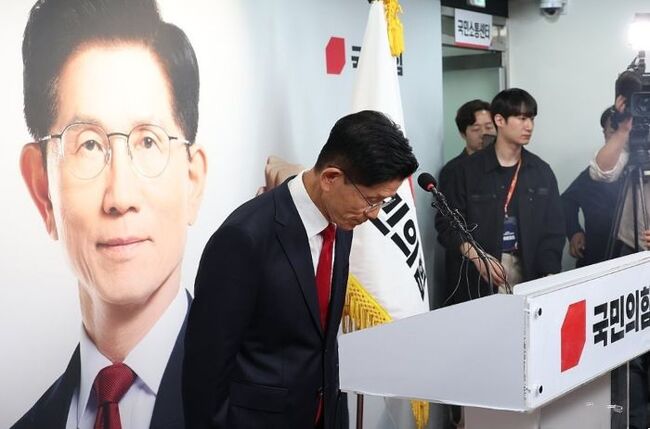 “Too little, too late?…” Kim Moon-soo, who previously conceded his presidential election defeat, now demands a special counsel investigation into ‘allegations of election fraud in the 2025 presidential election’
People Power Party presidential candidate Kim Moon-soo concedes defeat during a press conference at the party headquarters in Yeouido, Seoul, on June 4, 2025. [Joint Press Corps]As allegations emerge
“Too little, too late?…” Kim Moon-soo, who previously conceded his presidential election defeat, now demands a special counsel investigation into ‘allegations of election fraud in the 2025 presidential election’
People Power Party presidential candidate Kim Moon-soo concedes defeat during a press conference at the party headquarters in Yeouido, Seoul, on June 4, 2025. [Joint Press Corps]As allegations emerge
 Stock Market Crash 'Black Tuesday'… KOSPI down 10.8%, KOSDAQ down 7.7%
The KOSPI fell by more than 5% in early trading on the 28th, triggering a sell-side sidecar.On the 28th, the KOSPI plunged by more than 10%.Due to the sharp decline, a sell-side sidecar—a temporary
Stock Market Crash 'Black Tuesday'… KOSPI down 10.8%, KOSDAQ down 7.7%
The KOSPI fell by more than 5% in early trading on the 28th, triggering a sell-side sidecar.On the 28th, the KOSPI plunged by more than 10%.Due to the sharp decline, a sell-side sidecar—a temporary
 [World Heritage Committee] 25 New World Heritage Sites Inscribed in Busan… South Korea Successfully Expands 'Getbol' Listing
The Chairperson of the World Heritage Committee speaks at the plenary session of the 48th session of the World Heritage Committee, held at BEXCO in Busan on the 20th. [Photo: Yonhap News]A total of 25
[World Heritage Committee] 25 New World Heritage Sites Inscribed in Busan… South Korea Successfully Expands 'Getbol' Listing
The Chairperson of the World Heritage Committee speaks at the plenary session of the 48th session of the World Heritage Committee, held at BEXCO in Busan on the 20th. [Photo: Yonhap News]A total of 25
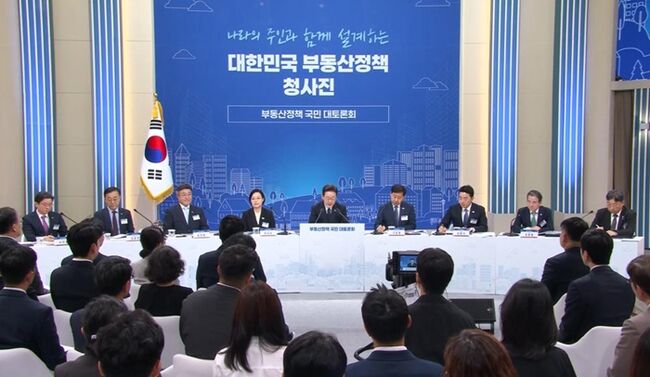 [Liberal Democratic Party Statement] Calling it a Grand Real Estate Debate… It Was Nothing More Than a Private Party Among Themselves
The 'National Grand Debate on Real Estate Policy' held on July 23rd and 27th. [Photo=Yonhap News]The 'National Grand Debate on Real Estate Policy,' hosted by the Lee Jae-myung administration under the
[Liberal Democratic Party Statement] Calling it a Grand Real Estate Debate… It Was Nothing More Than a Private Party Among Themselves
The 'National Grand Debate on Real Estate Policy' held on July 23rd and 27th. [Photo=Yonhap News]The 'National Grand Debate on Real Estate Policy,' hosted by the Lee Jae-myung administration under the
 [Photo] Evidence of Election Fraud Flooding U.S. Media… Trump Had 2.7 Million Votes Stolen
 [Video] U.S. Semiquincentennial Air Show... 'Art in the Sky' streaks across New York
 [Editorial Cartoon] A Draconian Law That Undermines Freedom of Expression

 List
List