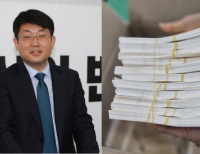
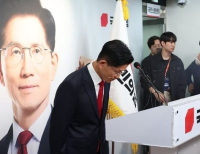
On the 24th, at the plenary session of the December extraordinary National Assembly held at the National Assembly, the bill for a special court for sedition is being processed under the leadership of the Democratic Party, with the People Power Party members having all withdrawn. Photo: Yonhap News
The controversy surrounding the so-called 'Sedition Special Court Act' passed by the National Assembly has not ended. While the law has the formal structure, concerns remain that its operational methods could infringe upon judicial independence and the fairness of trials.
What is interesting is that the battle surrounding this law is now moving away from a direct confrontation between the legislative and judicial branches, shifting to the unseen realms of 'procedure' and 'operation'.
At the center of this movement is Chief Justice Cho Hee-dae. While avoiding public confrontation before and after the bill's passage, Chief Justice Cho has proactively prepared internal regulations for a special court at the Supreme Court level. Ostensibly, this shows respect for the National Assembly's legislative power, but looking beneath the surface reveals the judiciary's most sophisticated defensive strategy.
The Law is Made, But 'Procedure' Makes It Move
The core of the Sedition Special Court Act is to establish a special court for specific types of crimes, but to entrust the criteria for its composition and operation to the judges' assembly and case assignment procedures. On the surface, this appears to be a mechanism that respects judicial autonomy. However, at the same time, this structure is designed to rely heavily on the judiciary's internal procedures for how the law will actually function.
What is important here is that the judges' assembly is not a mere customary body but a statutory organization based on the Court Organization Act. In other words, by explicitly mentioning the judges' assembly in the Sedition Special Court Act, the law has essentially entrusted the conditions for its own implementation to the internal consensus structure of the judiciary. From this moment, the fate of the law exits the realm of legislation.
Cho Hee-dae's Strategy: 'Absorption' Instead of 'Confrontation'
The path chosen by Chief Justice Cho Hee-dae and the Supreme Court is not direct confrontation. It is not about submitting the constitutionality of the law to the Constitutional Court or overtly refusing to enforce it. Instead, the Supreme Court has opted for a direction that seeks to absorb the effects of the National Assembly's bill procedurally, through regulations that maintain the principle of random assignment and existing case assignment principles.
These regulations appear functionally similar to the Sedition Special Court Act, but there is a crucial difference.
While the law posits a 'specialized structure for specific cases,' the Supreme Court's regulations maintain a framework of 'strengthening expertise within existing assignment principles.' Consequently, the law exists, but the nature of trials does not drastically change as a result.
This is the point that legal circles are paying attention to. A lawyer who is a former court president commented, "Rather than nullifying the law, the Supreme Court is reinterpreting it in the safest way to ensure it does not conflict with the Constitution."
Legal Circles' Concerns and Cautious Interpretations
Reactions from legal circles are divided. Some still believe that the Sedition Special Court Act itself has the potential to compromise trial fairness. Concerns are particularly raised about the judge assignment process potentially leading to political misunderstandings. On the other hand, there is also a pragmatic view that "if the Supreme Court clarifies the principle of random assignment through its regulations, the controversy over unconstitutionality can be largely resolved."
The phrase Chief Justice Cho Hee-dae repeatedly used in official settings was "under review." However, this short phrase is essentially a message. It signals an intent to find a solution through internal judicial procedures, rather than immediate rebuttal or outright acceptance.
The Lingering Question: "Where Will the Contest End?"
At this point, political questions naturally follow. If the judiciary limits the effect of the Sedition Special Court Act through its regulations and judges' assembly procedures, what will be the next step? Some in the political sphere are even mentioning the possibility of impeaching Chief Justice Cho Hee-dae. This is interpreted as the last card the current administration could play to pressure the judiciary.
However, impeachment would lead to another constitutional conflict. At that moment, the issue would expand beyond a single law to the very foundation of the separation of powers. Therefore, Cho Hee-dae's choice is less a simple defense and more a gambit. It is a declaration of intent to handle the law in a way that preserves the constitutional order without denying the law itself.
The Law's Fate Lies Not in its Clauses, But in its Operation
The controversy surrounding the Sedition Special Court Act clearly demonstrates one fact.
In a democracy, the most intense battles are not over the text of laws, but over how those laws are operated. Chief Justice Cho Hee-dae's strategy has chosen the path of 'constitutionally compliant neutralization' rather than 'claiming unconstitutionality.' It is a method of controlling the law through procedure and operation.
The fact remains that whether this law becomes a weapon or remains merely symbolic ultimately rests in the hands of the Supreme Court.
By Reporter Kim Young

 [Statement by the Seo-beo-kka Korea Military Academy Save-the-Nation Comrades Association] ㉛ Recount the Votes Publicly, as the Previous Recount Concealed Election Fraud
Tongyeong Mayoral Election Recount [Photo=Yonhap News]South Korea's liberal democracy is dying. The National Election Commission (NEC) and the judiciary, which have plummeted into criminal syndicates
[Statement by the Seo-beo-kka Korea Military Academy Save-the-Nation Comrades Association] ㉛ Recount the Votes Publicly, as the Previous Recount Concealed Election Fraud
Tongyeong Mayoral Election Recount [Photo=Yonhap News]South Korea's liberal democracy is dying. The National Election Commission (NEC) and the judiciary, which have plummeted into criminal syndicates
 What is the significance of the "Trump 2028" red hats that keep making a comeback?
It is noteworthy that President Donald Trump is "intentionally" fueling controversy over whether he can actually run in the 2028 presidential election, even though it is "highly likely he is seriously
What is the significance of the "Trump 2028" red hats that keep making a comeback?
It is noteworthy that President Donald Trump is "intentionally" fueling controversy over whether he can actually run in the 2028 presidential election, even though it is "highly likely he is seriously
 Jin Cummings: “North Korea says it will increase the number of spies, so what is the government doing?”
U.S. political columnist Gene Cummings has publicly questioned the South Korean government, asking, "North Korea is declaring that it will increase its number of spies, so what is the South Kore
Jin Cummings: “North Korea says it will increase the number of spies, so what is the government doing?”
U.S. political columnist Gene Cummings has publicly questioned the South Korean government, asking, "North Korea is declaring that it will increase its number of spies, so what is the South Kore
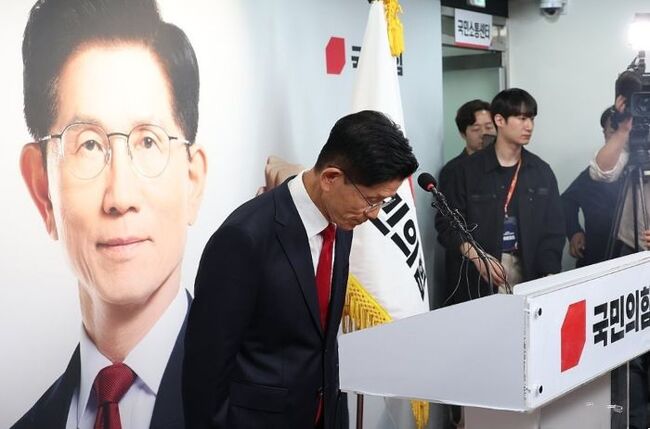 “Too little, too late?…” Kim Moon-soo, who previously conceded his presidential election defeat, now demands a special counsel investigation into ‘allegations of election fraud in the 2025 presidential election’
People Power Party presidential candidate Kim Moon-soo concedes defeat during a press conference at the party headquarters in Yeouido, Seoul, on June 4, 2025. [Joint Press Corps]As allegations emerge
“Too little, too late?…” Kim Moon-soo, who previously conceded his presidential election defeat, now demands a special counsel investigation into ‘allegations of election fraud in the 2025 presidential election’
People Power Party presidential candidate Kim Moon-soo concedes defeat during a press conference at the party headquarters in Yeouido, Seoul, on June 4, 2025. [Joint Press Corps]As allegations emerge
 Stock Market Crash 'Black Tuesday'… KOSPI down 10.8%, KOSDAQ down 7.7%
The KOSPI fell by more than 5% in early trading on the 28th, triggering a sell-side sidecar.On the 28th, the KOSPI plunged by more than 10%.Due to the sharp decline, a sell-side sidecar—a temporary
Stock Market Crash 'Black Tuesday'… KOSPI down 10.8%, KOSDAQ down 7.7%
The KOSPI fell by more than 5% in early trading on the 28th, triggering a sell-side sidecar.On the 28th, the KOSPI plunged by more than 10%.Due to the sharp decline, a sell-side sidecar—a temporary
 [World Heritage Committee] 25 New World Heritage Sites Inscribed in Busan… South Korea Successfully Expands 'Getbol' Listing
The Chairperson of the World Heritage Committee speaks at the plenary session of the 48th session of the World Heritage Committee, held at BEXCO in Busan on the 20th. [Photo: Yonhap News]A total of 25
[World Heritage Committee] 25 New World Heritage Sites Inscribed in Busan… South Korea Successfully Expands 'Getbol' Listing
The Chairperson of the World Heritage Committee speaks at the plenary session of the 48th session of the World Heritage Committee, held at BEXCO in Busan on the 20th. [Photo: Yonhap News]A total of 25
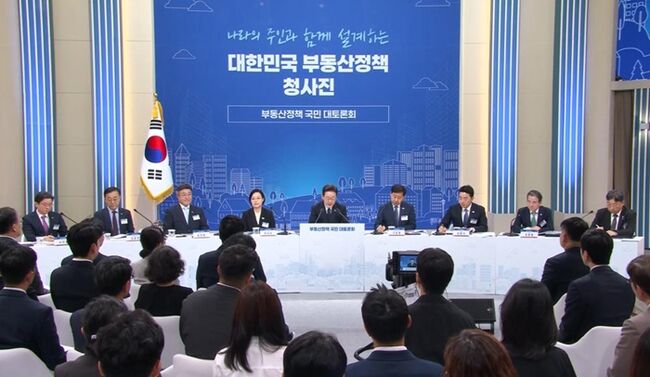 [Liberal Democratic Party Statement] Calling it a Grand Real Estate Debate… It Was Nothing More Than a Private Party Among Themselves
The 'National Grand Debate on Real Estate Policy' held on July 23rd and 27th. [Photo=Yonhap News]The 'National Grand Debate on Real Estate Policy,' hosted by the Lee Jae-myung administration under the
[Liberal Democratic Party Statement] Calling it a Grand Real Estate Debate… It Was Nothing More Than a Private Party Among Themselves
The 'National Grand Debate on Real Estate Policy' held on July 23rd and 27th. [Photo=Yonhap News]The 'National Grand Debate on Real Estate Policy,' hosted by the Lee Jae-myung administration under the
 [Photo] Evidence of Election Fraud Flooding U.S. Media… Trump Had 2.7 Million Votes Stolen
 [Video] U.S. Semiquincentennial Air Show... 'Art in the Sky' streaks across New York
 [Editorial Cartoon] A Draconian Law That Undermines Freedom of Expression

 List
List