이 시리즈는 지난 8년간 발표된 미국 국가안보전략(NSS) 문서를 바탕으로, 미국 안보전략이 어떤 단계적 변화를 거쳐 왔는지를 구조적으로 해설하기 위해 기획됐다. 해법을 제시하기보다, 무엇이 이미 바뀌었는지를 문서와 정책 신호를 통해 정리하는 데 초점을 맞췄다. 판단의 근거가 된 국가안보전략 원문은 독자가 직접 확인할 수 있도록 참조 문서로 함께 제시한다.
 Night view of the Korean Peninsula taken from the International Space Station (ISS), released by the Korea University Atmospheric Environment Research Institute on February 4, 2022 [Photo=Korea University Atmospheric Environment Research Institute]
[Table of Contents]
① Continuity of Trump-Biden-Trump through NSS
② Policy Signals from Trump's Second Term Security Strategy
③ Where is the Destination of Crisis Management Deterrence Strategy?
④ What Changes if Applied to the Korean Peninsula?
Shift from ‘Deterrence to Prevent War’ to ‘Deterrence to Control Crisis’
As the United States' alliance strategy moves beyond the so-called "collection" phase pursuing practical interests into the next stage, the most significant change lies in the concept of deterrence.
Traditional deterrence was a method of demonstrating 'certainty of intervention' to prevent the adversary from attempting provocation.
However, the direction of recent US strategy is different. Instead of automatically promising intervention, it is shifting towards deterring adversaries by instilling confidence in the ability to control escalation and costs when a crisis occurs.
This can be called 'crisis management deterrence.'
If this change is applied to the Korean Peninsula, the changes that South Korea will experience are more likely to appear first in the structural changes of policy signals rather than in the increase or decrease of military power.
Not Weakening Automatic Intervention, but Strengthening ‘Conditioned Intervention’
The first thing that will change on the Korean Peninsula is not the question of 'whether the US will come or not.'
The US will maintain alliances and the framework of deterrence. However, the key is that this deterrence is shifting from 'automatic' to 'conditional.' The US will maintain the principle of intervention in times of crisis, but the timing, scope, and method of intervention will be determined by situational judgment and conditions.
This decision will be influenced by a combination of factors such as the ally's contribution, the nature of the situation, the risk of escalation, the China variable, and domestic political burdens in the US. Consequently, deterrence on the Korean Peninsula will become more complex, and the strategic environment that South Korea must face will become more uncertain.
The 'uncertainty' referred to here is not a weakness of the US, but a strategic tool. It is a method of maintaining ambiguity for selective intervention while demanding clear roles and burdens from allies. US responsibility becomes ambiguous, while allied responsibility becomes clear. This is the basic operating principle of crisis management deterrence.
Focus of Deterrence Shifts from ‘Preventing Provocation’ to ‘Preventing Escalation’
The goal of traditional deterrence was to prevent provocation itself. However, in crisis management deterrence, provocation does not disappear entirely. Instead, the focus is on managing the situation so that even if provocation occurs, it does not escalate into full-scale war.
If applied to the Korean Peninsula, the US is more likely to design its response to North Korean provocations in a way that minimizes escalation risks by analyzing the scale and intent of the situation, rather than responding with 'immediate retaliation' to all provocations.
This change may create an impression in South Korean society that 'the US has weakened.' However, from the US perspective, this is closer to optimization than weakening.
If escalating North Korea's localized provocations into a full-scale war does not align with US interests, the intensity of retaliation will be adjusted.
While tensions may appear to be managed, there is also a risk that a wrong signal may be sent to North Korea that 'provocation can be managed.' This is the dilemma of 'crisis management deterrence.'
South Korea's Role: Reassigned from ‘Choice’ to ‘Upfront Burden’
In an environment where crisis management deterrence operates, South Korea's area of 'decision-making' decreases. Instead, the areas that South Korea must bear the burden for increase. As who does what in the early stages of a crisis becomes crucial, the burden of the so-called 'first 72 hours' is structurally transferred to South Korea.
The structure will change to South Korea shouldering the practical burdens in the early stages of a crisis, such as intelligence, surveillance, reconnaissance, command and control, missile defense, civil defense and rear stability, and cyber response, and the US deciding the scale and method of intervention based on the results.
This structure is often framed with language like "South Korea takes the lead." However, the reality is different. This is closer to a structure that demands crisis absorption capacity rather than an expansion of leadership. Crisis management deterrence operates by imposing a responsibility to endure first, rather than giving choices to allies.
North Korea's Localized Provocations May Be Defined as ‘Manageable’
If North Korea refrains from localized provocations for the time being, it is more likely due to a calculation of cost-effectiveness rather than goodwill. As crisis management deterrence becomes established, North Korea may refine its provocations to maximize political and psychological effects while minimizing the risk of full-scale war.
The proportion of gray zone actions combined with cyber and cognitive warfare may increase, minimizing military damage while amplifying anxiety in South Korean society. The most dangerous aspect at this time is the illusion that "security has stabilized because provocations have decreased." A reduction in provocations may signify an optimization of provocation methods, not stability.
Crisis management deterrence is considered successful if it can prevent escalation, even if it cannot completely prevent provocation. However, South Korean society perceives the very existence of provocation as a source of anxiety. The structure where the US's success criteria and South Korea's perceived criteria inevitably diverge.
The China Variable Becomes More Significant
The Korean Peninsula is no longer a standalone battlefield. In crisis management deterrence, the China variable plays a particularly significant role. The US will calculate how US responses to crises on the Korean Peninsula are linked to Taiwan and the South China Sea, and will assess whether North Korean provocations are connected to China's strategic objectives.
As a result, it will become difficult for South Korea to interpret crises solely based on North Korea. As responses to the Korean Peninsula are incorporated into China strategy, the conditions for intervention will become more complex, and decisions are likely to be delayed. The approach of "the Korean Peninsula issue is a Korean Peninsula issue" will gradually lose its relevance.
Signs Appear First in ‘Wording,’ Not ‘Troops’
Crisis management deterrence does not first manifest in the number of tanks or fighter jets. Changes begin with the wording in documents and diplomatic language. Definitive expressions like 'automatic,' 'immediate,' and 'ironclad' will decrease, while expressions like 'coordinated,' 'situation-based,' 'phased,' and 'options' will increase.
When changes in joint statement wording, adjustments in training methods, logic of operational plan updates, and the conditioning of deterrence commitments accumulate, the nature of deterrence has already changed. If this is dismissed as a 'change in words,' the strategic change will later return as a cost.
Conclusion Without an End, Unfilled Margins Left Behind
Crisis management deterrence may increase the possibility of preventing war on the Korean Peninsula, while simultaneously widening the scope for North Korea to refine its gray zone provocations.
What is clear is that this cannot be explained by a simple narrative of "the US has weakened." It is a strategy that involves an increase in choice, not a decrease in power, and as a consequence, increases the upfront burden on allies.
As this strategy is applied more deeply to the Korean Peninsula, the questions South Korea must face will become more stark and direct. This is because the core axis of deterrence is shifting from 'US defense' to 'South Korea's initial response capabilities.'
By Kim Young, Reporter

 [Statement by the Seo-beo-kka Korea Military Academy Save-the-Nation Comrades Association] ㉛ Recount the Votes Publicly, as the Previous Recount Concealed Election Fraud
Tongyeong Mayoral Election Recount [Photo=Yonhap News]South Korea's liberal democracy is dying. The National Election Commission (NEC) and the judiciary, which have plummeted into criminal syndicates
[Statement by the Seo-beo-kka Korea Military Academy Save-the-Nation Comrades Association] ㉛ Recount the Votes Publicly, as the Previous Recount Concealed Election Fraud
Tongyeong Mayoral Election Recount [Photo=Yonhap News]South Korea's liberal democracy is dying. The National Election Commission (NEC) and the judiciary, which have plummeted into criminal syndicates
 What is the significance of the "Trump 2028" red hats that keep making a comeback?
It is noteworthy that President Donald Trump is "intentionally" fueling controversy over whether he can actually run in the 2028 presidential election, even though it is "highly likely he is seriously
What is the significance of the "Trump 2028" red hats that keep making a comeback?
It is noteworthy that President Donald Trump is "intentionally" fueling controversy over whether he can actually run in the 2028 presidential election, even though it is "highly likely he is seriously
 Jin Cummings: “North Korea says it will increase the number of spies, so what is the government doing?”
U.S. political columnist Gene Cummings has publicly questioned the South Korean government, asking, "North Korea is declaring that it will increase its number of spies, so what is the South Kore
Jin Cummings: “North Korea says it will increase the number of spies, so what is the government doing?”
U.S. political columnist Gene Cummings has publicly questioned the South Korean government, asking, "North Korea is declaring that it will increase its number of spies, so what is the South Kore
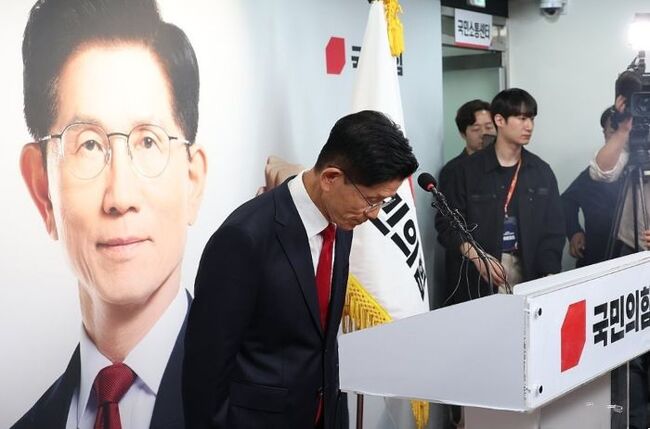 “Too little, too late?…” Kim Moon-soo, who previously conceded his presidential election defeat, now demands a special counsel investigation into ‘allegations of election fraud in the 2025 presidential election’
People Power Party presidential candidate Kim Moon-soo concedes defeat during a press conference at the party headquarters in Yeouido, Seoul, on June 4, 2025. [Joint Press Corps]As allegations emerge
“Too little, too late?…” Kim Moon-soo, who previously conceded his presidential election defeat, now demands a special counsel investigation into ‘allegations of election fraud in the 2025 presidential election’
People Power Party presidential candidate Kim Moon-soo concedes defeat during a press conference at the party headquarters in Yeouido, Seoul, on June 4, 2025. [Joint Press Corps]As allegations emerge
 Stock Market Crash 'Black Tuesday'… KOSPI down 10.8%, KOSDAQ down 7.7%
The KOSPI fell by more than 5% in early trading on the 28th, triggering a sell-side sidecar.On the 28th, the KOSPI plunged by more than 10%.Due to the sharp decline, a sell-side sidecar—a temporary
Stock Market Crash 'Black Tuesday'… KOSPI down 10.8%, KOSDAQ down 7.7%
The KOSPI fell by more than 5% in early trading on the 28th, triggering a sell-side sidecar.On the 28th, the KOSPI plunged by more than 10%.Due to the sharp decline, a sell-side sidecar—a temporary
 [World Heritage Committee] 25 New World Heritage Sites Inscribed in Busan… South Korea Successfully Expands 'Getbol' Listing
The Chairperson of the World Heritage Committee speaks at the plenary session of the 48th session of the World Heritage Committee, held at BEXCO in Busan on the 20th. [Photo: Yonhap News]A total of 25
[World Heritage Committee] 25 New World Heritage Sites Inscribed in Busan… South Korea Successfully Expands 'Getbol' Listing
The Chairperson of the World Heritage Committee speaks at the plenary session of the 48th session of the World Heritage Committee, held at BEXCO in Busan on the 20th. [Photo: Yonhap News]A total of 25
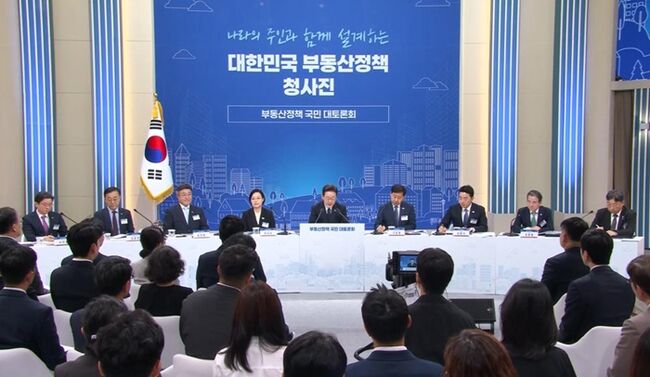 [Liberal Democratic Party Statement] Calling it a Grand Real Estate Debate… It Was Nothing More Than a Private Party Among Themselves
The 'National Grand Debate on Real Estate Policy' held on July 23rd and 27th. [Photo=Yonhap News]The 'National Grand Debate on Real Estate Policy,' hosted by the Lee Jae-myung administration under the
[Liberal Democratic Party Statement] Calling it a Grand Real Estate Debate… It Was Nothing More Than a Private Party Among Themselves
The 'National Grand Debate on Real Estate Policy' held on July 23rd and 27th. [Photo=Yonhap News]The 'National Grand Debate on Real Estate Policy,' hosted by the Lee Jae-myung administration under the
 [Photo] Evidence of Election Fraud Flooding U.S. Media… Trump Had 2.7 Million Votes Stolen
 [Video] U.S. Semiquincentennial Air Show... 'Art in the Sky' streaks across New York
 [Editorial Cartoon] A Draconian Law That Undermines Freedom of Expression

 List
List