Exchange rate information is displayed on a signboard at a currency exchange office on Myeongdong Street. [Photo=Yonhap News]
Following the government's verbal warning on the 24th, which mentioned the "possibility of strong intervention" regarding the Korean won exchange rate, many media outlets interpreted this as a signal for exchange rate stabilization and published related reports.
However, a close examination of the reports reveals that the premises themselves are often inaccurate or the causal relationships are exaggerated. We will differentiate between misconceptions and facts, focusing on the main issues in exchange rate reporting.
"Global Dollar Strength is the Main Cause of Won Weakness"
△ Misconception: The most common premise is "global dollar strength." However, looking at the trend of the Dollar Index (DXY), this explanation lacks persuasiveness. The recent Dollar Index is closer to a correction or range-bound movement rather than a clear upward trend. At the very least, it is difficult to argue that the dollar is uniformly strengthening worldwide.
Despite this, some reports simply attribute the rise in the won-dollar exchange rate to the "natural consequence of dollar strength." In such cases, domestic factors that cause the won's weakness, such as policy confidence, sluggish capital inflows, and political/economic risks, are easily excluded from the analysis.
△ Fact: The current exchange rate instability is closer to a phase where domestic factors have had a relatively greater impact than dollar factors.
"Government's Verbal Intervention Led to a Fall in the Exchange Rate"
△ Misconception: As the exchange rate showed some stabilization after the 24th, some reports concluded this was due to the effect of the government's verbal intervention. However, even within the same article, multiple variables are mentioned, such as tax measures, supply and demand factors, year-end position adjustments, and foreign exchange market liquidity.
Nevertheless, headlines or leads emphasize a simplistic causality of "Government Warning → Exchange Rate Fall." This is an overly simplistic way to explain the outcome.
△ Fact: While verbal intervention can influence short-term psychological adjustments, it is difficult to consider it as the sole factor explaining the overall trend of the exchange rate.
"The Government Actually Injected Billions of Dollars"
△ Misconception: Some media outlets highlighted the intensity of the intervention by mentioning specific figures such as "over 5 billion dollars injected." However, these figures are largely based on market participants' estimations and have not been officially confirmed by the authorities.
The problem is that these "estimates" become solidified as facts through secondary and tertiary citations. Readers may misunderstand that the government has actually sold a large amount of dollars.
△ Fact: The figures cited as intervention amounts are market estimates, not official confirmations, and it is difficult to ascertain them as facts.
"The Government Defends a Specific Exchange Rate Level (Support Level/Maginot Line)"
△ Misconception: Expressions such as "1450 won support level" and "year-end closing price management" are also repeated. However, the government has never officially set a specific exchange rate level as a target or announced a defense line. Despite this, some reports describe it as if a clear defense line exists.
This framing leads to a misunderstanding of the exchange rate as a "battle of lines" rather than a result of complex variables.
△ Fact: Exchange rates are influenced by a combination of factors such as supply and demand, policy confidence, and risk premiums, rather than specific figures.
"Tax and Supply/Demand Measures Will Stabilize the Exchange Rate"
△ Misconception: There are also evaluations that tax adjustments for overseas stock investors and supply and demand measures could contribute to exchange rate stabilization. While there is no need to deny the possibility itself, describing them as immediate and structural exchange rate stabilization mechanisms is an exaggeration.
△ Fact: Such measures may have some impact on short-term supply and demand, but it is difficult to see them as variables that will change the medium-term direction of the exchange rate.
Why Premises Matter
The problem with the current exchange rate reporting is not simply a matter of inaccurate phrasing. Incorrect premises distort policy messages and obscure readers' understanding of market conditions. In particular, the familiar frame of "global dollar strength" is easy to explain, but it needs to be checked whether it obscures reality.
This is also why skeptical views are emerging about whether the government's intervention warnings will be effective in the market. This is because, when the cause of the problem is not external, it is difficult to change the trend with warnings alone.
By Reporter Kim Young

 [Statement by the Seo-beo-kka Korea Military Academy Save-the-Nation Comrades Association] ㉛ Recount the Votes Publicly, as the Previous Recount Concealed Election Fraud
Tongyeong Mayoral Election Recount [Photo=Yonhap News]South Korea's liberal democracy is dying. The National Election Commission (NEC) and the judiciary, which have plummeted into criminal syndicates
[Statement by the Seo-beo-kka Korea Military Academy Save-the-Nation Comrades Association] ㉛ Recount the Votes Publicly, as the Previous Recount Concealed Election Fraud
Tongyeong Mayoral Election Recount [Photo=Yonhap News]South Korea's liberal democracy is dying. The National Election Commission (NEC) and the judiciary, which have plummeted into criminal syndicates
 What is the significance of the "Trump 2028" red hats that keep making a comeback?
It is noteworthy that President Donald Trump is "intentionally" fueling controversy over whether he can actually run in the 2028 presidential election, even though it is "highly likely he is seriously
What is the significance of the "Trump 2028" red hats that keep making a comeback?
It is noteworthy that President Donald Trump is "intentionally" fueling controversy over whether he can actually run in the 2028 presidential election, even though it is "highly likely he is seriously
 Jin Cummings: “North Korea says it will increase the number of spies, so what is the government doing?”
U.S. political columnist Gene Cummings has publicly questioned the South Korean government, asking, "North Korea is declaring that it will increase its number of spies, so what is the South Kore
Jin Cummings: “North Korea says it will increase the number of spies, so what is the government doing?”
U.S. political columnist Gene Cummings has publicly questioned the South Korean government, asking, "North Korea is declaring that it will increase its number of spies, so what is the South Kore
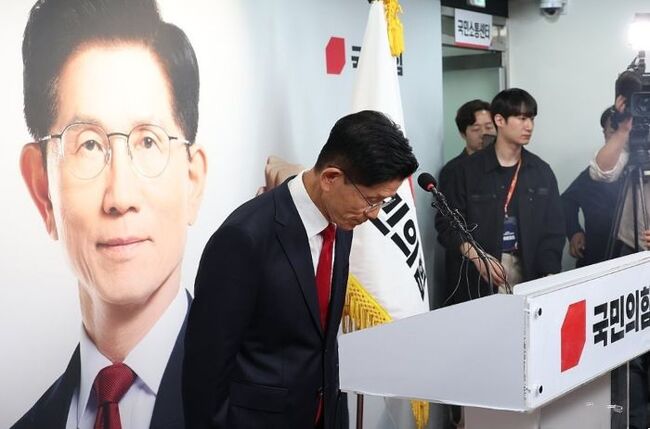 “Too little, too late?…” Kim Moon-soo, who previously conceded his presidential election defeat, now demands a special counsel investigation into ‘allegations of election fraud in the 2025 presidential election’
People Power Party presidential candidate Kim Moon-soo concedes defeat during a press conference at the party headquarters in Yeouido, Seoul, on June 4, 2025. [Joint Press Corps]As allegations emerge
“Too little, too late?…” Kim Moon-soo, who previously conceded his presidential election defeat, now demands a special counsel investigation into ‘allegations of election fraud in the 2025 presidential election’
People Power Party presidential candidate Kim Moon-soo concedes defeat during a press conference at the party headquarters in Yeouido, Seoul, on June 4, 2025. [Joint Press Corps]As allegations emerge
 Stock Market Crash 'Black Tuesday'… KOSPI down 10.8%, KOSDAQ down 7.7%
The KOSPI fell by more than 5% in early trading on the 28th, triggering a sell-side sidecar.On the 28th, the KOSPI plunged by more than 10%.Due to the sharp decline, a sell-side sidecar—a temporary
Stock Market Crash 'Black Tuesday'… KOSPI down 10.8%, KOSDAQ down 7.7%
The KOSPI fell by more than 5% in early trading on the 28th, triggering a sell-side sidecar.On the 28th, the KOSPI plunged by more than 10%.Due to the sharp decline, a sell-side sidecar—a temporary
 [World Heritage Committee] 25 New World Heritage Sites Inscribed in Busan… South Korea Successfully Expands 'Getbol' Listing
The Chairperson of the World Heritage Committee speaks at the plenary session of the 48th session of the World Heritage Committee, held at BEXCO in Busan on the 20th. [Photo: Yonhap News]A total of 25
[World Heritage Committee] 25 New World Heritage Sites Inscribed in Busan… South Korea Successfully Expands 'Getbol' Listing
The Chairperson of the World Heritage Committee speaks at the plenary session of the 48th session of the World Heritage Committee, held at BEXCO in Busan on the 20th. [Photo: Yonhap News]A total of 25
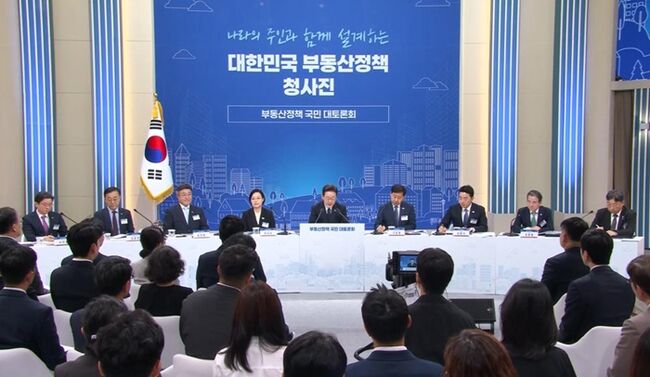 [Liberal Democratic Party Statement] Calling it a Grand Real Estate Debate… It Was Nothing More Than a Private Party Among Themselves
The 'National Grand Debate on Real Estate Policy' held on July 23rd and 27th. [Photo=Yonhap News]The 'National Grand Debate on Real Estate Policy,' hosted by the Lee Jae-myung administration under the
[Liberal Democratic Party Statement] Calling it a Grand Real Estate Debate… It Was Nothing More Than a Private Party Among Themselves
The 'National Grand Debate on Real Estate Policy' held on July 23rd and 27th. [Photo=Yonhap News]The 'National Grand Debate on Real Estate Policy,' hosted by the Lee Jae-myung administration under the
 [Photo] Evidence of Election Fraud Flooding U.S. Media… Trump Had 2.7 Million Votes Stolen
 [Video] U.S. Semiquincentennial Air Show... 'Art in the Sky' streaks across New York
 [Editorial Cartoon] A Draconian Law That Undermines Freedom of Expression

 List
List