Lotte World Tower [Photo = Songpa-gu Office]
As the year-end approaches, corporate financial structures naturally face market scrutiny. For conglomerates burdened by substantial debt, even minor cracks in cash flow can quickly signal trouble. However, this year-end, the market surrounding one large conglomerate has been unusually quiet.
This is the case for the Lotte Group.
While the short-term debt due for repayment by the end of the year amounts to 34 trillion won, the financial market has yet to show significant signs of tension. This suggests that a considerable portion has been refinanced or had its maturity extended. The issue is that this 'quiet' is ambiguous – is it a signal of stability, or a result of management?
Corporate Structure Managed Under Governmental Judgment
Here, Lotte's crisis transforms from a mere financial issue into a question of how the company manages its crisis. Structure is more important than numbers.
Lotte possesses large assets and a relatively low debt-to-equity ratio. Based solely on these figures, there are sufficient reasons for financial institutions not to exert immediate pressure. However, this structure is difficult to explain by mere financial stability alone.
Woori Bank and Shinhan Bank, often mentioned as Lotte's main transaction banks, are both financial institutions where government influence operates structurally. This is an environment where policy considerations have room to intervene, rather than immediate market judgment.
At this juncture, Lotte's crisis begins to take on the characteristic of a corporate structure managed under governmental judgment.
Companies that financial institutions do not flag do not collapse immediately. However, as a consequence, the company shifts from persuading the market to being mindful of the government's gaze. This is how Lotte's owner risk operates.
On the surface, Lotte already operates under a professional management system.
Most affiliates are headed by professional managers, and the owner does not take a front-facing role. However, the reality is different. Core decisions such as business divestment, large-scale asset sales, and structural transformation lie outside the authority of professional managers. While operations are delegated, final judgment is reserved.
Final Decision-Making Power Still Rests with the Owner
Here, Lotte's crisis transforms from a mere financial issue into a question of how the company manages its crisis. Structure is more important than numbers.
Lotte possesses large assets and a relatively low debt-to-equity ratio. Based solely on these figures, there are sufficient reasons for financial institutions not to exert immediate pressure. However, this structure is difficult to explain by mere financial stability alone.
Woori Bank and Shinhan Bank, often mentioned as Lotte's main transaction banks, are both financial institutions where government influence operates structurally. This is an environment where policy considerations have room to intervene, rather than immediate market judgment.
At this juncture, Lotte's crisis begins to take on the characteristic of a corporate structure managed under governmental judgment.
Companies that financial institutions do not flag do not collapse immediately. However, as a consequence, the company shifts from persuading the market to being mindful of the government's gaze. This is how Lotte's owner risk operates.
On the surface, Lotte already operates under a professional management system.
Most affiliates are headed by professional managers, and the owner does not take a front-facing role. However, the reality is different. Core decisions such as business divestment, large-scale asset sales, and structural transformation lie outside the authority of professional managers. While operations are delegated, final judgment is reserved.
Final Decision-Making Power Still Rests with the Owner
The 'decision-making authority' referred to here differs from ordinary management authority. It refers to the final decision-making power that can confirm a direction even at the risk of failure, meaning the authority to finalize irreversible choices. These are decisions that carry responsibility for the outcome, such as large-scale asset sales, abandonment of core businesses, or group-wide restructuring directions. This authority currently remains with the owner.
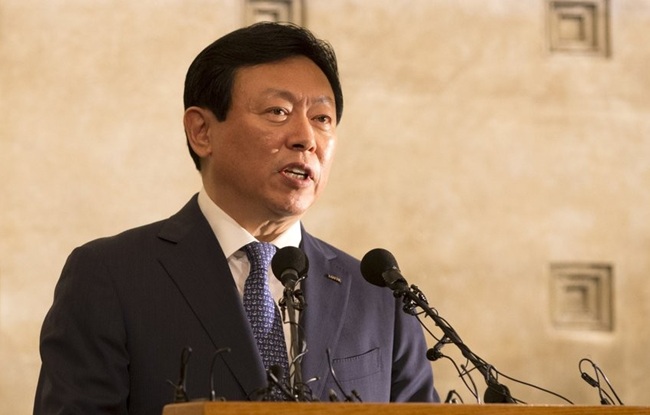 In his 2025 New Year's address, Chairman Shin Dong-bin urged strong reform, stating, "Without innovation, we could face even greater crises." [Photo = Yonhap News]
As a result, professional managers become administrators, and the organization waits for decisions.
The burden of failure is shifted internally, and the organization becomes increasingly fatigued. While there are no layoffs, uncertainty becomes constant. This is not employment stability but quiet attrition. This is the background to assessments within Lotte that organizational fatigue has reached a critical point.
Indeed, the Lotte Group is taking steps to address its liquidity.
Lotte Engineering & Construction has already raised a total of 1 trillion won in funds from its affiliates and is considering asset securitization plans worth approximately 1 trillion won, including the sale of its headquarters site in Jamwon-dong, Seocho-gu, Seoul. Management reform measures such as large-scale executive reshuffles, disposal of non-core assets, and revaluation of owned land are also being pursued concurrently.
However, these measures are all focused on cash flow management and crisis mitigation. Irreversible choices such as business divestment or portfolio transformation have not yet emerged.
This situation is not unfamiliar.
It resembles the crisis response methods that Japanese companies have repeatedly employed since the 1990s. The core of Japanese-style management lay in avoiding conflict, choosing banks over the market, and opting for survival over decisive action.
Unprofitable businesses were not resolved, and responsibility was dispersed. This is the background to the proliferation of so-called 'zombie companies.' While this approach may have delayed bankruptcy, it failed to restore competitiveness.
However, not all Japanese companies remained on this path.
What Lotte Needs is Substantive Authority for Professional Managers
Nissan abandoned its traditional consensus and survival-based management, handing over decision-making authority to outsiders and successfully recovering in a short period. Hitachi dismantled its 'department store-like conglomerate' structure and reorganized its business portfolio, restoring profitability and corporate value. This is why it is assessed that only companies that abandoned Japanese-style management have survived in Japan.
This transition is not exclusive to Japan.
There are exemplary cases in Korea as well. The SK Group chose a third path during its crisis, neither sole owner management nor survival-oriented management. Following the major decision of acquiring Hynix in 2012, SK officially launched the 'SUPEX Pursuing Council' in 2013, transitioning the group's decision-making structure to a collective system. The key was not the existence of the council itself, but the structural transfer of final decision-making authority.
Under the SUPEX system, affiliate CEOs operated as actual decision-makers. Key personnel at the time dedicated themselves to their work rather than job security, and group strategies did not falter even during periods of owner risk. As a result, SK succeeded in its resurgence, centered around semiconductors, batteries, and telecommunications. SUPEX is not a system that made SK perfect, but a structure that prevented the worst choices. This system remains in place today.
Returning to Lotte, the question becomes clear.
Lotte currently possesses the conditions for 'endurance.' However, the cost of this is being borne by the organization and its employees. The owner retains their position, the government manages, and banks extend deadlines, while internal members are consumed. Assessments suggest that organizational fatigue has already reached a critical point.
The conclusion is simple.
What Lotte needs is not nominal professional management, but a structure that allows for substantive decision-making. To achieve this, the owner must step down from management, and a collective decision-making system must be established. The resignation of Chairman Shin Dong-bin and the transfer of final decision-making authority to professional managers is not a moral imperative but a structural choice essential for the survival of the organization.
Japan failed in survival and succeeded through decisive action.
A Korean company made a choice at the same crossroads and proved it with results.
Now, Lotte faces one question.
Will it continue to endure, or will it relinquish its decision-making authority?
◆ SUPEX
This is a top decision-making system introduced by the SK Group, with the name being an abbreviation for Super Excellent Level. However, the essence of SUPEX lies not in its slogan but in the change of authority structure. SUPEX is not a council that manages the operations of affiliates. Its characteristic is a structure that grants collective final decision-making authority at the group level.
By Reporter Kim Young

 [Statement by the Seo-beo-kka Korea Military Academy Save-the-Nation Comrades Association] ㉛ Recount the Votes Publicly, as the Previous Recount Concealed Election Fraud
Tongyeong Mayoral Election Recount [Photo=Yonhap News]South Korea's liberal democracy is dying. The National Election Commission (NEC) and the judiciary, which have plummeted into criminal syndicates
[Statement by the Seo-beo-kka Korea Military Academy Save-the-Nation Comrades Association] ㉛ Recount the Votes Publicly, as the Previous Recount Concealed Election Fraud
Tongyeong Mayoral Election Recount [Photo=Yonhap News]South Korea's liberal democracy is dying. The National Election Commission (NEC) and the judiciary, which have plummeted into criminal syndicates
 What is the significance of the "Trump 2028" red hats that keep making a comeback?
It is noteworthy that President Donald Trump is "intentionally" fueling controversy over whether he can actually run in the 2028 presidential election, even though it is "highly likely he is seriously
What is the significance of the "Trump 2028" red hats that keep making a comeback?
It is noteworthy that President Donald Trump is "intentionally" fueling controversy over whether he can actually run in the 2028 presidential election, even though it is "highly likely he is seriously
 Jin Cummings: “North Korea says it will increase the number of spies, so what is the government doing?”
U.S. political columnist Gene Cummings has publicly questioned the South Korean government, asking, "North Korea is declaring that it will increase its number of spies, so what is the South Kore
Jin Cummings: “North Korea says it will increase the number of spies, so what is the government doing?”
U.S. political columnist Gene Cummings has publicly questioned the South Korean government, asking, "North Korea is declaring that it will increase its number of spies, so what is the South Kore
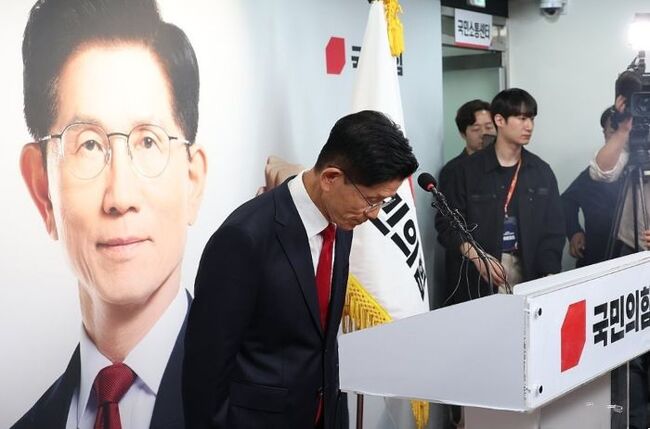 “Too little, too late?…” Kim Moon-soo, who previously conceded his presidential election defeat, now demands a special counsel investigation into ‘allegations of election fraud in the 2025 presidential election’
People Power Party presidential candidate Kim Moon-soo concedes defeat during a press conference at the party headquarters in Yeouido, Seoul, on June 4, 2025. [Joint Press Corps]As allegations emerge
“Too little, too late?…” Kim Moon-soo, who previously conceded his presidential election defeat, now demands a special counsel investigation into ‘allegations of election fraud in the 2025 presidential election’
People Power Party presidential candidate Kim Moon-soo concedes defeat during a press conference at the party headquarters in Yeouido, Seoul, on June 4, 2025. [Joint Press Corps]As allegations emerge
 Stock Market Crash 'Black Tuesday'… KOSPI down 10.8%, KOSDAQ down 7.7%
The KOSPI fell by more than 5% in early trading on the 28th, triggering a sell-side sidecar.On the 28th, the KOSPI plunged by more than 10%.Due to the sharp decline, a sell-side sidecar—a temporary
Stock Market Crash 'Black Tuesday'… KOSPI down 10.8%, KOSDAQ down 7.7%
The KOSPI fell by more than 5% in early trading on the 28th, triggering a sell-side sidecar.On the 28th, the KOSPI plunged by more than 10%.Due to the sharp decline, a sell-side sidecar—a temporary
 [World Heritage Committee] 25 New World Heritage Sites Inscribed in Busan… South Korea Successfully Expands 'Getbol' Listing
The Chairperson of the World Heritage Committee speaks at the plenary session of the 48th session of the World Heritage Committee, held at BEXCO in Busan on the 20th. [Photo: Yonhap News]A total of 25
[World Heritage Committee] 25 New World Heritage Sites Inscribed in Busan… South Korea Successfully Expands 'Getbol' Listing
The Chairperson of the World Heritage Committee speaks at the plenary session of the 48th session of the World Heritage Committee, held at BEXCO in Busan on the 20th. [Photo: Yonhap News]A total of 25
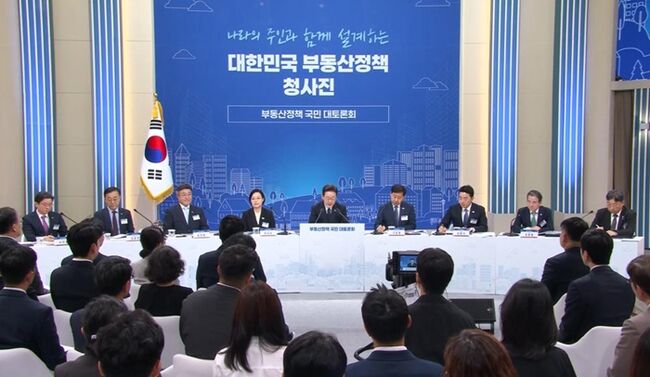 [Liberal Democratic Party Statement] Calling it a Grand Real Estate Debate… It Was Nothing More Than a Private Party Among Themselves
The 'National Grand Debate on Real Estate Policy' held on July 23rd and 27th. [Photo=Yonhap News]The 'National Grand Debate on Real Estate Policy,' hosted by the Lee Jae-myung administration under the
[Liberal Democratic Party Statement] Calling it a Grand Real Estate Debate… It Was Nothing More Than a Private Party Among Themselves
The 'National Grand Debate on Real Estate Policy' held on July 23rd and 27th. [Photo=Yonhap News]The 'National Grand Debate on Real Estate Policy,' hosted by the Lee Jae-myung administration under the
 [Photo] Evidence of Election Fraud Flooding U.S. Media… Trump Had 2.7 Million Votes Stolen
 [Video] U.S. Semiquincentennial Air Show... 'Art in the Sky' streaks across New York
 [Editorial Cartoon] A Draconian Law That Undermines Freedom of Expression

 List
List