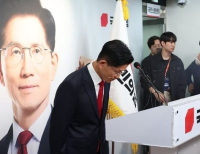
On the 23rd, National Power Party lawmaker Choi Su-jin is participating in an unlimited debate on the partial amendment of the Act on Promotion of Information and Communications Network Utilization and Information Protection, etc., at the plenary session of the extraordinary parliamentary session held in December. [Photo=Yonhap News]
Debate is escalating around the amendment to the Information and Communications Network Act that has passed the National Assembly. While the government and the ruling party explain it as a "minimal institutional improvement to prevent damage from false and manipulated information," voices of concern regarding the infringement of freedom of expression and self-censorship are continuing from the media and civil society. The facts and misunderstandings have been organized by issue in a fact-check format.
"The amendment to the Information and Communications Network Act is highly unconstitutional."
Criticism is being raised that the amendment is "effectively a censorship law with a high possibility of being unconstitutional." Conversely, the government argues that it is "legal regulation within the scope permitted by the Constitution."
The core of the current unconstitutionality debate lies not just in whether freedom of expression is infringed, but whether the law satisfies the principles of clarity, prohibition of excess, and predictability required by the Constitution. Key concepts for determining responsibility, such as "false and manipulated information," "continued distribution," and "reasonable measures," are not clearly defined in the amendment. This leads to the criticism that it is difficult for individuals to predict whether their actions are illegal beforehand, and responsibility is determined based on ex-post facto judgment. The sanction structure, which combines punitive damages and administrative fines, is also criticized as excessive.
The fact that the law does not explicitly stipulate prior censorship does not eliminate constitutional issues. The Constitutional Court has consistently ruled that even if it is not formal censorship, any structure that chills expression is subject to constitutional review. However, the actual constitutionality will be determined through specific enforcement cases after the law takes effect.
"Punitive damages can be up to 10 times."
The claim that "if false and manipulated information is distributed, punitive damages of up to 10 times can be imposed" is spreading regarding the amendment to the Information and Communications Network Act. The term "10x damage law" has also appeared, particularly in some political statements and on social media.
The upper limit for punitive damages in the amendment to the Information and Communications Network Act, which has passed the National Assembly, is "up to 5 times." It stipulates that in cases where damage is caused to others due to the distribution of illegal, false, or manipulated information with intent or gross negligence, damages may be ordered not exceeding 5 times the amount of damages recognized by the court. The "10x punitive damages" clause is not included anywhere in the finally passed amendment.
The misunderstanding of "10x punitive damages" is largely due to it being a claim raised during past discussions or confusion with the administrative fine provision of up to 1 billion won, which was also included in the amendment. However, given that punitive damages of 5 times and high administrative fines coexist, the actual regulatory impact could be significant. Accurate distinction is necessary, as failure to understand the level of sanctions precisely can lead to errors in either exaggerating or underestimating the risks of the law.
"The law takes effect immediately upon promulgation."
The claim that existing posts are also subject to regulation from the moment the law is promulgated.
The amended Information and Communications Network Act applies to actions taken after its effective date, which is 6 months after promulgation. Promulgation is merely a procedure to announce the establishment of the law; the standard for binding effect on citizens is the effective date. There are no provisions for retroactive punishment for posting activities prior to its effectiveness.
The perception that it is "dangerous immediately upon promulgation" is excessive. The actual standard for determining responsibility lies in what actions and management have occurred after the law takes effect.
"Past articles are also subject to punishment."
Concerns that articles or posts created before the law takes effect could be punished.
The law itself does not contain retroactive provisions for punishing past posts. However, if a post made before the effective date is maintained without deletion or blocking even after the effective date, and no action is taken despite a request for issues, there is room for interpretation that responsibility may arise as an act of "neglect after the effective date." This is the concept of "continued distribution."
While not retroactive in a legal sense, it is criticized as having a "circumventing retroactive effect" because past content can ultimately become subject to regulation. This is one of the key points of contention surrounding this amendment.
"If an issue is raised, it must be deleted unconditionally."
The perception that content must be deleted immediately upon the raising of an issue.
There is no provision in the amended law that mandates deletion upon the raising of an issue. Various measures are allowed, including modification, appending counterarguments, marking disputed points, restricting access, or deciding to maintain the content. What the law requires is a reasonable response, not deletion.
However, because punitive damages and administrative fines are combined in a situation where the criteria for responsibility are abstract, concerns about self-censorship arise from the high likelihood that deletion will be the safest option in practice.
"The standards and deadlines for action are clear."
The claim that the standards and deadlines for action are clearly defined in the law.
The deadlines or specific standards for action are not specified in the law. The standard of judgment is evaluated ex-post facto based on whether "prompt action was taken after recognizability." The existence of review, judgment, and action is key, rather than time itself.
For this reason, in actual law enforcement, the criterion for determining responsibility is likely to be the existence of records of what judgments and responses were made after an issue was raised, rather than whether deletion occurred. For media organizations, it is advantageous to respond by creating a checklist that includes legal review.
Conclusion
The amendment to the Information and Communications Network Act is more likely to be resolved with a "limited unconstitutionality or constitutional interpretation" rather than full unconstitutionality, and the key issue lies in how narrowly the enforcement standards are defined, rather than the law's provisions themselves.
This is not a law that compels immediate deletion upon the raising of an issue or retroactively punishes past posts. However, by designing a framework of ex-post facto responsibility with vague concepts like "continued distribution" and "reasonable measures," it has left room to increase the pressure for self-censorship on media and platforms.
How these standards are concretized in the actual enforcement process after the law takes effect is expected to be the key variable determining the direction of the freedom of expression debate.
Reporter Kim Young

 [Statement by the Seo-beo-kka Korea Military Academy Save-the-Nation Comrades Association] ㉛ Recount the Votes Publicly, as the Previous Recount Concealed Election Fraud
Tongyeong Mayoral Election Recount [Photo=Yonhap News]South Korea's liberal democracy is dying. The National Election Commission (NEC) and the judiciary, which have plummeted into criminal syndicates
[Statement by the Seo-beo-kka Korea Military Academy Save-the-Nation Comrades Association] ㉛ Recount the Votes Publicly, as the Previous Recount Concealed Election Fraud
Tongyeong Mayoral Election Recount [Photo=Yonhap News]South Korea's liberal democracy is dying. The National Election Commission (NEC) and the judiciary, which have plummeted into criminal syndicates
 What is the significance of the "Trump 2028" red hats that keep making a comeback?
It is noteworthy that President Donald Trump is "intentionally" fueling controversy over whether he can actually run in the 2028 presidential election, even though it is "highly likely he is seriously
What is the significance of the "Trump 2028" red hats that keep making a comeback?
It is noteworthy that President Donald Trump is "intentionally" fueling controversy over whether he can actually run in the 2028 presidential election, even though it is "highly likely he is seriously
 Jin Cummings: “North Korea says it will increase the number of spies, so what is the government doing?”
U.S. political columnist Gene Cummings has publicly questioned the South Korean government, asking, "North Korea is declaring that it will increase its number of spies, so what is the South Kore
Jin Cummings: “North Korea says it will increase the number of spies, so what is the government doing?”
U.S. political columnist Gene Cummings has publicly questioned the South Korean government, asking, "North Korea is declaring that it will increase its number of spies, so what is the South Kore
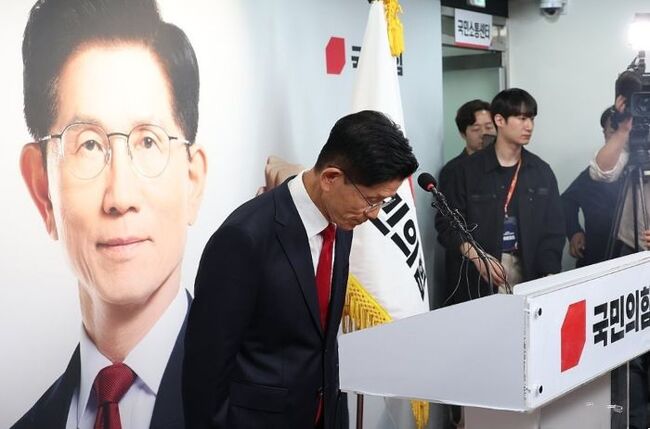 “Too little, too late?…” Kim Moon-soo, who previously conceded his presidential election defeat, now demands a special counsel investigation into ‘allegations of election fraud in the 2025 presidential election’
People Power Party presidential candidate Kim Moon-soo concedes defeat during a press conference at the party headquarters in Yeouido, Seoul, on June 4, 2025. [Joint Press Corps]As allegations emerge
“Too little, too late?…” Kim Moon-soo, who previously conceded his presidential election defeat, now demands a special counsel investigation into ‘allegations of election fraud in the 2025 presidential election’
People Power Party presidential candidate Kim Moon-soo concedes defeat during a press conference at the party headquarters in Yeouido, Seoul, on June 4, 2025. [Joint Press Corps]As allegations emerge
 Stock Market Crash 'Black Tuesday'… KOSPI down 10.8%, KOSDAQ down 7.7%
The KOSPI fell by more than 5% in early trading on the 28th, triggering a sell-side sidecar.On the 28th, the KOSPI plunged by more than 10%.Due to the sharp decline, a sell-side sidecar—a temporary
Stock Market Crash 'Black Tuesday'… KOSPI down 10.8%, KOSDAQ down 7.7%
The KOSPI fell by more than 5% in early trading on the 28th, triggering a sell-side sidecar.On the 28th, the KOSPI plunged by more than 10%.Due to the sharp decline, a sell-side sidecar—a temporary
 [World Heritage Committee] 25 New World Heritage Sites Inscribed in Busan… South Korea Successfully Expands 'Getbol' Listing
The Chairperson of the World Heritage Committee speaks at the plenary session of the 48th session of the World Heritage Committee, held at BEXCO in Busan on the 20th. [Photo: Yonhap News]A total of 25
[World Heritage Committee] 25 New World Heritage Sites Inscribed in Busan… South Korea Successfully Expands 'Getbol' Listing
The Chairperson of the World Heritage Committee speaks at the plenary session of the 48th session of the World Heritage Committee, held at BEXCO in Busan on the 20th. [Photo: Yonhap News]A total of 25
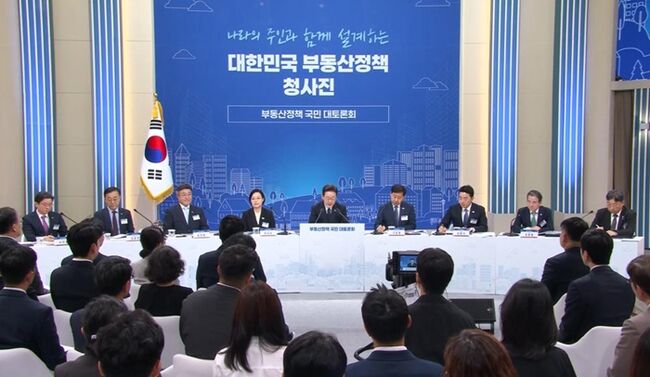 [Liberal Democratic Party Statement] Calling it a Grand Real Estate Debate… It Was Nothing More Than a Private Party Among Themselves
The 'National Grand Debate on Real Estate Policy' held on July 23rd and 27th. [Photo=Yonhap News]The 'National Grand Debate on Real Estate Policy,' hosted by the Lee Jae-myung administration under the
[Liberal Democratic Party Statement] Calling it a Grand Real Estate Debate… It Was Nothing More Than a Private Party Among Themselves
The 'National Grand Debate on Real Estate Policy' held on July 23rd and 27th. [Photo=Yonhap News]The 'National Grand Debate on Real Estate Policy,' hosted by the Lee Jae-myung administration under the
 [Photo] Evidence of Election Fraud Flooding U.S. Media… Trump Had 2.7 Million Votes Stolen
 [Video] U.S. Semiquincentennial Air Show... 'Art in the Sky' streaks across New York
 [Editorial Cartoon] A Draconian Law That Undermines Freedom of Expression

 List
List