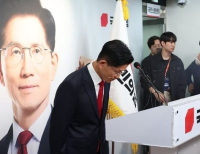
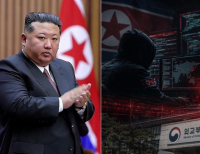
대통령의 발언은 비록 직접적인 지시가 아닐지라도 강력한 정책 신호로 기능한다. 그 막중한 무게를 감안할 때, 지금 필요한 조치는 소통 확대가 아니라 철저한 ‘입단속’이다.
권력의 언어가 한 박자 늦춰지고 자제될 때, 법과 절차는 비로소 본연의 제자리를 찾을 수 있다.
 President Lee Jae-myung enters the State Council meeting held at the Yongsan Presidential Office on the 2nd, before the Presidential Office's relocation to Cheong Wa Dae. [Photo = Yonhap News]
Coupang's personal information leakage incident has, from a certain point, become the center of a political whirlwind rather than a security incident.
Before the full truth of the incident was ascertained, the President's remarks came out first, followed by a series of responses from the National Assembly and across the government. As a result, the focus of controversy shifted from the scale of personal information leakage and responsibility to the meaning of the President's words.
In this situation, President Lee Jae-myung stated, "We must make companies feel that they will go bankrupt if they cause harm to the public by violating regulations."
He did not name specific companies, and formally, these were not administrative or judicial directives. Legally, they were closer to statements of principle.
However, given the timing and tone of the remarks, it was by no means an issue that could be easily dismissed.
Immediately afterward, parliamentary standing committees were mobilized, and the State Council meeting, which involved the entire government, even included the National Tax Service and the Ministry of Foreign Affairs. Before the investigation results were finalized, the message from power had already acted. While the legal form was limited to involvement, the political effect was close to intervention, meaning excessive interference.
The problem is that such remarks do not end as a one-off happening.
Previously, regarding the Daejang-dong case, the President made remarks at a State Council meeting that essentially hinted at abandoning an appeal, and he directly mentioned the possibility of dissolving the Unification Church, thereby sparking controversy.
There are commonalities among these three sets of remarks concerning Daejang-dong, the Unification Church, and Coupang.
The issues involved legal judgments and procedures, and the President's remarks came first, disrupting the order of the judiciary and administration.
The Coupang incident followed the same path as the previous two cases.
The technical and legal issue of personal information leakage was immediately transformed into a political frame. In particular, as Coupang's lobbying in the United States came to the fore, the issue expanded to become a diplomatic and trade matter.
However, even at this point, sufficient benchmarks were not provided.
According to publicly available data, Coupang's expenditure for lobbying in the United States was approximately $10 million over the last five years, translating to about $2 million annually. During the same period, Google and Amazon have spent over $10 million to $20 million annually on lobbying. Even when viewed as a percentage of revenue, Coupang's lobbying expenses fall within the levels typically borne by global platform companies.
More importantly, trade and regulatory issues are typical subjects of lobbying for platform companies.
Data protection and platform regulations, along with issues related to cross-border data movement, are structural problems that inevitably arise within the industrial framework. Nevertheless, the discussions so far have been fixated solely on Coupang's lobbying activities in the United States, treating them as the essence of the issue. In the process, the core tasks of investigating the reality and determining responsibility for personal information leakage were pushed to the back burner.
During this process, suspicions of the National Intelligence Service's (NIS) involvement also emerged.
The NIS officially refuted these claims, stating, "There were no directives, only consultations." Directives and consultations are clearly different in nature. A directive is direct involvement where the state shares responsibility for the action, while consultation is merely sharing information and understanding the situation.
The NIS's explanation was an attempt to distance itself and prevent the issue from escalating into a national security intervention case. However, the political fallout had already become uncontrollably widespread, and the explanation was insufficient to resolve the suspicions and quell the controversy.
There are various interpretations regarding the background of this incident deviating from its essence.
It cannot be definitively stated that President Lee Jae-myung intended to pressure a specific company.
However, it cannot be denied that the remarks were made in a situation where it was fully predictable what kind of political and administrative chain reactions strong messages would trigger. Consequently, before facts were confirmed, the message exerted influence first, and in that process, even a slim possibility was immediately accepted as a foregone conclusion.
The rule of law is a matter of order.
Investigation and judgment must come first, and holding someone accountable must follow.
When the President's words repeatedly leapfrog this order, the government appears not as a problem solver but as an amplifier of conflict. The Daejang-dong, Unification Church, and Coupang incidents all demonstrate this warning in the same manner.
What is needed is not stronger words. What is needed is restraint in words.
Even if not a direct order, the President's remarks function as a powerful policy signal. Given their immense weight, the action needed now is not expanded communication but thorough "mouth-shutting."
Only when the language of power slows down and is restrained can law and procedure finally return to their rightful place.

 [Statement by the Seo-beo-kka Korea Military Academy Save-the-Nation Comrades Association] ㉛ Recount the Votes Publicly, as the Previous Recount Concealed Election Fraud
Tongyeong Mayoral Election Recount [Photo=Yonhap News]South Korea's liberal democracy is dying. The National Election Commission (NEC) and the judiciary, which have plummeted into criminal syndicates
[Statement by the Seo-beo-kka Korea Military Academy Save-the-Nation Comrades Association] ㉛ Recount the Votes Publicly, as the Previous Recount Concealed Election Fraud
Tongyeong Mayoral Election Recount [Photo=Yonhap News]South Korea's liberal democracy is dying. The National Election Commission (NEC) and the judiciary, which have plummeted into criminal syndicates
 What is the significance of the "Trump 2028" red hats that keep making a comeback?
It is noteworthy that President Donald Trump is "intentionally" fueling controversy over whether he can actually run in the 2028 presidential election, even though it is "highly likely he is seriously
What is the significance of the "Trump 2028" red hats that keep making a comeback?
It is noteworthy that President Donald Trump is "intentionally" fueling controversy over whether he can actually run in the 2028 presidential election, even though it is "highly likely he is seriously
 Jin Cummings: “North Korea says it will increase the number of spies, so what is the government doing?”
U.S. political columnist Gene Cummings has publicly questioned the South Korean government, asking, "North Korea is declaring that it will increase its number of spies, so what is the South Kore
Jin Cummings: “North Korea says it will increase the number of spies, so what is the government doing?”
U.S. political columnist Gene Cummings has publicly questioned the South Korean government, asking, "North Korea is declaring that it will increase its number of spies, so what is the South Kore
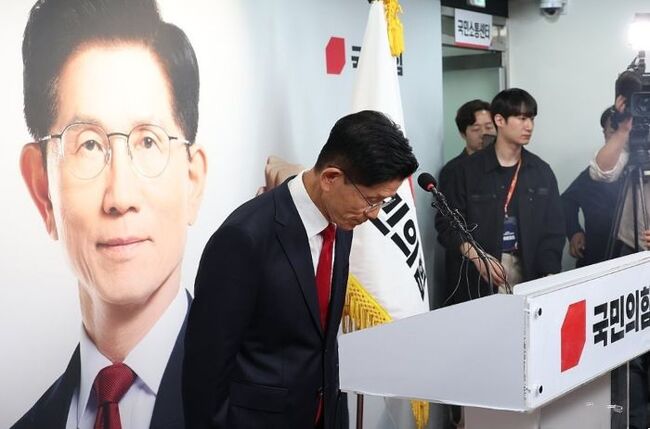 “Too little, too late?…” Kim Moon-soo, who previously conceded his presidential election defeat, now demands a special counsel investigation into ‘allegations of election fraud in the 2025 presidential election’
People Power Party presidential candidate Kim Moon-soo concedes defeat during a press conference at the party headquarters in Yeouido, Seoul, on June 4, 2025. [Joint Press Corps]As allegations emerge
“Too little, too late?…” Kim Moon-soo, who previously conceded his presidential election defeat, now demands a special counsel investigation into ‘allegations of election fraud in the 2025 presidential election’
People Power Party presidential candidate Kim Moon-soo concedes defeat during a press conference at the party headquarters in Yeouido, Seoul, on June 4, 2025. [Joint Press Corps]As allegations emerge
 Stock Market Crash 'Black Tuesday'… KOSPI down 10.8%, KOSDAQ down 7.7%
The KOSPI fell by more than 5% in early trading on the 28th, triggering a sell-side sidecar.On the 28th, the KOSPI plunged by more than 10%.Due to the sharp decline, a sell-side sidecar—a temporary
Stock Market Crash 'Black Tuesday'… KOSPI down 10.8%, KOSDAQ down 7.7%
The KOSPI fell by more than 5% in early trading on the 28th, triggering a sell-side sidecar.On the 28th, the KOSPI plunged by more than 10%.Due to the sharp decline, a sell-side sidecar—a temporary
 [World Heritage Committee] 25 New World Heritage Sites Inscribed in Busan… South Korea Successfully Expands 'Getbol' Listing
The Chairperson of the World Heritage Committee speaks at the plenary session of the 48th session of the World Heritage Committee, held at BEXCO in Busan on the 20th. [Photo: Yonhap News]A total of 25
[World Heritage Committee] 25 New World Heritage Sites Inscribed in Busan… South Korea Successfully Expands 'Getbol' Listing
The Chairperson of the World Heritage Committee speaks at the plenary session of the 48th session of the World Heritage Committee, held at BEXCO in Busan on the 20th. [Photo: Yonhap News]A total of 25
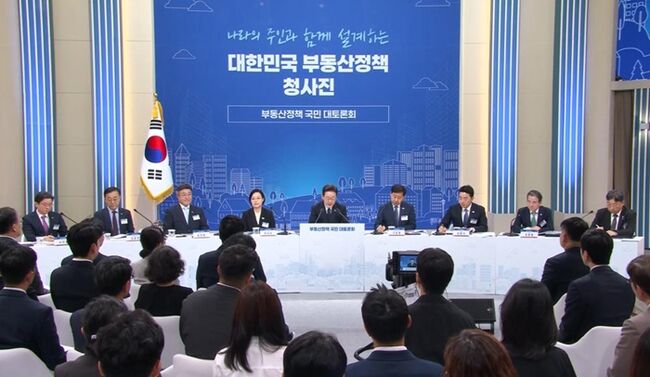 [Liberal Democratic Party Statement] Calling it a Grand Real Estate Debate… It Was Nothing More Than a Private Party Among Themselves
The 'National Grand Debate on Real Estate Policy' held on July 23rd and 27th. [Photo=Yonhap News]The 'National Grand Debate on Real Estate Policy,' hosted by the Lee Jae-myung administration under the
[Liberal Democratic Party Statement] Calling it a Grand Real Estate Debate… It Was Nothing More Than a Private Party Among Themselves
The 'National Grand Debate on Real Estate Policy' held on July 23rd and 27th. [Photo=Yonhap News]The 'National Grand Debate on Real Estate Policy,' hosted by the Lee Jae-myung administration under the
 [Photo] Evidence of Election Fraud Flooding U.S. Media… Trump Had 2.7 Million Votes Stolen
 [Video] U.S. Semiquincentennial Air Show... 'Art in the Sky' streaks across New York
 [Editorial Cartoon] A Draconian Law That Undermines Freedom of Expression

 List
List