America's KH-11 reconnaissance satellite, considered the strongest in spy satellites. [Photo = reddit.com]
During the First Battle of Yeonpyeong in 1999, North Korean Air Force fighter jets were spotted on the runway with their engines ignited, awaiting takeoff, by a U.S. spy satellite, which became a topic of discussion at the time.
The agency responsible for managing this spy satellite is the U.S. National Reconnaissance Office (NRO).
The NRO, the most secretive of intelligence agencies, only began to be publicly acknowledged in 1993. Prior to that, its existence and even its name were kept secret.
Established in 1960 to operate U-2 reconnaissance aircraft
The first official record mentioning the NRO appeared in the 1980s, when Representative George Brown (California) referred to it in the House Permanent Select Committee on Intelligence (PSCI).
The NRO has a longer history than is generally known. The agency was established in 1960 to manage the development of U.S. intelligence policy and to operate the U-2 reconnaissance aircraft and other spy planes.
Since then, with the proliferation of space, aviation, and information technology, it has grown rapidly. Today, it designs, develops, launches, and operates a vast array of spy satellites, including advanced satellites like the KH-11 and Lacross Behemoth, each costing $1 billion (approximately 1.45 trillion won). Its budget is known to be $6 billion (8.67 trillion won), far exceeding that of the CIA.
NRO: A specialized agency for image collection
The NRO is a specialized agency for image collection, one pillar of technical intelligence. In the U.S. intelligence community, image intelligence is divided into collection and analysis.
Prior to the Gulf War, image analysis was handled by 11 different agencies. However, it was abruptly consolidated by General Herbert N. Schwarzkopf, the commander of the Gulf War, and reborn as the National Geospatial-Intelligence Agency (NGA).
For image collection agencies, operations are segmented into △National Foreign Intelligence Program (NFIP) △Joint Military Intelligence Program (JMIP) △Tactical Intelligence and Related Activities (TIARA). Here, the NRO serves as the highest authority, overseeing and managing subordinate organizations such as the Defense Aerial Reconnaissance Office (DARO).
In other words, the NRO does not conduct its own intelligence analysis. It provides raw data of images and signals intelligence (SIGINT) to organizations such as the △National Security Agency (NSA) △Central Intelligence Agency (CIA) △National Geospatial-Intelligence Agency (NGA: image analysis organization), and other intelligence agencies, where highly trained analysts convert this raw data into finished intelligence using computers.
Unlike the labor-intensive NGA, the NRO is hardware-centric and employs a relatively small staff of approximately 2,290 personnel (as of 1998).
One of the ways the NRO differs from other intelligence agencies is its collaboration with defense contractors such as △Lockheed Martin △Boeing △Rockwell, and E-systems.
According to testimony from a former senior CIA official, Lockheed Martin accounted for half of the NRO's total budget in 1996.
In 1995, the well-funded NRO reportedly spent $300 million (approximately 440 billion won) to construct a new headquarters in the Virginia area of Washington D.C., without consulting Congress, the Department of Defense, or the Director of Central Intelligence (DCI). Further testimony suggests that the NRO manages its own secret accounts with funds totaling $4 billion (5.7 trillion won).
Professor Emeritus, Pukyong National University; Director, UN Research Institute

◆ Professor Ha Bong-kyu
Professor Emeritus at Pukyong National University and Director of the UN Research Institute. He actively voices his opinions on political and social issues through columns and other writings. As the Director of the Korean UN Peace Research Institute, he leads UN supporter activities and projects related to UN peace culture.

 [Statement by the Seo-beo-kka Korea Military Academy Save-the-Nation Comrades Association] ㉛ Recount the Votes Publicly, as the Previous Recount Concealed Election Fraud
Tongyeong Mayoral Election Recount [Photo=Yonhap News]South Korea's liberal democracy is dying. The National Election Commission (NEC) and the judiciary, which have plummeted into criminal syndicates
[Statement by the Seo-beo-kka Korea Military Academy Save-the-Nation Comrades Association] ㉛ Recount the Votes Publicly, as the Previous Recount Concealed Election Fraud
Tongyeong Mayoral Election Recount [Photo=Yonhap News]South Korea's liberal democracy is dying. The National Election Commission (NEC) and the judiciary, which have plummeted into criminal syndicates
 What is the significance of the "Trump 2028" red hats that keep making a comeback?
It is noteworthy that President Donald Trump is "intentionally" fueling controversy over whether he can actually run in the 2028 presidential election, even though it is "highly likely he is seriously
What is the significance of the "Trump 2028" red hats that keep making a comeback?
It is noteworthy that President Donald Trump is "intentionally" fueling controversy over whether he can actually run in the 2028 presidential election, even though it is "highly likely he is seriously
 Jin Cummings: “North Korea says it will increase the number of spies, so what is the government doing?”
U.S. political columnist Gene Cummings has publicly questioned the South Korean government, asking, "North Korea is declaring that it will increase its number of spies, so what is the South Kore
Jin Cummings: “North Korea says it will increase the number of spies, so what is the government doing?”
U.S. political columnist Gene Cummings has publicly questioned the South Korean government, asking, "North Korea is declaring that it will increase its number of spies, so what is the South Kore
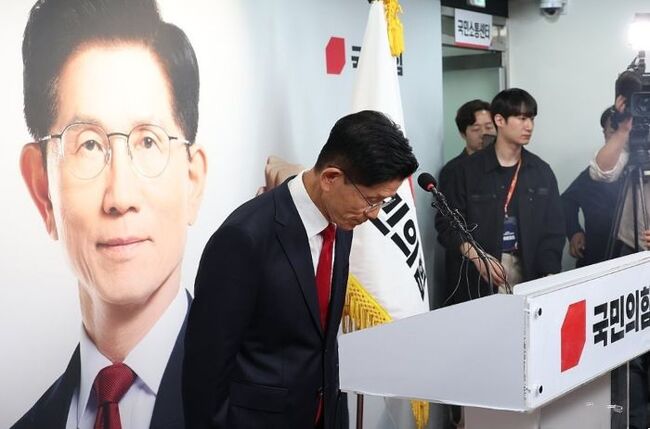 “Too little, too late?…” Kim Moon-soo, who previously conceded his presidential election defeat, now demands a special counsel investigation into ‘allegations of election fraud in the 2025 presidential election’
People Power Party presidential candidate Kim Moon-soo concedes defeat during a press conference at the party headquarters in Yeouido, Seoul, on June 4, 2025. [Joint Press Corps]As allegations emerge
“Too little, too late?…” Kim Moon-soo, who previously conceded his presidential election defeat, now demands a special counsel investigation into ‘allegations of election fraud in the 2025 presidential election’
People Power Party presidential candidate Kim Moon-soo concedes defeat during a press conference at the party headquarters in Yeouido, Seoul, on June 4, 2025. [Joint Press Corps]As allegations emerge
 Stock Market Crash 'Black Tuesday'… KOSPI down 10.8%, KOSDAQ down 7.7%
The KOSPI fell by more than 5% in early trading on the 28th, triggering a sell-side sidecar.On the 28th, the KOSPI plunged by more than 10%.Due to the sharp decline, a sell-side sidecar—a temporary
Stock Market Crash 'Black Tuesday'… KOSPI down 10.8%, KOSDAQ down 7.7%
The KOSPI fell by more than 5% in early trading on the 28th, triggering a sell-side sidecar.On the 28th, the KOSPI plunged by more than 10%.Due to the sharp decline, a sell-side sidecar—a temporary
 [World Heritage Committee] 25 New World Heritage Sites Inscribed in Busan… South Korea Successfully Expands 'Getbol' Listing
The Chairperson of the World Heritage Committee speaks at the plenary session of the 48th session of the World Heritage Committee, held at BEXCO in Busan on the 20th. [Photo: Yonhap News]A total of 25
[World Heritage Committee] 25 New World Heritage Sites Inscribed in Busan… South Korea Successfully Expands 'Getbol' Listing
The Chairperson of the World Heritage Committee speaks at the plenary session of the 48th session of the World Heritage Committee, held at BEXCO in Busan on the 20th. [Photo: Yonhap News]A total of 25
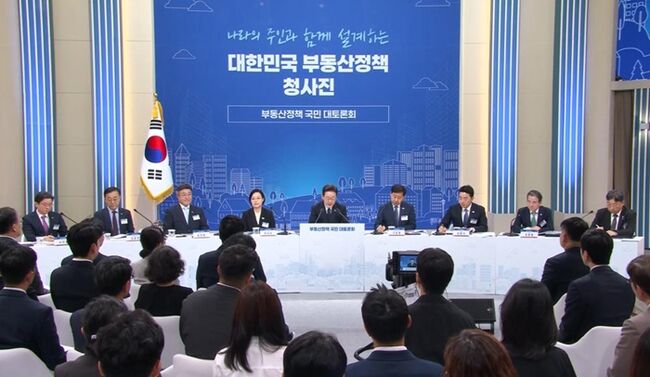 [Liberal Democratic Party Statement] Calling it a Grand Real Estate Debate… It Was Nothing More Than a Private Party Among Themselves
The 'National Grand Debate on Real Estate Policy' held on July 23rd and 27th. [Photo=Yonhap News]The 'National Grand Debate on Real Estate Policy,' hosted by the Lee Jae-myung administration under the
[Liberal Democratic Party Statement] Calling it a Grand Real Estate Debate… It Was Nothing More Than a Private Party Among Themselves
The 'National Grand Debate on Real Estate Policy' held on July 23rd and 27th. [Photo=Yonhap News]The 'National Grand Debate on Real Estate Policy,' hosted by the Lee Jae-myung administration under the
 [Photo] Evidence of Election Fraud Flooding U.S. Media… Trump Had 2.7 Million Votes Stolen
 [Video] U.S. Semiquincentennial Air Show... 'Art in the Sky' streaks across New York
 [Editorial Cartoon] A Draconian Law That Undermines Freedom of Expression

 List
List