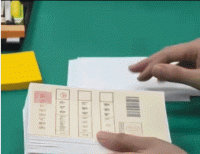
Joseon scholar Jeong Yak-yong's "Mongmin Simseo" is a book that does not fit modern political systems. [Photo: Academy of Korean Studies · Bank of Korea]
Every time I see politicians nowadays casually saying things like, "I always keep Mongmin Simseo by my side," or "I read it every night to learn the attitude of a public servant," I feel more than just discomfort; I feel revulsion.
This is not out of respect for the classics, but rather because they use classics as props to package themselves. Classics can be objects of reverence, but they are not ornaments to embellish one's image.
"Mongmin Simseo" was written for those in power to exercise self-restraint, not as a get-out-of-jail-free card to allow them to put on a benevolent facade while holding onto power.
Yet, many politicians, while claiming to read this book, ignore the era and limitations it presupposes, as well as the structural problems that are not applicable today. The moment they mention classics, they believe they will appear more moral; hypocrisy begins precisely at this point.
"Mongmin Simseo" is a book that does not fit modern political systems
This hypocrisy is not accidental. For a long time, "Mongmin Simseo" has been consumed in Korean society as a symbol of "good politics." Sentences like "Love your people," "Be incorruptible," and "Beware of greed" are repeatedly quoted as timeless good sayings.
Jeong Yak-yong is also consistently referred to as a reformer, a Silhak scholar, and a thinker who cared for the people's welfare. In this process, "Mongmin Simseo" became a proven "good book," and those who say they read it naturally ascend to the position of "good politicians."
The problem is that almost no one asks what the book actually says, or what it does not say.
To read "Mongmin Simseo" properly, we must first clarify its nature. This is neither a textbook on democracy nor a reformist manifesto to overthrow outdated systems.
Most accurately, "Mongmin Simseo" is an administrative guide that outlines how local officials should treat and manage the people in pre-modern society.
It is a book that teaches how to govern the people well, not a book that establishes the people as sovereign. If this distinction is not acknowledged, "Mongmin Simseo" will always be overvalued or misused.
The people in "Mongmin Simseo" are not the subjects of politics. They are always portrayed as people to be protected, subjects to be taught, and beings to be pitied. There are almost no scenes depicting them as individuals who judge, choose, and decide their own lives.
Jeong Yak-yong tells officials to love the people, but that love is different from the respect for citizens that we speak of today.
It does not say that the people have rights, nor does it say they have the freedom to choose. Instead, it says, "The people are poor, so they must be helped," "The people are ignorant, so they must be taught," and "The people are weak, so they must be protected."
A Book from an Era When "The People as Sovereign" Was Not Recognized
Although these words sound warm on the surface, they clearly imply a hierarchy. The official is the protector, and the people are the protected. The official is the one who judges, and the people are the ones being judged.
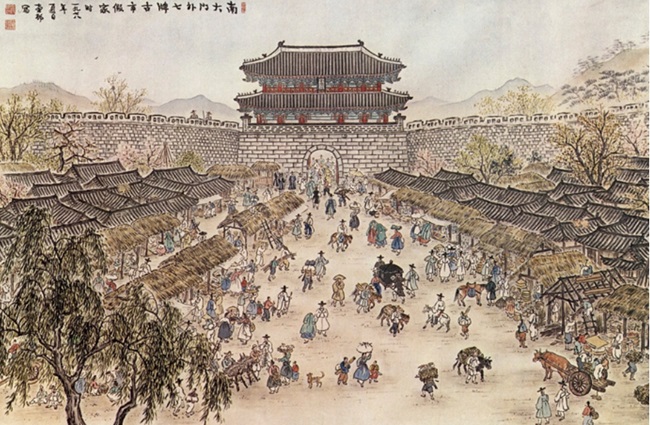 A painting depicting Jongno in the Joseon Dynasty by artist Hyechon Kim Hak-su (1919-2009). Hyechon Kim Hak-su Memorial Hall
In such a structure, no matter how benevolent the official is or how good the intentions are, the people can never become the masters of politics. They may be objects of affection, but they do not appear as subjects with rights. This is the greatest limitation of "Mongmin Simseo."
The critique in "Mongmin Simseo" always focuses on individuals. If local administration goes awry, it does not attribute the cause to the system. It states that it is because the official is greedy, lazy, or lacks knowledge.
Therefore, the solutions are always similar: Be more frugal, be more diligent, study more, and discipline yourself. In other words, this book is not about changing the system but about correcting people's attitudes.
This way of thinking is typical of Joseon's Neo-Confucian politics. It's a method of attributing social problems to individual moral issues rather than structural ones. This approach always leads to the same conclusion: "Bad people are the problem," "If good people come, everything will be solved."
However, history has repeatedly shown how weak this idea is. No matter how benevolent a person is in power, problems will recur if power is concentrated.
The emergence of modern politics was not because people suddenly became good, but because it was recognized that politics relying solely on goodness cannot last.
"Mongmin Simseo" does not go this far. It only advises caution in using power, but it does not suggest dividing or limiting power.
This difference is significant. Restraint relies on individual conscience, while limitation requires institutional change. Modern politics chose the latter, while "Mongmin Simseo" remained rooted in the former until the end.
This pre-modern perspective is also evident in its view of the economy. In "Mongmin Simseo," the people becoming wealthy is always viewed with caution. It assumes that wealth leads to extravagance, and extravagance leads to moral decay. Therefore, it states that officials must monitor the people to prevent them from becoming excessively wealthy.
From this perspective, wealth is a risk to be managed, not a result of development. It views desires as needing suppression and order as something that must come from above.
In this way of thinking, concepts such as individual choice, market autonomy, and growth through competition are almost non-existent. The people are seen as subjects to be protected from starvation, not as beings who change their living conditions by accumulating wealth on their own.
Loving the People and Recognizing Rights Are Different Matters
Therefore, although "Mongmin Simseo" is often praised for "serving the people's welfare," it is actually closer to a political idea that restrains the people's welfare without significantly disrupting it. The reason Joseon failed to transition to a modern economic society is clearly seen at this point.
Then why has a book with such clear limitations been called a "good book" until now? The reason lies not in the book itself, but in the way Korean society has long accepted it. Korean society has long been accustomed to seeking the cause of problems in people rather than in systems.
Consequently, it has always awaited "good leaders," "incorruptible public servants," and "moral politicians." While parsimonious in fixing systems, it has placed great expectations on changing people. "Mongmin Simseo" perfectly aligns with these expectations.
This is why the scene of politicians today claiming to read "Mongmin Simseo" feels even more offensive. Their words are not a pledge to reform systems, but rather self-staging as good people.
There is no hypocrisy easier than saying, "I always exercise self-restraint" while holding power. True restraint is revealed not in words, but in actions and structures.
Whether one relinquishes authority, accepts checks and balances, or changes the system is important. To invoke classics without discussing such matters is not an act of respecting them, but rather an act of demeaning them.
There is no need to disparage Jeong Yak-yong as an individual. By the standards of his time, he was a diligent, serious person who deeply contemplated contemporary issues. However, he ultimately could not break free from the confines of Joseon.
He thought within the framework of Joseon's national vision, its view of humanity, and its moral politics. Therefore, his book remained not a revolutionary text but an administrative guideline for operating Joseon with as few problems as possible.
Failing to acknowledge this fact will lead us to repeat the same misconception: "The ancients have already written all the answers," and "We just need to follow them." However, classics are not answer keys. Classics are records that show how far things have progressed and where they stopped.
"Mongmin Simseo" advocates loving the people but does not grant them rights. It emphasizes incorruptibility but does not share power. It speaks of morality but does not change systems.
Therefore, this book should be read not as an ethical prop to be placed on a modern politician's bedside table, but as a text for examining the limitations of pre-modern politics.
To read "Mongmin Simseo" seriously is not to memorize its content, but to clearly see the boundary it ultimately failed to cross. And we have already seen enough in history what kind of results politics that failed to cross that boundary produced.
Poet, Historian & Philosopher, Translator
◆ Songsan
A poet and a researcher of history and philosophy, he previously served as a director of the Rhee Syngman School and is currently an advisor to the Korean Modern and Contemporary History Research Society and the representative of the Philosophy Forum Lyceum. He has published four poetry collections and co-translated "The Hero of Hook Island." Songsan is a pen name.

 Trump pressures for rate cut again ahead of FOMC... "Should be the lowest in the world"
U.S. President Donald Trump. [Photo = The White House] U.S. President Donald Trump once again pressured the Federal Reserve, the U.S. central bank, to lower interest rates on the 27th (local time
Trump pressures for rate cut again ahead of FOMC... "Should be the lowest in the world"
U.S. President Donald Trump. [Photo = The White House] U.S. President Donald Trump once again pressured the Federal Reserve, the U.S. central bank, to lower interest rates on the 27th (local time
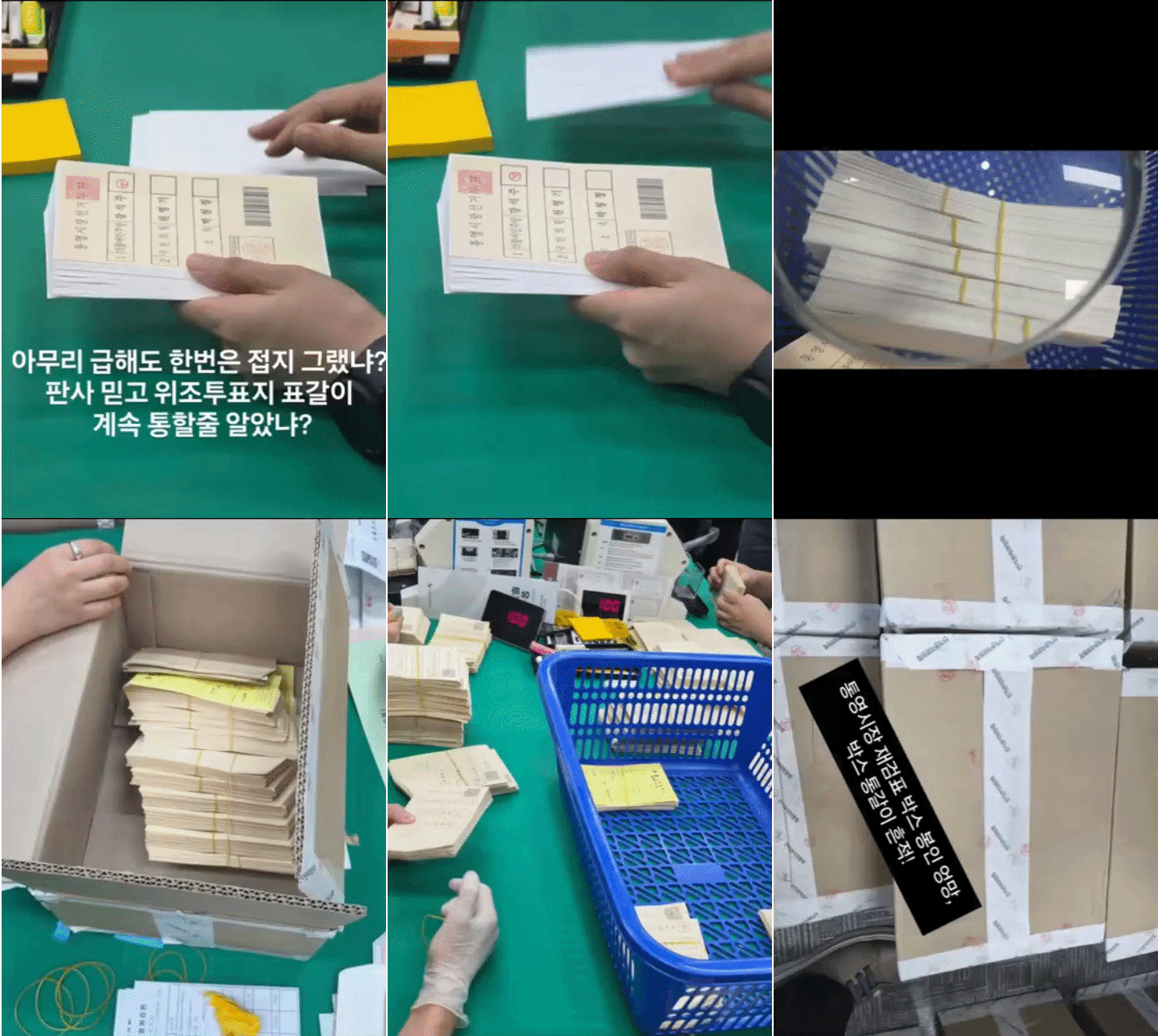 “Ignoring crisp ballots and damaged seals”… Tongyeong mayoral recount concludes with ‘no change in outcome,’ leaving suspicions and public outrage behind
Suspected counterfeit ballots discovered in Tongyeong [GIF from social media of Representative Hwang Kyo-ahn / Attorney Park Joo-hyun]During a recount of the Tongyeong mayoral election in South Gyeong
“Ignoring crisp ballots and damaged seals”… Tongyeong mayoral recount concludes with ‘no change in outcome,’ leaving suspicions and public outrage behind
Suspected counterfeit ballots discovered in Tongyeong [GIF from social media of Representative Hwang Kyo-ahn / Attorney Park Joo-hyun]During a recount of the Tongyeong mayoral election in South Gyeong
 President Yoon, regarding the first-instance ruling on the Public Official Election Act: “An excessive political verdict that distorts the facts… We will appeal immediately.”
The first-instance sentencing hearing for President Yoon Suk Yeol regarding violations of the Public Official Election Act is being broadcast live at Seoul Station on the 27th. [Photo=Yonhap News]Pres
President Yoon, regarding the first-instance ruling on the Public Official Election Act: “An excessive political verdict that distorts the facts… We will appeal immediately.”
The first-instance sentencing hearing for President Yoon Suk Yeol regarding violations of the Public Official Election Act is being broadcast live at Seoul Station on the 27th. [Photo=Yonhap News]Pres
 WSJ: "SK Hynix ADR Premium Is a Sign of AI Trading Overheat"
Advertisement for SK Hynix ADR listing in New York's Times Square [Reuters=Yonhap News file photo]The Wall Street Journal (WSJ) has pointed out that the price of SK Hynix’s American Depositary Recei
WSJ: "SK Hynix ADR Premium Is a Sign of AI Trading Overheat"
Advertisement for SK Hynix ADR listing in New York's Times Square [Reuters=Yonhap News file photo]The Wall Street Journal (WSJ) has pointed out that the price of SK Hynix’s American Depositary Recei
 'Godfather of Japanese Mystery Novels' Keigo Higashino Passes Away After Battle with Cancer at 68
Famous Japanese mystery novelist Keigo Higashino [AFP=Yonhap News]It has been belatedly reported that Keigo Higashino, the "godfather of Japanese mystery novels" and author of bestsellers such as "The
'Godfather of Japanese Mystery Novels' Keigo Higashino Passes Away After Battle with Cancer at 68
Famous Japanese mystery novelist Keigo Higashino [AFP=Yonhap News]It has been belatedly reported that Keigo Higashino, the "godfather of Japanese mystery novels" and author of bestsellers such as "The
 [Park Pil-kyu Security Column] To the Ignorant Trying to Clothe a Beast in Sheep's Clothing
Rep. Kim Byung-joo of the Democratic Party of Korea [Photo=Yonhap News]“The Air Force Academy doesn't teach you how to fly a plane!” “The Army, Navy, and Air Force academies are exactly the
[Park Pil-kyu Security Column] To the Ignorant Trying to Clothe a Beast in Sheep's Clothing
Rep. Kim Byung-joo of the Democratic Party of Korea [Photo=Yonhap News]“The Air Force Academy doesn't teach you how to fly a plane!” “The Army, Navy, and Air Force academies are exactly the
 [Issue Diagnosis] Two Effects of the Election Petition Review
 [Photo] Evidence of Election Fraud Flooding U.S. Media… Trump Had 2.7 Million Votes Stolen
 [Video] U.S. Semiquincentennial Air Show... 'Art in the Sky' streaks across New York
 [Editorial Cartoon] A Draconian Law That Undermines Freedom of Expression

 List
List