At a press conference on Saturday regarding the potential arrest of Venezuela's Nicolas Maduro, President Donald Trump expressed optimism about the future of Venezuelan oil production. He stated that "very big oil companies from the United States" would "rebuild the very badly damaged [oil] infrastructure," leading to revenues for Venezuela.
President Trump noted, "As everyone knows, Venezuela's oil business has been completely broken for a long time. They've been producing very little compared to what they were capable of producing and what they were able to achieve."
It remains unclear how quickly Venezuela, which possesses the world's largest proven oil reserves, can recover. Robert Rapier, a chemical engineer and editor of Shale Magazine, told Just The News that Venezuelan oil production is not easy. Much of the country's oil infrastructure has been neglected for decades due to mismanagement, with little to no maintenance.
"This is going to be a slow process," Rapier said.
In 1970, Venezuela was producing over 3.7 million barrels of oil per day, but current production is less than 1 million barrels per day. In comparison, the United States, the world's largest producer, produces 13.8 million barrels per day.
David Blackmon, an analyst with over 40 years in the oil and gas industry and author of the Substack "Energy Absurdities," explained to Just The News that Venezuelan crude oil is "about like tar that you see on the road."
U.S. companies like Exxon and Chevron, along with Britain's Shell, have developed technologies to extract and transport this heavy crude oil using steam and diluents.
Venezuela nationalized its oil industry in the 1970s but allowed foreign investors to re-enter in the late 1990s. After coming to power, the Chavez regime implemented policies requiring the state to hold a majority stake in oil assets, leading to the expropriation of assets from companies like Exxon and ConocoPhillips. While these companies later received compensation through international courts, the policy ultimately resulted in the country losing expertise needed for oil extraction.
Rapier stated, "Chavez brought in a lot of political appointees into technical roles. Then sanctions and corruption combined to cause everything to collapse."
He believes sanctions have somewhat suppressed Venezuela's oil production and that lifting them would lead to a surge in output. However, he estimates it could take up to a decade for the country to recover or exceed its 1970s production levels.
"The real variable here is how much of that infrastructure is so old that it's unusable," Rapier said.
He pointed out that low oil prices do not serve as a strong incentive for investors, and historical animosity towards foreign investors could also make many hesitant.
Blackmon estimates the timeline could be shortened to five to seven years. He stated that while most infrastructure is aging and needs modernization, existing facilities could shorten the timeline.
Blackmon suggested it's too early to predict how much influence the U.S. will wield over Venezuela's administration, but if permitting processes can be expedited, progress could accelerate. The U.S. federal government could also alleviate investor hesitation by offering low-interest loans or investment incentives.
Blackmon said, "Depending on how all of this plays out, you could have significant new production within just a few years. Venezuela used to produce 4 million barrels a day. Now it's less than a million barrels a day, but theoretically, you could get back to 1.5 million to 2 million barrels a day very rapidly. So, it could happen pretty quickly depending on how all the mechanisms work."
Blackmon noted on his Substack that increased Venezuelan production could have ripple effects for Canada and OPEC+ nations. While the U.S. produces a lot of oil domestically, most refineries were built in the 1970s before shale oil technology allowed for the massive production of crude.
The crude oil produced from U.S. shale is light and low-sulfur, unlike the heavy crude from Venezuela, Canada, and the Middle East. Since U.S. refineries are designed to process heavy crude, they must import a significant portion of the crude oil they use. About 60% of the oil imported by the U.S. comes from Canada.
Frustrated by Trump's tariffs, Canada's Prime Minister Mark Carney has worked with Alberta Premier Danielle Smith to advance the construction of pipelines to transport crude oil from Canada's oil sands to the West Coast. This is expected to open up avenues for Canada to enter Asian markets.
Blackmon wrote, "Now that Trump has control of Venezuela's heavy crude resources, he can exert leverage in return."
As the U.S. gains influence over key OPEC+ nations, it will now have a say in quota negotiations. This will weaken the negotiating power of Russia and Iran, who are struggling under sanctions, Blackmon analyzed.
U.S. NNP = Hong Seong-gu, Chief Reporter / Special Correspondent NNP info@newsandpost.com

 [Statement by the Seo-beo-kka Korea Military Academy Save-the-Nation Comrades Association] ㉛ Recount the Votes Publicly, as the Previous Recount Concealed Election Fraud
Tongyeong Mayoral Election Recount [Photo=Yonhap News]South Korea's liberal democracy is dying. The National Election Commission (NEC) and the judiciary, which have plummeted into criminal syndicates
[Statement by the Seo-beo-kka Korea Military Academy Save-the-Nation Comrades Association] ㉛ Recount the Votes Publicly, as the Previous Recount Concealed Election Fraud
Tongyeong Mayoral Election Recount [Photo=Yonhap News]South Korea's liberal democracy is dying. The National Election Commission (NEC) and the judiciary, which have plummeted into criminal syndicates
 What is the significance of the "Trump 2028" red hats that keep making a comeback?
It is noteworthy that President Donald Trump is "intentionally" fueling controversy over whether he can actually run in the 2028 presidential election, even though it is "highly likely he is seriously
What is the significance of the "Trump 2028" red hats that keep making a comeback?
It is noteworthy that President Donald Trump is "intentionally" fueling controversy over whether he can actually run in the 2028 presidential election, even though it is "highly likely he is seriously
 Jin Cummings: "North Korea says it will increase the number of spies, so what is the government doing?"
U.S. political columnist Gene Cummings has publicly questioned the South Korean government, asking, "North Korea is announcing plans to increase its number of spies, yet what is the South Korean
Jin Cummings: "North Korea says it will increase the number of spies, so what is the government doing?"
U.S. political columnist Gene Cummings has publicly questioned the South Korean government, asking, "North Korea is announcing plans to increase its number of spies, yet what is the South Korean
 Attorney Do Tae-woo: “Discrepancies in Voter Count and Improper Sealing Confirmed in Tongyeong Mayoral Recount… Official Request for Additional Verification Submitted to Gyeongnam Election Commission”
A bundle of mail-in early voting ballots captured by lawyer Do Tae-woo at the Tongyeong mayoral election recount site. A clear solid line, raising suspicions of election fraud, is visible on the side
Attorney Do Tae-woo: “Discrepancies in Voter Count and Improper Sealing Confirmed in Tongyeong Mayoral Recount… Official Request for Additional Verification Submitted to Gyeongnam Election Commission”
A bundle of mail-in early voting ballots captured by lawyer Do Tae-woo at the Tongyeong mayoral election recount site. A clear solid line, raising suspicions of election fraud, is visible on the side
 Stock Market Crash 'Black Tuesday'… KOSPI down 10.8%, KOSDAQ down 7.7%
The KOSPI fell by more than 5% in early trading on the 28th, triggering a sell-side sidecar.On the 28th, the KOSPI plunged by more than 10%.Due to the sharp decline, a sell-side sidecar—a temporary
Stock Market Crash 'Black Tuesday'… KOSPI down 10.8%, KOSDAQ down 7.7%
The KOSPI fell by more than 5% in early trading on the 28th, triggering a sell-side sidecar.On the 28th, the KOSPI plunged by more than 10%.Due to the sharp decline, a sell-side sidecar—a temporary
 [World Heritage Committee] 25 New World Heritage Sites Inscribed in Busan… South Korea Successfully Expands 'Getbol' Listing
The Chairperson of the World Heritage Committee speaks at the plenary session of the 48th session of the World Heritage Committee, held at BEXCO in Busan on the 20th. [Photo: Yonhap News]A total of 25
[World Heritage Committee] 25 New World Heritage Sites Inscribed in Busan… South Korea Successfully Expands 'Getbol' Listing
The Chairperson of the World Heritage Committee speaks at the plenary session of the 48th session of the World Heritage Committee, held at BEXCO in Busan on the 20th. [Photo: Yonhap News]A total of 25
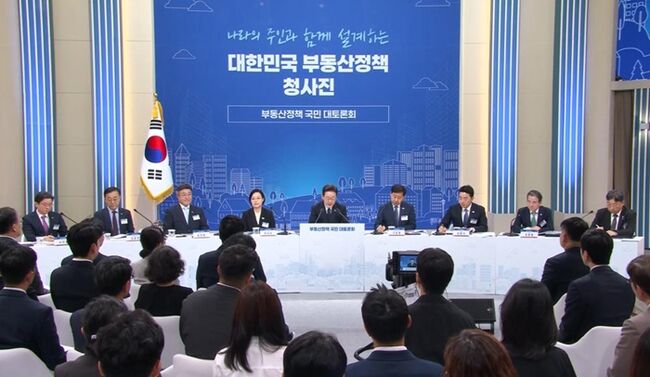 [Liberal Democratic Party Statement] Calling it a Grand Real Estate Debate… It Was Nothing More Than a Private Party Among Themselves
The 'National Grand Debate on Real Estate Policy' held on July 23rd and 27th. [Photo=Yonhap News]The 'National Grand Debate on Real Estate Policy,' hosted by the Lee Jae-myung administration under the
[Liberal Democratic Party Statement] Calling it a Grand Real Estate Debate… It Was Nothing More Than a Private Party Among Themselves
The 'National Grand Debate on Real Estate Policy' held on July 23rd and 27th. [Photo=Yonhap News]The 'National Grand Debate on Real Estate Policy,' hosted by the Lee Jae-myung administration under the
 [Photo] Evidence of Election Fraud Flooding U.S. Media… Trump Had 2.7 Million Votes Stolen
 [Video] U.S. Semiquincentennial Air Show... 'Art in the Sky' streaks across New York
 [Editorial Cartoon] A Draconian Law That Undermines Freedom of Expression

 List
List