The market is buzzing with debate over whether the KOSPI index will break 5000. [Photo=Yonhap News]
Since the start of the year, the KOSPI has continued its sharp ascent, dividing market attention between concerns of overheating and the possibility of the KOSPI reaching 5000.
Although the index is setting new record highs daily, it is being assessed that the signals from the current market trend are different from interpretations solely based on simple optimism or bubble concerns.
The key is not how much it has risen, but why such a rapid rise has been possible.
The most distinct characteristic of this rally is that despite the sharp surge in the index, the price-to-earnings ratio (PER) has not skyrocketed.
In a typical overheating phase, the PER rapidly increases as stock prices outpace the growth in corporate earnings. However, recently, the KOSPI has seen its earnings estimates, particularly for semiconductors, revised upward at a fast pace, absorbing a significant portion of the stock price increase.
This is interpreted as a signal that the market is not betting on a short-term boom, but rather preemptively reflecting the assumption that current profitability and earnings structures will be maintained going forward.
In simpler terms, this surge is a result of the judgment that "we can continue to earn as we are now" being reflected in prices, rather than an expectation of "we will earn more in the future."
Therefore, while the index has risen rapidly, the PER has not strayed far from its historical average range. Looking at the numbers alone, it is difficult to definitively conclude that this is an overheating market.
The movement of foreign capital can also be explained within this structural framework.
Foreign investors do not purchase Korean stocks based on the premise of a strong won.
The key is the judgment that exchange rates will not spiral out of control. The fact that the Federal Reserve is not rushing to cut interest rates but is not negating the direction, and maintains an attitude of controlling the pace once cuts begin, acts as a factor that lowers the possibility of a sharp decline in the won.
Rather than expectations of a weaker dollar, the perception that the dollar will not surge unchecked is seen as the backdrop for foreign capital inflows.
For this reason, exchange rates are closer to a safety net preventing a sharp decline rather than a driving force for this rally.
The direct engine of the rise is the improved outlook and confidence in sustained profitability, centered on semiconductors and AI infrastructure. As a result, the recent market is not seeing a broad-based rise across all sectors, but rather a selective rally where capital is concentrated in specific sectors and large-cap stocks.
If these conditions are maintained, the KOSPI reaching 5000 is not an unrealistic figure based on calculations.
If earnings estimates are maintained and PER moves within its normal range, the upside for the index remains open.
What is important is that this process is not a runaway market driven by euphoria fueled by liquidity. A structure that allows for growth even without help from the U.S. has already been formed.
The problem, however, still lies with the U.S. variables.
If a rapid shift in the Fed's stance, a sharp rise in U.S. Treasury yields, a resurgence of dollar strength, and uncertainties surrounding trade and fiscal policy occur simultaneously, exchange rates and foreign capital flows can be quickly destabilized.
And at the center of the political variables that could trigger this 'circuit breaker' is Trump.
Trump favors interest rate cuts, but he is also an individual who has pursued increased tariffs and fiscal expansion concurrently.
Tariffs can stimulate import prices and inflation expectations, while fiscal expansion can lead to increased Treasury issuance, creating upward pressure on Treasury yields. This can increase market interest rate and exchange rate volatility, separate from expectations of policy rate cuts.
Furthermore, Trump's characteristic unpredictable remarks and policy approaches can create sufficient uncertainty to shake market expectations and positions, even without changing the Fed's policy path.
Therefore, Trump is perceived not as a driver of the KOSPI's rise, but as the sole political variable capable of halting the ascent.
The current market trend is closer to a phase where we hope for what Trump will *not* do, rather than expecting what he will do.
In a structure where a tariff statement or a signal of fiscal expansion can immediately impact exchange rates and foreign capital flows, unnecessary conflicts can directly lead to market volatility.
Ultimately, the current KOSPI rally can be defined as follows:
The engine of the rise is in Korea, the circuit breaker is in the U.S., and Trump holds the handle.
KOSPI 5000 is a condition, not a declaration. And the core of that condition is not Trump's decision, but refraining from provoking Trump.
This is the clearest signal the market is currently sending.
By Kim Young, Reporter

 [Statement by the Seo-beo-kka Korea Military Academy Save-the-Nation Comrades Association] ㉛ Recount the Votes Publicly, as the Previous Recount Concealed Election Fraud
Tongyeong Mayoral Election Recount [Photo=Yonhap News]South Korea's liberal democracy is dying. The National Election Commission (NEC) and the judiciary, which have plummeted into criminal syndicates
[Statement by the Seo-beo-kka Korea Military Academy Save-the-Nation Comrades Association] ㉛ Recount the Votes Publicly, as the Previous Recount Concealed Election Fraud
Tongyeong Mayoral Election Recount [Photo=Yonhap News]South Korea's liberal democracy is dying. The National Election Commission (NEC) and the judiciary, which have plummeted into criminal syndicates
 What is the significance of the "Trump 2028" red hats that keep making a comeback?
It is noteworthy that President Donald Trump is "intentionally" fueling controversy over whether he can actually run in the 2028 presidential election, even though it is "highly likely he is seriously
What is the significance of the "Trump 2028" red hats that keep making a comeback?
It is noteworthy that President Donald Trump is "intentionally" fueling controversy over whether he can actually run in the 2028 presidential election, even though it is "highly likely he is seriously
 Jin Cummings: "North Korea says it will increase the number of spies, so what is the government doing?"
U.S. political columnist Gene Cummings has publicly questioned the South Korean government, asking, "North Korea is announcing plans to increase its number of spies, yet what is the South Korean
Jin Cummings: "North Korea says it will increase the number of spies, so what is the government doing?"
U.S. political columnist Gene Cummings has publicly questioned the South Korean government, asking, "North Korea is announcing plans to increase its number of spies, yet what is the South Korean
 Attorney Do Tae-woo: “Discrepancies in Voter Count and Improper Sealing Confirmed in Tongyeong Mayoral Recount… Official Request for Additional Verification Submitted to Gyeongnam Election Commission”
A bundle of mail-in early voting ballots captured by lawyer Do Tae-woo at the Tongyeong mayoral election recount site. A clear solid line, raising suspicions of election fraud, is visible on the side
Attorney Do Tae-woo: “Discrepancies in Voter Count and Improper Sealing Confirmed in Tongyeong Mayoral Recount… Official Request for Additional Verification Submitted to Gyeongnam Election Commission”
A bundle of mail-in early voting ballots captured by lawyer Do Tae-woo at the Tongyeong mayoral election recount site. A clear solid line, raising suspicions of election fraud, is visible on the side
 Stock Market Crash 'Black Tuesday'… KOSPI down 10.8%, KOSDAQ down 7.7%
The KOSPI fell by more than 5% in early trading on the 28th, triggering a sell-side sidecar.On the 28th, the KOSPI plunged by more than 10%.Due to the sharp decline, a sell-side sidecar—a temporary
Stock Market Crash 'Black Tuesday'… KOSPI down 10.8%, KOSDAQ down 7.7%
The KOSPI fell by more than 5% in early trading on the 28th, triggering a sell-side sidecar.On the 28th, the KOSPI plunged by more than 10%.Due to the sharp decline, a sell-side sidecar—a temporary
 [World Heritage Committee] 25 New World Heritage Sites Inscribed in Busan… South Korea Successfully Expands 'Getbol' Listing
The Chairperson of the World Heritage Committee speaks at the plenary session of the 48th session of the World Heritage Committee, held at BEXCO in Busan on the 20th. [Photo: Yonhap News]A total of 25
[World Heritage Committee] 25 New World Heritage Sites Inscribed in Busan… South Korea Successfully Expands 'Getbol' Listing
The Chairperson of the World Heritage Committee speaks at the plenary session of the 48th session of the World Heritage Committee, held at BEXCO in Busan on the 20th. [Photo: Yonhap News]A total of 25
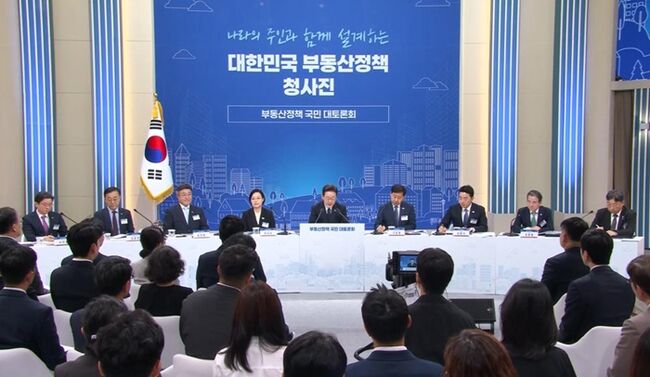 [Liberal Democratic Party Statement] Calling it a Grand Real Estate Debate… It Was Nothing More Than a Private Party Among Themselves
The 'National Grand Debate on Real Estate Policy' held on July 23rd and 27th. [Photo=Yonhap News]The 'National Grand Debate on Real Estate Policy,' hosted by the Lee Jae-myung administration under the
[Liberal Democratic Party Statement] Calling it a Grand Real Estate Debate… It Was Nothing More Than a Private Party Among Themselves
The 'National Grand Debate on Real Estate Policy' held on July 23rd and 27th. [Photo=Yonhap News]The 'National Grand Debate on Real Estate Policy,' hosted by the Lee Jae-myung administration under the
 [Photo] Evidence of Election Fraud Flooding U.S. Media… Trump Had 2.7 Million Votes Stolen
 [Video] U.S. Semiquincentennial Air Show... 'Art in the Sky' streaks across New York
 [Editorial Cartoon] A Draconian Law That Undermines Freedom of Expression

 List
List