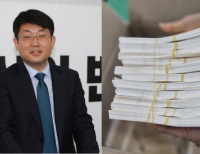
Former People Power Party leader Han Dong-hoon [Photo=Yonhap News]
The most dangerous thing in politics is not lies. It is the collapse of standards.
Lies can be refuted, but when standards collapse, it becomes impossible to distinguish fact from judgment.
The recent remarks by former People Power Party leader Han Dong-hoon, revealed in the controversy surrounding martial law and presidential impeachment, illustrate how this collapse of standards occurs.
Han Dong-hoon was resolute regarding the controversy on the party members' bulletin board surrounding himself and his family.
His judgment was that claims with unclear sources, unverified originals, and unspecified authors and intentions were "fabricated" and "political maneuvers."
His stance was that one cannot judge solely based on allegations, and that fabricating facts by piecing together unconfirmed circumstances is unacceptable.
This standard was strict, and from a legal perspective, it was a perfectly understandable position.
However, in the debate over treason related to martial law, Han Dong-hoon did not maintain his standard.
The judgment that martial law review or attempt could constitute treason, the statement that there was a possibility of arresting politicians, and the conjecture that the National Assembly's functions were intended to be neutralized were combined, making 'possibility of treason' a premise for political judgment.
And that conclusion directly led to the inevitability of presidential impeachment.
The issue is not a difference in stance. It is that completely different standards of judgment were applied to the same level of evidence and circumstances.
While unconfirmed circumstances were excluded as "fabrication" regarding family allegations, "possibility" and "statements" were adopted as significant grounds for the judgment of impeachment, the supreme means of constitutional order.
The more serious the issue, the stricter the standard of proof should be, yet the opposite occurred.
Treason under criminal law is the most serious crime. It is not established by intent or conjecture alone. It requires the actual exercise of armed force, coercion against constitutional bodies, and objective evidence of an attempt to carry it out.
Nevertheless, in the martial law debate, treason was not defined by proving each element of the offense, but was first characterized as a political narrative pieced together from various circumstances. It was a structure where political conclusions preceded legal judgment.
At this point, an unavoidable question remains.
If the same standard applied by Han Dong-hoon when judging the party members' bulletin board controversy as "fabrication" were applied, would not the narrative constructing martial law as treason also be classified as a political construct?
This is not a question aimed at attacking a specific individual. It is a question about consistency of standards.
Here, the standard of judgment shifts one step further.
The moment the judgment of whether it constitutes treason moves to the issue of relationships and separation, the discussion of facts and responsibilities turns into an examination of political attitude.
From this point on, the language of law disappears, and "relationship politics," which divides right from wrong based on relationships, emerges.
Han Dong-hoon states that there is no future for conservatism without severing ties with "Yoon Again," and argues that an apology for impeachment is meaningless without the premise of severing ties with Yoon Suk-yeol.
This is a logic that places the standard of political legitimacy not on actions and responsibilities, but on "severing relationships."
This is relationship politics. It is politics where the standard of judgment is not what someone did, but who they were with.
If this logic is applied directly, another question arises.
If reform is impossible without severing ties with former President Yoon Suk-yeol, is the law impossible without severing ties with Han Dong-hoon?
These two questions are not different in that they are structures that judge legitimacy based on relationships rather than actions. This is not an extension of the rule of law, but a retreat from it.
The issue of apology also follows from here.
The judgment of right or wrong must always be applied with the same standard, and an apology is made when one has failed to meet that standard.
An apology is not an act of settling a relationship, but the language of responsibility acknowledging that the standard of judgment was misapplied. An apology lacking this condition can be called an "apology without a standard."
Former President Yoon also apologized for the confusion and lack of communication during his administration.
In that it was an expression of political regret rather than an acknowledgment of legal responsibility, it is not different in nature from the demand for an apology surrounding impeachment.
Nevertheless, if one party's apology is rendered invalid, and the other party's apology is demanded without explanation of the standard, the apology becomes not the end of responsibility, but the starting point for another interpretation.
The perception of election fraud also stems from the same problem.
It is a matter of standards: what is immediately excluded at the stage of suspicion, and what is adopted as grounds for political judgment without sufficient verification?
Elections are the starting point of democracy, but they are also an area that demands the most rigorous proof and transparent verification.
However, the debates in reality are divided by political necessity rather than the presence or absence of evidence.
The practice of treating the question itself as taboo or a management subject may seem to maintain short-term order, but in the long run, it erodes trust in the system.
Whether it is the martial law debate, the judgment of impeachment, the demand for an apology, or the perception of election fraud, it ultimately converges into one question.
"Are the standards for determining what to judge as fact and what to exclude consistent?"
If those standards change depending on the issue and the person, the rule of law becomes a language of choice, and democracy accumulates distrust.
While reform is spoken of in words, actions become a repetition of old-style politics.
Reform that does not change the standards is ultimately just another name for the same politics.
Right and wrong must be judged by the same standard, and an apology is made when one has failed to meet that standard.
An apology that does not explain the standard is meaningless. Therefore, the controversy continues even after the apology.

 [Statement by the Seo-beo-kka Korea Military Academy Save-the-Nation Comrades Association] ㉛ Recount the Votes Publicly, as the Previous Recount Concealed Election Fraud
Tongyeong Mayoral Election Recount [Photo=Yonhap News]South Korea's liberal democracy is dying. The National Election Commission (NEC) and the judiciary, which have plummeted into criminal syndicates
[Statement by the Seo-beo-kka Korea Military Academy Save-the-Nation Comrades Association] ㉛ Recount the Votes Publicly, as the Previous Recount Concealed Election Fraud
Tongyeong Mayoral Election Recount [Photo=Yonhap News]South Korea's liberal democracy is dying. The National Election Commission (NEC) and the judiciary, which have plummeted into criminal syndicates
 What is the significance of the "Trump 2028" red hats that keep making a comeback?
It is noteworthy that President Donald Trump is "intentionally" fueling controversy over whether he can actually run in the 2028 presidential election, even though it is "highly likely he is seriously
What is the significance of the "Trump 2028" red hats that keep making a comeback?
It is noteworthy that President Donald Trump is "intentionally" fueling controversy over whether he can actually run in the 2028 presidential election, even though it is "highly likely he is seriously
 Jin Cummings: "North Korea says it will increase the number of spies, so what is the government doing?"
U.S. political columnist Gene Cummings has publicly questioned the South Korean government, asking, "North Korea is announcing plans to increase its number of spies, yet what is the South Korean
Jin Cummings: "North Korea says it will increase the number of spies, so what is the government doing?"
U.S. political columnist Gene Cummings has publicly questioned the South Korean government, asking, "North Korea is announcing plans to increase its number of spies, yet what is the South Korean
 Attorney Do Tae-woo: “Discrepancies in Voter Count and Improper Sealing Confirmed in Tongyeong Mayoral Recount… Official Request for Additional Verification Submitted to Gyeongnam Election Commission”
A bundle of mail-in early voting ballots captured by lawyer Do Tae-woo at the Tongyeong mayoral election recount site. A clear solid line, raising suspicions of election fraud, is visible on the side
Attorney Do Tae-woo: “Discrepancies in Voter Count and Improper Sealing Confirmed in Tongyeong Mayoral Recount… Official Request for Additional Verification Submitted to Gyeongnam Election Commission”
A bundle of mail-in early voting ballots captured by lawyer Do Tae-woo at the Tongyeong mayoral election recount site. A clear solid line, raising suspicions of election fraud, is visible on the side
 Stock Market Crash 'Black Tuesday'… KOSPI down 10.8%, KOSDAQ down 7.7%
The KOSPI fell by more than 5% in early trading on the 28th, triggering a sell-side sidecar.On the 28th, the KOSPI plunged by more than 10%.Due to the sharp decline, a sell-side sidecar—a temporary
Stock Market Crash 'Black Tuesday'… KOSPI down 10.8%, KOSDAQ down 7.7%
The KOSPI fell by more than 5% in early trading on the 28th, triggering a sell-side sidecar.On the 28th, the KOSPI plunged by more than 10%.Due to the sharp decline, a sell-side sidecar—a temporary
 [World Heritage Committee] 25 New World Heritage Sites Inscribed in Busan… South Korea Successfully Expands 'Getbol' Listing
The Chairperson of the World Heritage Committee speaks at the plenary session of the 48th session of the World Heritage Committee, held at BEXCO in Busan on the 20th. [Photo: Yonhap News]A total of 25
[World Heritage Committee] 25 New World Heritage Sites Inscribed in Busan… South Korea Successfully Expands 'Getbol' Listing
The Chairperson of the World Heritage Committee speaks at the plenary session of the 48th session of the World Heritage Committee, held at BEXCO in Busan on the 20th. [Photo: Yonhap News]A total of 25
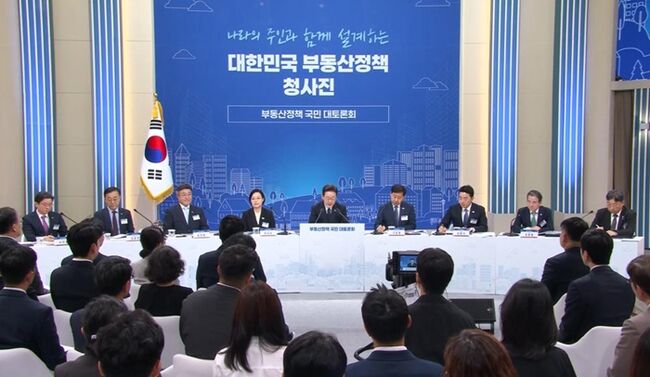 [Liberal Democratic Party Statement] Calling it a Grand Real Estate Debate… It Was Nothing More Than a Private Party Among Themselves
The 'National Grand Debate on Real Estate Policy' held on July 23rd and 27th. [Photo=Yonhap News]The 'National Grand Debate on Real Estate Policy,' hosted by the Lee Jae-myung administration under the
[Liberal Democratic Party Statement] Calling it a Grand Real Estate Debate… It Was Nothing More Than a Private Party Among Themselves
The 'National Grand Debate on Real Estate Policy' held on July 23rd and 27th. [Photo=Yonhap News]The 'National Grand Debate on Real Estate Policy,' hosted by the Lee Jae-myung administration under the
 [Photo] Evidence of Election Fraud Flooding U.S. Media… Trump Had 2.7 Million Votes Stolen
 [Video] U.S. Semiquincentennial Air Show... 'Art in the Sky' streaks across New York
 [Editorial Cartoon] A Draconian Law That Undermines Freedom of Expression

 List
List